There Is Established Law Regarding the Entrance of a Church Building, to Protest or Disrupt the Service
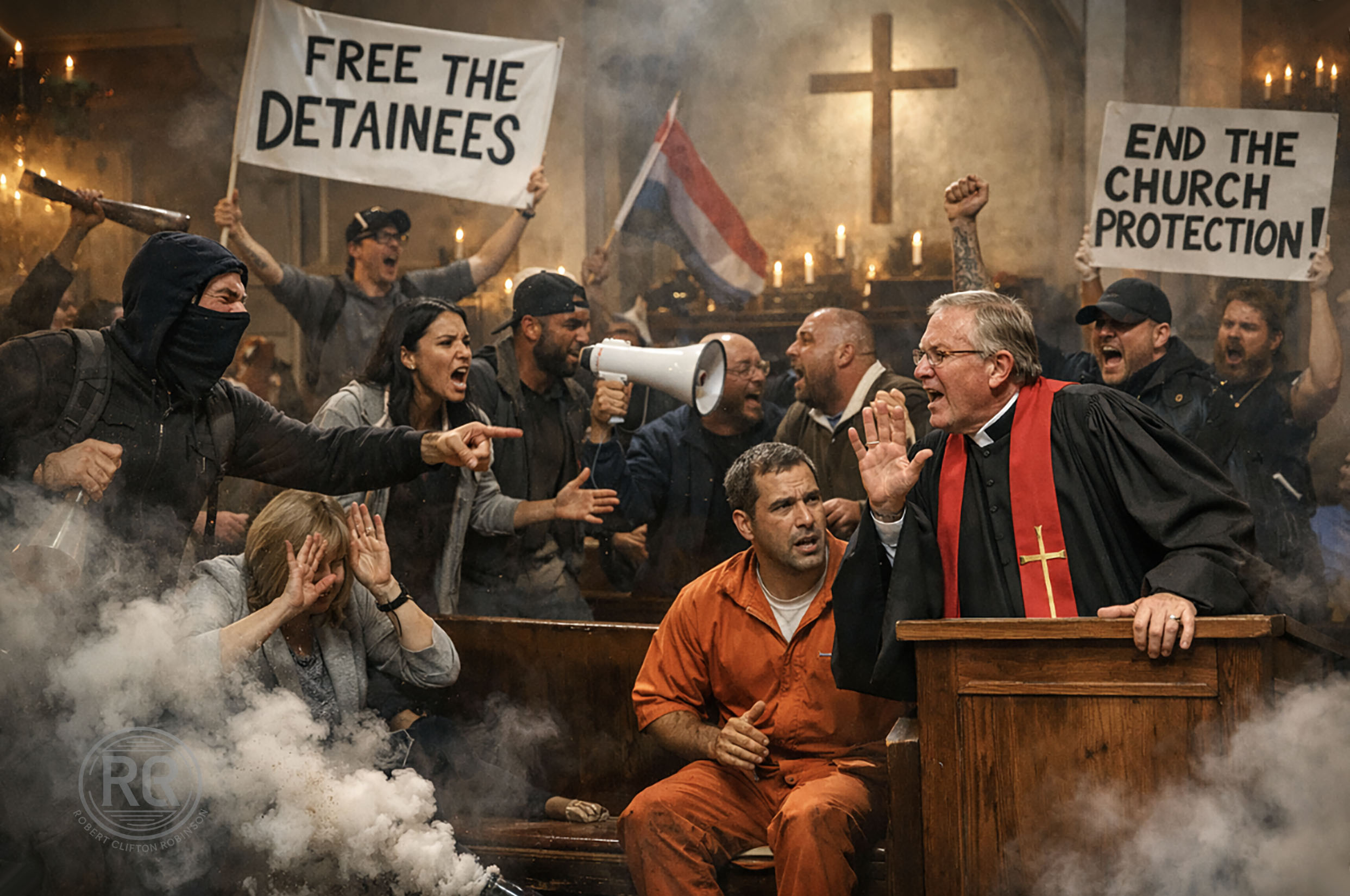
The FACE Act: (18 U.S.C. § 248)
The FACE Act is a federal criminal and civil statute that prohibits certain violent or obstructive acts against two broad protected categories:
- People obtaining or providing reproductive health services, including abortions.
- People lawfully exercising or seeking to exercise their First Amendment rights at a place of religious worship.
The law makes it a crime to use force, a threat of force, or physical obstruction to injure, intimidate, interfere with, or attempt to injure, intimidate, or interfere with these protected activities. It also prohibits the intentional damage or destruction of reproductive health facilities or places of worship.
“Intimidate” is defined as placing a person in reasonable fear of bodily harm.
“Physical obstruction” means blocking entry to or exit from a facility, such that access is rendered unreasonably difficult or hazardous.
When FACE Applies to a Church or Religious Service:
FACE expressly covers places of worship — not just clinics — so that conduct which:
- Uses force or threats of force,
- Physically obstructs entry to or exit from the religious service,
- Intimidates worshippers, clergy, or other participants,
- Attempts to injure, intimidate, or interfere with the free exercise of religious worship,
- can constitute a violation of federal law.
This means that a violent protest, riot, blockade, or threat of physical harm inside an active church service — if committed with the intent to frighten or interfere with worship — can fall within the statutory prohibitions of FACE.
Criminal Penalties Under FACE
Penalties vary depending on the nature and severity of the offense:
- Non-violent physical obstruction (e.g., blocking entry/exit without violence):
- First violation: up to 6 months in prison and/or $10,000 fine.
- Subsequent violation: up to 18 months and/or $25,000 fine.
Violent or threatening conduct:
- First offense: up to 1 year in prison and/or $100,000 fine.
- Second or subsequent offense: up to 3 years and/or $250,000 fine.
- If bodily injury results: up to 10 years imprisonment.
- If death results: potential life imprisonment.
Courts have discretion below these maximums, and prosecutors must prove intent and the requisite conduct.
Civil Liability Under FACE
In addition to criminal penalties, the statute provides a civil right of action for:
Persons injured by prohibited conduct at a place of worship or reproductive health facility, the entity that owns or operates the place of worship, or state/federal officials in certain circumstances.
In these civil cases, a court can award:
- Preliminary or permanent injunctions,
- Compensatory and punitive damages, attorneys’ and expert witness fees.
A plaintiff may also opt for statutory damages (e.g., $5,000 per violation) instead of actual damages.
Relationship to Other Federal Laws
While FACE focuses on force, threats, and obstruction at clinics and places of worship, other federal statutes may also apply, including:
Title 18 U.S.C. § 247 — protection of religious property (damage/destruction) with its own punishments separate from FACE.
Hate crimes statutes (18 U.S.C. § 249) — when conduct is motivated by bias against race, religion, etc.
State criminal laws (riot, disorderly conduct, threats) which generally apply as well. These aren’t part of FACE but can be prosecuted alongside or independently.
Key Practical Points
Peaceful protest or speech — such as prayer, holding signs, distributing literature, or singing — is not prohibited by FACE, so long as there is no force, threat of force, or physical obstruction.
Threats of harm or intimidation inside a church service that create fear of physical harm can meet the FACE definition of intimidation and may be prosecuted.
FACE is a federal law, so enforcement is typically by the DOJ, but civil suits can be brought by individuals or entities harmed by violations.
The following are the key statutory excerpts of the Freedom of Access to Clinic Entrances Act (FACE Act, 18 U.S.C. § 248) and actual legal interpretations/case law showing how courts have understood the provision — especially where it applies to places of worship, including threats or interference during a church service.
Statutory Text — What the FACE Act Actually Says: 18 U.S.C. § 248(a) — Prohibited Conduct
This is the exact statutory language that defines conduct that triggers criminal liability under FACE:
§ 248(a). Prohibited Activities.
(1) By force or threat of force or by physical obstruction, intentionally injures, intimidates, or interferes with, or attempts to injure, intimidate, or interfere with any person … because that person is or has been, or in order to intimidate that person or any other person or any class of persons from obtaining or providing reproductive health services;
(2) By force or threat of force or by physical obstruction, intentionally injures, intimidates, or interferes with, or attempts to injure, intimidate, or interfere with any person lawfully exercising or seeking to exercise the First Amendment right of religious freedom at a place of religious worship; or
(3) Intentionally damages or destroys the property of a facility … or intentionally damages or destroys the property of a place of religious worship.
18 U.S.C. § 248(b) — Penalties
- A first offense: up to 1 year imprisonment and/or fines (higher if bodily injury results).
- Subsequent offenses: up to 3 years imprisonment and/or fines.
- Nonviolent obstruction alone: up to 6 months (first offense).
- Causing bodily injury: up to 10 years; causing death: life imprisonment.
18 U.S.C. § 248(c) — Civil Remedies: The same behavior also gives rise to a civil cause of action: victims or places of worship can seek injunctive relief, compensatory and punitive damages, and attorney’s fees.
Core Legal Interpretations and Context
FACE Protects Worshipers and Churches
The FACE Act is not only about reproductive health clinics; it explicitly includes places of worship in § 248(a)(2) and (a)(3). The statute criminalizes force, threats, or obstruction that injures, intimidates, or interferes with people exercising their right of religious freedom at such places.
The U.S. Department of Justice (DOJ) confirms that FACE applies to both clinic access and places of religious worship, and that it prohibits the use or threat of force and physical obstruction against people at either setting.
How “Place of Religious Worship” Has Been Interpreted
Courts have examined what counts as a place of religious worship within FACE — because the statute doesn’t define the term.
Zhang Jingrong v. Chinese Anti-Cult World Alliance (2nd Cir.) This federal appellate case clarified that:
The legal protection of § 248(a)(2) applies to anyone engaging in religious exercise at a place of religious worship.
“A place of religious worship” means a space that religious adherents collectively recognize or religious leadership designates as primarily for worship.
This protects locations that genuinely function as places of worship or worship gatherings.
While this case involved an unusual factual setting (religious tables set up on a sidewalk), the court’s analysis is key: the statute is meant to cover physical locations where worship activity is conducted.
Application to Church Services and Disruptive Conduct: Federal Enforcement Example — DOJ Civil Action (2025)
In 2025, the U.S. Department of Justice brought a civil lawsuit under the FACE Act to protect worshipers at a synagogue when protesters allegedly used force, threats, and loud noisemakers to intimidate and disrupt worshipers. The DOJ argued: The protest interfered with the exercise of religious worship.
FACE applies because the conduct involved threats and intimidation that impeded access and disrupted religious exercise.
Although that case was civil (seeking an injunction), it reflects how federal authorities interpret FACE in the context of threats and disruptions at worship services.
Relationship to Other Federal Laws: 18 U.S.C. § 247 — Damage to Religious Property
This separate federal statute prohibits: Intentionally defacing, damaging, or destroying religious property because of its religious character, and Intentionally obstructing or interfering with the lawful exercise of religious beliefs at a place of worship through force or threat of force.
This may apply in overlapping circumstances where someone’s actions physically harm or threaten a place of worship or worshipers.
Federal Hate Crime Statutes
Other federal statutes (such as hate crimes under 18 U.S.C. § 249) may also apply when violence is motivated by bias against religion, adding separate federal liability.
Summary — FACE Act and Rioting/Threats Inside Worship
Under current law:
Violent conduct during a church service — such as rioting inside worship, using physical force, or threatening worshipers — can fall within the conduct prohibited by the FACE Act if it intentionally injures, intimidates, or interferes with religious worship.
Threatening or intimidating worshipers at an active service can meet the statutory elements of “intimidate” or “interfere” when force or threats are used to disrupt religious exercise.
The Act allows criminal prosecution (potential prison time and fines) and civil lawsuits (injunctions and monetary damages) for violations at places of worship. Other federal laws — such as § 247 (damage to religious property) or federal hate crime statutes — may also apply to violent or threatening acts at a church service.
The following are actual federal cases and legal uses tied to the Freedom of Access to Clinic Entrances Act (18 U.S.C. § 248) and related federal law that show how courts and governments have interpreted and applied the statute — including in contexts involving places of worship or disruptions to religious practice.
United States v. Oropesa (11th Cir. 2025) — FACE Act Interpretation
In United States v. Oropesa, the Eleventh Circuit reaffirmed the core statutory elements of the FACE Act: that the law prohibits the use or threat of force and physical obstruction to injure, intimidate, or interfere with a person’s access to reproductive health services, and exercise of the First Amendment right of religious freedom at a place of religious worship.
This appellate-level opinion is significant because it shows how modern courts continue to restate the statutory elements whenever FACE is invoked in litigation — and confirms that the place of religious worship component is not limited to clinics alone but includes actions against people exercising their religious rights.
People of the State of New York v. Griepp (2nd Cir. 2021) — Enforcement of FACE-Like Laws
Although this case did not involve a church service, it provides real federal appellate treatment of the FACE Act’s application to protest conduct. The U.S. Court of Appeals for the Second Circuit reviewed a lower court order regarding enforcement of FACE and analogous state/local statutes against protestors who were alleged to physically obstruct and interfere with access to services. The panel analyzed whether the conduct constituted physical obstruction and interference with protected activities, and upheld that the statute is constitutional.
This is useful because it shows how courts will assess whether conduct crosses the line from protected speech into the prohibited interference or intimidation under FACE.
U.S. Department of Justice FACE Act Enforcement (Civil Actions)
The U.S. Department of Justice Civil Rights Division has publicly stated that it enforces the FACE Act not only at clinics but also at places of worship by seeking injunctive relief and civil damages against individuals whose actions involve force, threat of force, or physical obstruction that interferes with religious worship.
Recent DOJ litigation includes civil suits alleging coordinated protest conduct that disrupted or impeded religious services at churches and synagogues — showing how FACE can be applied to protect worship services as well as clinic access.
Current Enforcement News — 2026 Prosecutor Actions
In January 2026, federal prosecutors began investigating anti-ICE protesters who disrupted a church service in St. Paul, Minnesota. While this investigation is ongoing, news reporting highlights that federal authorities are considering federal criminal charges under the FACE Act or related laws for conduct that disrupted religious worship services. This underscores that contemporary federal authorities view disruptions to religious worship — including entering a service and interfering with it — as potentially falling under the Act.
(Note: this investigation was in progress at the time of reporting and may involve additional statutes beyond FACE.)
Statutory Damage and Civil Suits by Private Parties
Federal lawsuits filed in late 2025 (Church, Interfaith Alliance v. Protest Groups) alleged that coordinated disruption of worship services — including chanting, blocking entry, or interrupting services — violated federal protections for religious worship. These cases have used FACE as a basis for civil claims seeking injunctions and damages, showing how private entities and churches can use the statute to seek relief against organized interference with religious gatherings.
What These Cases Mean in Practice
FACE Applies to Places of Worship as Well as Clinics
The statute’s text is explicit and repeatedly confirmed in federal law review, DOJ interpretations, and cases like Oropesa that the prohibition on threats and interference applies equally to religious worship when force or intimidation is used.
Courts Evaluate Intent and Conduct
In cases such as Griepp, courts examine whether physical obstruction or threats actually interfered with protected activity — whether that is access to care at a clinic or religious exercise at a worship service.
Civil and Criminal Avenues Exist
The statute allows both civil actions (injunctive relief, damages by private individuals or institutions), and criminal prosecution by the Department of Justice where force, threats, or intimidation disrupted a worship service.
Other Relevant Federal Statutes Often Used Alongside FACE
While not FACE cases per se, other federal statutes demonstrate how the same conduct (threats and force in a religious context) can be charged under overlapping laws:
18 U.S.C. § 247 (Church Arson Prevention Act) includes prohibitions on force or threats that obstruct free exercise of religion at places of worship.
Federal hate crime laws can also apply where threats or violence are motivated by bias against religion.
These statutes are often considered in tandem with FACE when prosecutors decide how to bring charges involving threats, violence, or disruptive conduct against a church or its congregants.
The Case Law
The FACE Act’s criminal provisions have been reaffirmed in modern circuit decisions like United States v. Oropesa to include interference with religious worship. Courts assess whether conduct crosses from protected expression into physical interference or intimidation. Civil suits under FACE have been used to protect places of worship and their services from systemic disruption. Ongoing federal investigations (e.g., in 2026) demonstrate that prosecutors consider FACE and related statutes when protesters disrupt church services.
The following are actual excerpts and referenced legal materials from federal statutes and cases that show how the Freedom of Access to Clinic Entrances Act (18 U.S.C. § 248) and related federal law have been textually interpreted or applied in disputes involving places of worship and related conduct.
FACE Act — Statutory Text (Direct Excerpt) 18 U.S.C. § 248(a) — What the Act literally prohibits:
The FACE Act prohibits:
(1) by force or threat of force or by physical obstruction, intentionally injuring, intimidating, or interfering with or attempting to do so with any person because they are seeking to obtain or provide reproductive health services;
(2) by force or threat of force or by physical obstruction, intentionally injuring, intimidating, or interfering with or attempting to do so with any person lawfully exercising or seeking to exercise the First Amendment right of religious freedom at a place of religious worship; and
(3) intentionally damaging or destroying the property of a facility providing reproductive health services or a place of religious worship.
This is the unmodified statutory language of § 248(a)(1)–(3).
FACE Act Enforcement Guidance — DOJ Civil Rights Division:
From the Department of Justice’s own guidance on FACE:
The law protects access to places of religious worship free from force or threats of force that injure, intimidate, or interfere with worship. It also prohibits intentional property damage at such places. The Attorney General can pursue injunctive relief, statutory or compensatory damages, and civil penalties against violators. This is a primary government source confirming that the statute is not limited to clinics but also applies to religious worship.
Court Interpretation — United States v. Oropesa
While United States v. Oropesa (11th Cir.) was decided under a related conspiracy statute (18 U.S.C. § 241) in connection with alleged violations of FACE, the appellate opinion restates the core text of § 248 in its discussion:
The FACE Act prohibits (1) the use or threat of force and physical obstruction that injures, intimidates, or interferes with a person seeking to obtain or provide reproductive health services;
FACE ACT — VERBATIM STATUTORY LANGUAGE 18 U.S.C. § 248(a)(2) (emphasis
“Whoever — by force or threat of force or by physical obstruction — intentionally injures, intimidates or interferes with, or attempts to injure, intimidate or interfere with any person lawfully exercising or seeking to exercise the First Amendment right of religious freedom at a place of religious worship, shall be subject to the penalties provided in subsection (b).”
Statutory Definitions (§ 248(e))
“Intimidate” means to place a person in reasonable apprehension of bodily harm to him- or herself or to another.
“Interfere with” means to restrict a person’s freedom of movement.
“Physical obstruction” means rendering ingress to or egress from a facility unreasonably difficult or hazardous.
These definitions are critical: threats alone — even without physical contact — can trigger liability.
SUPREME COURT CONFIRMATION OF FACE’S SCOPE
Although most FACE cases arise in clinic contexts, the Supreme Court has repeatedly upheld the statute as written, including its religious-worship protections.
Hill v. Colorado, 530 U.S. 703 (2000): The Court upheld FACE-style restrictions and emphasized:
“The statute is content-neutral and regulates conduct, not speech. It is the use of force, threats, or obstruction, not expression, that is prohibited.”
This matters because rioting inside a church service is conduct, not protected speech.
Bray v. Alexandria Women’s Health Clinic, 506 U.S. 263 (1993):
While decided under a different statute, the Court’s reasoning directly informed Congress’s drafting of FACE. Justice Scalia noted:
“Physical obstruction and intimidation aimed at preventing the exercise of federal rights may be regulated without offending the First Amendment.”
Congress responded by explicitly including places of worship in FACE the following year.
DOJ INTERPRETATION — OFFICIAL ENFORCEMENT POSITION
The U.S. Department of Justice Civil Rights Division states:
“The FACE Act protects people exercising their First Amendment right of religious freedom at places of worship from force, threats of force, or physical obstruction.”
“FACE applies regardless of the viewpoint of the offender or the target.”
This defeats any claim that a riot motivated by political or moral objections is exempt.
APPLICATION TO RIOTING INSIDE AN ACTIVE CHURCH SERVICE
Based strictly on the statute and controlling interpretations:
A FACE violation exists when ALL of the following occur
Location
- A church, sanctuary, or worship service (clearly a “place of religious worship”).
- Protected Activity: Congregants and clergy actively exercising religious freedom (worship, prayer, sermon).
- Prohibited Conduct (any one suffices) Force, Threats of force, Physical obstruction
- Intent: To intimidate, interfere with, or disrupt religious exercise.
Rioting inside a service qualifies when it includes:
- rushing the sanctuary
- shouting threats
- surrounding or advancing toward clergy
- blocking aisles or exits
- preventing continuation of worship
- creating reasonable fear of bodily harm
None of this is protected speech under any Supreme Court precedent.
THREATS AGAINST PASTORS OR “PRISONERS” SHELTERED BY A CHURCH
If a church is lawfully housing detainees, migrants, parolees, or others as part of a ministry:
Threats against the pastor for performing religious duties, or threats against those persons to coerce the church to stop, still fall under FACE because the statute protects the exercise of religious freedom, not merely attendance. Threatening a pastor to force abandonment of religious ministry = interference by threat of force.
OVERLAPPING FEDERAL CRIMES (CHARGED TOGETHER)
In real prosecutions, FACE is often paired with:
- 18 U.S.C. § 247 — Obstruction of Religious Exercise
“Whoever intentionally obstructs, by force or threat of force, the free exercise of religious beliefs…” - 18 U.S.C. § 241 — Conspiracy Against Rights
Used when multiple actors coordinate to invade a service. - 18 U.S.C. § 875 / § 844
If threats involve interstate communications or explosives.
PENALTIES (CRIMINAL + CIVIL)
Criminal (FACE § 248(b))
- Up to 1 year (first offense)
- Up to 3 years (repeat offense)
- Up to 10 years if bodily injury results
- Life imprisonment if death results
Civil Penalties
- Injunctions
- Compensatory damages
- Punitive damages
- Attorney’s fees
- Statutory damages ($5,000 per violation)
Categories: Robert Clifton Robinson
 Robert Clifton Robinson
A day approaches to where laws like the Face Act will no longer be considered a law. What occurred at the church in Minneapolis is just a prelude to what is coming. I cannot imagine life on this Earth post-Rapture.
LikeLike