It Was Impossible To Produce Our Universe By An Unguided Process
The universe does not exist by happenstance or as the result of chance. In the first picosecond (one trillionth of a second) of the universe, the precise balance between gravitational force and the expansion of energy was precisely calibrated within extremely narrow limits—necessary for life to exist on earth billions of years later (if it is billions of years old).
The big question is why these forces were calibrated at all since the models that scientists have developed for how the universe should have expanded reveal a universe drastically different from what actually occurred.
The universe cannot be explained apart from an intelligent source. It is far too complex, exceedingly super-engineered, and masterfully balanced.
The evidence of science confirms that before the universe, there was nothing. There was no matter to make a universe, no space for it to reside in, and no time to mark its history.
Consider an eternity past had already existed when suddenly and without warning, the material for the universe came into being and was directed to expand in a predetermined manner.
Since matter is not eternal and cannot create itself from nothing, something outside of the material realm must have brought matter into existence. The non-existence of anything prior, with a sudden beginning, requires a cause that must have existed before the moment creation began.
Since there was also no space or time before matter expanded, the source of the universe must be transcendent to all things material.
Dr. Francis Collins, a Geneticist who is a co-discoverer of the Human Genome, describes the unlikely chance that life would have ever taken place anywhere in the universe:
“The chance that all of these constants would take on the values necessary to result in a stable universe capable of sustaining complex life forms is almost infinitesimal. And yet, those are exactly the parameters that we observe. In sum, our universe is wildly improbable.”[1]
Our universe is fine-tuned for human life on Earth. More than 200 essential constants, in balance with each other, were present during the expansion of the universe—that would later permit Earth and human life to exist.
Scientific Evidence For God: A Fine-Tuned Universe
Image a control board before you with 200 dials. In order for our universe to exist, and be able to support human beings on a planet like earth, each of these 200 dials (constants) must be set at a precise setting. If you miss this precise setting on any of the 200 dials, the universe will collapse back upon itself, and cease to exist.

If you are going to create a universe like ours, you must know what the setting for each of these 200 constants must be, before you begin to create the universe. If you don’t know, and just one of these constants is off my as little as 1 part in 10^40, the universe will collapse before it begins.
Imagine accurately hitting a target 156 billion light-years away, on your first attempt.[2] To balance gravity and electromagnetism correctly the first time, in a a trillionth of a billionth of a second—at the beginning of the universe—this accuracy was essential. There was only one opportunity for this fine balance to take place when the universe began and it happened perfect the first time. If this balance was off by as little as 10^40, the universe would have collapsed back upon itself before it even began.

Moment of Creation Singularity, Copyright RCR
These events that took place at the beginning of the universe were so fast, and happened at precise and specific times, our method of keeping time is useless.
A new method of dividing time into smaller pieces had to be created. Mathematicians call it, “Plank Time.” There are more Plank Times in one second, than there are seconds in 14 billion years.
In -430 of Planck Time, Gravity was created with Electromagnetism. These two essential constants had to exist at this precise moment, and they had to be precisely balanced within 1 part in 10^40, or the universe would have ceased to exist before it even started. How finely tuned was gravity and electromagnetism?
Physicist and Cosmologist Paul Davies confirmed the likelihood that the correct ratio of gravity to electromagnetism could have occurred by accident as a 1-in-10^40 chance. The probability that this precise calibration could have occurred on its own would be like trying to hit a coin at the far end of the universe (156 billion light years) from earth with a single shot on the first try.[3] And this is just one of the 209 essential constants that our fine-tuned universe achieved perfectly the first time.
Evidence For Fine-Tuning Of The Universe: 209 Physical Constants That Make Life On Earth Possible
And yet, on the first try, at the exact moment it was required, gravity and electromagnetism were instantaneously created, and controlled by this perfect balance.
If we believe the universe was created by a long evolutionary, natural process, it could never achieve a precise setting for any essential constant, on its first try. Cosmic Evolution, the process that some scientists say created the universe, exists by billions of tries before a useful mutation is created.
The chance that gravity and electromagnetism could be precisely set at this precise balance, is zero—no chance—not ever.
Estimating the Probability
Physicist Roger Penrose has estimated the probability of a universe capable of supporting life based on the 209 fine-tuning considerations, including gravity, electromagnetism, and other constants. Under the initial entropy conditions of the universe, alone, the probability is roughly: 1 in 10^10^123
This number is so vast that it defies comprehension.
The mathematical probability of gravity and electromagnetism being precisely balanced to allow for the formation of a stable, life-permitting universe is extraordinarily low, based on modern physics. This balance is often referred to as a “fine-tuning” problem in cosmology and physics. Here’s a detailed exploration of the issue:
Gravity and Electromagnetism in Fine-Tuning
Gravitational Strength:
The gravitational force is governed by Newton’s gravitational constant (G). It is exceedingly weak compared to other forces; for instance, the ratio of the strength of gravity to electromagnetism is approximately 10^{-36}. If gravity were slightly stronger or weaker, stars either wouldn’t form or would burn too quickly for life-supporting planets to develop.
Electromagnetic Force:
The electromagnetic force governs the interactions between charged particles and plays a critical role in chemistry and biology. If this force were even slightly stronger or weaker, the formation of stable atoms (like hydrogen and carbon) would be impossible, eliminating the building blocks of life.
Relative Fine-Tuning:
The precise ratio of these forces is essential. If the balance between gravity and electromagnetism deviated by even 1 part in 10^{40}, stars like our Sun could not form. This calculation comes from theoretical astrophysics, where even slight changes in fundamental constants prevent the long-term stability of stellar systems.
Estimating the Probability
Physicist Roger Penrose has estimated the probability of a universe capable of supporting life based on fine-tuning considerations, including gravity, electromagnetism, and other constants. For the initial entropy conditions alone, the probability is roughly:
1 { in } 10^{10^{123}
This number is so vast it defies comprehension. When gravity and electromagnetism are specifically analyzed, the probability is similarly tiny—around 10^{-40} or smaller for their relative fine-tuning.
Efforts To Explain Fine-Tuning
Anthropic Principle:
Some argue that the fine-tuning is explained by the anthropic principle: we observe these values because, in universes where they are different, observers like us wouldn’t exist.
Multiverse Hypothesis:
Another explanation is the multiverse theory, suggesting that countless universes exist with varying physical constants, and we happen to be in the one where the values align for life.
Design Argument:
Many philosophers and theologians see the fine-tuning of these constants as evidence for an intelligent designer. This argument aligns with teleological reasoning that posits purposeful arrangement.
The probability of gravity and electromagnetism being precisely balanced by chance alone is astronomically low, underscoring the remarkable fine-tuning required for the existence of a life-permitting universe. Whether attributed to natural processes, multiverse dynamics, or divine creation, this fine-tuning remains one of the profound mysteries of cosmology.
A Practical Illustration of Probability For the Number 1 { in } 10^{10^{123}
The number 10^{10^{123}} is so enormous that it defies practical comprehension. However, let’s break it down with a few illustrations to help conceptualize this number’s magnitude.
What Does 10^{10^{123}} Mean?
- It is a 10 raised to the power of 10 to the 123rd power.
- Written out, it’s a “1” followed by 10^{123} zeros.
- To grasp this, note that 10^{123} alone is already unimaginably large—it’s a “1” followed by 123 zeros.
Illustrations of 10^{10^{123}}:
Subatomic Particles in the Universe:
The observable universe contains about 10^{80} atoms. Even if we counted subatomic particles (protons, neutrons, electrons), the total is estimated to be around 10^{90}. This means 10^{10^{123}} dwarfs even the number of subatomic particles by an incomprehensible factor. You could consider each particle representing a “universe,” and you’d still barely scratch the surface.
Counting Seconds:
Let’s imagine counting one number every second. The age of the universe is approximately 13.8 billion years, or about 10^{17} seconds. Even if you counted for every second since the beginning of the universe, you wouldn’t even approach 10^{10^{123}}—not even close!
Writing the Number:
If you tried to physically write 10^{10^{123}} out as a “1” followed by 10^{123} zeros: Each zero is about 1 mm wide. Even if you stretched the zeros across the observable universe (93 billion light-years or about 10^{26} meters), you wouldn’t have enough space to write them.
Filling the Universe with Sand Grains:
Assume each grain of sand is about 1 cubic millimeter. You could fill the observable universe (10^{80} cubic meters) with sand grains, but the total number of grains would still only be around 10^{96}.
10^{10^{123}} is astronomically larger than the number of sand grains that could fit in every corner of every universe we can imagine.
Computing the Number of Universes:
Imagine every atom in the observable universe is itself another universe, and every atom in those universes is another universe, and so on—nested universes up to 123 levels deep. The resulting total would still be infinitely smaller than 10^{10^{123}}.
The number 10^{10^{123}} is so large that it transcends practical illustration. It’s not just bigger than anything in the physical universe—it’s bigger than almost any concept of “big” you can imagine. It’s a number so vast that it’s primarily useful in theoretical contexts, such as describing the improbability of certain physical conditions arising by chance.
Why Did The Universe Begin, When A Near Infinite Span Of Time Had Already Passed?
The beginning of the universe at a specific moment, when nothing existed prior; the beginning of gravity and electromagnetism, precisely balanced within 1 part in 10^40; the beginning of hydrogen and helium at precisely 3 minutes into the beginning of the universe—also precisely balanced at a precise setting; and a total of 209 essential constants—many precisely set during the first few moments of Planck Time—required intelligence. Anything that is precisely set within very limited parameters could not have happened by random chance or any natural process.
Theoretical physicist and cosmologist, Stephen Hawking writes:
“The laws of science, as we know them at present, contain many fundamental numbers, like the size of the electric charge of the electron and the ratio of the masses of the proton and the electron. … The remarkable fact is that the values of these numbers seem to have been very finely adjusted to make possible the development of life.”[4]
Our Universe Exists Because of a Person, Not a Process
 If God exists, and He desires that we know Him, how would He communicate with us and prove His existence? Three thousand years ago, King David wrote the texts above in Psalms 19: “ The universe displays his craftsmanship. Day after day they continue to speak.” David states that humans on earth can see the visible evidence of God in the universe He made.
When we examine the 66 books of the Bible, we find that several authors in several books repeat this statement that God created the universe. There are specific scientific statements about the existence and nature of the universe that were unknown by anyone on Earth at the time these things were written in the Bible.
Published in 1450 BC: Time, Space, and Matter: Genesis 1: 1: “In the beginning, God created the heavens and the earth.” This is the first sentence of the first book in the Bible describing how the universe came into existence from nothing. The Hebrew word used for “created” is Bara, to make from non preexistent materials—to create from nothing. Notice that time, space, and matter are listed in the correct order that they first existed: “In the beginning (time), God created the heavens (space) and the earth (matter).
Published in 1000 BC: The Universe Is Stretched Out: Psalms 104:2: “You, Lord, who cover yourself with light as with a garment, who stretch out the heavens like a curtain:” Also, Isaiah 40:22 says that God “stretches out the heavens like a curtain.” This reference to the universe expanding like a curtain is found 11 times in the Bible. How could man—three thousand years ago—know the specific process of our universe at its inception in expanding from one side to another, like a curtain?
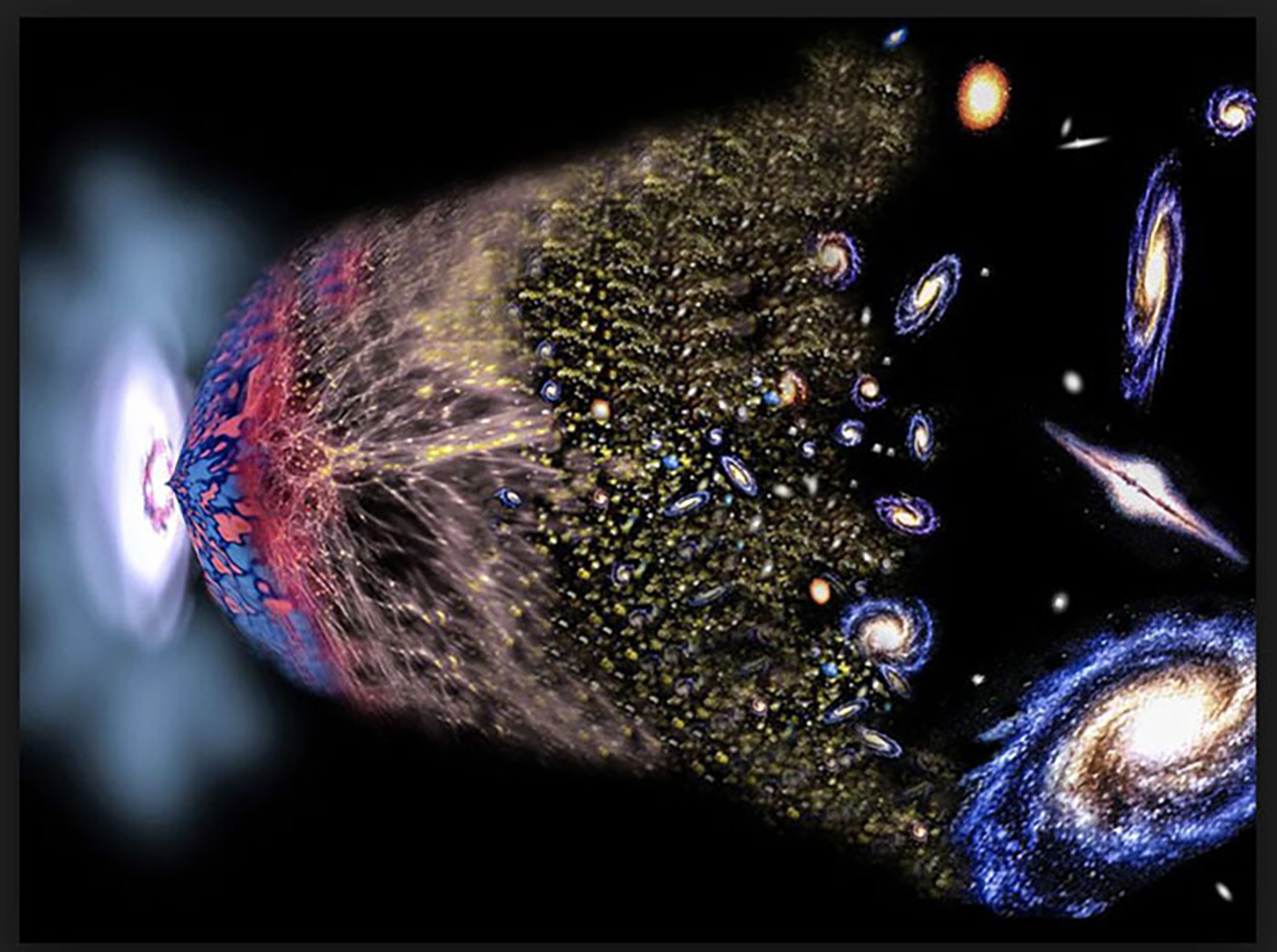
NASA Image of the Universe Expanding Like a Curtain (used by permission)
Published in 700 BC: The Earth Is Round: Isaiah 40:22 describes the “circle of the earth.” When the Earth is viewed from space, this is exactly what we see: a circle. Job 26:10, written over 4,000 years ago, also describes the earth as a circle. This text from Isaiah was given to him by God. Only God could see what the earth looked like from space 4,000 years ago. Man did not acquire the ability to see the Earth from space until 1959, when the Explorer 6 satellite captured the first photograph of Earth from orbit, taking a picture of the Pacific Ocean and its cloud cover while situated around 17,000 miles above the planet.
Published in 4000 BC: The Existence of Gravity: “The Earth Hangs In Space.” over 4,000 years ago, the book of Job, the oldest book in the Bible, accurately describes in Job 26:7, “He hangs the earth on nothing.” How could a man write thousands of years before Sir Isaac Newton (1642-1727) discovered gravity in 1665 at the age of 23, correctly describe the true nature of earth hanging in empty space by the force of gravity that was unseen?[5]
These are scientific statements about the universe that were not discovered until hundreds or thousands of years after man knew they existed. God told us these facts of science so that later we would know that He is the source of the Cosmos.
One of the most famous atheists was Philosopher, Dr. Antony Flew. Although Dr. Flew did not believe that God exists, he was willing to follow the evidence where it led in making his final conclusions. Near the end of his life, Dr. Flew came to the realization that the universe must exist as the result of an intelligence, he believed that intelligence is God.[6]
“There were two factors in particular that were decisive. One was my growing empathy with the insight of Einstein and other noted scientists that there had to be an Intelligence behind the integrated complexity of the physical Universe. The second was my own insight that the integrated complexity of life itself – which is far more complex than the physical Universe – can only be explained in terms of an Intelligent Source.”
“I believe that the origin of life and reproduction simply cannot be explained from a biological standpoint despite numerous efforts to do so. With every passing year, the more that was discovered about the richness and inherent intelligence of life, the less it seemed likely that a chemical soup could magically generate the genetic code.”
“The difference between life and non-life, it became apparent to me, was ontological and not chemical. The best confirmation of this radical gulf is Richard Dawkins’ comical effort to argue in The God Delusion that the origin of life can be attributed to a “lucky chance.” If that’s the best argument you have, then the game is over. No, I did not hear a Voice. It was the evidence itself that led me to this conclusion.”[7]
Leading atheist and author of “The God Delusion,” Professor Richard Dawkins, admits that a fine-tuned universe is good evidence for believing the universe was created:
“There may be good reasons for believing in a god, and if there are any I would expect them to come from possibly modern physics, from cosmology, from the observation that (as some people claim), that laws and constants of the universe are too finely tuned to be an accident. That would not be a wholly disreputable reason for believing in some form of supernatural deity.”[8]—Richard Dawkins
Romans 1:20 declares that God has made Himself known to every person by the things that He has made. It is foolish to proclaim that there is no evidence for the existence of God when everything that exists declares the fact of His existence.
Psalm 19: 1-4, that we examined earlier, states, “The heavens declare the glory of God; the skies proclaim the work of His hands. Day after day they pour forth speech; night after night they display knowledge. They have no speech, there are no words; no sound is heard from them. Yet their voice goes out into all the Earth, their words to the ends of the world.”
Physicists, Cosmologist, Astrobiologists, Mathematical Physicists, and Astronomers Who Support a Fine—Tuned Universe
Many prominent scientists affirm the fine-tuning of the universe, recognizing that the physical constants and laws of nature appear to be exquisitely balanced to permit life. Here is a list of some of the most well-known scientists who have acknowledged fine-tuning:
Paul Davies (Theoretical physicist, cosmologist, astrobiologist)
Paul Davis has written extensively on fine-tuning and the apparent design in physics.
- Quote: “There is now broad agreement among physicists and cosmologists that the universe is in several respects ‘fine-tuned’ for life.”
- Book: The Goldilocks Enigma: Why Is the Universe Just Right for Life? (2006)
- Quote: “There is now broad agreement among physicists and cosmologists that the universe is in several respects ‘fine-tuned’ for life.”
- Paper: Davies, P. (2004). The Anthropic Principle and the Laws of Nature. Modern Physics Letters A, 19(10), 727-744.
Sir Martin Rees (Former Astronomer Royal, cosmologist, professor at Cambridge)
Author of Just Six Numbers, which argues that six fundamental constants in physics are finely tuned for life.
- Quote: “If any one of these numbers (fine-tuned constants) were different, even to a small degree, there would be no stars, no complex chemistry, and no life.”
- Book: Just Six Numbers: The Deep Forces That Shape the Universe (1999)
- Quote: “If any one of these numbers were different, even to a small degree, there would be no stars, no complex chemistry, and no life.”
- Journal Article: Rees, M. (2003). Numerical Coincidences and ‘Tuning’ in Cosmology. Philosophical Transactions of the Royal Society A, 361(1812), 2427-2433.
Roger Penrose (Mathematical physicist, Oxford University)
Calculated the improbability of our low-entropy universe forming by chance as 1 in 10^10^123.
- Quote: “This number is so large that if you were to write it out in ordinary notation, it would be far longer than the number of atoms in the universe.”
- Book: The Emperor’s New Mind (1989)
- Quote: “The precision needed to produce our low-entropy universe by chance is 1 in 10^10^123.”
- Book: The Road to Reality: A Complete Guide to the Laws of the Universe (2004)
Leonard Susskind (Theoretical physicist, Stanford University)
Co-founder of string theory; acknowledges fine-tuning but appeals to the multiverse as a potential explanation.
- Quote: “The laws of physics have been fine-tuned to an incredible degree to permit the existence of life.”
- Book: The Cosmic Landscape: String Theory and the Illusion of Intelligent Design (2005)
- Paper: Susskind, L. (2003). The Anthropic Landscape of String Theory. arXiv:hep-th/0302219.
Luke Barnes (Astrophysicist, cosmologist)
Co-author of A Fortunate Universe with Geraint Lewis, detailing the precision of cosmic constants.
- Quote: “Fine-tuning is not a religious conclusion. It is a scientific conclusion.”
- Book: A Fortunate Universe: Life in a Finely Tuned Cosmos (2016) (co-authored with Geraint Lewis)
- Paper: Barnes, L. A. (2012). The Fine-Tuning of the Universe for Intelligent Life. Publications of the Astronomical Society of Australia, 29(4), 529-564.
Frank Tipler (Mathematical physicist)
Argues that fine-tuning is best explained by the existence of God.
- Quote: “When we analyze the structure of the universe, we find overwhelming evidence that it is the product of intelligent design.”
- Book: The Anthropic Cosmological Principle (1986) (co-authored with John Barrow)
- Paper: Tipler, F. J. (2005). Intelligent Life in Cosmology. International Journal of Astrobiology, 4(1), 45-52.
John Barrow (Cosmologist, University of Cambridge)
Co-author of The Anthropic Cosmological Principle with Frank Tipler.
- Quote: “The universe is not just ‘somehow’ suited for life; it is uniquely and delicately balanced.”
- Book: The Constants of Nature: From Alpha to Omega (2002)
- Paper: Barrow, J. D., & Tipler, F. J. (1986). The Anthropic Cosmological Principle. Oxford University Press.
Guillermo Gonzalez (Astrobiologist, astronomer)
Co-author of The Privileged Planet, which argues Earth’s place in the universe is special and fine-tuned.
- Quote: “Our planet is extraordinarily fine-tuned not only for life but also for scientific discovery.”
- Book: The Privileged Planet: How Our Place in the Cosmos is Designed for Discovery (2004) (co-authored with Jay Richards)
- Paper: Gonzalez, G. (2005). Habitable Zones in the Universe. Origins of Life and Evolution of Biospheres, 35(6), 555-606.
Hugh Ross (Astrophysicist)
Founder of Reasons to Believe, a group that defends the fine-tuning of the universe from a theistic perspective.
- Quote: “The fine-tuning of the universe is a hundred times, a thousand times, a million times more impressive than the finest human engineering.”
- Book: Why the Universe Is the Way It Is (2008)
- Paper: Ross, H. (2003). Design Evidence in the Cosmos. Perspectives on Science and Christian Faith, 55(1), 2-12.
Fred Hoyle (Astronomer, developed the theory of stellar nucleosynthesis)
Though originally an atheist, he later acknowledged the appearance of fine-tuning.
- Quote: “A commonsense interpretation of the facts suggests that a superintellect has monkeyed with physics, as well as with chemistry and biology.”
- Book: The Intelligent Universe (1983)
- Paper: Hoyle, F. (1982). The Universe: Past and Present Reflections. Engineering & Science, 45(2), 8-12.
Max Tegmark (Cosmologist, MIT)
Discusses fine-tuning but leans toward multiverse explanations.
- Quote: “The fine-tuning problem is one of the biggest mysteries in physics.”
- Book: Our Mathematical Universe: My Quest for the Ultimate Nature of Reality (2014)
- Paper: Tegmark, M. (1998). Is ‘the Theory of Everything’ Merely the Ultimate Ensemble Theory?. Annals of Physics, 270(1), 1-51.
Andrei Linde (Theoretical physicist, Stanford University)
A leading scientist in inflationary cosmology; acknowledges fine-tuning but suggests a multiverse solution.
- Quote: “The fine-tuning of the universe is real, but maybe it’s not unique if we have multiple universes.”
- Book: Inflation and Quantum Cosmology (1990)
- Paper: Linde, A. (2007). Universe, Life, Consciousness. arXiv:0705.0164.
Robin Collins (Physicist, philosopher of science)
Specializing in fine-tuning arguments and their implications for theism.
- Quote: “The precise fine-tuning of cosmic parameters for life provides strong evidence for an intelligent designer.”
- Book: The Fine-Tuning of the Universe for Intelligent Life (unpublished manuscript, extensive research cited in academic debates)
- Paper: Collins, R. (2003). Evidence for Fine-Tuning. In Manson, N. (Ed.), God and Design: The Teleological Argument and Modern Science, Routledge.
NOTES
[1] 1. Collins, Francis S. (2006-07-17). The Language of God: A Scientist Presents Evidence for Belief (p. 74). Free Press. Kindle Edition. ”
2. Collins, Francis S. (2006-07-17). The Language of God: A Scientist Presents Evidence for Belief (p. 75). Free Press. Kindle Edition. 3. I. G. Barbour, When Science Meets Religion (New York: HarperCollins, 2000).
[2] Ross, Hugh. The Creator and the Cosmos: How the Latest Scientific Discoveries Reveal God (Kindle Locations 659-666). RTB Press. Kindle Edition.
[3] Vibert Douglas, “Forty Minutes with Einstein,” Journal of the Royal Astronomical Society of Canada 50 (June 1956): 100. Ross, Hugh. The Creator and the Cosmos: How the Latest Scientific Discoveries Reveal God (Kindle Locations 4693-4694). RTB Press. Kindle Edition.
[4] Stephen Hawking, 1988. A Brief History of Time, Bantam Books, ISBN 0-553-05340-X, p. 125
[5] The Book of Job predates all other books in the Bible. The Hebrew tradition is that Job was written near 4000 BC.
[6] “Anthony Flew with Roy Abraham Varghese, There is a God: How the World’s Most Notorious Atheist Changed His Mind”. Archived from the original on 24 September 2015. Retrieved 10 September 2011.
[7] 1. “Anthony Flew with Roy Abraham Varghese, There is a God: How the World’s Most Notorious Atheist Changed His Mind”. Archived from the original on 24 September 2015. Retrieved 10 September 2011.
2. Habermas, Gary R. (9 December 2004), “My Pilgrimage from Atheism to Theism: An Exclusive Interview with Former British Atheist Professor Antony Flew”, Philosophia Christi, 6 (2), Biola, archived from the original on 30 October 2005
8. Richard Dawkins on the announcement that Antony Flew now believes in God. http://www.youtube.com/watch?v=bEPUn__hYso
Categories: Robert Clifton Robinson
 Robert Clifton Robinson
Please see, "Guidelines For Debate," at the right-side menu. Post your comment or argument here: