Scientists Present Evidence From Cosmology That Proves The God of the Bible Is The Source of the Universe
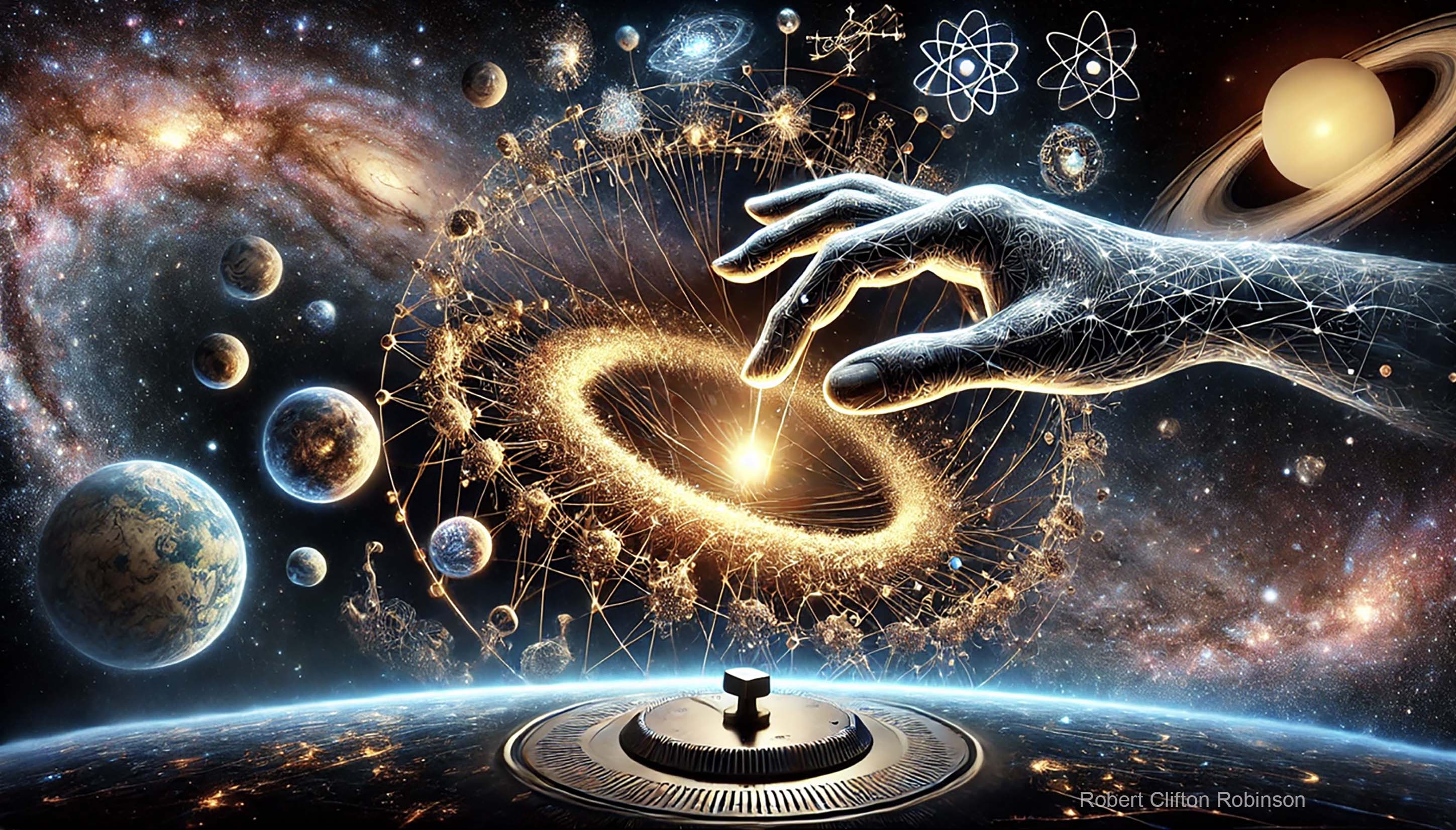
Universe Fine Tuned For Life, Copyright RCR
See A List of 75 Phds Who Believe God Created the Universe
“There is no law of nature that instructs matter to produce end-directed, self-replicating entities” —Physicists, Gerald L. Schroeder
“Fine-tuning is not a religious conclusion. It is a scientific conclusion.” —Astrophysicist, cosmologist, Luke Barnes. Co-author of A Fortunate Universe with Geraint Lewis, detailing the precision of cosmic constants.
In other words the universe does not simply exist because it exists. This is not a reason for our universe as some critics assert. In order for our universe to exist with the fine-tuned physical constants and laws that we can observe, these constants and laws must have been directed by an intelligence.
Evidence For Fine-Tuning Of The Universe: 209 Physical Constants That Make Life On Earth Possible
Does Occam’s Razor prove that the existence of fine-tuned physical constants in our universe, disproves a universe created by a natural or evolutionary process?

Occam’s Razor, Copyright, RCR
Occam’s Razor strongly supports the argument that a fine-tuned universe is best explained by an intelligent cause rather than a naturalistic process. Occam’s Razor states that, when faced with multiple explanations for a phenomenon, the simplest explanation that requires the fewest assumptions is most likely to be correct.
Occam’s Razor: is a problem-solving principle that states the simplest explanation is usually the best one. William of Ockham, an English theologian, logician, and Franciscan friar who lived from around 1285 to 1348. The word “razor” refers to the idea of “shaving away” unnecessary assumptions. Atheists often asser Occam’s Razor in seeking to impeach the idea of a universe created by God.
The Fine-Tuning Problem
Physicists have discovered that the physical constants of our universe—such as the gravitational constant, the strong and weak nuclear forces, and the cosmological constant—are precisely set to allow for life and stable structures. Even the smallest deviation in these constants would make the formation of galaxies, planets, and life impossible. This is widely recognized as the fine-tuning problem in physics.
Naturalistic Explanations Are Less Parsimonious
Naturalists attempt to explain fine-tuning using models like:
- The Multiverse Hypothesis: Suggests that an infinite number of universes exist with different constants, and we just happen to be in one that supports life.
- Self-Organizing Natural Laws: Proposes that unknown physical principles necessitate the existence of fine-tuned constants.
Anthropic Principle: States that we only observe fine-tuning because we exist, so there is no need for explanation.
- However, these hypotheses introduce unverified assumptions:
- The multiverse requires an infinite number of unseen universes, violating Occam’s Razor by vastly increasing complexity.
- The “self-organizing” hypothesis assumes unknown laws without evidence.
- The anthropic principle is not an explanation but rather an observation that sidesteps causation.
A Creator is the Most Parsimonious Explanation
By contrast, the hypothesis of an intelligent designer (God) requires one explanatory cause rather than an infinite number of speculative universes. The concept of a self-existent, necessary Being who fine-tuned the universe is a simpler and more direct solution than invoking an infinite, undetectable multiverse.
Naturalism Violates Occam’s Razor
Since naturalistic explanations require additional, speculative entities (like an unseen multiverse) to explain fine-tuning, whereas theism requires only one necessary cause (God), Occam’s Razor favors the theistic explanation. Therefore, fine-tuning strongly argues against a universe that arose purely through natural processes and supports the necessity of an intelligent Creator.
N=1 Our Universe, In Relation To Fine-Tuned Physical Constants
The statement that the universe is N=1 refers to the idea that we have only one observable universe to study. In scientific and cosmological discussions, this presents a fundamental limitation in drawing statistical conclusions about the properties of the universe.
What N-1 means in different contexts:
Observational Constraint – Since we can only observe one universe (N=1), we lack a larger sample size to compare our universe against others. This makes it difficult to determine whether our universe’s properties (e.g., physical constants, the laws of physics, the initial conditions of the Big Bang) are typical or exceptional.
Cosmological Theories – Many theories, such as the multiverse hypothesis, propose the existence of multiple universes (N > 1). However, because we only observe one universe, these theories are largely speculative and not empirically testable at present.
Anthropic Principle – The idea that the universe is N=1 is sometimes discussed in relation to the anthropic principle, which suggests that certain properties of the universe appear “fine-tuned” for life simply because we exist in this particular universe to observe them. If there were multiple universes (N > 1), we might have a broader context to assess whether our universe is unique or part of a larger statistical distribution.
Scientific Challenges – In fields like cosmology, physics, and probability theory, having only one data point (our universe) makes it challenging to apply traditional scientific methods that rely on repeatability and statistical analysis.
N=1 means that we only have one observable universe, limiting our ability to compare any other universe with ours
The concept that N=1 (our universe is the only observable one) significantly impacts the discussion on fine-tuning and the essential physical constants of the universe. Here’s how this idea aligns with fine-tuning arguments:
The Fine-Tuning of Physical Constants
There are several fundamental constants in physics that appear to be precisely set to allow for the existence of life, including:
- The gravitational constant (G)
- The fine-structure constant (α)
- The cosmological constant (Λ)
- The masses of fundamental particles (such as electrons and quarks)
If these constants were slightly different, the universe as we know it would not support galaxies, stars, planets, or life.
The N=1 Problem and the Impossibility of Comparison
Since we only observe one universe (N=1), we cannot directly compare our universe to a hypothetical set of other universes with different constants. This means:
- We cannot perform a statistical analysis to determine whether our universe’s constants are common or exceptional within a larger “set” of universes.
- The fact that we exist means we are observing a universe that supports observers—but we cannot determine whether this fine-tuning is necessary, accidental, or the result of design without additional universes for comparison.
The Multiverse Hypothesis as an Attempt to Solve N=1
Some physicists propose a multiverse (N > 1) where different regions of reality have different values for fundamental constants. In such a scenario:
- Our universe might just be one of many, and we happen to live in the one where conditions support life.
- However, this hypothesis is untestable, making it more of a philosophical assumption than a scientific conclusion.
The Theistic Interpretation of N=1 and Fine-Tuning
Many argue that fine-tuning is best explained by an intelligent designer rather than a random occurrence:
- If N=1 and we observe an incredibly fine-tuned universe, it suggests a purpose behind its parameters rather than them being the result of chance within a larger statistical set.
- The improbability of life-supporting constants arising randomly (without a multiverse) is so vast that many argue design is the best explanation.
Conclusion: N=1 Strengthens the Fine-Tuning Argument
- If we had many observable universes (N > 1), we could use probability theory to argue that our universe is just one among many possibilities.
- But because N=1, and the fine-tuned constants appear necessary for life, the best explanation remains either design or an extreme statistical anomaly.
- The lack of a naturalistic mechanism to determine why these constants have their precise values makes fine-tuning a strong argument for intentional calibration.
The fact that N=1 reinforces the significance of fine-tuning, making it more difficult to dismiss as mere chance. This has profound implications for discussions about the origins of the universe, including the possibility of an intelligent creator.
Preeminent Scientists Who Support The Fine-Tuned Universe As A Fact Of Our Universe
- How The Physical Constants And Fine-Tuning Of The Universe Prove God Exists
- Evidence For Fine-Tuning Of The Universe: 209 Physical Constants That Make Life On Earth Possible
Many prominent scientists affirm the fine-tuning of the universe, recognizing that the physical constants and laws of nature appear to be exquisitely balanced to permit life. Here is a list of some of the most well-known scientists who have acknowledged fine-tuning:
Paul Davies (Theoretical physicist, cosmologist, astrobiologist)
Paul Davis has written extensively on fine-tuning and the apparent design in physics.
- Quote: “There is now broad agreement among physicists and cosmologists that the universe is in several respects ‘fine-tuned’ for life.”
- Book: The Goldilocks Enigma: Why Is the Universe Just Right for Life? (2006)
- Quote: “There is now broad agreement among physicists and cosmologists that the universe is in several respects ‘fine-tuned’ for life.”
- Paper: Davies, P. (2004). The Anthropic Principle and the Laws of Nature. Modern Physics Letters A, 19(10), 727-744.
Sir Martin Rees (Former Astronomer Royal, cosmologist, professor at Cambridge)
Author of Just Six Numbers, which argues that six fundamental constants in physics are finely tuned for life.
- Quote: “If any one of these numbers (fine-tuned constants) were different, even to a small degree, there would be no stars, no complex chemistry, and no life.”
- Book: Just Six Numbers: The Deep Forces That Shape the Universe (1999)
- Quote: “If any one of these numbers were different, even to a small degree, there would be no stars, no complex chemistry, and no life.”
- Journal Article: Rees, M. (2003). Numerical Coincidences and ‘Tuning’ in Cosmology. Philosophical Transactions of the Royal Society A, 361(1812), 2427-2433.
Roger Penrose (Mathematical physicist, Oxford University)
Calculated the improbability of our low-entropy universe forming by chance as 1 in 10^10^123.
- Quote: “This number is so large that if you were to write it out in ordinary notation, it would be far longer than the number of atoms in the universe.”
- Book: The Emperor’s New Mind (1989)
- Quote: “The precision needed to produce our low-entropy universe by chance is 1 in 10^10^123.”
- Book: The Road to Reality: A Complete Guide to the Laws of the Universe (2004)
Leonard Susskind (Theoretical physicist, Stanford University)
Co-founder of string theory; acknowledges fine-tuning but appeals to the multiverse as a potential explanation.
- Quote: “The laws of physics have been fine-tuned to an incredible degree to permit the existence of life.”
- Book: The Cosmic Landscape: String Theory and the Illusion of Intelligent Design (2005)
- Paper: Susskind, L. (2003). The Anthropic Landscape of String Theory. arXiv:hep-th/0302219.
Luke Barnes (Astrophysicist, cosmologist)
Co-author of A Fortunate Universe with Geraint Lewis, detailing the precision of cosmic constants.
- Quote: “Fine-tuning is not a religious conclusion. It is a scientific conclusion.”
- Book: A Fortunate Universe: Life in a Finely Tuned Cosmos (2016) (co-authored with Geraint Lewis)
- Paper: Barnes, L. A. (2012). The Fine-Tuning of the Universe for Intelligent Life. Publications of the Astronomical Society of Australia, 29(4), 529-564.
Frank Tipler (Mathematical physicist)
Argues that fine-tuning is best explained by the existence of God.
- Quote: “When we analyze the structure of the universe, we find overwhelming evidence that it is the product of intelligent design.”
- Book: The Anthropic Cosmological Principle (1986) (co-authored with John Barrow)
- Paper: Tipler, F. J. (2005). Intelligent Life in Cosmology. International Journal of Astrobiology, 4(1), 45-52.
John Barrow (Cosmologist, University of Cambridge)
Co-author of The Anthropic Cosmological Principle with Frank Tipler.
- Quote: “The universe is not just ‘somehow’ suited for life; it is uniquely and delicately balanced.”
- Book: The Constants of Nature: From Alpha to Omega (2002)
- Paper: Barrow, J. D., & Tipler, F. J. (1986). The Anthropic Cosmological Principle. Oxford University Press.
Guillermo Gonzalez (Astrobiologist, astronomer)
Co-author of The Privileged Planet, which argues Earth’s place in the universe is special and fine-tuned.
- Quote: “Our planet is extraordinarily fine-tuned not only for life but also for scientific discovery.”
- Book: The Privileged Planet: How Our Place in the Cosmos is Designed for Discovery (2004) (co-authored with Jay Richards)
- Paper: Gonzalez, G. (2005). Habitable Zones in the Universe. Origins of Life and Evolution of Biospheres, 35(6), 555-606.
Hugh Ross (Astrophysicist)
Founder of Reasons to Believe, a group that defends the fine-tuning of the universe from a theistic perspective.
- Quote: “The fine-tuning of the universe is a hundred times, a thousand times, a million times more impressive than the finest human engineering.”
- Book: Why the Universe Is the Way It Is (2008)
- Paper: Ross, H. (2003). Design Evidence in the Cosmos. Perspectives on Science and Christian Faith, 55(1), 2-12.
Fred Hoyle (Astronomer, developed the theory of stellar nucleosynthesis)
Though originally an atheist, he later acknowledged the appearance of fine-tuning.
- Quote: “A commonsense interpretation of the facts suggests that a superintellect has monkeyed with physics, as well as with chemistry and biology.”
- Book: The Intelligent Universe (1983)
- Paper: Hoyle, F. (1982). The Universe: Past and Present Reflections. Engineering & Science, 45(2), 8-12.
Max Tegmark (Cosmologist, MIT)
Discusses fine-tuning but leans toward multiverse explanations.
- Quote: “The fine-tuning problem is one of the biggest mysteries in physics.”
- Book: Our Mathematical Universe: My Quest for the Ultimate Nature of Reality (2014)
- Paper: Tegmark, M. (1998). Is ‘the Theory of Everything’ Merely the Ultimate Ensemble Theory?. Annals of Physics, 270(1), 1-51.
Andrei Linde (Theoretical physicist, Stanford University)
A leading scientist in inflationary cosmology; acknowledges fine-tuning but suggests a multiverse solution.
- Quote: “The fine-tuning of the universe is real, but maybe it’s not unique if we have multiple universes.”
- Book: Inflation and Quantum Cosmology (1990)
- Paper: Linde, A. (2007). Universe, Life, Consciousness. arXiv:0705.0164.
Robin Collins (Physicist, philosopher of science)
Specializing in fine-tuning arguments and their implications for theism.
- Quote: “The precise fine-tuning of cosmic parameters for life provides strong evidence for an intelligent designer.”
- Book: The Fine-Tuning of the Universe for Intelligent Life (unpublished manuscript, extensive research cited in academic debates)
- Paper: Collins, R. (2003). Evidence for Fine-Tuning. In Manson, N. (Ed.), God and Design: The Teleological Argument and Modern Science, Routledge.
Fine-tuning is widely recognized by both theists and atheists in the scientific community
While some, like Paul Davies and Roger Penrose, see fine-tuning as pointing toward design, others, like Leonard Susskind and Andrei Linde, invoke the multiverse as an alternative explanation. However, the consensus remains that the physical constants and initial conditions of the universe are balanced on a razor’s edge to allow life.
NOTES:
Formatted citations in APA (7th edition) style for the scientists who affirm fine-tuning
These citations provide academic sources supporting the fine-tuning argument from well-established scientists.
Books:
- Barrow, J. D., & Tipler, F. J. (1986). The anthropic cosmological principle. Oxford University Press.
- Barnes, L. A., & Lewis, G. F. (2016). A fortunate universe: Life in a finely tuned cosmos. Cambridge University Press.
- Collins, R. (2003). Evidence for fine-tuning. In Manson, N. (Ed.), God and design: The teleological argument and modern science (pp. 178-199). Routledge.
- Davies, P. (2006). The Goldilocks enigma: Why is the universe just right for life? Allen Lane.
- Gonzalez, G., & Richards, J. W. (2004). The privileged planet: How our place in the cosmos is designed for discovery. Regnery Publishing.
- Hoyle, F. (1983). The intelligent universe. Holt, Rinehart, and Winston.
- Linde, A. (1990). Inflation and quantum cosmology. Academic Press.
- Penrose, R. (1989). The emperor’s new mind: Concerning computers, minds, and the laws of physics. Oxford University Press.
- Penrose, R. (2004). The road to reality: A complete guide to the laws of the universe. Jonathan Cape.
- Rees, M. (1999). Just six numbers: The deep forces that shape the universe. Basic Books.
- Ross, H. (2008). Why the universe is the way it is. Baker Books.
- Susskind, L. (2005). The cosmic landscape: String theory and the illusion of intelligent design. Little, Brown and Company.
- Tegmark, M. (2014). Our mathematical universe: My quest for the ultimate nature of reality. Knopf Doubleday Publishing Group.
Journal Articles:
- Barrow, J. D. (2003). Numerical coincidences and ‘tuning’ in cosmology. Philosophical Transactions of the Royal Society A: Mathematical, Physical and Engineering Sciences, 361(1812), 2427-2433. https://doi.org/10.1098/rsta.2003.1289
- Barnes, L. A. (2012). The fine-tuning of the universe for intelligent life. Publications of the Astronomical Society of Australia, 29(4), 529-564. https://doi.org/10.1071/AS12015
- Davies, P. (2004). The anthropic principle and the laws of nature. Modern Physics Letters A, 19(10), 727-744. https://doi.org/10.1142/S0217732304013852
- Gonzalez, G. (2005). Habitable zones in the universe. Origins of Life and Evolution of Biospheres, 35(6), 555-606. https://doi.org/10.1007/s11084-005-1965-z
- Hoyle, F. (1982). The universe: Past and present reflections. Engineering & Science, 45(2), 8-12.
- Linde, A. (2007). Universe, life, consciousness. arXiv preprint, arXiv:0705.0164. https://doi.org/10.48550/arXiv.0705.0164
- Ross, H. (2003). Design evidence in the cosmos. Perspectives on Science and Christian Faith, 55(1), 2-12.
- Susskind, L. (2003). The anthropic landscape of string theory. arXiv preprint, arXiv:hep-th/0302219. https://doi.org/10.48550/arXiv.hep-th/0302219
- Tegmark, M. (1998). Is ‘the theory of everything’ merely the ultimate ensemble theory? Annals of Physics, 270(1), 1-51. https://doi.org/10.1006/aphy.1998.5855
- Tipler, F. J. (2005). Intelligent life in cosmology. International Journal of Astrobiology, 4(1), 45-52. https://doi.org/10.1017/S1473550405002450
Categories: Robert Clifton Robinson
 Robert Clifton Robinson
Please see, "Guidelines For Debate," at the right-side menu. Post your comment or argument here: