In Debating Hundreds of Atheists Over The Past 49 years, I Have Often Heard A Common Objection: “God Has No Scientific Basis”
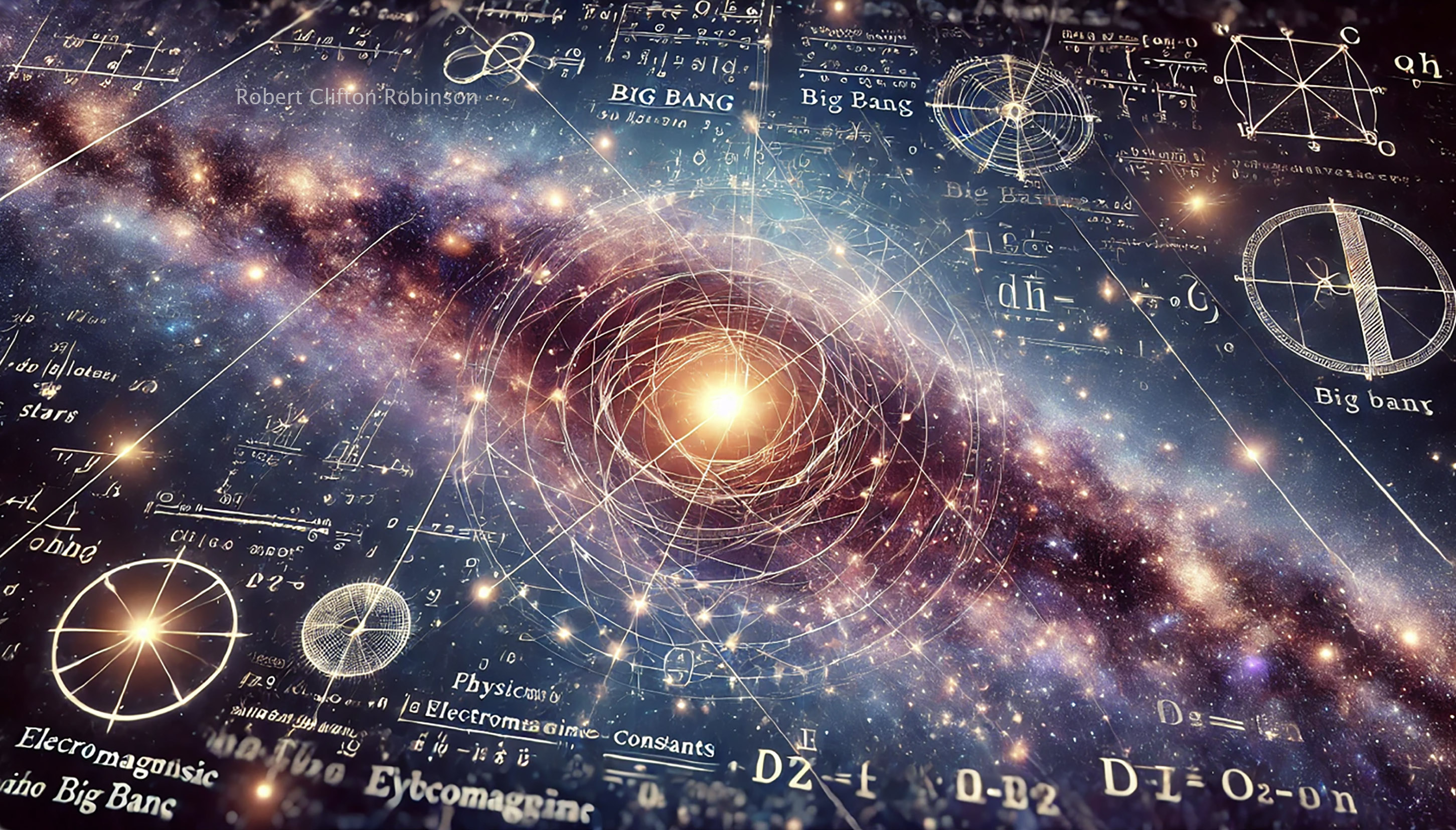
The Universe And God, Copyright, RCR
The assertion that “God has no scientific basis” is a common argument among atheists. However, this statement reflects a misunderstanding of both science and the nature of evidence. While science cannot directly test metaphysical concepts like God, it can examine empirical evidence that points to intelligent design, causality, and fine-tuning in the universe. When natural explanations fail to account for these phenomena, the most rational inference is that an intelligent Creator is responsible for the existence of the universe. This essay demonstrates that the precise fine-tuning of the universe, the impossibility of a self-created cosmos, and the limits of the scientific method collectively provide strong evidence for God’s existence.
The Fine-Tuning Argument as Scientific Inference
Scientific evidence shows that the universe is governed by physical constants—such as the gravitational constant, cosmological constant, and electromagnetic force—that must fall within narrow, precise ranges for life to exist. Even the slightest deviation would render life impossible. This precision suggests intentional calibration rather than random chance.
For example, the cosmological constant, which governs the expansion rate of the universe, is fine-tuned to one part in 10^120. If it were even slightly stronger or weaker, galaxies, stars, and planets could not form, making life impossible. In science, extreme improbability often points to intentional design. Just as archaeologists infer intelligence when discovering arrowheads (rather than random rocks), the fine-tuning of the universe is best explained by an intelligent designer.
The Impossibility of a Self-Created Universe
The scientific principle of causality states that every effect must have a cause. Since the universe is an effect, it cannot be its own cause. A natural process cannot create itself because it would have to exist before it began—an impossibility. Thus, the universe requires an uncaused, eternal Being who transcends time, space, and matter.
The Big Bang theory demonstrates that time, space, and matter began simultaneously. Since physical laws did not exist before the Big Bang, the cause of the universe must be non-physical, timeless, and immaterial—attributes that align with the concept of God. Therefore, the claim that “God has no scientific basis” ignores the logical necessity of a supernatural cause to explain the universe’s origin.
The Scientific Method Supports Inferences to the Best Explanation
While the scientific method is designed to test natural phenomena within the universe, it also allows scientists to make inferences based on evidence. When natural explanations fail, it is reasonable to infer a non-natural cause.
For instance, when scientists discover complex coded information in DNA, they infer an intelligent source, just as software implies a programmer. Similarly, the precise fine-tuning of the universe is best explained by an intelligent Creator. The inability of natural processes to account for this precision makes the inference of God more rational than the assumption that the universe arose by chance.
How The Physical Constants And Fine-Tuning Of The Universe Prove God Exists
Addressing the Limits of the Scientific Method
Many atheists misuse the scientific method by assuming that what cannot be directly tested in a laboratory cannot exist. However, science cannot measure concepts like love, morality, or consciousness, yet their existence is undeniable. Similarly, the existence of God, though beyond direct scientific testing, can be inferred from the evidence of design and causality.
Moreover, the absence of empirical evidence for God is not evidence of His absence. Science cannot prove that God does not exist, and the inability to test God using the scientific method does not negate the logical inference of His existence based on the available evidence.
Roger Penrose: The Multiverse v. Intelligent Creator: Examining The Cosmological Evidence
Probability and Logical Consistency
The probability of the universe forming by random chance is astronomically low—so low that it defies rational belief. When comparing hypotheses—random chance versus intelligent design—intelligent design is far more plausible.
For example, the probability of a Boeing 747 assembling itself from random parts during a tornado is effectively zero. Similarly, the universe, which is infinitely more complex, could not have arisen without design. Science often rejects hypotheses based on extreme improbability, and the universe’s fine-tuning falls into this category.
Evidence For Fine-Tuning Of The Universe: 209 Physical Constants That Make Life On Earth Possible
Science and Theism Are Not in Conflict
Science and theism are not in conflict, but rather mutually supportive. We must distinguish between superficial conflict and deep concord. While certain scientific theories may seem to conflict with religious beliefs, these conflicts are surface-level and often arise from misinterpretations. On a deeper level, science and theism are compatible because theism provides the metaphysical foundation that makes science possible. A rational Creator explains why the universe operates according to consistent, discoverable laws, aligning with the assumptions underlying scientific inquiry.
The reliability of human cognitive faculties is best explained by theism. A God who created humans in His image would ensure that their cognitive faculties are generally reliable. In contrast, naturalistic evolution, which selects for survival rather than truth, provides no guarantee that human beliefs are accurate.
Naturalism Is Self-Defeating:
The Evolutionary Argument Against Naturalism (EAAN) demonstrates that naturalism is self-defeating. Evolution selects traits that enhance survival and reproduction, not necessarily those that produce true beliefs. Since false beliefs can still lead to adaptive behavior, the probability that our cognitive faculties are reliable under naturalism is low or unknown.
As a result, if naturalism is true, we cannot trust our cognitive faculties, including the belief in naturalism itself. This creates a logical contradiction, making naturalism epistemically self-defeating. Theism, by contrast, provides a coherent foundation for rational thought and scientific inquiry, as it posits that human cognitive faculties were designed by a rational Creator to perceive and understand truth.
The claim that “God has no scientific basis” is a category error that misunderstands the limits of the scientific method. While science cannot directly test metaphysical concepts, it can examine evidence that points to intelligent design, causality, and fine-tuning. Given the extreme improbability of a self-created universe, the precise calibration of physical constants, and the rational foundation theism provides for science and human cognition, the most coherent and rational inference is that an intelligent, eternal Creator—God—is responsible for the existence of the universe. Therefore, the evidence from both science and philosophy not only supports but necessitates the conclusion that God must exist.
See Rob’s New Book: “A Universe That Proves God: The True Source of the Cosmos:
Click On Image To Look Inside
Sources and Citations:
Fine-Tuning Argument as Scientific Inference
Martin Rees, Just Six Numbers: The Deep Forces That Shape the Universe (2000)
Rees, a British cosmologist, discusses six fundamental numbers that govern the universe, each precisely calibrated to allow life to exist. His work highlights the improbability of these numbers aligning by chance.
Paul Davies, The Goldilocks Enigma: Why Is the Universe Just Right for Life? (2006)
Davies explores the fine-tuning of physical constants and how their precise values suggest intentional calibration. He acknowledges that naturalistic explanations fall short of explaining this phenomenon.
Roger Penrose, The Road to Reality: A Complete Guide to the Laws of the Universe (2004)
Penrose, a renowned physicist and mathematician, calculates the probability of the universe’s low entropy state occurring by chance as 1 in 10^10^123, an astronomically improbable event that suggests design.
Impossibility of a Self-Created Universe
William Lane Craig and James D. Sinclair, “The Kalam Cosmological Argument,” in The Blackwell Companion to Natural Theology (2009)
Craig and Sinclair present the Kalam Cosmological Argument, which posits that the universe had a beginning, therefore requiring a cause that is timeless, immaterial, and powerful—attributes that align with the concept of God.
Alexander Vilenkin, Many Worlds in One: The Search for Other Universes (2006)
Vilenkin, a theoretical physicist, states that “all the evidence we have says that the universe had a beginning,” emphasizing that natural processes cannot account for their own existence.
Scientific Method and Inferences to the Best Explanation
Stephen C. Meyer, Signature in the Cell: DNA and the Evidence for Intelligent Design (2009)
Meyer argues that the complex, information-rich structure of DNA is best explained by an intelligent source, using the scientific principle of inference to the best explanation.
John Lennox, God’s Undertaker: Has Science Buried God? (2009)
Lennox, a mathematician and philosopher of science, demonstrates that science and belief in God are compatible, and that scientific evidence can lead to the inference of an intelligent Creator.
Limits of the Scientific Method
Thomas Nagel, Mind and Cosmos: Why the Materialist Neo-Darwinian Conception of Nature Is Almost Certainly False (2012)
Nagel, an atheist philosopher, argues that scientific materialism cannot explain consciousness, morality, and reason, suggesting that naturalism is incomplete.
Michael Polanyi, Personal Knowledge: Towards a Post-Critical Philosophy (1958)
Polanyi explains that science cannot fully account for subjective experiences like love, morality, and consciousness, demonstrating the limits of empirical methods.
Probability and Logical Consistency
Sir Fred Hoyle, The Intelligent Universe: A New View of Creation and Evolution (1983)
Hoyle famously stated that the probability of the universe’s complexity arising by chance is akin to a tornado assembling a Boeing 747 from junkyard parts, reinforcing the argument for intelligent design.
Robin Collins, “The Teleological Argument: An Exploration of the Fine-Tuning of the Universe,” in The Blackwell Companion to Natural Theology (2009)
Collins presents the teleological argument based on fine-tuning, using probability theory to show that the likelihood of a life-permitting universe occurring by chance is astronomically low.
Additional Philosophical and Theological Sources
Alvin Plantinga, Where the Conflict Really Lies: Science, Religion, and Naturalism (2011)
Plantinga argues that science and theism are not in conflict and that naturalism is self-defeating, strengthening the case for God’s existence.
Richard Swinburne, The Existence of God (2004, Revised Edition)
Swinburne uses probability theory to argue that the existence of God is more likely than not, given the evidence of fine-tuning and the order of the universe.
Argument: Science and Theism Are Not in Conflict
Plantinga, A. (2011). Where the Conflict Really Lies: Science, Religion, and Naturalism. Oxford University Press.
Plantinga, A. (1993). Warrant and Proper Function. Oxford University Press.
Scholarly Articles
Collins, R. (2003). Evidence for Fine-Tuning. In W.L. Craig (Ed.), God and Design: The Teleological Argument and Modern Science. Routledge.
Craig, W.L. (2000). The Kalam Cosmological Argument. In P. Copan & P. Moser (Eds.), The Rationality of Theism. Routledge.
Davies, P. (1983). The Anthropic Principle and the Structure of the Physical World. Nature, 301, 398–400.
Categories: Age of the Earth, Cosmology, Evidence For God, Origin of the Universe, Physical Constants, Religion vs. Relationship, Robert Clifton Robinson, Salvation is a free gift, Science and the Bible, Scientific Evidence For God, Scientists Who Believe in God, The Creation of the Universe, The Existence of God, We must repent, What is required for Heaven?
 Robert Clifton Robinson
In Ezekiel 38:23, God says, “Thus will I magnify Myself and sanctify Myself, and I will be known in the eyes of many nations; and they shall know that I am the Lord”.
Just as is in ancient days, so to shall it be today.
And we know this to be true because of what The Lord said in Isaiah 42:8: “I am the Lord; that is my name. And my glory will I not give to another, neither my praise to graven images”.
I wish I was humble enough to offer a prayer to God for humanity in the likeness of the one Daniel made for his people in while in exile (Daniel 9).
We who read your writings are always grateful to the Lord for You.
The Beginning is Near.
LikeLike
If we are the result of a natural process then we are nothing more than a byproduct of cruelty. This would be a logical conclusion if the multi-verse were ever proven. Imagine how cruel this natural process is by giving us hope, love, care, family, friendship, companionship, relationship, etc, etc, etc through the process of evolution; and then, at the end, take it all away at death … like it never happened.
Is this where we really think we are? For many … Yes. (The Bible explains why this is true in many places.)
So no. I will never accept that we are a byproduct of cruelty. I will always believe we are a byproduct of God’s love and grace simply because I have a hope. A hope that there is more to this story than what we see or hear. It’s an eternal hope. And I will have it … because I can and will.
So to the atheist, why can I not have this hope? Hasn’t evolution through this natural process given it to me to have? And if so, why can I not exercise that hope unless it is just a LIE? Well. Isn’t it a lie after all? More cruelty? Nothing like being lied to … surely Eve understood that afterwards.
Evolution did not given this hope to me … God did.
How could evolution ever allow me the opportunity to deny it? Is evolution truly that blind, like the idols of wood and silver made by human hands in ancient times, that it cannot see what it is I am doing here today by writing this note of defiance. Why hasn’t it struck me down as weak? Where is your false god of evolution?
No more. Please believe what you wish. I will chose to believe in the Grace and Love of the Lord my God, the One True God, The God of Abraham, Issac and Jacob, who gave me a savior in Jesus Christ. And I believe that because MY GOD is not cruel like the God of Evolution. So deal with it.
Blessings to all.
I have read the book mentioned above. I have recommended this book before and will recommend it again to anyone who is in a scientific field like me, and, is most times tolerated for our belief in the One True God.
I praise the Lord our God for the writings of Pastor Rob. Thank you for them my brother.
May the Lord our God bless you always.
LikeLike
Thank you, Tony
You are correct. What is cited by critics as evidence that God is not necessary; Darwinian Evolution, is the scientific evidence that God must exist.
The idea that all species evolved from a single common ancestor is central to the theory of evolution. However, there are several scientific challenges and problems associated with this idea. While many of these challenges are addressed within evolutionary biology, they remain points that make a common ancestor impossible. The following facts of science, biology, and geology, address these primary scientific impossibilities:
Most people think of Evolution as a singular subject—every creature on earth evolved from a singular source. The truth is that Evolution has three parts to its premise.
1. Evolution by Natural Selection
2. Abiogenesis
3. Universal Common Ancestry
Only One Is Provable By Science!
There is no scientific evidence that all life originated from one common ancestor, a primary claim of atheists.
There is no evidence for life spontaneously beginning on earth, though atheists consistently assert it did.
It takes far more blind faith to believe the universe and human life are random accidents, than the obvious answer that a Being of infinite power and knowledge created all that exists.
As time marches on and our knowledge of the universe increases, we grow closer to a universal acknowledgment of God as Creator of all that exists.
Thank you, Tony, for your constant brilliant observations!
LikeLike