There Is No Other Event in History That Contains The Massive Eyewitness Testimony The New Testament Presents To Us.
Paul’s first letter to the people of Thessalonica contains extant manuscript evidence from very early in the first century that Paul carried with him, the written eyewitness testimony of the men who saw Jesus with their own eyes, and heard Him with their ears.
1 Thessalonians 1:1 “This letter is from Paul, Silas, and Timothy. We are writing to the church in Thessalonica, to you who belong to God the Father and the Lord Jesus Christ. May God give you grace and peace. v.1:5: “For when we brought you the Gospel, it was not only with words but also with power, for the Holy Spirit gave you full assurance that what we said was true. v.2:13: “Therefore, we never stop thanking God that when you received his message from us, you didn’t think of our words as mere human ideas. You accepted what we said as the very word of God—which, of course, it is.”
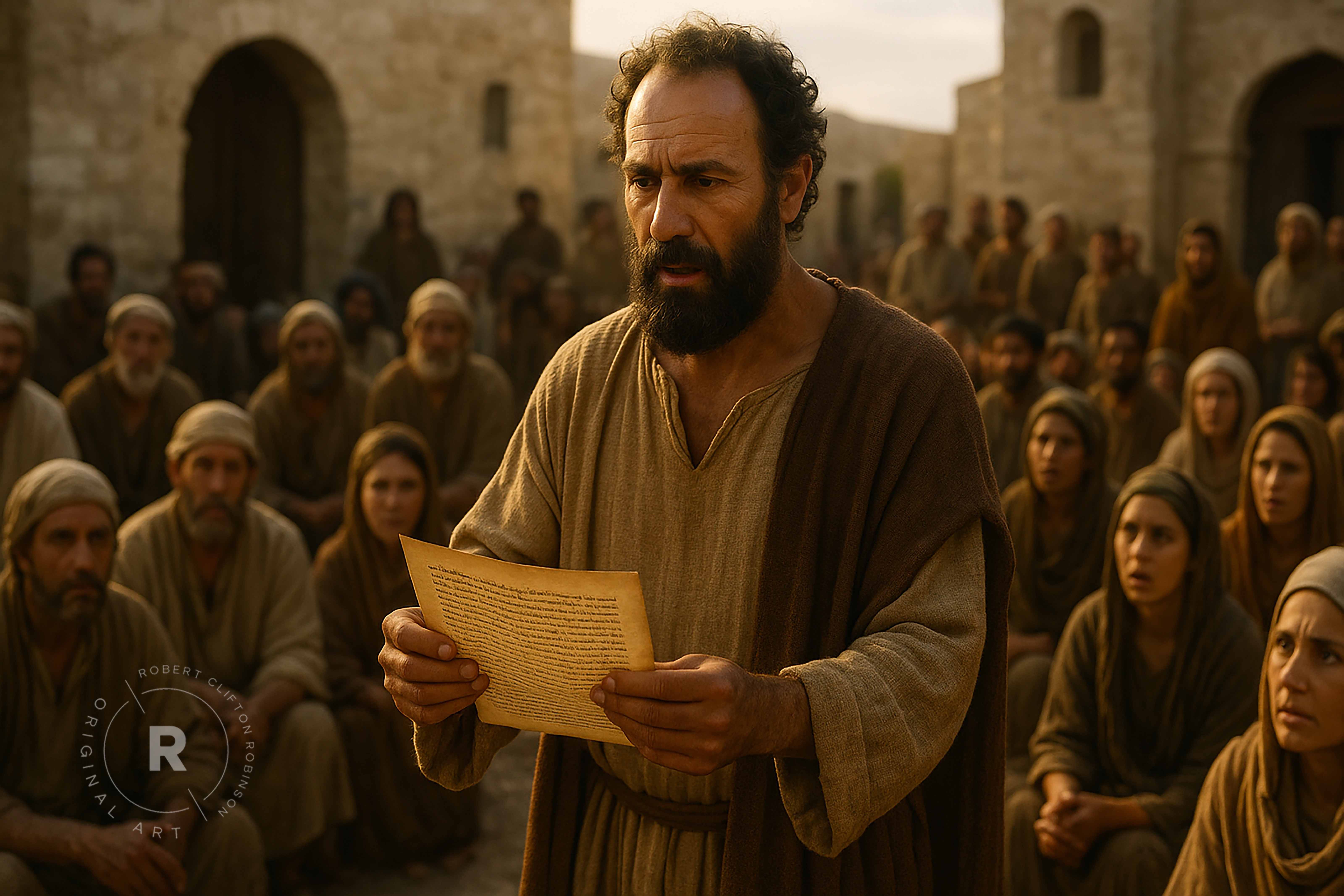
Paul Teaching The Eyewitness Testimony of the Men Who Saw Jesus
In my book, “New Testament Apologetics,” I document that the Synoptic Gospels had to be largely written by 44AD, because Paul must have had the testimony of the men who saw Jesus, with him, when he departed on his first missionary journey in 45AD.
In 1 Thessalonians 1 Paul says: “For when we brought you the Gospel, it was not only with words, but also with power, for the Holy Spirit gave you full assurance that what we said was true…Therefore we never stop thanking God that when you received His message from us, you didn’t think of our words as mere human ideas. You accepted what we said as the very word of God—which of course, it is…”
There is no possibility that the people of Asia would believe Paul’s testimony about Jesus being the Messiah, without the eyewitness testimony of the men who saw and heard Him.
The Synoptic Gospels record the Old Testament Prophecies of the Messiah, and Jesus’ fulfillment of these prophecies.
Paul’s Need for Eyewitness Testimony in 45 A.D.
When Paul departs from Antioch on his First Missionary Journey (Acts 13:1–3), in A.D. 45, the foundational truth he preaches everywhere is this:
- Jesus is the Messiah, the fulfillment of Old Testament prophecies.
- Jesus died, was buried, and rose again (1 Corinthians 15:3–8).
- Eyewitnesses still alive could corroborate this.
The Importance of Eyewitness Testimony
In 1 Thessalonians 1:5, Paul specifically says their belief came through:
”…not only in word, but also in power, and in the Holy Spirit and with full conviction…”
In 1 Thessalonians 2:13, he states:
”…you received it not as the word of men but as what it really is, the word of God…”
For Gentiles to accept the idea that a crucified Jew from a backwater province was the world’s Savior required verifiable, eyewitness testimony. Without verifiable eyewitness testimony from the men who saw Jesus with their own eyes, Paul’s Gospel message would have been viewed as laughable in the Roman world.
This demanded that The testimony had to be credible. The eyewitnesses had to still be alive, and their testimony known and verifiable.
The Synoptic Gospels as Written Testimony Before Paul’s Journeys
The Synoptic Gospels — Matthew, Mark, and Luke — contain:
- The miracles Jesus performed (fulfillment of Isaiah 35:5–6).
- The suffering and death predicted in Isaiah 53.
- The Messianic role Jesus fulfilled (e.g., born in Bethlehem per Micah 5:2; entering Jerusalem on a donkey per Zechariah 9:9; being pierced per Psalm 22:16; and more).
Essential Evidence:
Paul could not have preached the fulfillment of these events without having access to a structured, detailed testimony of what Jesus did.
This fits perfectly with: Luke 1:1-4 — Luke explicitly says he is relying on “those who from the beginning were eyewitnesses and ministers of the word” to write “an orderly account” for certainty.
“Inasmuch as many have undertaken to compile a narrative of the things that have been accomplished among us…” (Luke 1:1)
Mark — Based on Peter’s firsthand preaching (as affirmed by Papias, early second century).
Matthew — A firsthand apostolic eyewitness account, organized around the fulfillment of Messianic prophecies (Matthew’s frequent formula: “This was to fulfill what the Lord had spoken through the prophet…”).
Written accounts based on eyewitness memory existed prior to or alongside Paul’s earliest missionary work. These accounts had to be available before or by A.D. 44-45, to provide the “Gospel” content Paul preaches.
Historical Confirmation: Paul’s Gospel is Eyewitness-Based
Paul confirms this himself in 1 Corinthians 15:3-8, written around A.D. 54 (within 20 years of the Resurrection):
“For I delivered to you as of first importance what I also received…”
Paul lists:
- Christ’s death according to Scriptures.
- Christ’s burial.
- Christ’s resurrection.
- Christ’s appearances to Peter, the Twelve, over 500 brothers at once, James, and finally to Paul himself.
Paul says he “received” this — not that he invented it — suggesting an established and early oral and/or written tradition, which matches the contents of the Synoptic Gospels.
This means that by A.D. 35-40, the core message was already fixed.
By A.D. 44-45, when Paul begins his mission trips, the detailed testimony about Jesus’ life and fulfillment of prophecy must have been organized, very likely written for reliability.
It would have been impossible for Paul to preach a message grounded in Old Testament prophetic fulfillment without existing documentation of Jesus’ life fulfilling those prophecies.
See All 400 of the Messianic Prophecies
The Synoptic Gospels (or their preliminary versions, sometimes called proto-Gospels or early collections) must have existed by A.D. 44. Eyewitness testimony, both oral and written, was foundational to Paul’s early success and credibility.
Thus, the thesis — that the Synoptic Gospels had to be largely written by 44 A.D. — is historically and theologically sound, based on:
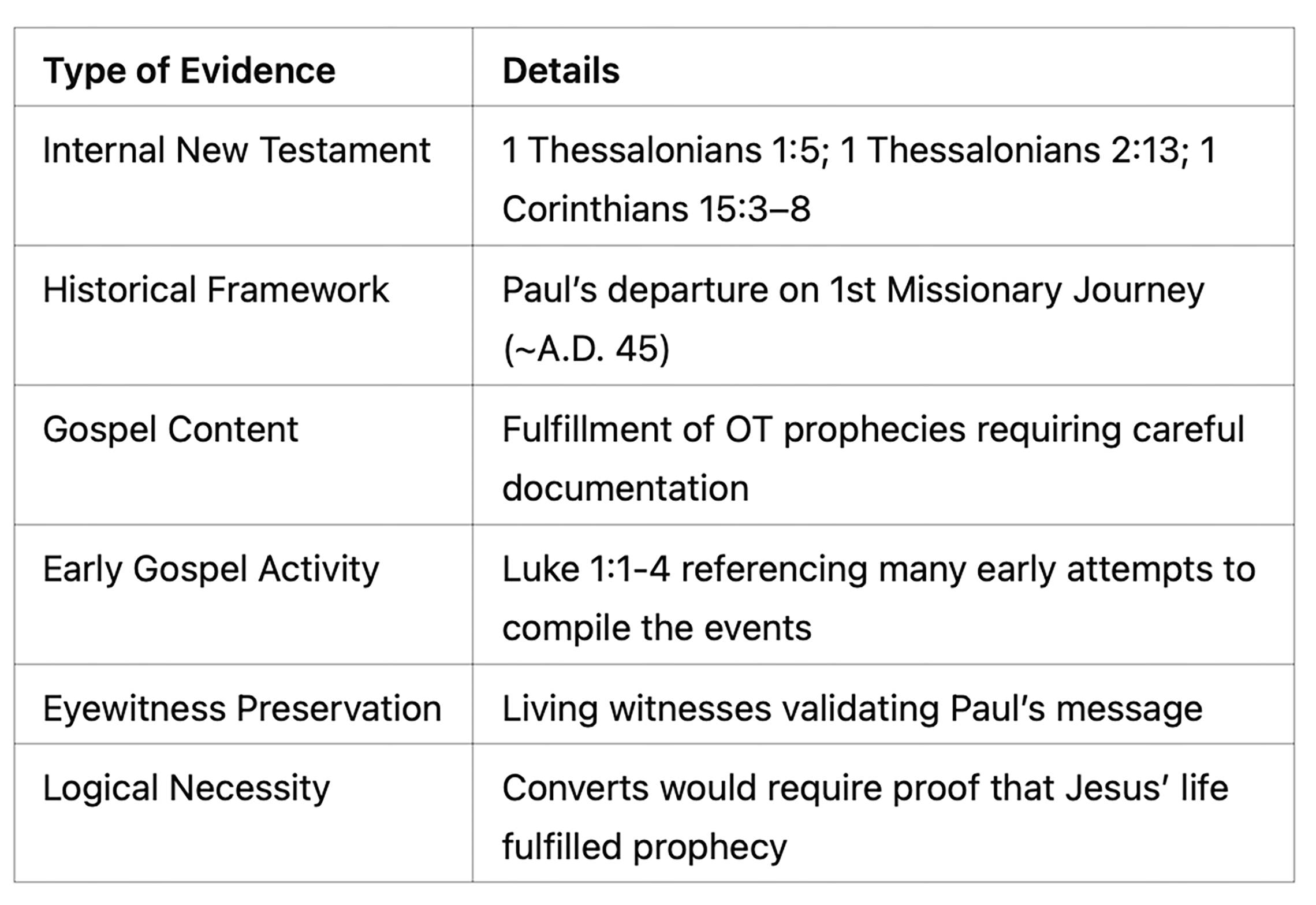
Chart Illustrating Early Writing of the New Testament Synoptic Gospels
Early Christian Writers Support Early Gospel Composition
Papias (c. 110 A.D.): Reported that Matthew compiled the sayings of Jesus in Hebrew/Aramaic early on, and Mark recorded Peter’s eyewitness testimony.
Clement of Rome (c. 95 A.D.): Shows familiarity with Jesus’ sayings, many of which align with the Synoptic tradition.
Ignatius of Antioch (c. 107 A.D.): References sayings of Jesus known from Matthew and Luke.
This early familiarity indicates Gospel records existed early enough to be widely recognized by the late first century — a trajectory that requires their existence long before 70 A.D., and supports your proposed dating near 44 A.D.
Paul could not have converted Asia Minor, Macedonia, and Greece without credible, detailed, eyewitness-supported testimony about Jesus — testimony that aligns with the content of the Synoptic Gospels, which therefore must have existed substantially by A.D. 44-45.
This is evidence that builds a case from internal, external, and logical evidence.
It is one of the strongest arguments for the early dating of the Gospels — and one that deserves far more attention in current scholarship.
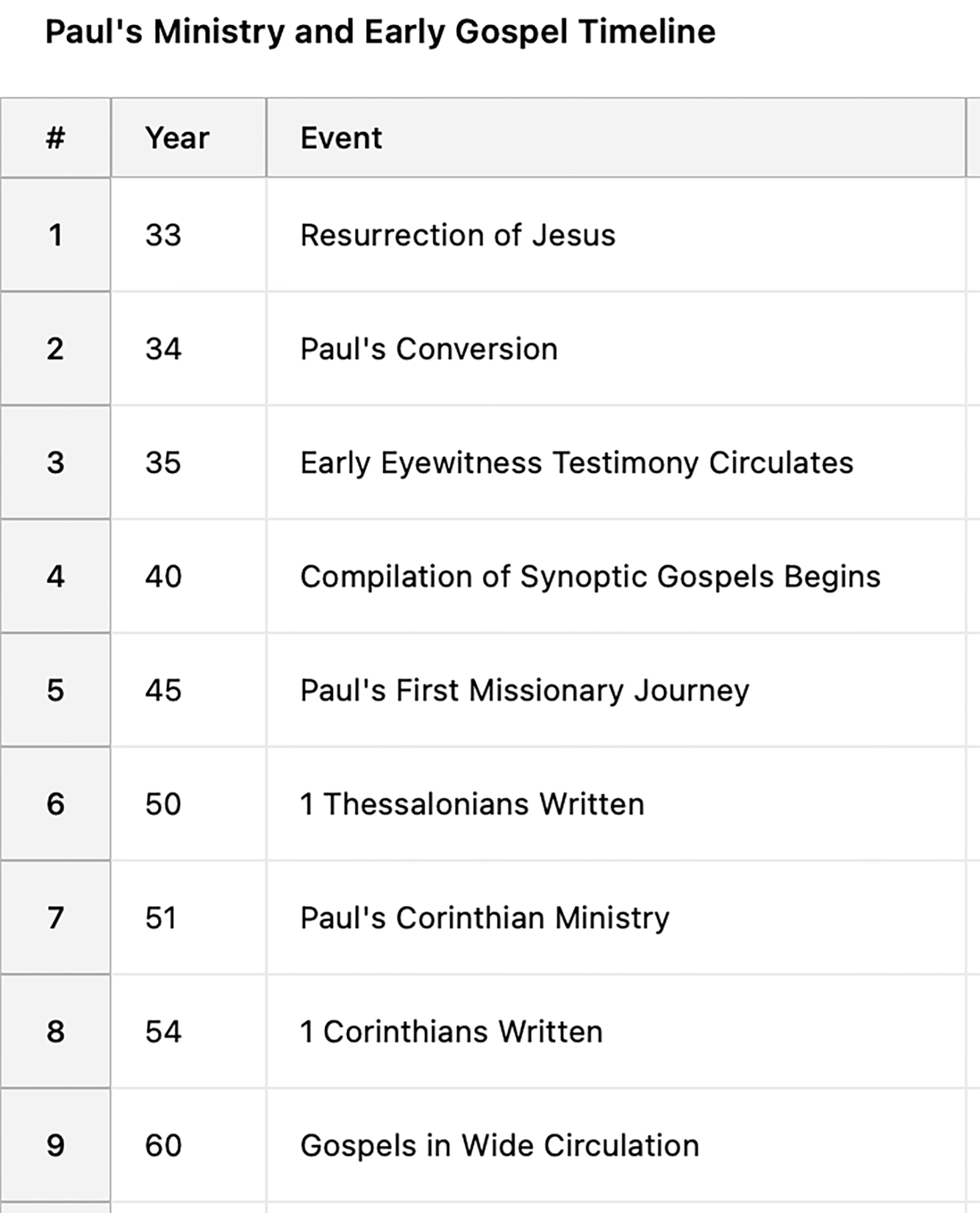
New Testament Timeline Illustrating Synoptic Gospel Early Writing
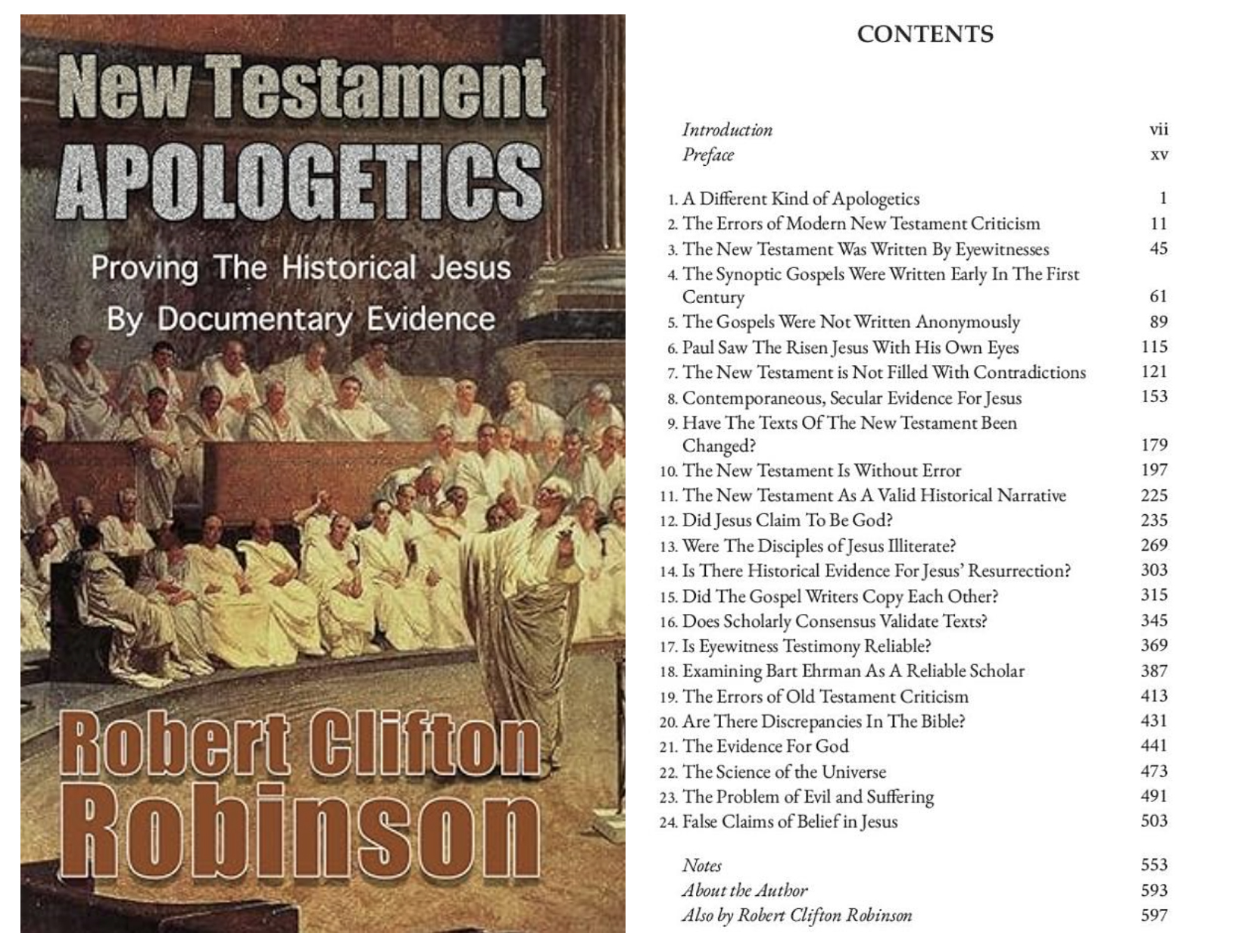
All of This Historical, Eyewitness Evidence, Is Documented In My New Book: “New Testament Apologetics.
For a Limited Time, “New Testament Apologetics,” is just .99 cents, as a Kindle eBook
- 203 Eyewitness Statements About Jesus In The New Testament
- Is The New Testament A Valid Historical Narrative?
- Paul Saw The Risen Jesus With His Own Eyes
Categories: Robert Clifton Robinson
 Robert Clifton Robinson
Chat GTP confirms it … check out this youtube short video.
LikeLike
As always, you make a strong, well-reasoned argument. Much appreciated, my friend.
LikeLiked by 1 person
Thank you, Mitch!
LikeLiked by 1 person