We live during a time when many untrained persons try to use the scriptures of the Bible to prove their ideology or agenda. These attempts are increasingly more visible in the Transgender and LGBTQ communites.
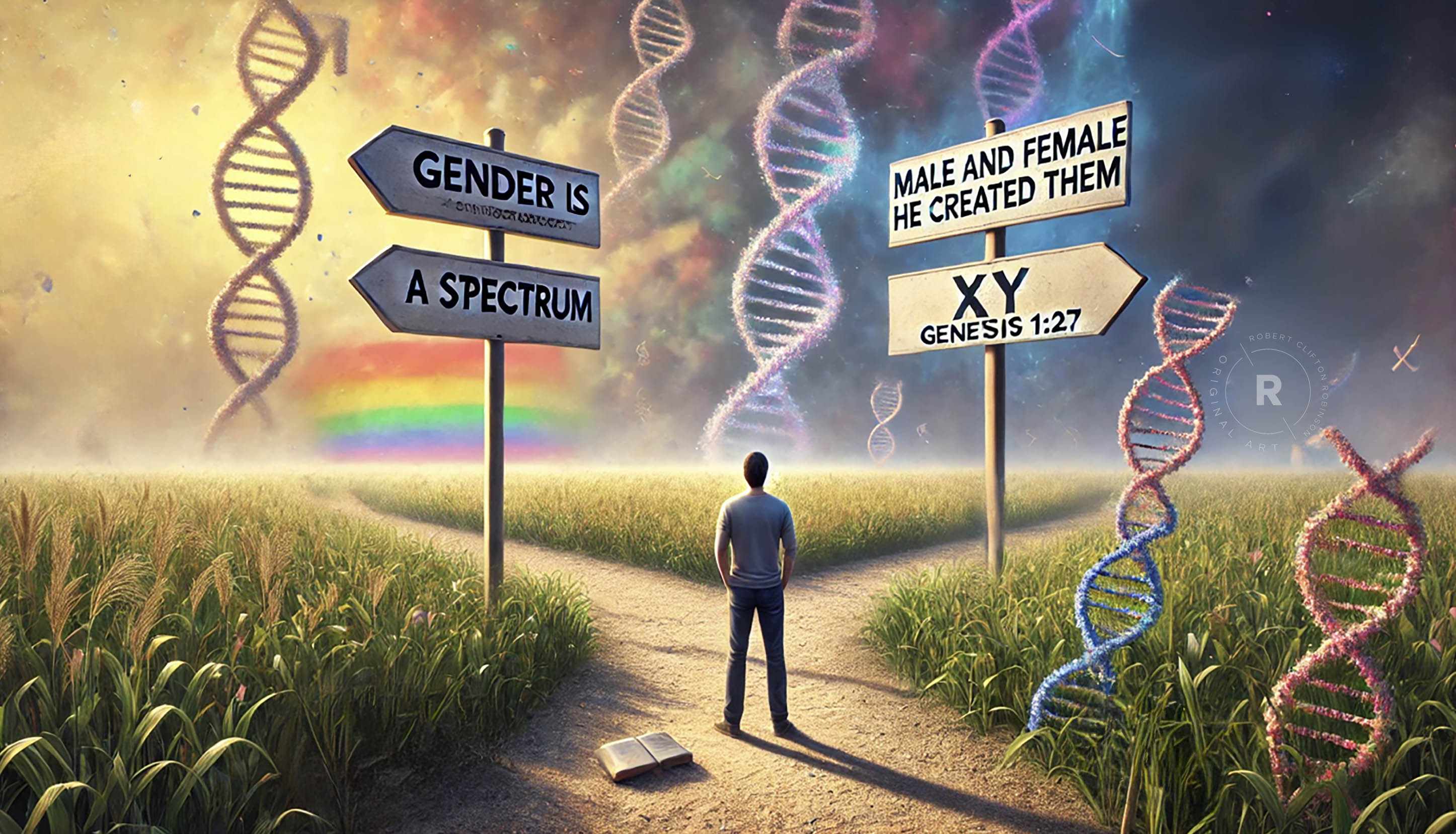
First Let’s Look At The Actual Biblical Texts That Advocates of Same-Sex, Transgender Persons Try To Use To Prove That “Intersex Persons” Exist, As Created by God
Matthew 19:1-12 : Jesus Describes Divorce and Marriage
1 When Jesus had finished saying these things, he left Galilee and went down to the region of Judea east of the Jordan River. 2 Large crowds followed him there, and he healed their sick.
3 Some Pharisees came and tried to trap him with this question: “Should a man be allowed to divorce his wife for just any reason?”
4 “Haven’t you read the Scriptures?” Jesus replied. “They record that from the beginning ‘God made them male and female.’” 5 And he said, “‘This explains why a man leaves his father and mother and is joined to his wife, and the two are united into one.’ 6 Since they are no longer two but one, let no one split apart what God has joined together.”
7 “Then why did Moses say in the law that a man could give his wife a written notice of divorce and send her away?” they asked.
8 Jesus replied, “Moses permitted divorce only as a concession to your hard hearts, but it was not what God had originally intended. 9 And I tell you this, whoever divorces his wife and marries someone else commits adultery—unless his wife has been unfaithful.”
10 Jesus’ disciples then said to him, “If this is the case, it is better not to marry!”
11 “Not everyone can accept this statement,” Jesus said. “Only those whom God helps. 12 Some are born as eunuchs, some have been made eunuchs by others, and some choose not to marry for the sake of the Kingdom of Heaven. Let anyone accept this who can.”
The specific scripture that is used to try and prove that Intersex persons exist, as created by God, is Matthew 19:12:
“Some are born as eunuchs, some have been made eunuchs by others, and some choose not to marry for the sake of the Kingdom of Heaven. Let anyone accept this who can.”
The key koine greek word used in this text, for “eunuch, is εὐνοῦχος (eunouchos) in Matthew 19:12 does not refer to an “intersex” individual but rather a male, either physically castrated or spiritually consecrated for the purpose of celibacy—to not marry, so that they might more fully dedicate themselves to the service of Christ:
Lexical Analysis:
The Greek word εὐνοῦχος (Strong’s 2135) has a well-documented semantic range:
- Literally: a castrated male, often used in the royal courts (e.g., Daniel 1:3 LXX; Esther 2:14–15 LXX).
- Figuratively: a man who chooses to abstain from marriage and sexual relations for the sake of God’s Kingdom.
The primary meaning is “alone in bed”, i.e., not engaging in sexual union, with emphasis on abstinence, not intersexuality.
Contextual Argument (Matthew 19:10–12):
The entire discourse is about celibacy versus marriage—not biological sex identity. Jesus outlines three types of eunuchs:
- Born: congenital physical defect, not intersexuality (likely impotence or sterility in males).
- Made: castrated by others (e.g., court officials).
- Voluntary: those who remain unmarried for the sake of the Kingdom of Heaven.
The third category clearly aligns with Paul’s teaching in 1 Corinthians 7:32–38, where voluntary celibacy is described as a spiritual decision to remove distractions in order to better serve the Lord.
Theological Assertion:
God does not make mistakes in assigning gender (cf. Genesis 1:27 – “male and female He created them”). The assertion that Jesus endorsed gender ambiguity or biological intersex identity from this text is both eisegetical and contradicted by the grammatical and historical evidence.
Paul’s Complementary Teaching (1 Cor. 7):
Paul confirms Jesus’ teaching by instructing that singleness can be a greater benefit for serving the Lord if one has the spiritual gift or discipline to maintain celibacy. This is a spiritual gift, not a physical condition or confusion of gender.
Historical-Linguistic Background:
εὐνοῦχος in classical Greek never refers to an intersex person. The term always describes a male (ἄρρην) either by biological designation or social function.
In the Septuagint (LXX), eunuchs are explicitly male and are involved in palace or harem service (e.g., 2 Kings 9:32; Jeremiah 38:7).
Isaiah 56:3–5 LXX Reference:
Jesus likely alludes to Isaiah 56:3–5, where God promises a name better than sons and daughters to eunuchs who keep His covenant:
“Let not the eunuch say, ‘Behold, I am a dry tree.’ For thus says the Lord… I will give them an everlasting name that shall not be cut off.”
This is not about gender ambiguity but about spiritual inclusion for those who devote themselves to God in celibacy.
Misuse by Modern Gender Activists:
People who cite Matthew 19:12 to support gender identity theory are guilty of category error—reading modern psychological or sociological constructs into ancient spiritual concepts.
Jesus is not validating a third gender; He is validating the self-denial of men who choose not to marry to serve God, consistent with the call to deny yourself (Luke 9:23).
Citation from The Early Christian Church
Origen, who voluntarily became a eunuch for the sake of celibacy (as some early sources state), interpreting this passage literally and spiritually—never as license for gender identity reassignment.
“The word εὐνοῦχος, as used by Jesus in Matthew 19:12, refers exclusively to males—either by birth condition, external force, or voluntary choice—who abstain from marriage and sexual relations. The term is never used in ancient Greek literature or Scripture to describe an ‘intersex’ person or to blur the lines of male and female identity. Jesus upholds the Genesis paradigm of male and female, and His point in Matthew 19 is not about biological ambiguity, but about spiritual dedication to God’s Kingdom through celibacy. Any modern reinterpretation of this text as support for gender fluidity is a misreading, disconnected from the historical, lexical, and theological context.”
The Transgender/LGBTQ Argument:
The generally stated premise of the transgender and LGBTQ community regarding intersex persons is that biological sex is not strictly binary (male or female), and the existence of intersex individuals is cited as evidence that gender identity and sex are not always aligned or clearly defined at birth. This premise is used to challenge traditional views of sex and gender and to support a broader, more fluid understanding of human identity.
Intersex People as Evidence Against Binary Sex
Claim: Not all humans are born clearly male or female.
Support: Intersex conditions (also called Differences in Sex Development or DSDs) involve atypical chromosomal, gonadal, or anatomical sex development, such as:
- Androgen Insensitivity Syndrome (AIS)
- Klinefelter Syndrome (XXY)
- Turner Syndrome (XO)
- 5-Alpha Reductase Deficiency
If Intersex individuals really were created by God, the argument is that biological sex is a spectrum, not a binary.
Assertion 1: Gender Identity Is Distinct from Biological Sex
The Claim: A person’s internal sense of gender (their identity) may not align with their biological or assigned sex at birth.
The Application to Intersex Persons As Valid:
Intersex individuals may be assigned a gender at birth that they later reject or feel never suited them. The Trans/LGBTQ community argues this experience validates the idea that gender identity is personal, psychological, and social, not purely biological.
The Broader Implication: If even biological sex can be ambiguous, then gender must be self-determined, not imposed.
Assertion 2: Intersex Conditions Are Natural, Not Abnormal
The Claim: Intersex traits are normal variations within human biology.
This challenges religious or traditional narratives that male and female are absolute, fixed categories. Some argue that the Genesis creation account (male and female) is incomplete or non-inclusive, based on intersex diversity.
Assertion 3: Medical Interventions Are Ethically Problematic
The Claim: Many intersex individuals have been subjected to surgical or hormonal interventions in infancy or childhood to make their bodies conform to male or female norms.
The LGBTQ and intersex advocacy communities argue that: These surgeries are often done without consent. They are based on social discomfort with ambiguity, not on medical necessity. The child should be allowed to develop their identity and make their own decisions later in life.
Assertion 4: Legal and Social Recognition
The Claim: Advocacy for a third gender category or non-binary recognition in law and social practice. Some countries (e.g., Germany, Australia, India) recognize a non-binary or third gender option in legal documents. The LGBTQ community sees this as a form of justice and recognition for intersex and gender-diverse individuals.
The Summary Statement of the LGBTQ Premise:
“Intersex individuals demonstrate that biological sex is not always binary. This reality supports the view that gender identity is diverse and deeply personal, and should be recognized as such by society, medicine, and law. No one should be forced into rigid categories of male or female, especially when their biology or identity doesn’t fit those molds.”
The Arguments That Disprove All of the Above Assertions by Trans/LGBTQ Advocates:
The assumptions made by the transgender and LGBTQ community regarding intersex individuals as proof that sex is not binary may seem persuasive on the surface, but they fail under careful scrutiny through scientific, medical, and logical analysis. Below is a comprehensive, point-by-point rebuttal of these assumptions:
FALSE CLAIM 1: “Intersex people prove that biological sex is not binary.”
❌ Why This Is Invalid:
Scientific Classification:
- Biological sex is defined by gametes:
- Males: produce small gametes (sperm).
- Females: produce large gametes (ova).
- This is a binary reproductive system, and it is fixed in all mammalian biology, including humans.
- Intersex individuals do not represent a third gamete type—thus, no third sex exists biologically.
Medical Understanding:
- Intersex conditions are disorders or variations of sex development (DSDs)—they are medical abnormalities (birth defects) affecting less than 0.018% of the population (according to Leonard Sax, Journal of Sex Research, 2002).
- These are deviations from the norm, not a third biological sex.
- Every intersex person is still genetically male (XY) or female (XX) in over 99.9% of cases—despite ambiguous genitalia or hormone imbalances.
The Logical Fallacy:
- Equivocation fallacy: Redefining “sex” to mean both biological sex and gender identity interchangeably.
- Just because a biological anomaly exists does not disprove the underlying binary classification.
- Analogy: Some people are born with six fingers. This does not refute the fact that humans are genetically structured to have five.
False CLAIM 2: “Intersex conditions show that sex is a spectrum, not binary.”
❌ Why This Is Invalid:
Statistical Outliers Don’t Redefine the Norm:
- Intersex individuals are biological exceptions, not a third category.
- In science, classification is determined by function, not form. Despite intersex variations, reproductive function remains binary (sperm or egg).
Sex ≠ Gender Identity:
- Intersex conditions are biological and diagnosable.
- Transgender identity is a psychological perception, not a biological condition.
- Using intersex individuals to validate subjective gender identities is a category error.
False CLAIM 3: “God made intersex people, so He must support non-binary identity.”
❌ Why This Is Invalid (Biblically and Theologically):
The Biblical Creation Order:
- Genesis 1:27: “Male and female He created them.”
- Jesus reaffirms this in Matthew 19:4.
Deviations from original creation (such as intersex) are the result of the Fall (Genesis 3)—not part of God’s perfect design.
Moral vs. Physical Conditions:
- Intersex conditions are physical disorders, not moral ones.
- Same-sex attraction or gender dysphoria are moral/spiritual issues involving volitional behavior, which is what Jesus addresses regarding eunuchs in Matthew 19:12.
False CLAIM 4: “Intersex people should determine their own identity.”
❌ Why This Is Invalid:
Identity Based on Objective Biology:
- Identity is not self-created; it is rooted in biological facts.
- Every nucleated cell in the body carries either XX or XY chromosomes, which are immutable and determine sex.
- Feelings may change, but biology doesn’t.
Psychological Issues Are Not Identity Foundations:
In medicine, we do not redefine the body to match the mind when someone has:
- Anorexia (they perceive themselves as overweight),
- Body Integrity Identity Disorder (they believe they should be amputated),
- Or other identity misalignments.
- Likewise, gender dysphoria should be treated psychologically, not surgically or hormonally.
False CLAIM 5: “Recognizing intersex persons justifies third-gender laws and LGBTQ identities.”
❌ Why This Is Invalid:
False Equivalence:
- Intersex conditions are not gender identities; they are biological anomalies.
- LGBTQ identities are based on self-perception or behavior, not anatomical structure.
- Therefore, using intersex people to validate LGBTQ+ ideology is misappropriation of a medical condition.
Ethical Misuse of Medical Conditions:
- Intersex advocacy groups (e.g., InterACT) have criticized LGBTQ groups for exploiting their condition to push gender ideology, which does not represent intersex realities.
SCIENTIFIC & MEDICAL SOURCES
Biological Sex Is Binary: “In humans, biological sex is determined by the type of gametes the individual is capable of producing: males produce small gametes (sperm), and females produce large gametes (ova).”
Citation: Stearns, Stephen C., and Rolf F. Hoekstra. Evolution: An Introduction. Oxford University Press, 2005.
“There is no third gamete type in human reproduction. Therefore, biological sex remains binary.”
Citation: Dawkins, Richard. The Selfish Gene. Oxford University Press, 1976 (see Chapter on Reproductive Strategies).
Intersex Conditions Do Not Invalidate the Binary: “The prevalence of true intersex conditions is estimated at about 0.018% of the population.”
Citation: Leonard Sax, “How Common is Intersex? A Response to Anne Fausto‐Sterling,” Journal of Sex Research 39, no. 3 (2002): 174–78.
https://doi.org/10.1080/00224490209552139
“DSDs [Disorders of Sex Development] are rare congenital conditions in which the development of chromosomal, gonadal, or anatomical sex is atypical… individuals are still classifiable as male or female for medical and biological purposes.”
Citation: Hughes, I. A. et al., “Consensus Statement on Management of Intersex Disorders,” Pediatrics 118, no. 2 (2006): e488–500.
https://doi.org/10.1542/peds.2006-0738
Chromosomal Sex Determines Biological Identity: “Every nucleated cell in the human body carries either XX or XY chromosomes (barring rare chromosomal abnormalities, which are pathological, not normative).”
Citation: Sadler, T. W. Langman’s Medical Embryology, 13th ed. Wolters Kluwer, 2015.
PSYCHOLOGICAL & LOGICAL ANALYSIS
Misuse of Intersex to Justify Transgenderism: “Transgenderism is not a biological condition; it is a psychological phenomenon involving gender dysphoria. Using intersex conditions to validate transgender identity is misleading.”
Citation: McHugh, Paul R., former Chief of Psychiatry at Johns Hopkins Hospital, “Transgender Surgery Isn’t the Solution,” Wall Street Journal, May 13, 2016.
https://www.wsj.com/articles/paul-mchugh-transgender-surgery-isnt-the-solution-1402615120
“The existence of anomalies does not redefine a category. If someone is born with six fingers, it does not mean humans have six fingers by design.”
Citation: This is a logical analogy rooted in Aristotelian category theory, affirmed in classical logic. See: Copi, Irving M., and Carl Cohen. Introduction to Logic, 14th ed. Pearson, 2010.
BIBLICAL & THEOLOGICAL SOURCES
God Created Male and Female (No Third Category): “So God created mankind in his own image… male and female He created them.” Scripture: Genesis 1:27 (ESV)
“Have you not read that He who created them from the beginning made them male and female?” Jesus: Matthew 19:4 (NLT)
The Fall Introduced Disorder into Creation: “Therefore, just as sin came into the world through one man, and death through sin, so death spread to all men because all sinned.” Scripture: Romans 5:12 (ESV)
“All of creation has been groaning… as in the pains of childbirth right up to the present time.” Scripture: Romans 8:22 (NLT)
Jesus on Eunuchs (Matthew 19:12): “Some are born as eunuchs, some have been made eunuchs by others, and some choose not to marry for the sake of the Kingdom of Heaven.” Scripture: Matthew 19:12 (NLT)
Lexical Source: Strong’s Greek 2135 (εὐνοῦχος): Properly means “castrated male,” but also used figuratively for a man who abstains from marriage and sexual relations to devote himself to God.
Citation: HELPS Word-Studies and Souter’s Lexicon.
ETHICAL ISSUES IN ADVOCACY
Intersex Advocacy Groups Criticize LGBTQ Misuse: “Intersex people are not transgender, yet we are often co-opted in that debate. Intersex conditions are biological; gender identity is psychological. They should not be conflated.”
Citation: Statement by InterACT Advocates for Intersex Youth, 2017
Categories: Robert Clifton Robinson
 Robert Clifton Robinson
Please see, "Guidelines For Debate," at the right-side menu. Post your comment or argument here: