People Have A Lot of Opinions About What Is Right Concerning Sexual Relationships. Jesus Said: One Man, One Woman, For Life.
When Jesus was asked about what is right concerning the intimacy of sexual relationships, He went back to the beginning of Creation when He created the Earth for human life. Jesus said that “From the beginning ‘God made them male and female. This explains why a man leaves his father and mother and is joined to his wife, and the two are united into one.’”

The Bible defines sexual immorality as any sexual activity that violates God’s moral standards, which are consistently expressed throughout both the Old and New Testaments. The Greek and Hebrew terms used—zanah (זָנָה) in the Old Testament and porneia (πορνεία) in the New Testament—broadly cover all sexual behavior outside of the divinely established covenant of marriage between one man and one woman.
How The Old Testament Defines Sexual Immorality
Hebrew Term: Zanah (זָנָה) — often translated as “to commit fornication,” “to be a harlot,” or “to be unfaithful.”

God’s covenant with Israel is often described using sexual language to depict faithfulness or betrayal (e.g., Israel’s idolatry portrayed as adultery – Ezekiel 16, Hosea 1–3).
How The New Testament Defines Sexual Immorality
New Testament Koine Greek Term: Porneia (πορνεία) — a broad term covering any sexual sin. It is the root for the English word “pornography” and originally referred to all illicit sexual activity.
What Jesus Said:
Matthew 5:27–28: “You have heard the commandment that says, ‘You must not commit adultery.’ But I say, anyone who even looks at a woman with lust has already committed adultery with her in his heart.”
Matthew 15:19: “For from the heart come evil thoughts, murder, adultery, all sexual immorality (porneia), theft, lying, and slander.”
Jesus equated internal lustful thoughts with sexual immorality, expanding the Law to include inner moral purity.
What Hebrew Scholar, Paul, Said:
Paul clearly defines and condemns sexual immorality:
1 Corinthians 6:9–10: “Don’t you realize that those who do wrong will not inherit the Kingdom of God? Don’t fool yourselves. Those who indulge in sexual sin (porneia), or who worship idols, or commit adultery, or are male prostitutes, or practice homosexuality…”
1 Corinthians 6:18: “Run from sexual sin! No other sin so clearly affects the body as this one does.”
Galatians 5:19–21: “When you follow the desires of your sinful nature, the results are very clear: sexual immorality (porneia), impurity, lustful pleasures…”
Ephesians 5:3: “Let there be no sexual immorality (porneia), impurity, or greed among you. Such sins have no place among God’s people.”
How The Book of Revelation Defines Sexual Immorality
Revelation 21:8 : “But cowards, unbelievers, the corrupt, murderers, the immoral (pornoi), those who practice witchcraft… their fate is in the fiery lake of burning sulfur.”
THE BIBLICAL STANDARD FOR SEXUALITY
Sexual purity is defined and protected by the covenant of marriage:
Genesis 2:24: “This explains why a man leaves his father and mother and is joined to his wife, and the two are united into one.”
Matthew 19:4-6: Jesus Restates What Moses Wrote In Genesis 2:24 “Haven’t you read the Scriptures?” Jesus replied. “They record that from the beginning ‘God made them male and female.’” And he said, “‘This explains why a man leaves his father and mother and is joined to his wife, and the two are united into one.’ Since they are no longer two but one, let no one split apart what God has joined together.”
Hebrews 13:4: “Give honor to marriage, and remain faithful to one another in marriage. God will surely judge people who are immoral and those who commit adultery.”
Sexual Immorality in the Bible describes any sexual behavior outside the marriage covenant as defined by God — one man and one woman in a lifelong union of marriage (Genesis 2:24; Matthew 19:4–6). This includes:
- Adultery
- Fornication
- Homosexual behavior
- Incest
- Bestiality
- Lustful intent
- Prostitution
- Pornography (by extension in modern application)
It is consistently condemned in both Testaments as a violation of holiness and covenant relationship with God.
The New Progressive Church Has A Different Definition For Old And New Testament Sins
It is a common claim in progressive churches that Old Testament laws concerning sexual sin no longer apply under the New Covenant. Laws such as those that specify the mixing of fabrics or dietary laws, are used as a central premise in modern progressive Christian theology. However, this claim reflects a serious misunderstanding—or a deliberate misrepresentation—of how biblical law is fulfilled, reaffirmed, or abrogated in the New Testament.
THE PROGRESSIVE CLAIM
“Old Testament laws on sexuality (like prohibitions against homosexuality, adultery, or fornication) are no longer binding under the New Covenant, just like dietary restrictions or the prohibition against mixing fabrics. Jesus fulfilled the Law, and we are no longer under legalism.” —The Progressive Church
This Biblical Texts Cited By Progressives As Examples of Conflict
- Leviticus 19:19 (mixed fabrics)
- Leviticus 11 (kosher food laws)
- Colossians 2:16–17 (“Don’t let anyone condemn you for what you eat or drink…”)
- Galatians 5:1 (“Christ has set us free from the law…”)
THE BIBLICAL RESPONSE: RIGHTLY DIVIDING THE LAW
The Bible distinguishes between three categories of Mosaic Law:
 The command to not wear mixed fabrics or eat pork falls under ceremonial law—ritual laws tied to Israel’s covenant identity and temple worship.
By contrast, sexual prohibitions—such as in Leviticus 18 and 20—are moral laws. These are grounded in creation design (Genesis 1–2), and they are reaffirmed verbatim in the New Testament.
THE EVIDENCE THAT SEXUAL MORALITY CARRIES OVER TO THE NEW TESTAMENT
The Old Testament Moral Laws That Are Reaffirmed by Jesus and Paul
Adultery, fornication, homosexuality, and lust are all explicitly condemned in the NT:
- Matthew 5:28 – lust = adultery of the heart
- 1 Corinthians 6:9–10 – porneia, adultery, homosexuality
- Romans 1:26–27 – unnatural sexual relations, both male and female
- Ephesians 5:3 – “not even a hint of sexual immorality”
These laws are not tied to ritual purity or temple worship, but to God’s unchanging moral nature.
Jesus Fulfilled, Not Abolished the Moral Law
Matthew 5:17–18: “Don’t misunderstand why I have come. I did not come to abolish the law of Moses or the writings of the prophets. No, I came to accomplish their purpose.”
Jesus fulfilled the sacrificial system, but never relaxed the moral standards. Instead, He magnifies them—bringing them to their real issue, what is in the heart (e.g., lust, hate = murder).
Acts 15: Documents That Sexual Immorality Is Still Prohibited In The New Testament
At the Jerusalem Council (Acts 15), the apostles decided Gentile believers were not bound to ceremonial laws (e.g., circumcision, kosher laws), but they were bound to four essential commands, one of which was:
“Abstain from sexual immorality” (porneia) – Acts 15:20, 29
This demonstrates a clear apostolic distinction between ritual and moral law, with sexual immorality still forbidden for all believers.
LEVITICUS 18 AS ETERNAL MORAL LAW
Leviticus 18 lists sexual sins including:
- Incest
- Adultery
- Homosexual acts (v. 22)
- Bestiality (v. 23)
Then God gives this warning:
Leviticus 18:24–25: “Do not defile yourselves in any of these ways, for the people I am driving out before you have defiled themselves in all these ways. That is why the land is detestable…”
God judged pagan nations for these acts long before the Law of Moses, showing these are universal moral laws, not ritual Israelite customs.
PAUL AFFIRMS CREATION-BASED SEXUAL ETHICS
Romans 1:26–27 condemns homosexual behavior by grounding his argument in creation order—not Mosaic law:
“Even their women turned against the natural way to have sex and instead indulged in sex with each other… And the men, instead of having normal sexual relations with women, burned with lust for each other.”
This demonstrates Paul’s ethic is rooted not in Levitical ritual, but in God’s design for male-female union in Genesis 2:24.
THE FALSE COMPARISON: Mixed Fabrics vs. Moral Law
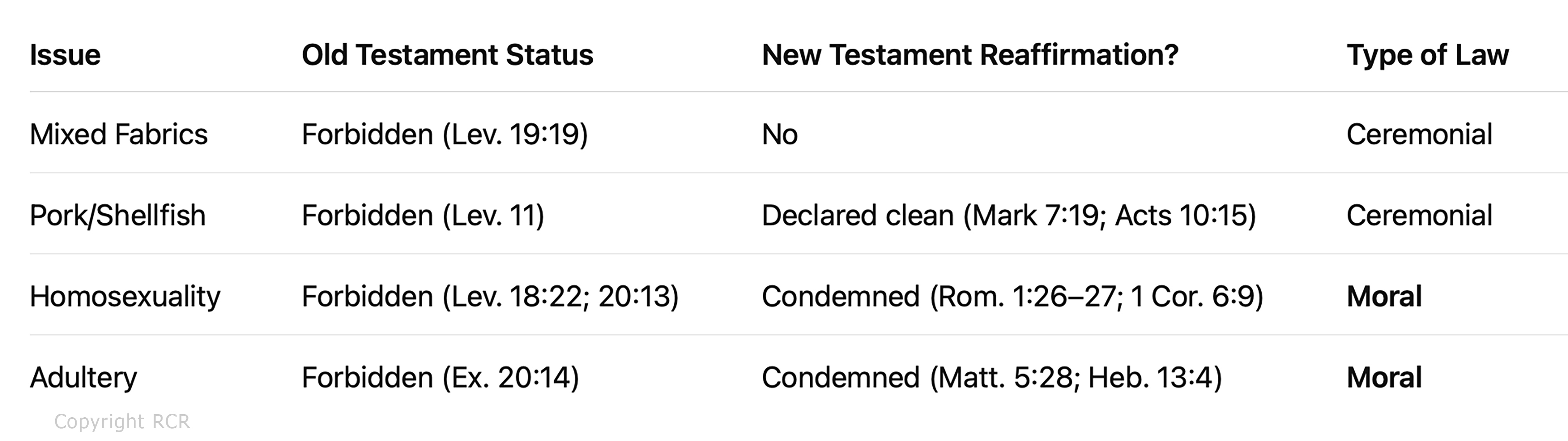
Progressive churches that dismiss Old Testament sexual ethics on the same grounds as dietary or clothing laws commit a category error.
- The ceremonial and civil laws were for Israel’s covenant identity and were fulfilled in Christ (Col. 2:16–17; Hebrews 10).
- The moral laws, especially concerning sexuality, reflect God’s unchanging character and are reaffirmed across the New Testament.
Sexual immorality (porneia) is condemned in both Old and New Testaments as sin against God, rooted in the moral law and creation design, not in obsolete ritual laws.
- It Was Jesus Who Destroyed Sodom And Gomorrah
- Translators Of The Early Koine Greek Texts Of The New Testament, Understood That Jesus Was Yahweh/Jehovah Of The Old Testament
- How The LGBTQ Movement Created The Progressive Christian Church
- Impeaching The Assertion That Homosexuality Did Not Exist In The Bible Until 1946
- Can Matthew Chapter 19 Be Used To Prove “Intersex” Individuals Exist?
Categories: Robert Clifton Robinson
 Robert Clifton Robinson
This is such timely information. Thank you Lord for having our brother, Pastor Rob, continue giving us these gentle reminders.
LikeLike