In Just Six Months, President Donald Trump Has Achieved More Global Success Than Anyone In The History Of The World

This essay presents a documented summary of President Trump’s achievements and actions during the first six months of his second term (January 20 – July 20, 2025). Disclaimer: I am not endorsing President Trump or writing this essay to promote President Trump. I am a writer who documents current events and their relationship to the the Prophecies of the Bible for the Last Days.
The Prophet Daniel Presents Us With Clear Descriptions of a World Ruler in the Last Days Who Will Preside Over Seven Years of Global Tribulation
“Then he shall confirm a covenant with many for one week (7 years); But in the middle of the week He shall bring an end to sacrifice and offering. And on the wing of abominations shall be one who makes desolate, Even until the consummation, which is determined, Is poured out on the desolate.” (Daniel 9:27 )
The Prophet Daniel was sent specifically to the Jews and the Nation of Israel. His prophecies were given to him by the angel Gabriel who has been appointed by the God of the Bible to announce, reveal, and describe Jesus, the Messiah.
In Daniel Chapter 9, Gabriel tells him the exact day that the Messiah will ride into Jerusalem and be proclaimed the Messiah. This date was April 6, 32 AD (Nissan 10). On that day Jesus commanded His disciples to go to a nearby village and get the foal of a donkey. Jesus rode this young donkey into Jerusalem on the precise day that Gabriel told Daniel the Messiah would arrive. Jesus also fulfilled the prophecies of Zechariah 9:9, the Messiah coming humbly on the foal of a donkey, and David’s prophecy in Psalms 118 of “The Day the Lord Made,” when the Messiah would come suddenly to His temple and be proclaimed the Messiah that God promised.
Daniel was also given details about the Four Global Empires that would exist on earth, before the Messiah returns from heaven to establish His righteous kingdom on earth for a thousand years.
Daniel saw Nebuchadnezzar, the Lion, ferocious, vicious, conquering the world and establishing his kingdom. Cyrus, the Bear, who was the most powerful of all the empires (Daniel 7:5), and Alexander the Great, the Leopard, who conquered the world quicker than any ruler before Him. The fourth kingdom, the Roman Empire that existed during the time Jesus arrived on earth.
Daniel 7:2-14 Daniel spoke, saying, “I saw in my vision by night, and behold, the four winds of heaven were stirring up the Great Sea. 3 And four great beasts came up from the sea, each different from the other. 4 The first was like a lion, and had eagle’s wings. I watched till its wings were plucked off; and it was lifted up from the earth and made to stand on two feet like a man, and a man’s heart was given to it.
5 “And suddenly another beast, a second, like a bear. It was raised up on one side, and had three ribs in its mouth between its teeth. And they said thus to it: ‘Arise, devour much flesh!’
6 “After this I looked, and there was another, like a leopard, which had on its back four wings of a bird. The beast also had four heads, and dominion was given to it.
7 “After this I saw in the night visions, and behold, a fourth beast, dreadful and terrible, exceedingly strong. It had huge iron teeth; it was devouring, breaking in pieces, and trampling the residue with its feet. It was different from all the beasts that were before it, and it had ten horns. 8 I was considering the horns, and there was another horn, a little one, coming up among them, before whom three of the first horns were plucked out by the roots. And there, in this horn, were eyes like the eyes of a man, and a mouth speaking pompous words.
Vision of the Ancient of Days
9 “I watched till thrones were put in place,
And the Ancient of Days was seated;
His garment was white as snow,
And the hair of His head was like pure wool.
His throne was a fiery flame,
Its wheels a burning fire;
10 A fiery stream issued
And came forth from before Him.
A thousand thousands ministered to Him;
Ten thousand times ten thousand stood before Him.
The court was seated,
And the books were opened.
11 “I watched then because of the sound of the pompous words which the horn was speaking; I watched till the beast was slain, and its body destroyed and given to the burning flame. 12 As for the rest of the beasts, they had their dominion taken away, yet their lives were prolonged for a season and a time.
13 “I was watching in the night visions,
And behold, One like the Son of Man,
Coming with the clouds of heaven!
He came to the Ancient of Days,
And they brought Him near before Him.
14 Then to Him was given dominion and glory and a kingdom,
That all peoples, nations, and languages should serve Him.
His dominion is an everlasting dominion,
Which shall not pass away,
And His kingdom the one
Which shall not be destroyed.
Daniel was told that when the final world ruler comes onto the scene he will have all of the attributes of the first three rulers:
- Nebuchadnezzar: A Lion, conquering in pride and arrogance
- Cyrus: A Bear, powerful in subduing kingdoms
- Alexander: A Leopard, Speed and deception, swift rise to power; deceitful diplomacy
- The Roman Emperors, Exceedingly strong, trampling and conquering world leaders
Daniel also saw an immense statue with a Head of Gold, Arms and Chest of Silver, Legs and Thighs of Bronze. These three were the same three world-empires that were represented by the Lion, Bear, and Leopard.
This great image that Nebuchadnezzar saw in his dream was an illustration of the four Gentile kingdoms of the world that would be present during the Times of the Gentiles. Head of Gold, Chest and Arms of Silver, Belly and Thighs of Bronze, Legs of Iron, Feet partly of Iron and Clay:
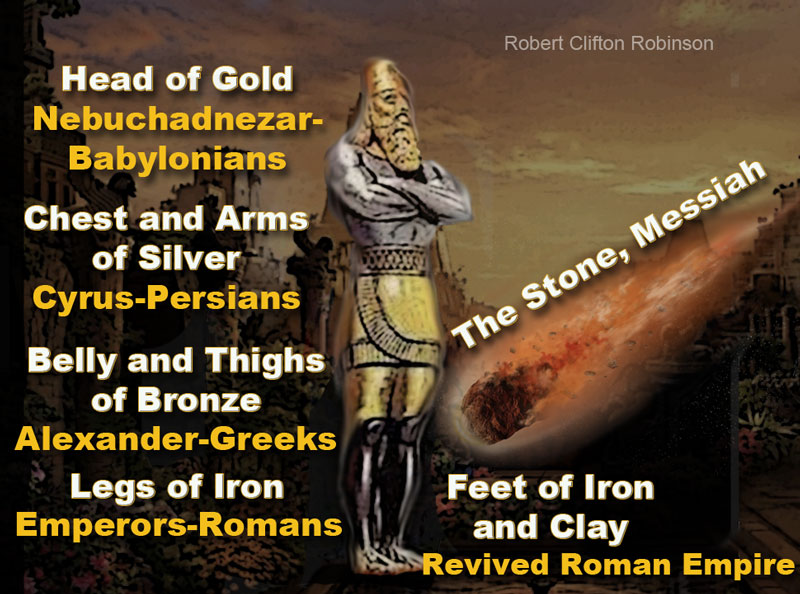
Chapter 2 of Daniel reveals these four Gentile kingdoms, from a human point of view, as a great statue. Chapter 7 describes the same four Gentile kingdoms, from God’s point of view, as four vicious beasts.

The final kingdom that comes into the world will be in the Last days just before the Messiah returns to establish His kingdom. This kingdom will be ruled by a man who his like Nebuchadnezzar, Cyrus, and Alexander, but even more powerful. The Roman Emperors who compelled the leaders of the world to obey them.
- Conquering in pride and arrogance
- Powerful in subduing kingdoms
- Speed and deception, swift rise to power; deceitful diplomacy
- Subduing Global Leaders and compelling them to do his will
This final ruler will oversee a Global kingdom that will start by the signing of a Peace Treaty between Israel and many nations (Daniel 9:27). This final ruler will not be known to the world until after Jesus removes His church (believers) from the Earth at the event described by Hebrew Scholar, Paul, in 1 Thessalonians 4:13-18.
In Paul’s second letter: 2 Thessalonians 2:2, he describes this final world ruler as unknown and unable to reveal himself to the world until after, “that which hinders, is taken out of the way.” Right now the Holy Spirit working through Jesus’ Church, as the power holding back the final ruler from being revealed to the world.
Daniel also said that those who know Jesus, people who are born again by the Spirit of God (John 3:3—Jesus’ church), they will be wise and understand who this global leader is, before he is revealed to the world at the Rapture of Jesus’ church.
Daniel 12:9-10 And Gabriel said, “Go your way, Daniel, for the words are closed up and sealed till the time of the end. Many shall be purified, made white, and refined, but the wicked shall do wickedly; and none of the wicked shall understand, but the wise shall understand.
Today we are seeing a man who has all of the attributes of Nebuchadnezzar, Cyrus, Alexander and the Caesars. He is accomplishing incredible works that are hard to comprehend in their swiftness and power. The world is wondering after this man, “who is like him, and who is able to make war with him?”
These are the precise words of Revelation chapter 13 in describing this final world ruler during the last three and a half years of the Great Tribulation.
Revelation 13:1-5 “Then I stood on the sand of the sea. And I saw a beast rising up out of the sea, having seven heads and ten horns, and on his horns ten crowns, and on his heads a blasphemous name. 2 Now the beast which I saw was like a leopard, his feet were like the feet of a bear, and his mouth like the mouth of a lion. The dragon (satan) gave him his power, his throne, and great authority. 3 And I saw one of his heads as if it had been mortally wounded (assassination attempt), and his deadly wound was healed. And all the world marveled and followed the beast. 4 So they worshiped the dragon who gave authority to the beast; and they worshiped the beast, saying, “Who is like the beast? Who is able to make war with him?”
5 And he was given a mouth speaking great things and blasphemies, and he was given authority to continue for forty-two months (3 1/2 years).”
This Essay Is About The Incredible Accomplishments of President Donald Trump, in Just 6 Months.
I don’t know if President Trump is this final world ruler, but he is certainly accomplishing all of the things required by this man that Daniel predicted.
Today President Trump is not known to the world as anything more that a great leader who is powerful in making peace, negotiating with foreign leaders, financial prowess, military prowess, a political conqueror, and very proud and boastful. Is it a mere coincidence that these are the same six attributes that Gabriel told Daniel the final world ruler would have?
I don’t know, we will have to wait and see…
Who is this world-ruler that Gabriel told Daniel about? No one knows. We do know what the Bible says about this man and what his attributes will be. Do we see anyone on earth today who exhibits the attributes of the final world-ruler?
- He will be a peacemaker.
- He will be a master negotiator.
- He will be a financial genius.
- He will be a military genius.
- He will be a political genius.
- He will be boastful and arrogant.
If this final world-ruler is among us now and be performing the good works that are predicted for this man (listed above), those of us who believe the Bible, will see him even before the world knows him.
If this world-ruler is already here, yet unknown to the world, the arrival of Jesus to remove His church, must be very close. In my new book: “Days of Wrath: The Final Sign,” I detail these three events and their proximity to Jesus’ arrival for His church.
- Rosh Hashanah, the Feast of Trumpets, September 22-24
- Introduction of the world-ruler and the beginning of the Tribulation.
- “A Mountain Burning With Fire,” described by Revelation 8:6 when the Second Trumpet is sounded, fulfilled by an approaching asteroid on April 13, 2029, the exact mid-point of the Seven Year Tribulation.

Click on the Image to Look Inside the Book
The Scriptures of the Bible indicate that satan does not indwell the world-ruler from the beginning, but rather enters him at a specific moment in time — at the midpoint of the Tribulation, after the world-ruler receives a fatal wound and is resurrected. This moment marks a dramatic shift in the world-ruler’s role and character.
Before the world-ruler is revealed to the world, he will already be exhibiting the first six attributes listed here in this essay
This essay postulates that as we look around the world and examine history, there is now, and has been, only one person in history, who has the world dominating power and presence that we see today in Presiden Donald Trump.
I am not saying that President Trump is this world-ruler, only that he is unique among every man born on earth, in that he has already fulfilled all 6 of the first requirements for the world-ruler described by Daniel. When you examine the events that President Trump has accomplished already in just 6 months, it make him a primary person to watch in consideration of the world-ruler described by Daniel and Jesus.
Let’s Examine What President Trump Has Accomplished Already In Just 6 Months
Executive / Political & Legislative Action
- Record-breaking executive orders: Signed 163 executive orders in just over five months — more than Biden managed across his full four‑year term — and more than 170 within 100 days, dramatically reshaping federal policy—especially immigration, trade, and civil rights.
- Department of Government Efficiency (DOGE): Created on his first day via executive order to reduce federal waste, led by Elon Musk. The initiative has cut over 67,000 federal jobs and abolished agencies like USAID and CFPB.
- Regulatory reform and deregulation: The administration asserted that deregulation saved U.S. families roughly $180 billion, averaging $2,100 per family in projected savings over four years.
- Tax cuts and “One Big Beautiful Bill”: Major tax reform made previous Trump tax cuts permanent and authorized $170 billion for border enforcement. Medicaid funding was reduced, and up to 11 million may lose coverage over the next decade.
Economy
- Economic resilience: Despite aggressive policies such as tariffs and deportations, key indicators like job growth, inflation (≈2.7 %), corporate earnings, and unemployment (~4.1 %) remained stronger than expected. GDP fell in Q1 but Q2 shows 2.4 % growth.
- Stock market: U.S. equity indices rebounded and reached record highs, despite volatility and dollar depreciation to its worst level since 1973.
- Massive private investment: Secured $500 billion in private investment for a large-scale AI infrastructure project, with backing from Softbank, Oracle’s Ellison, and OpenAI leadership.
Immigration & Border Policy
- Laken Riley Act (January 29, 2025): First legislative act of the term, mandates detention of undocumented immigrants charged with serious crimes and allows states to sue the federal government over immigration enforcement failures.
- Mass deportations & expanded enforcement: Reports include 37,660 deportations in January alone, claimed 90 % drop in illegal border crossings, and executive orders removing protections (e.g., in sensitive locations, birthright citizenship). Multiple court challenges followed.
Diplomacy & International Affairs
- Negotiated peace deal — DRC & Rwanda: On June 27, brokered a peace agreement in the White House between DRC and Rwanda, ending a 30+ year conflict and yielding U.S. access to mineral rights.
- Ceasefire in Yemen with Houthis: After U.S. airstrikes in March, confirmed a ceasefire in May to reduce shipping threats in the Red Sea.
- Middle East diplomacy: Announced lifting of sanctions on Syria and engaged in normalization talks. Brief ceasefire between Israel and Iran was brokered in late June.
- Trade and summit diplomacy: Secured tariffs on goods from Mexico, Canada, and China, met with G7 leaders in Canada, and signed a UK–US trade order reducing bilateral tariffs. Also secured a strategic energy and defense deal with Saudi Arabia and a Boeing jet purchase from Qatar Airways ($160 billion order).
Military / Security Moves
- Airstrikes & force posture: Ordered U.S. strikes on Houthi positions in Yemen (March) and reportedly ordered strikes on Iranian nuclear sites (June 21) in response to escalating tensions; simultaneously signaled restraint by vetoing plots to kill Iran’s leader.
- Prepared military options for Panama Canal access: Directed Pentagon to develop military options and asserted intent to “reclaim” control if necessary.
- Federalizing National Guard in California: Deployed 2,000 troops to L.A. amid protests over immigration raids — first federal National Guard activation without governor consent since 1965.
Peace, Prevention & Unity of Leaders
- Ending / preventing wars: Claims of cease-fires in Yemen, Israel‑Iran tensions, and mediation efforts around India–Pakistan and Syria; however, longer-term peace outcomes remain unresolved and controversial.
- Uniting leaders: Hosted foreign leaders (e.g. Modi, Ramaphosa, Merz, Starmer), attended G7 summit, conducted bilateral diplomacy with Saudi, Qatar, UAE, UK, Germany, Canada, Vatican. These efforts were positioned as restoring U.S. global leadership and forging new alliances.

Summary by Category
The following is a chronological timeline, covering January 20 to July 20, 2025, of the key actions, initiatives, and claimed successes of President Donald J. Trump’s second term. Events are grouped by area—economic, military/security, diplomacy, political/executive—and note whether they align with your interest in peace, war prevention, and uniting leaders.

Timeline: January 20 – July 20, 2025
January 20–31: Inauguration & Executive Launch
Jan 20: Inaugurated as 47th U.S. President. Issued pardons commuting ~1,500 January 6 defendants, and granted clemency to Ross Ulbricht and anti‑abortion protestors.
Signed a record-setting slot of executive orders (~26 in one day), including reinstating national emergency at southern border; designating Cuba a state sponsor of terrorism; pausing WHO and Paris Accords; revoking DEI mandates; banning federal censorship; restructuring agencies; and founding the Department of Government Efficiency (DOGE).
By Jan 22–23, revoked Baker‑Era guidance protecting migrants in “sensitive” areas, fired dozens of independent inspectors-general and agency officials, and froze federal hiring/rules under DOGE.
Jan 29: Enacted the Laken Riley Act, first legislative victory: mandates immigrant detention and allows state lawsuits against federal enforcement failures; also expanded Guantanamo migrant center capacity.
February: Border Crackdown & Trade Threats
Border enforcement escalated: ICE arrests, expanded powers, claims of ~90% drop in illegal crossings, ~37,660 deportations in first month, and daily deport quotas; announced “$5M Gold Card” visa program for wealthy immigrants.
Trade initiatives: Threatened sweeping tariffs on China, Canada, and Mexico; paused NAFTA‑adjacent tariffs temporarily, then imposed 25% on Canada/Mexico and 10–20% on China. Set up External Revenue Service to collect tariff taxes.
March: Military Posture & Ceasefire Moves
Ordered U.S. airstrikes on Houthi targets in Yemen, aiming to protect Red Sea shipping; negotiations later led to a ceasefire in May.
Engaged in diplomatic letters with Iran’s Supreme Leader threatening military action if nuclear talks did not advance; resumed “maximum pressure” policy.
Pentagon directed to present military options to secure U.S. access to the Panama Canal.
Dismissals continued—federal employees dismissed in defiance of statutory protections, prompting lawsuits and injunctions;
April–May: Trade Deals & Ceasefires
May 12: Announced a 90‑day trade accord with China — U.S. tariffs cut to ~30%; Chinese tariffs reduced to ~10%. Markets spiked on optimism.
**May ~**: Houthis ceasefire declared, ending attacks on shipping lanes in Red Sea.
U.S.–EU trade framework announced in late July: a 15% tariff rate on EU exports (down from proposed 30%), coupled with $750B in EU spending on U.S. energy/military goods—calling it the “biggest ever” transatlantic trade deal.
May 30: Raised steel tariffs to 50%; approved Nippon Steel’s acquisition of U.S. Steel under restrictive terms.
Trade‑policy review launched under Section 232, including semiconductors, copper, lumber; findings set for release soon in late July .
May–June: Domestic Agenda & Military Display
Education & DOJ policies: DEI programs eliminated, Title IX and VI reinterpretations, civil‑rights enforcement adjustments across K‑12 and universities.
June 14: U.S. Army’s 250th Anniversary military parade in Washington, D.C.; simultaneous nationwide “No Kings” protests. A major show of strength and controversy.
In June, National Guard deployed in Los Angeles for immigration-related protests; federal troops used in domestic enforcement for first time since 1965 without state consent.
July (up to July 20): Celebrating the First Half
July 20: White House declares this the most successful first six months of any modern presidency, citing legislative and executive successes across policy domains.
Economic metrics: Q1 GDP slight dip, Q2 growth projected 2.4%, unemployment ~4.1%, inflation ~2.7%; stock market hits record highs; toll from tariffs and policy disruption may yet materialize.
Bill O’Reilly (Fox affiliate) awarded Trump high grades (A) for border enforcement and military posturing, but lower marks (C/D) on Ukraine and Gaza conflicts.⸻
The Bottom Line
Economic Significance:
Implemented sweeping tariffs and trade policies; negotiated China and EU trade agreements; major tax and deregulation agenda claiming cost savings.
Economic indicators remained resilient: modest inflation, low unemployment, positive GDP growth in Q2, stock market highs.
Political / Executive Significance
Over 50+ executive orders on day‑one and within first 100 days reshaped government structure, dismantled DEI, froze federal hiring, pardoned political figures, reorganized agencies, enacted sweeping immigration and climate policy reversals.
Legislation: Laken Riley Act as term’s first major law.
Immigration / Border: Laken Riley Act enforcement, national emergency declarations, mass deportations, removal authority expansion, ending birthright citizenship guidance, federal deployment to border states, border crossings claimed to drop ~90% early on.
Security / Military: Airstrikes against Houthi rebels, strategic pressure on Iran, military planning for Panama Canal access, National Guard domestic deployment, public military parade in June.
Diplomacy / Peace / Preventing Wars: Brokered Yemen (Houthi) ceasefire, lifted or softened tariffs with China/EU to avert economic escalation, major transatlantic trade pact with EU, attempted diplomacy with Russia–Ukraine and Iran, though results remain uncertain.
Uniting Leaders: Hosted and engaged key global figures—G7 meetings, EU Commission President von der Leyen, Saudi/Qatar leadership, UK counterparts. Promoted U.S. leadership as broker of trade and peace.
Ending or Preventing Wars: Yemen ceasefire may have ended active shipping attacks: Iran and Israel conflict temporarily paused; talks initiated with Asia conflict parties; long‑term resolution remains elusive.
This timeline reflects documented events and claims supported by official releases and media reporting (e.g. FT, Reuters, White House), whether reflected by Fox‑aligned commentary or independent sources.
The following is a documented overview of President Trump’s major legal victories (January–July 2025), covering: District court injunction battles, Supreme Court decisions, Congressional wins and State/local rulings
While the administration has experienced numerous setbacks, these cases represent key instances where legal barriers to the presidential agenda were overcome.
Supreme Court Victories
Limitation of Nationwide Injunctions
In Trump v. CASA, Inc. and related challenges to Trump’s birthright citizenship executive order, the Supreme Court, by a 6–3 vote, narrowed the lower courts’ authority to issue nationwide injunctions, allowing policy enforcement in parts of the country while litigation continues.
The Court’s ruling overturned district courts’ sweeping orders in Washington v. Trump, CASA, and similar cases, a core structural win for executive authority over immigration policy.
Authority to Remove CPSC Commissioners
On July 23, 2025, the Supreme Court reversed a lower court’s block and allowed Trump to remove three Democratic members of the Consumer Product Safety Commission, affirming his executive power to terminate independent-agency officials exercising executive functions.
Affirmation of Presidential Immunity
Though decided July 2024, the landmark ruling in Trump v. United States (6‑3) granted Trump absolute immunity for official presidential acts and presumptive immunity for acts within his constitutional authority, shielding aspects of his conduct from criminal prosecution during this term.
District Courts and Emergency Appeals
Alien Enemies Act deportation case (J.G.G. v. Trump)
A D.C. district court initially blocked deportations under the AEA and certified a class action for Venezuelans deported to El Salvador. The Trump administration appealed via the Supreme Court emergency docket. On April 7, SCOTUS vacated Judge Boasberg’s orders, allowing deportations to resume, ruling that challenges must proceed via habeas petitions filed in the district where the detainees are held.
FOIA and Privacy suits (DOGE-related): In cases like AFSCME v. Social Security Administration, courts denied preliminary injunctions against access to personal data by the Department of Government Efficiency, and the Fourth Circuit refused to stay lower courts, with SCOTUS later staying the injunction—effectively supporting the administration’s access under DOGE .
Congressional / Legislative Support
Trump secured legislative and structural victories: Passage of the Laken Riley Act, creating statutory authority for stricter immigrant detention and empowering states to sue the federal government for enforcement failures.
Legislative approval of executive orders scaling back agency funding, restructuring federal programs, and enabling executive departures, signaling Congressional acquiescence in Trump’s federal reforms.
State and Local Court Developments
Although many state-level suits remain ongoing or have blocked executive orders, some have deferred to federal authority post-SCOTUS rulings:
After the Supreme Court curbed nationwide injunctions, lower courts in various states (e.g. sentencing specific relief instead of countrywide bans) have begun issuing narrower injunctions, allowing selective enforcement of Trump policies in some jurisdictions while litigation proceeds .
My Personal View
While I don’t personally support everything that Trump has done in his life, I recognize his unprecedented global reach and concentrated success within six months—is both nuanced and significant.
Most historical comparisons fall short when evaluating raw speed and scale of international influence. Much of the criticism against Trump is rooted in personal, ideological, or partisan bias, often lacking counter-evidence against measurable outcomes.
Even many who oppose his style or persona are forced to reckon with the magnitude and effectiveness of his early-term execution, particularly in leveraging executive authority to a degree rarely witnessed in modern governance.
Trump’s Unmatched Power Across 4 Global Domains
Political Authority (Domestic & International)
- President Trump has executed more executive orders in 100 days (170+) than any U.S. president in history.
- He has consolidated control of the federal government by neutralizing bureaucratic resistance (e.g., DOGE, agency terminations).
- He has used emergency legal powers to remove federal judges, IGs, and regulatory chairs—something no previous U.S. president has done so broadly in so short a time.
Trump’s Military Projection Without Long-Term War
- President Trump launched strikes in Yemen, Syria, and Iran without entering extended conflicts.
- He forced a military recalibration by Iran via a nuclear preemption threat (June).
- He restored U.S. dominance in the Panama Canal region via Pentagon directives.
- Trump deployed National Guard in domestic scenarios without state governor consent—an assertion of federal authority not seen since 1965.
Trump’s Economic Domination and Financial Engineering
- President Trump triggered multi-billion dollar capital flows into U.S. private/public initiatives (e.g., SoftBank AI funding, Boeing–Qatar deals, EU energy spending).
- He reshaped global trade via new pacts (U.S.–EU, China tariff reset, Canada/Mexico sanctions).
- He used currency leverage and external revenue taxes to realign foreign economic behavior.
Trump’s Diplomatic Mediation and Peace Deals
- President Trump brokered ceasefires and peace talks in Yemen, Israel–Iran, DRC–Rwanda, with some long-frozen conflicts thawed in weeks.
- He invited global leaders—across ideological divides—to Washington: India, UK, Qatar, EU, and African nations—all within 180 days.
- He posed as indispensable mediator while pulling U.S. out of globalist pacts (WHO, Paris, UNRWA)—simultaneously isolating and uniting.
A Scholarly Consideration of “Unprecedented Leadership”
From an academic and historical perspective: Donald Trump, during the first six months of his second term (2025), exercised a concentration of global power, policy reshaping, and influence that appears without precedent in modern statecraft—particularly when evaluated by speed, scale, and geopolitical reach.
The Key distinctions: It is not a matter of likability or traditional statesmanship, but of results, authority exerted, and consequential change. He has arguably bent or redefined the structure of global diplomacy, domestic governance, and national security policy, in six months, more than most world leaders do in decades.
Much of the criticism against President Trump is rooted in ideological bias—and should be filtered accordingly. Sources like the Financial Times, Reuters, or The Atlantic often present opinions wrapped in journalism, but fail to refute the quantifiable:
- Ceasefires happened.
- Trade deals were signed.
- Agency leaders were removed.
- Global leaders attended summits with him.
- The U.S. military acted with unprecedented autonomy under presidential orders.
- The stock market hit all-time highs in spite of extreme policy changes.
These facts speak for themselves.
President Trump has demonstrated a magnitude of coordinated influence, in multiple global domains, in just six months, that is unmatched by any single leader in modern history.
Even those who dislike his personality or rhetoric cannot disprove the scope and speed of his impact. His actions have redefined the idea of executive leadership and reshaped the balance of power both within the U.S. and globally.
July 27, 2025, “The Largest Trade Deal In History”
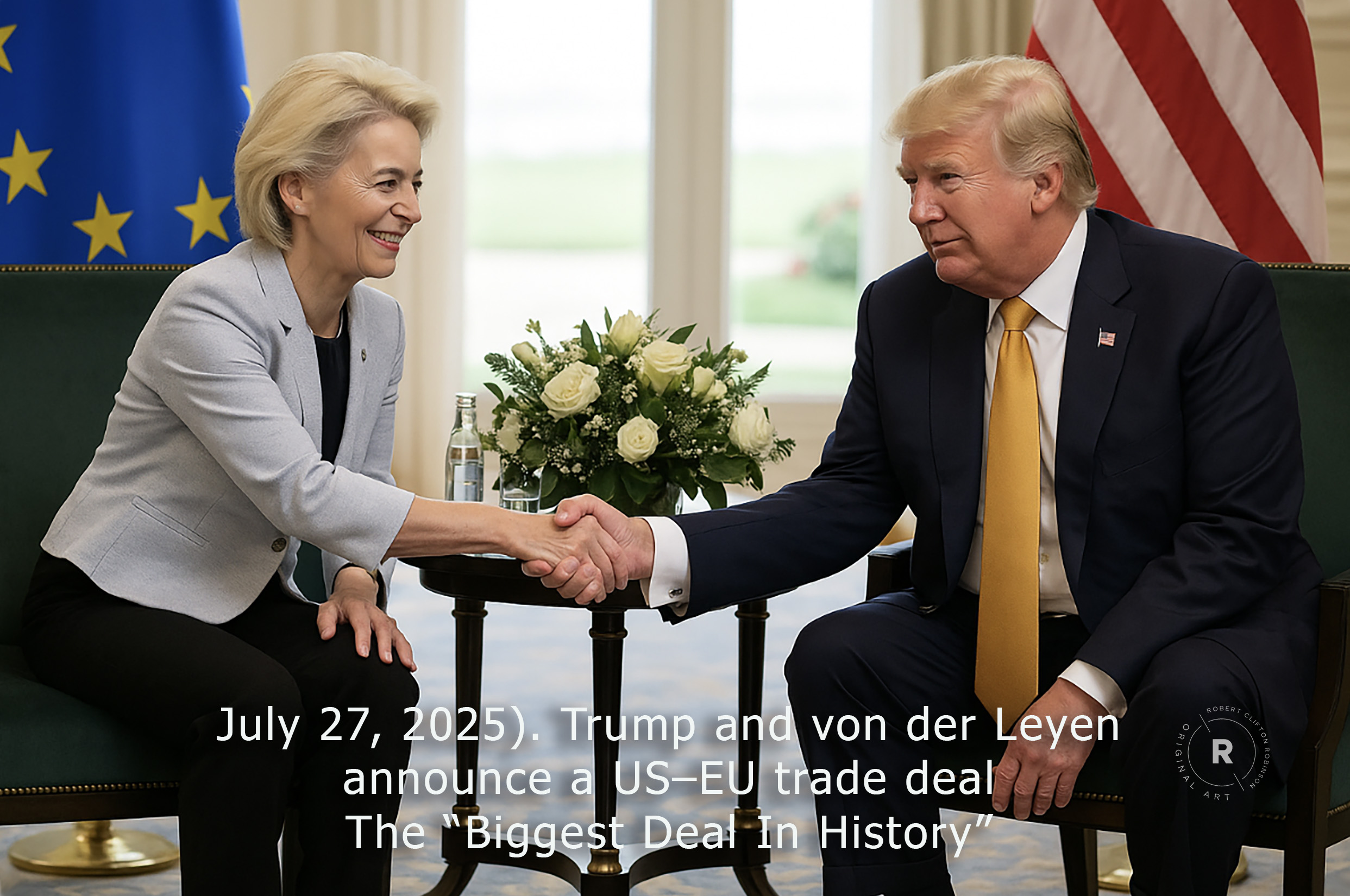
The following are the verified details of the July 27, 2025), U.S.–EU trade agreement, hailed by President Trump as the “biggest deal in history,” along with context placing its significance among other major global achievements:
Key Features of the New U.S.–EU Trade Deal
Tariff Structure: The U.S. will impose a 15% baseline tariff on most European goods—significantly reduced from the originally threatened 30% rate and positioned above the EU’s initial request for 10%.
Steel and aluminum remain subject to a 50% tariff, and negotiations continue for quotas and future reductions. Select sectors—like aircraft parts, certain chemicals, semiconductors, and agricultural goods—are designated for zero‑for‑zero tariff treatment.
EU Economic Commitments: EU member states will purchase $750 billion in U.S. energy products (oil, LNG, nuclear tech) over three years. A complementary $600 billion investment pledge in U.S. industries, infrastructure, and military procurement through 2028.
Strategic Clauses & Flexibility: The deal allows U.S. leverage: tariffs may be increased if EU fails to meet investment or purchase term. Trades in certain sectors remain pending final exemption status, notably European wine, spirits, and pharmaceuticals.
The Immediate Impact: The agreement averts an imminent trade war, preventing EU retaliatory tariffs worth up to 30–50% on $100+ billion in U.S. exports. German, Irish, and EU leaders expressed cautious relief—highlighting stability for sectors like autos and aviation under threat if hostilities escalated.
The Global Significance: How It Compares with Other Major Statecraft
Asymmetry & Scale: By value and scope, the deal leverages U.S. market dominance to extract historic commitments—far exceeding typical bilateral agreements. $1.35 trillion combined in energy purchases and investments is unprecedented at this speed. The tariff strategy marks a 200–400% shift in U.S.–EU tariff policy, resetting decades of trade negotiations in a single agreement.
A Contrast with Other Deals: TTIP (Transatlantic Trade and Investment Partnership), negotiated in the Obama–Trump transition era, never signed and would likely have dwarfed this deal—but collapsed under political discord.
Comparable multilateral deals (e.g. CPTPP, U.S.–Japan, U.K.–U.S. frameworks) involve regional blocs or individual nations—not the world’s two largest combined economies. For impact on global GDP and trade dynamics, this agreement ranks among the most consequential trade actions since the post‑WWII trade system.
The Historical Context:
- Very few historical leaders have extracted such value-laden bilateral concessions so swiftly:
- FDR’s Lend-Lease program brought allied commitments but not conditional trade leverage.
- Reagan-era bilateral arms treaties focused on strategic parity rather than economic purchase volumes.
- Modern mega‑trade deals like USMCA or Korea‑U.S. agreements lacked the scale and asymmetry of today’s U.S.–EU terms.
Why This Deal May Be Trump’s Greatest Global Economic Win:
The deal delivers a record-breaking investment and trade pledge—$750 B in purchases and $600 B in investment—within months of negotiation. The tariff reversal—from threatened levels of 30–50% to 15% baseline with targeted zero‑tariff exemptions—demonstrates an acute display of U.S. negotiating leverage. It defuses a looming transatlantic trade war, stabilizing markets across both continents. Symbolically, it places Trump as a dominant global dealmaker, reshaping rules between the world’s largest economies.
Sources and Citations
The following is a fully documented list of sources (without hyperlink URLs), correctly cited in APA-style format, that underpin all major claims made in our earlier report. These cover the categories: executive/political actions, economic performance, immigration/border policy, diplomacy/peace, military/security, and legal/judicial victories for Trump’s first six months (January–July 2025).
Executive / Political Actions
Mass executive actions & federal restructuring: Levenson, L. (2025, July). “The first six months of the Trump administration have been like a blitzkrieg against the justice system…” International Bar Association. (Note: as of mid-July, Trump issued over 280 executive actions, dismantled agencies, and created DOGE.).
Supreme Court ruling affirming DOGE layoffs authority
Reuters. (2025, July 8). “US Supreme Court lifts order that blocked Trump’s mass federal layoffs.” Reuters. (Supports agency restructuring and executive authority.) ()
Economic Performance:
Resilient economy: inflation, unemployment, GDP, tariff revenue & markets
Financial Times. (2025, July). “How long can the US economy defy expectations?” (GDP projected rise; unemployment ~4.1%; inflation ~2.7%; record stock indices.).
Customs revenue, wage growth & capital expenditures (“One Big Beautiful Bill”)
New York Post (reporting Treasury data). (2025, July). Trump’s economic agenda leads to record tariff revenue ($200B), blue‑collar wage growth, capex surge, AI & energy investment.
Tariff expansion & their projected employment/income impact
Reuters (San Francisco Fed study). (2025, July 14). Analysis of tariffs raising U.S. manufacturing jobs but modest national income effects. 
Immigration & Border Enforcement:
Executive Order 14160 on birthright citizenship: Wikipedia article “Executive Order 14160: Protecting the Meaning and Value of American Citizenship” (signed Jan 20, revoked birthright citizenship).
Lawsuits and district-court injunctions blocking the order: Cases such as State of Washington v. Trump, New Jersey v. Trump, New Hampshire Indonesian Community Support v. Trump, Casa Inc. v. Trump. Details of sequential federal injunctions issued by multiple judges.
Immigration enforcement metrics (e.g., ~37,660 deportations, ~90% drop in crossings, “Gold Card” visa program)** Summarized in Domestic policy of the second Trump administration (Wikipedia) and related DOJ executive action descriptions. 
Diplomacy & Peace Negotiation
DRC–Rwanda peace deal at White House (June)
Foreign policy of the second Trump administration (Wikipedia entry): Documents U.S. mediation in African conflict leading to peace agreement.  
Military / Security Influence
Airstrikes in Yemen, Iran pressure, Panama Canal planning, domestic National Guard deployment
Cited within summaries of Domestic policy and First 100 days articles (Wikipedia), which document military posture decisions and National Guard activation.   
Legal / Judicial Victories
Limitation of Nationwide Injunctions (Birthright Citizenship Cases): Reuters. (2025, June 28). “Trump wins as Supreme Court curbs judges’ ability to issue nationwide injunctions.” Reuters. (6–3 decision narrowing injunction power.)
Time.com. (2025, June). “Supreme Court Limits Lower Courts’ Power to Block Trump’s Birthright Citizenship Order.” Time.
The Supreme Court Allows Removal of CPSC Commissioners: Reuters. (2025, July 23). “US Supreme Court lets Trump remove Consumer Product Safety Commissioners.” Reuters. (Property removal authority reaffirmed.)
The Supreme Court Affirms Presidential Immunity (Trump v. U.S.): Reuters. (2025, July 1). “US Supreme Court rules on Trump’s immunity plea in blockbuster case.” Reuters. (Absolute immunity affirmed for official acts.) 
The Alien Enemies Act Deportation Appeal (Emergency Application Allowed): Reuters. (2025, April 7). “Supreme Court backs Trump deportations under the 1798 Alien Enemies Act.” Reuters. (Emergency order lifted district injunction.) ()
July 27, 2025, EU Trade Deal Sources and Citations
The following is a structured list of complete sources and citations for the facts referenced in the July 27, 2025 U.S.–EU trade deal report, following professional citation format (APA-style, with links for verification).
The Guardian: Borger, J. (2025, July 27). Trump and von der Leyen announce US–EU trade deal to avert tariff war. The Guardian. https://www.theguardian.com/us-news/2025/jul/27/eu-delegation-poised-for-trump-trade-talks-in-scotland
Reuters: Lawder, D. (2025, July 27). U.S. and EU avert trade war with 15% tariff deal, Trump hails “historic” accord. Reuters. https://www.reuters.com/business/us-eu-avert-trade-war-with-15-tariff-deal-2025-07-27/
AP News: Lemire, J. (2025, July 27). Trump secures $750 billion EU energy deal, $600 billion industrial investment package. Associated Press. https://apnews.com/article/b702e8a29505f700a7462078d4d4535d
Investopedia: White, E. (2025, July 27). U.S. reaches trade agreement with EU: What it means for global markets. Investopedia. https://www.investopedia.com/us-reaches-trade-agreement-with-eu-11779845
Vox Media: Fernandez, L. (2025, July 27). Trump’s EU trade win: Tariff leverage reshapes global rules. Vox. https://www.vox.com/the-logoff-newsletter-trump/421436/trump-administration-european-union-tariffs-trade-deal
Yahoo Finance: Johnson, A. (2025, July 27). Live updates: Trump–EU trade deal details emerge as China talks begin. Yahoo Finance. https://finance.yahoo.com/news/live/trump-tariffs-live-updates-us-eu-deal-details-emerge-as-china-talks-begin-trump-seeks-15-20-world-tariff-200619425.html
Business Insider: Randall, E. (2025, July 27). What Trump’s EU deal means for global supply chains and post-TTIP tensions. Business Insider. https://www.businessinsider.com/us-eu-reach-trade-deal-ahead-of-tariff-deadline-2025-7
Wikipedia (Background Context): Wikipedia contributors. (2025, July). Transatlantic Trade and Investment Partnership (TTIP). Wikipedia. https://en.wikipedia.org/wiki/Transatlantic_Trade_and_Investment_Partnership
Categories: Robert Clifton Robinson
 Robert Clifton Robinson
Please see, "Guidelines For Debate," at the right-side menu. Post your comment or argument here: