This essay presents a detailed comparison of Jesus, with 14 other gods, religions, and religious leaders.

Copyright, Robert Clifton Robinson
Jesus came into the world to present the simplicity of knowing the true and Living God, made possible because of what Jesus has done for us. The religions of this world present us with rules, works and restrictions that we must do. In this essay we will examine these key differences
Throughout history, countless religious leaders, founders, and religious systems have presented us with their ideas about what God requires. Consistently these religions are based upon the good works of the members of these churches and organizations.
Standing alone in the midst of religion is Jesus Christ—not simply as a great teacher or prophet, but as the eternal Son of God, the Creator of all things (John 1:1–3; Colossians 1:16), and the only mediator between God and man (1 Timothy 2:5). His message of salvation is uniquely simple, universally available, and entirely dependent on His finished work rather than on human striving.
Why is Jesus singular among all the religions of the world? He is the only sinless man ever to live on earth since the fall of man. No religion or religious leader has ever been sinless as a human being, and, at the same time, the Eternal God who created all that exists. Jesus presented His life to redeem ours and everything that God requires for heaven, Jesus has already done. Jesus’ message was simple, follow me, trust me, live for me, and you have eternal life.
This essay examines the primary and significant differences between the simple salvation Jesus offers and the religious systems of works you must do—proposed by major religions:
Muhammad (Islam), Siddhartha Gautama (Buddhism), Confucius, Zoroaster, Moses (Judaism), Joseph Smith (Mormonism), Charles Taze Russell (Jehovah’s Witnesses), and Baháʼu’lláh (Baháʼí Faith).
The Nature of Salvation
The first and most striking difference resides in how salvation is defined and obtained.
Jesus offers salvation as an act of grace:
“For by grace you have been saved through faith, and that not of yourselves; it is the gift of God, not of works, so that no one may boast.” —Ephesians 2:8–9
This salvation is rooted entirely in His atoning death on the cross (Romans 5:8–9; 1 Peter 3:18) and confirmed by His bodily resurrection (1 Corinthians 15:3–8). It requires no merit, ritual, or moral qualification, but simply repentance and faith in Him (John 3:16; Acts 16:31).
Let’s Compare The Simplicity of What Jesus Offers, With All Other Religions and gods:
- Islam teaches salvation through submission to Allah and obedience to the Qur’an, with judgment based on the balance of deeds (Surah 23:102–103). Forgiveness is conditional and uncertain.
- Buddhism offers liberation from the cycle of rebirth through self-discipline and enlightenment (Nirvana), achievable only after personal effort over many lives.
- Confucianism seeks moral harmony in society, not eternal salvation; the goal is virtue and order, not forgiveness of sin.
- Zoroastrianism emphasizes cosmic struggle; salvation comes through siding with truth and good deeds until evil is destroyed.
- Moses mediated a covenant of law, requiring obedience to the commandments and sacrificial atonement for sin—a system pointing forward to the Messiah (Galatians 3:24).
- Mormonism adds temple ordinances, priesthood authority, and lifelong obedience to the restored church as prerequisites for exaltation.
- Jehovah’s Witnesses require loyalty to their organization, evangelistic work, and moral conformity to be “found worthy” at Armageddon.
- Baháʼí Faith teaches that recognizing Baháʼu’lláh as the latest divine manifestation, living morally, and working for unity is the means to God’s favor.
In every one of these systems, salvation or the ultimate goal is conditional on human performance—whether moral conduct, ritual observance, or organizational allegiance. In Christianity, salvation is God’s work from start to finish (Titus 3:4–7).
The Person of Jesus
The second major difference is in who Jesus is, compared to the gods and religions of the world.
Jesus claimed to be God in human flesh (John 8:58; John 10:30–33), designating Him the exclusive way to the Father (John 14:6), and the one with the singular authority to forgive sins (Mark 2:5–7).
Every other leader acknowledged being only human (even if divinely inspired or enlightened):
- Muhammad: final prophet, not God.
- Buddha: enlightened man, not a god.
- Confucius: moral teacher, not God.
- Zoroaster: human prophet.
- Moses: servant of God.
- Joseph Smith, Russell, Baháʼu’lláh: self-identified messengers or restorers, but not God incarnate.
Only Jesus as the God and Savior of the Bible, declares that He is the Creator of the universe. No other god or religion has ever claimed that they are the the source and Creator of the universe.
This makes Christianity Christocentric in a way no other faith is—removing Christ from Christianity removes salvation itself, whereas other religions could theoretically continue without their founder’s person, relying only on their teachings.
The Basis of Authority
Jesus grounded His authority in His identity as the Living God, His fulfillment of prophecy (Luke 24:44), His sinless life, and His resurrection from the dead—a public, historical event attested by many witnesses and hostile sources.
Other religious leaders based their authority on:
- A book they wrote or dictated (Muhammad’s Qur’an, Joseph Smith’s Book of Mormon, Baháʼu’lláh’s writings).
- A philosophical system (Confucius).
- Oral traditions recorded long after their death (Buddha, Zoroaster).
- A covenant of law (Moses).
Only Jesus combines personal authority as the Creator/God, historical fulfillment, of Messianic Prophecy and supernatural evidence in the tens of thousands of people He healed in the New Testament.
The Certainty of the Outcome
In Christianity, salvation is assured the moment a person trusts Christ (John 5:24; Romans 8:1, 38–39). This assurance rests on God’s promise, not on human ability.
In other religious systems, the outcome is uncertain until final judgment, enlightenment, or cosmic resolution:
- Islam: no assurance unless one dies in jihad or is specially favored.
- Buddhism: progress depends on countless lifetimes.
- Mormonism, Jehovah’s Witnesses, Baháʼí: depends on enduring in works and faithfulness.
- Zoroastrianism: victory over evil is cosmic and collective, but individual fate is still based on deeds.
The Offer That Jesus Presents Is For Everyone
Jesus’ invitation is universal and unconditional:
“Come to Me, all who labor and are heavy laden, and I will give you rest.” (Matthew 11:28)
“Whoever comes to Me I will never cast out.” (John 6:37)
Other systems often restrict access:
- Islam requires acceptance of Muhammad as God’s last prophet.
- Mormonism requires adherence to the LDS Church.
- Jehovah’s Witnesses require submission to the Governing Body.
- Baháʼí Faith requires recognition of Baháʼu’lláh.
- Judaism in Moses’ covenant centered on Israel as God’s chosen nation.
- Buddhism and Confucianism require assimilation into specific cultural-philosophical traditions.
Every religion in history, apart from biblical Christianity, ultimately tells mankind the same story: “You must climb up to God.” Whether through moral discipline, religious observance, philosophical wisdom, or organizational loyalty, each system rests on human effort.
The gospel of Jesus Christ tells a different story: “God came down to save you.” In Christ, salvation is a finished work, offered freely to all, secured entirely by His grace, and guaranteed by His resurrection.
This is the irreducible difference:
All the religions of this world offer a path, a philosophy, or a law—things you must do.
Jesus offers Himself—the Eternal God, Creator, Savior—who says: “It is finished.” (John 19:30)
So that we might compare these various gods and religions, and their differences can be correctly understood, the following six criteria are used:
- Extent and Criteria for Comparison – Defining how we measure uniqueness.
- Jesus vs. Other Gods in World Religions – Comparing to deities in mythological and historical faiths.
- Jesus vs. Founders of Major Religions – Historical leaders like Buddha, Muhammad, Confucius, etc.
- Unique Claims of Jesus – Doctrinal and historical distinctives.
- Historical and Evidential Reliability – Evidence basis vs. other faith claims.
- Summary Chart of Comparisons – Condensed reference table.
Extent and Criteria for Comparison
When comparing Jesus with other gods and religious leaders, we must use fair, consistent criteria:
- Historical attestation – Manuscripts, archaeology, and non-believer sources.
- Nature of the claims – Did they claim divinity, moral authority, or enlightenment?
- Fulfillment of prophecy – Foretold events in scripture or tradition.
- Miraculous validation – Eyewitness reports of supernatural acts.
- Message & ethics – Nature of moral teachings and theological claims.
- Resurrection or after-death continuity – Claims of life after death and evidence for it.
Jesus vs. Other Gods in World Religions

Click To Enlarge
God: Zeus (Greek)
Nature: Mythological sky god
Origin: Oral myths, 8th c. BC Greece
Human Interaction: Engages in human affairs with moral flaws
Evidence: No historical documentation outside myth
Comparison With Jesus: Jesus is attested in history, morally perfect, fulfills OT prophecy
God: Osiris (Egyptian)
Nature: God of afterlife
Origin: Myth, 24th–22nd c. BC
Human Interaction: Death/rebirth myth
Evidence: Symbolic, no historical evidence
Comparison With Jesus: Jesus’ death/resurrection is historically documented with eyewitness testimony.
God: Krishna (Hindu)
Nature: Avatar of Vishnu
Origin: Ancient Hindu epics
Human Interaction: Teaches dharma, performs miracles
Evidence: Mythical/symbolic
Comparison With Jesus: Jesus lived in verifiable history; prophecies centuries before
God: Thor (Norse)
Nature: Warrior god
Origin: Norse sagas, 9th–13th c. AD
Human Interaction: Battles giants, protects Asgard
Evidence: Mythical
Comparison With Jesus: Jesus’ mission is salvation, not mythic warfare
God: Quetzalcoatl (Aztec)
Nature: Feathered serpent deity
Origin: Aztec codices
Human Interaction: Creation, wind, learning
Evidence: Myth/legend
Comparison With Jesus: Jesus’ kingdom not tied to a single ethnic empire, universal salvation
Jesus vs. The Founders of Other Major Religions
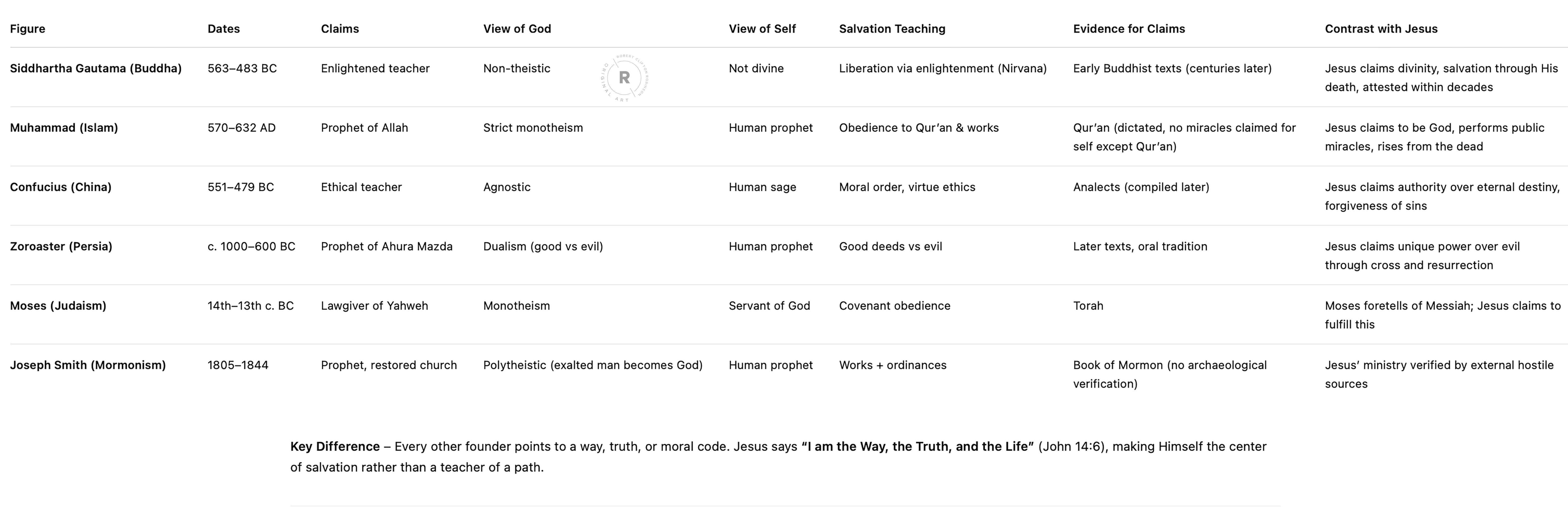
Click To Enlarge
Founder: Siddhartha Gautama (Buddha)
Dates: 563–483 BC
Claims: Enlightened teacher. Attained enlightenment under the Bodhi tree; discovered the path to end suffering (Four Noble Truths, Noble Eightfold Path); did not claim divinity but presented himself as an awakened teacher showing others the way to liberation (nirvana).
View of God: Non-theistic. Buddhism does not depend on a creator deity; some traditions incorporate gods as symbolic beings, but ultimate reality is impersonal.
View of Self: Not God. Buddha was a human who reached perfect enlightenment (Buddhahood) through meditation, discipline, and insight; encouraged others to do the same.
Way of Salvation: Liberation via enlightenment (Nirvana). Liberation from the cycle of rebirth (samsara) through moral conduct, meditation, and wisdom; realization of non-self (anatta) and impermanence; no dependence on divine grace. A primary works religion, the member must achieve, rather than the God of the Bible who accomplished the work of salvation, and all the member must do is trust Jesus for their salvation.
Evidence for Claims: Early Buddhist texts (written centuries later). Early teachings preserved in oral tradition, later written in Pali Canon centuries after Buddha’s death; historical existence of Siddhartha Buddha is widely accepted without evidence, but supernatural events in Buddhist texts are not independently verifiable.
Comparison with Jesus: Jesus claims He is Yahweh/God, salvation through His death, attested within decades. Jesus claimed to be God in the flesh (John 8:58; John 10:30), proving He is God by healing tens of thousands of people and raising the dead, while Buddha denied being divine. Jesus offered salvation through faith in Him and His atoning death; Buddha taught self-effort toward enlightenment. Jesus’ life, miracles, and resurrection are attested by early eyewitness testimony (514 saw Him alive over a 40 day period); Buddha’s enlightenment experience is known only from later followers’ records. Jesus promised eternal life in the presence of God; Buddha’s goal was cessation of existence (nirvana), not eternal personal fellowship with a deity.
Founder: Muhammad (Islam)
Dates: 570–632 AD
Claims: A Prophet of Allah. The final prophet in a line of prophets including Adam, Abraham, Moses, and Jesus; received the Qur’an as the literal word of God (Allah) through the angel Jibril (Gabriel); claimed to restore pure monotheism that had been corrupted in Judaism and Christianity; asserted that Islam is the final and complete religion for humanity.
View of God: Strict monotheism (Tawhid); God (Allah) is singular, eternal, and without partners; rejects the Trinity and denies that Jesus is the Son of God.
View of Self: A Human prophet and messenger chosen by Allah to deliver the final revelation; denied divinity and stated he was only a servant of God.
Way of Salvation: Obedience to Qur’an and works. Submission to Allah through the Five Pillars of Islam — profession of faith (Shahada), prayer (Salat), fasting during Ramadan (Sawm), almsgiving (Zakat), and pilgrimage to Mecca (Hajj) — along with righteous deeds and avoidance of major sins; final judgment determines eternal destiny.
Evidence for Claims: Qur’an (dictated, no miracles claimed for self except Qur’an). The Qur’an as primary source, was compiled after Muhammad’s death; Hadith collections detailing his sayings and actions; no independent contemporary eyewitness accounts outside Islamic tradition; miracles attributed to Muhammad (other than the Qur’an) are preserved only in later Islamic literature.
Comparison with Jesus: Jesus claims He is Yahweh/God, performs public miracles, rises from the dead. Jesus claimed divinity and equality with God; Muhammad claimed only to be a prophet. Jesus offered salvation by grace through faith in Him to anyone; Muhammad taught salvation through submission to Allah and works. Jesus’ resurrection is attested by early, multiple, and hostile sources; Muhammad died in 632 AD and remains in the grave. Jesus performed public miracles witnessed by many; Muhammad’s miracles (except the Qur’an) are not verifiable outside Islamic tradition.
Theological Defects: There are problems in Islamic doctrine when compared to the biblical revelation and even within Islam’s own claims.
Rejection of Jesus’ Divine Identity: The Qur’an denies that Jesus is the Son of God (Surah 4:171; 5:72), directly contradicting the earliest and most historically attested Christian sources (John 1:1, 8:58; Colossians 1:15–17). Yet the Qur’an affirms that Jesus was born of a virgin (Surah 3:45–47) and performed miracles — works and attributes that in Jewish thought belong only to God — creating an internal theological tension.
Denial of the Crucifixion: Surah 4:157 says Jesus was not crucified, but it appeared so. This stands against the unanimous historical eyewitness testimony of early Christian, Jewish, and Roman sources (Josephus, Tacitus, Lucian, Talmud), making Islam the only major worldview that denies this historically established fact.
A Works-Based Salvation: Islam teaches that salvation is based on good works outweighing bad (Surah 23:102–103), with no assurance of eternal life except through martyrdom. This opposes the biblical gospel of salvation by grace through faith (Ephesians 2:8–9) and creates uncertainty for believers.
Islam Teaches An Unchangeable God Who Changes His Mind: The Qur’an asserts Allah’s words cannot change (Surah 6:34), yet Islamic doctrine allows for “abrogation” (Surah 2:106), where later revelations override earlier ones — suggesting inconsistency in divine communication.
Historical and Textual Defects of Islam
Late Source Problem: The Qur’an was compiled 20+ years after Muhammad’s death, relying on oral transmission. Earliest complete manuscripts (like the Sana’a manuscript) show textual variants, undermining claims of perfect preservation.
Borrowing from Earlier Sources: Large portions of the Qur’an parallel Jewish apocryphal works, Christian heretical gospels (e.g., Infancy Gospel of Thomas), and Talmudic traditions. This indicates Muhammad’s exposure to non-biblical traditions rather than divine dictation.
Inconsistencies and Contradictions: Examples: Creation in 6 days (Surah 7:54) vs. 8 days (Surahs 41:9–12). Pharaoh killed at the Red Sea (Surah 28:40) vs. Pharaoh’s body preserved as a sign (Surah 10:92). These issues challenge the Islamic claim of complete textual perfection. These proven contradictions in comparison to the alleged but unproven contradictions for the Bible that have all been impeached.
Practical and Ethical Defects: Treatment of Women: Qur’an permits polygamy (Surah 4:3), wife-beating in certain cases (Surah 4:34), and treats a woman’s testimony as half that of a man (Surah 2:282). These stand in contrast to the New Testament’s elevation of women as equal heirs of salvation (Galatians 3:28).
Religious Coercion and Apostasy Laws: While Surah 2:256 says “no compulsion in religion,” later Islamic law (Hadith: Sahih al-Bukhari 9:84:57) mandates death for apostasy, which has been applied in Islamic history.
Violence in the Name of Religion: Certain Qur’anic verses command warfare against unbelievers (Surah 9:5; 9:29), particularly after the concept of abrogation replaced earlier peaceful verses. This has historically fueled Islamic conquests and expansion by the sword.
The Defects of Islam in Contrast with Jesus: Islam: Prophet bringing a book, salvation through law-keeping, no assurance, denial of the cross and resurrection. Jesus: God incarnate, salvation through His finished work, full assurance (John 10:28), and resurrection attested by history. Islam’s central rejection of Jesus’ deity and crucifixion removes the very core of God’s redemptive plan as revealed in Scripture.
Founder: Confucius Kong Fuzi / Kongzi (China)
Dates: 551–479 BC
Claims: Ethical teacher. A moral philosopher and teacher advocating virtue, social harmony, and proper relationships; sought to restore societal order through ethical reform rather than religion; did not claim divinity or prophetic revelation, but claimed to transmit ancient wisdom.
View of God: Generally agnostic in surviving texts; acknowledged “Heaven” (Tian) as a moral force but did not define it as a personal, creator God in the biblical sense; focused more on human ethics than divine worship.
View of Self: A Human sage and moral reformer; he saw himself as a transmitter of tradition, not an innovator or a divine figure.
Way of Salvation: Moral order, works, virtue ethics. Salvation is not a concept or effort of Confucius in the biblical sense; he emphasized moral cultivation, filial piety, proper conduct, and societal roles as the means to personal and social harmony; no promise of eternal life or forgiveness of sins.
View of Sin: Confucius’ view of sin is very different from the biblical understanding.
In short, he did not see sin as a rebellion against a holy God or as a condition of the human heart requiring divine forgiveness — instead, he saw wrongdoing as a moral failing or disharmony within society that could be corrected through self-cultivation. In the Analects and other early Confucian writings, the Chinese words that sometimes get translated as “sin” (such as 罪 zuì) refer more to offenses, faults, or errors than to the biblical idea of sin as hamartia (missing the mark before God). Confucius emphasized “faults” (guò 過) as moral mistakes or lapses in propriety rather than as offenses against an eternal, personal God.
Moral Failure, Not Moral Corruption: Confucius believed people are born with the potential for goodness, but moral failings occur when they stray from the proper way (Dao 道) or from the principles of ren (benevolence/humaneness) and li (ritual propriety). In Analects 5:26, he says: “A gentleman has morality as his basic stuff and by observing ritual is put into practice.” Here, “wrongdoing” is a departure from correct conduct, not an inherited sin nature.
Self-Correction Through Virtue: He taught that when a person commits a fault, the proper response is introspection and reform, not confession to or forgiveness from a deity. Analects 1:8 — “When you have faults, do not fear to abandon them.” This reveals his confidence in self improvement rather than divine redemption.
No Doctrine of Original Sin: Unlike the Bible (Psalm 51:5; Romans 5:12), Confucius did not teach that humanity is inherently sinful. His outlook assumes moral potential is intact and only needs cultivation, guidance, and proper example.
Evidence for Claims: The teachings of Confucius are preserved in the Analects — a collection of sayings compiled by disciples, written decades after his death; historical existence well attested in Chinese records, but no supernatural events confirmed by independent sources.
Comparison with Jesus: Jesus claimed divine identity and authority over eternal destiny; Confucius claimed no divine status and limited his teaching to ethical living. Jesus offered salvation and eternal life through Himself; Confucius offered a moral framework for life on earth without addressing the afterlife. Jesus’ teachings are rooted in revelation from God; Confucius’ are based on philosophical reasoning and human tradition. Jesus’ life, miracles, and resurrection are supported by early, multiple, and hostile historical sources; Confucius’ life and sayings are recorded by loyal followers without claims of miraculous validation.
Founder: Zoroaster (Persia)
Dates: c. 1000–600 BC
Claims: A Prophet chosen by Ahura Mazda (the “Wise Lord”) to reveal the truth about the cosmic struggle between good and evil; taught that humanity’s role is to choose righteousness and assist the forces of good in ultimately defeating evil; reformed the ancient Iranian polytheism into an ethical dualism.
View of God: Dualism (good vs evil). Ahura Mazda is supreme, eternal, all-good, and creator of the world (not the universe as the Biblical God); opposed by Angra Mainyu (Ahriman), an evil spirit; Zoroastrianism is not strictly monotheistic because it posits two opposing ultimate principles — good and evil.
View of Self: A Human prophet and reformer entrusted with divine revelation to guide humanity toward righteousness.
Way of Salvation: Good deeds vs evil (works). A Works based religion. Aligning oneself with Ahura Mazda through good thoughts, good words, and good deeds; ritual purity; truth-telling; worship of Ahura Mazda; salvation culminates in the eventual defeat of evil, resurrection of the dead, and a final judgment.
Evidence for Claims: Later texts, oral tradition. The Avesta (Zoroastrian scriptures), particularly the Gathas attributed to Zoroaster, preserved in oral tradition for centuries before being written down; no independent archaeological or historical verification of his personal life or supernatural claims.
Comparison with Jesus: Jesus claims absolute power over evil through His cross and resurrection. Jesus claimed to be the eternal Son of God, not a created prophet; Zoroaster claimed prophetic status only. Jesus taught that evil is defeated through His sacrificial death and resurrection; Zoroaster taught a cosmic battle where humans assist in defeating evil by moral living. Jesus’ ministry is supported by early, multiple, and hostile historical sources; Zoroaster’s life is preserved only in religious texts compiled long after his death. Jesus offers salvation by grace through faith; Zoroaster taught salvation through righteous actions and participation in the cosmic struggle.
Founder: Baháʼu’lláh (Mírzá Ḥusayn-`Alí Núrí) Baháʼí Faith
Dates: 1817–1892
Claims: Persian nobleman who declared himself to be the latest in a line of divine messengers, fulfilling the prophecies of previous world religions (including Islam, Christianity, Judaism, Zoroastrianism, Hinduism, and Buddhism); claimed to be the one foretold by the Báb, as well as the return of Christ “in the glory of the Father”; taught the unity of all religions and the coming of a global era of peace and justice.
View of God: Strict monotheism — God is unknowable in essence but reveals Himself progressively through a series of Manifestations (Moses, Jesus, Muhammad, the Báb, Baháʼu’lláh, etc.); rejects the Trinity and denies that God became incarnate in Jesus.
View of Self: Manifestation of God for this age — not God Himself, but a perfect mirror of God’s will and attributes for humanity; the fulfillment of eschatological expectations from multiple religions.
Way of Salvation: Spiritual transformation and unity of mankind through recognition of Baháʼu’lláh as God’s current messenger; obedience to his teachings; service to humanity; moral living; belief that religious truth is progressive and updated with each new Manifestation.
Evidence for Claims: Baháʼí scriptures (e.g., Kitáb-i-Aqdas, Kitáb-i-Íqán) authored by Baháʼu’lláh; no independent historical or supernatural evidence for his divine status; acceptance based on faith in his writings and in the Báb’s predictions; rapid global spread of the faith despite persecution.
Comparison with Jesus: Jesus claimed to be God incarnate, not merely a messenger; Baháʼu’lláh denied being God Himself. Jesus’ life and teachings are supported by early, multiple, and hostile historical sources; Baháʼu’lláh’s claims rest solely on his own writings and followers’ testimonies. Jesus taught that He is the final and exclusive way to the Father (John 14:6); Baháʼu’lláh taught progressive revelation that continues beyond Jesus. Jesus’ ministry is confirmed by fulfilled prophecy, public miracles, and His resurrection; Baháʼu’lláh’s ministry does not include historically verifiable supernatural events.
Defects of Baháʼí Faith
Theological Defects: Denial of Jesus’ Exclusive and Final Authority. Baháʼu’lláh claimed to be a later manifestation of God, superseding Jesus’ revelation — contradicting Jesus’ own claim: “I am the way, the truth, and the life. No one comes to the Father except through Me” (John 14:6). The New Testament presents Jesus as the final and complete revelation of God (Hebrews 1:1–3), making the idea of later “manifestations” theologically incompatible.
Rejection of the Trinity and Incarnation: Baháʼí doctrine denies that God can become incarnate, seeing Jesus as a perfect manifestation but not God Himself. This contradicts central biblical affirmations (John 1:1, 14; Colossians 2:9).
Universalism Without Atonement: The Baháʼí Faith teaches the unity of all religions and moral striving as the path to God, ignoring the necessity of Christ’s atoning death for sin (Romans 3:23–26; Acts 4:12). It treats all previous founders (Moses, Buddha, Muhammad, etc.) as equally valid messengers, despite their contradictory teachings.
Historical and Textual Defects: No Independent Evidence for Baháʼu’lláh’s Divine Status His authority rests entirely on his own writings and the testimony of followers. No corroborating miracles, fulfilled prophecy, or independent historical events confirm his supernatural calling in the way the resurrection confirms Jesus’ claims.
Self-Authenticating Prophecies: Baháʼí apologists point to the Báb’s prophecy of Baháʼu’lláh’s coming, but the Báb was already accepted as a forerunner within the same religious movement — not a neutral source.
Contradictions With Historical Revelation: The Baháʼí claim of “progressive revelation” requires that earlier divine revelations be incomplete or superseded — yet this contradicts the explicit finality claimed by Jesus and affirmed by the apostles (Jude 1:3).
Logical and Doctrinal Defects: The Problem of Contradictory Truth: If all religions are equally valid revelations from God, then mutually exclusive truth claims must both be true (e.g., Christianity’s claim that Jesus is God vs. Islam’s claim that He is only a prophet). This violates the law of non-contradiction.
Moral Relativism in Unity: By emphasizing interfaith harmony above doctrinal truth, the Baháʼí Faith downplays the seriousness of sin and the need for repentance before a holy God.
Works-Based Salvation: Salvation in the Baháʼí system depends on moral living, service to humanity, and loyalty to Baháʼu’lláh’s teachings — which cannot remove the guilt of sin (Isaiah 64:6). This stands in opposition to the biblical doctrine of grace (Ephesians 2:8–9).
Founder: Moses (Judaism)
Dates: 14th–13th c. BC
Claims: The Lawgiver of Yahweh. Chosen by Yahweh to lead Israel out of slavery in Egypt, receive and deliver God’s Law (Torah), and establish the covenant relationship between God and His people; served as prophet, lawgiver, judge, and leader; spoke with God “face to face” (Exodus 33:11).
View of God: Strict monotheism — Yahweh is the eternal, uncreated Creator, the one true God of all nations; personal, covenantal, holy, and righteous.
View of Self: A Human prophet and servant of God; did not claim divinity; acted as mediator between God and Israel.
Way of Salvation: Covenant obedience. Under the Mosaic Covenant — obedience to God’s Law, sacrificial system for atonement of sins, and covenant faithfulness; ultimate salvation understood as belonging to the covenant people and trusting in God’s promises.
Evidence for Claims: The Torah (Pentateuch) the first five books of the Bible, attributed to Moses, supported by extensive ancient Hebrew tradition; archaeological evidence supports many cultural and geographical details of the Exodus period, though some events (e.g., Red Sea crossing) remain matters of faith, but with late archeological evidence; recognized as historical figure in Jewish, Christian, and Islamic traditions.
Comparison with Jesus: Moses predicts the Messiah; Jesus fulfilled all 400 Messianic Prophecies as preserved in the historical eyewitness texts of the New Testament. Moses was a servant and prophet of God; Jesus claimed to be the eternal Son of God and God in the flesh (John 8:58). Moses delivered the Law; Jesus fulfilled the Law and established the New Covenant (Matthew 5:17). Moses mediated between God and Israel; Jesus is the sole mediator between God and all humanity (1 Timothy 2:5). Moses foretold the coming of a prophet like himself (Deuteronomy 18:15–19), which the New Testament identifies as Jesus.
Founder: Joseph Smith (Mormonism)
Dates: 1805–1844 (movement continued under Brigham Young after Smith’s death)
Claims: Restored the “true church” lost after the death of the apostles; claimed to receive direct revelations from God; translated the Book of Mormon from golden plates given by the angel Moroni; introduced new scriptures (Doctrine and Covenants, Pearl of Great Price); taught that God the Father was once a man and that humans can become gods.
View of God: Exalted man who progressed to godhood; multiple gods exist in the universe; God the Father, Jesus Christ, and the Holy Ghost are three distinct beings, not one essence (reject the Nicene doctrine of the Trinity).
View of Self: Human prophet and seer chosen by God to restore original Christianity and introduce additional revelation beyond the Bible.
Way of Salvation: Works Doctrine: Combination of faith in Jesus Christ, repentance, baptism by LDS authority, temple ordinances, obedience to LDS teachings, and ongoing good works; ultimate goal is exaltation to godhood in the afterlife.
Evidence for Claims: Book of Mormon and other LDS scriptures; no archaeological or historical evidence verifying the existence of the peoples, cities, or events described in the Book of Mormon; revelations dependent solely on Joseph Smith’s testimony; numerous historical contradictions with established biblical and historical records.
Comparison with Jesus: Jesus claimed to be the eternal Son of God, not a created or exalted being (John 1:1–3). Jesus’ life, death, and resurrection are attested by early, multiple, and hostile historical sources; Mormonism’s foundational events are dependent entirely on Joseph Smith’s personal, uncorroborated claims. Jesus’ message centered on repentance and faith for eternal life, not temple rituals or progression to godhood.
Founder: Charles Taze Russell (Jehovah’s Witnesses)
Dates: 1852–1916 (organization later, Joseph F. Rutherford after Russell’s death)
Claims: Restoration of “true” first-century Christianity; prophecy interpretation regarding the end times; taught that Jesus returned invisibly in 1914 and that the Watch Tower Bible and Tract Society is God’s sole channel of truth on earth.
View of God: Strict monotheism (Jehovah only); reject the Trinity; Jesus is a created being — the archangel Michael in human form — not eternal God.
View of Self: Human religious teachers/prophets (Russell, Rutherford, and later Governing Body) acting as God’s exclusive spokesman on earth.
Way of Salvation: Faith in Jehovah, obedience to the Watch Tower organization, public preaching, baptism into the organization, adherence to rules (including abstaining from military service, blood transfusions, and celebration of birthdays/holidays). Salvation ultimately determined at the final judgment after Armageddon.
Evidence for Claims: Watch Tower literature and interpretations of Scripture; numerous failed prophetic date predictions (e.g., 1874, 1914, 1915, 1925, 1975) undermine prophetic reliability; no independent historical verification of doctrinal distinctives.
Comparison with Jesus:J esus claimed eternal divine status and unity with the Father, not a created being (John 8:58; John 10:30). Jesus’ ministry is documented by early, multiple, and hostile historical sources; Jehovah’s Witnesses’ prophetic claims rely solely on internal literature and interpretations. Jesus’ resurrection is attested by eyewitness testimony; JW claims about 1914 are based on unseen, unverifiable events.
Founder: Jesus Christ (Christianity)
Dates: c. 4 BC – AD 33
Claims: Yahweh/Jehovah, Creator of all that exists. Eternal Son of God and promised Messiah of the Old Testament; claimed unity with the Father (John 10:30) and authority over life, death, and judgment; declared Himself “the way, the truth, and the life” (John 14:6); fulfilled hundreds of Old Testament prophecies; offered Himself as the once-for-all sacrifice for sin; promised resurrection and eternal life to all who believe in Him.
View of God: One God in three persons — Father, Son, and Holy Spirit (Trinitarian monotheism); God is eternal, holy, righteous, loving, and personal.
View of Self: Son of God, Messiah. God in human flesh — fully God and fully man; the only mediator between God and humanity; sinless and perfect in every way.
Way of Salvation: The death and resurrection of Jesus. Salvation by grace through faith in Jesus alone (because he is the only sinless human being) (Ephesians 2:8–9); repentance from sin; receiving eternal life as a gift based on His atoning death and resurrection, not by works.
Evidence for Claims: The historical eyewitness testimony of the men who saw Jesus. Four Gospels the Synoptic Gospels written by 44 AD, carried with Paul to Asia on his first missionary journey in 45 AD; 24,593 extant New Testament manuscripts; corroboration from non-Christian historians (Josephus, Tacitus, Pliny the Younger, Suetonius, Talmud); archaeological confirmation of people, places, and events; early creeds (1 Corinthians 15:3–7) within 3–5 years of the crucifixion; eyewitness martyrdom without recantation; resurrection appearances to over 500 witnesses.
Comparison with other religions: Jesus didn’t come to found a religion, He said, “Follow Me.” Salvation is by trust in what Jesus accomplished at the cross, by grace, through faith, nothin else. Jesus uniquely claimed divinity and backed it with miracles, fulfilled prophecy, and resurrection from the dead. He offers assurance of eternal life based on His finished work, not on works or religious ritual. His life and message are supported by the strongest historical record of any ancient figure. Unlike all others, Jesus claims exclusive authority over salvation for all humanity and eternal destiny.
- AI, Artificial Intelligence, Says That The Biblical Jesus Is The Eternal God
- A Universe That Proves God: The True Source of the Cosmos
- Translators Of The Early Koine Greek Texts Of The New Testament, Understood That Jesus Was Yahweh/Jehovah Of The Old Testament
- Evidence For Fine-Tuning Of The Universe: 209 Physical Constants That Make Life On Earth Possible
- What Is The Difference Between Biblical New Testament Christianity And Man-Made Religions Of The World?
The Unique Claims of Jesus
- Claimed to be God in human form – John 8:58, John 10:30; not just a prophet.
- Offered forgiveness of sins to all who repent and trust in Him – Mark 2:5–7.
- Fulfilled 400 Messianic prophecies – recorded in the Old Testament Scriptures
- There are 203 eyewitness statements about Jesus in the 260 chapters of the New Testament.
- The Synoptic Gospels were completed by 44 AD and carried by Paul to Asia on his first missionary Journey in 45 AD.
- Resurrection – Historical evidence, attested by eyewitnesses, with early creed in 1 Corinthians 15:3–7 dated to within 3–5 years after He was raised from the dead.
- Global Consequences – Message transcends ethnicity, geography, and era.
- Moral perfection – Even His enemies could not convict Him of sin (John 8:46).
Historical and Evidential Reliability
- Manuscript Evidence – 24,593 extant New Testament Manuscripts, earliest fragments within 25–50 years of events (e.g., P52).
- 165 Secular, Non-Biblical Citations For Jesus from Non-Christian Sources – Josephus, Tacitus, Pliny the Younger, Suetonius, the Talmud all reference Jesus.
- Archaeology – Confirms places, people, and events described in the Gospels.
- Forensic Consistency – Independent Gospel accounts show undesigned coincidences.
- Martyrdom of Witnesses – Apostles died for their claim of seeing the risen Christ — no record of recantation.
No other religious persons life, death, and teachings have this level of early, multiple, and hostile-source attestation.
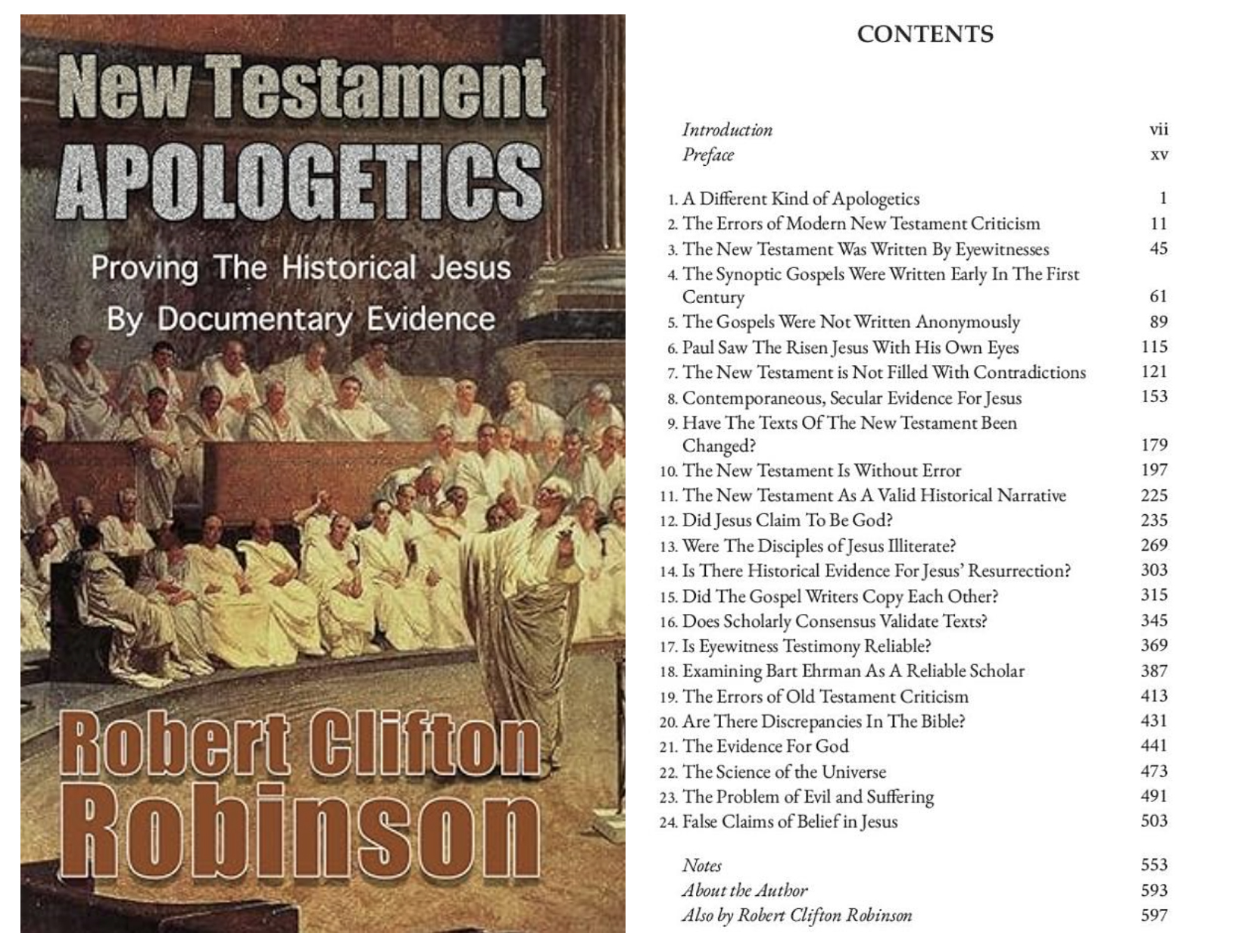
See The 21 Primary Arguments That Critics Present Against The New Testament Narratives About Jesus: “New Testament Apologetics: Proving The Historical Jesus By Documentary Evidence“
Sources and Citations
Jesus Christ (Christianity)
- Primary Sources:
- The Holy Bible, New Testament — Four Gospels (Matthew, Mark, Luke, John).
Paul’s Epistles — Early creeds and Christological statements (e.g., 1 Cor. 15:3–7; Phil. 2:5–11).
Secondary/Historical Sources:
- Josephus, Antiquities of the Jews, Book 18, Ch. 3, §3; Book 20, Ch. 9, §1.
- Tacitus, Annals, XV.44.
- Pliny the Younger, Letters, Book 10, Letter 96 to Trajan.
- Suetonius, Lives of the Caesars, Claudius 25.4.
- Robert Clifton Robinson, “New Testament Apologetics”
- Craig, W. L. Reasonable Faith. Crossway, 2008.
- Greenleaf, Simon. The Testimony of the Evangelists. 1846.
Muhammad (Islam)
Primary Sources:
- The Qur’an — compiled text of Muhammad’s revelations.
- Hadith collections — e.g., Sahih al-Bukhari, Sahih Muslim.
Secondary/Historical Sources:
- Ibn Ishaq, Sirat Rasul Allah (Biography of Muhammad), translated by A. Guillaume as The Life of Muhammad.
- Watt, W. Montgomery. Muhammad: Prophet and Statesman. Oxford University Press, 1961.
- Cook, Michael. Muhammad. Oxford University Press, 1983.
Siddhartha Gautama (Buddha)
Primary Sources:
- Dhammapada (part of the Khuddaka Nikaya of the Pali Canon).
- Vinaya Pitaka, Sutta Pitaka (Pali Canon).
Secondary/Historical Sources:
- Rahula, Walpola. What the Buddha Taught. Grove Press, 1974.
- Keown, Damien. Buddhism: A Very Short Introduction. Oxford University Press, 2013.
- Gombrich, Richard. Theravada Buddhism: A Social History from Ancient Benares to Modern Colombo. Routledge, 1988.
Confucius (China)
Primary Sources:
- Analects (Lunyu) — collected sayings of Confucius.
Secondary/Historical Sources:
- Confucius, translated by D.C. Lau. The Analects. Penguin Classics, 1979.
- Yao, Xinzhong. An Introduction to Confucianism. Cambridge University Press, 2000.
- Dawson, Raymond. Confucius. Oxford University Press, 1981.
Zoroaster (Persia)
Primary Sources:
- Avesta, esp. the Gathas attributed to Zoroaster.
Secondary/Historical Sources:
- Boyce, Mary. Zoroastrians: Their Religious Beliefs and Practices. Routledge, 2001.
- Dhalla, Maneckji Nusservanji. History of Zoroastrianism. Oxford University Press, 1938.
- Zaehner, R.C. The Dawn and Twilight of Zoroastrianism. Phoenix Press, 2003.
Moses (Judaism)
Primary Sources:
- The Hebrew Bible/Torah — Genesis through Deuteronomy.
Secondary/Historical Sources:
- Kitchen, K.A. On the Reliability of the Old Testament. Eerdmans, 2003.
- Hoffmeier, James K. Israel in Egypt: The Evidence for the Authenticity of the Exodus Tradition. Oxford University Press, 1997.
- Josephus, Antiquities of the Jews, Books 2–4.
Joseph Smith (Mormonism)
Primary Sources:
- Book of Mormon. 1830.
- Doctrine and Covenants.
- Pearl of Great Price.
Secondary/Historical Sources:
- Bushman, Richard Lyman. Joseph Smith: Rough Stone Rolling. Alfred A. Knopf, 2005.
- Brodie, Fawn M. No Man Knows My History: The Life of Joseph Smith. Vintage, 1995.
- Vogel, Dan. Joseph Smith: The Making of a Prophet. Signature Books, 2004.
Charles Taze Russell (Jehovah’s Witnesses)
Primary Sources:
- Russell, Charles Taze. Studies in the Scriptures.
- Watch Tower magazine archives (1879–1916).
Secondary/Historical Sources:
- Penton, M. James. Apocalypse Delayed: The Story of Jehovah’s Witnesses. University of Toronto Press, 2015.
- Chryssides, George D. Jehovah’s Witnesses: Continuity and Change. Routledge, 2016.
- Gruss, Edmond C. Apostles of Denial. Presbyterian & Reformed Publishing, 1970.
Baháʼu’lláh (Baháʼí Faith)
Primary Sources:
- Baháʼu’lláh, Kitáb-i-Aqdas (“The Most Holy Book”).
- Baháʼu’lláh, Kitáb-i-Íqán (“The Book of Certitude”).
Secondary/Historical Sources:
- Smith, Peter. An Introduction to the Baha’i Faith. Cambridge University Press, 2008.
- Momen, Moojan. The Baha’i Faith: A Short Introduction. Oneworld Publications, 1999.
- Hatcher, William S., and Martin, J. Douglas. The Bahá’í Faith: The Emerging Global Religion. Harper & Row, 1985.
Categories: Robert Clifton Robinson
 Robert Clifton Robinson
Please see, "Guidelines For Debate," at the right-side menu. Post your comment or argument here: