Daniel Chapter 11 Presents Us With The Most Detailed Prophecies Ever Recorded For The Last Days.
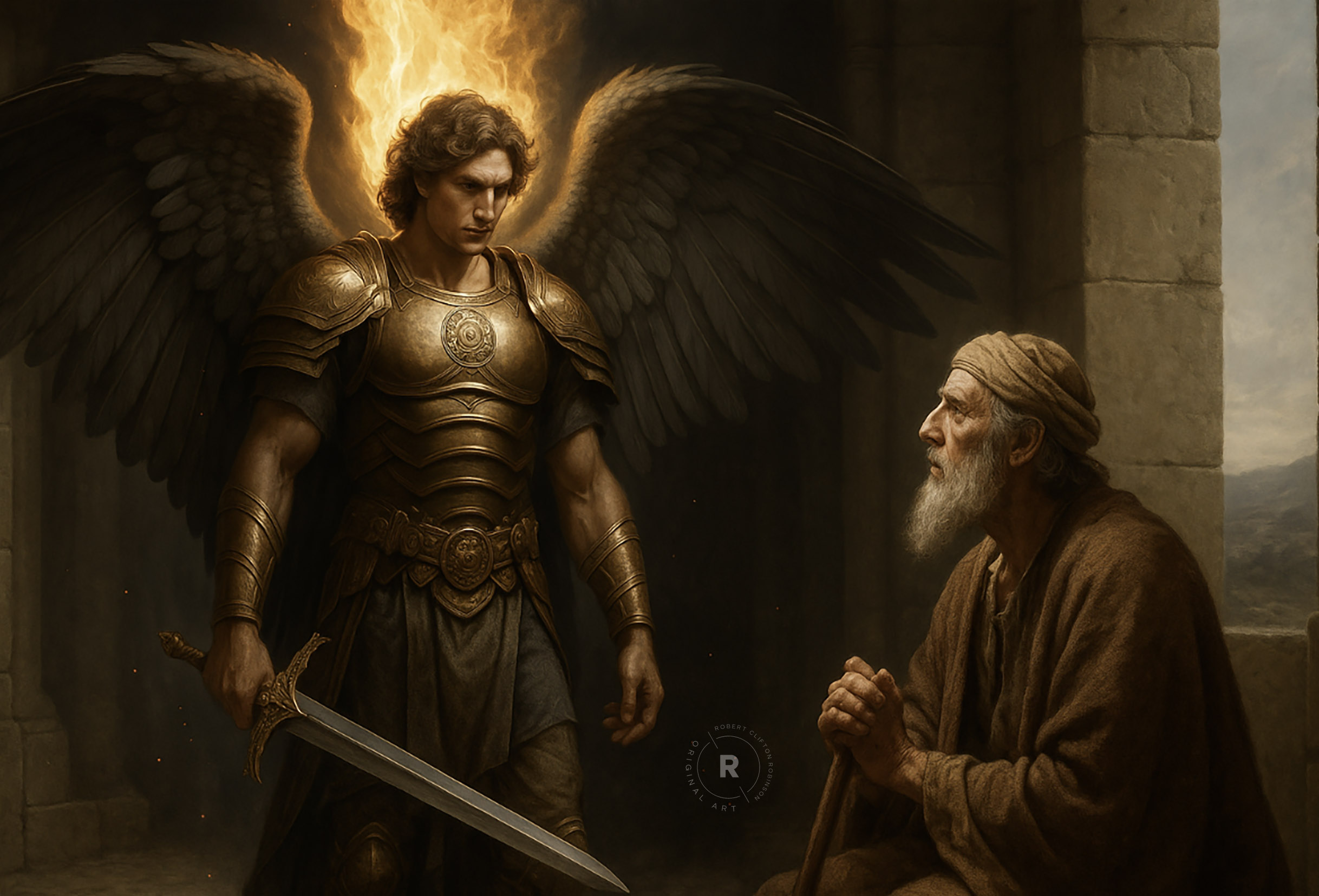
Gabriel and Daniel, Copyright Robert Clifton Robinson
The following is a comprehensive exegesis and historical-prophetic commentary on Daniel 11:1–12:1. This chapter is one of the most detailed and astonishing prophetic revelations in the Bible, outlining events that span from the Persian Empire through the rise of Alexander the Great, the Seleucid and Ptolemaic conflicts, and ultimately to the rise of a final eschatological figure—often identified as the Antichrist—culminating in the great deliverance at the time of the end.
Daniel 11:1–12:1: The Most Detailed Prophecies in Scripture
Introduction and Historical Framework (Daniel 11:1–4)
Daniel 11:1-2 “In the first year of Darius the Mede, I, even I (Gabriel, stood up to confirm and strengthen him.)
Verse 1:
Daniel is being informed of events that will take place in the last of the Last Days by the same angel who spoke to him in chapter 10. This angel (Gabriel) states that in the first year of Darius the Mede, he “stood up to confirm and strengthen him”—likely referring to angelic involvement in influencing world powers (cf. Dan. 10:13, 20–21).
Daniel 11:2 And now I will tell you the truth (Daniel): Behold, three more kings will arise in Persia, and the fourth shall be far richer than them all; by his strength, through his riches, he shall stir up all against the realm of Greece.
Verse 2: Gabriel tell Daniel about four future Persian kings:
- Cambyses (530–522 BC) – Son of Cyrus.
- Pseudo-Smerdis (Gaumata) – A usurper who reigned briefly.
- Darius I (Hystaspes, 522–486 BC)
- Xerxes I (486–465 BC) – The “fourth” and richest. He launched a massive campaign against Greece (cf. Herodotus, Histories, VII), fulfilling the text’s statement that “he shall stir up all against the realm of Greece.”
Daniel 11:3 Then a mighty king shall arise, who shall rule with great dominion, and do according to his will.
Verse 3: The Mighty King – Alexander the Great (336–323 BC)
Alexander rapidly conquered the Medo-Persian Empire, ruling with vast dominion and doing “according to his will.” His sudden death at 32 left his empire in chaos.
Daniel 11:4 And when he has arisen, his kingdom shall be broken up and divided toward the four winds of heaven, but not among his posterity nor according to his dominion with which he ruled; for his kingdom shall be uprooted, even for others besides these.
Verse 4: Division of Alexander’s Empire
His empire was divided into four parts—not given to his sons but to his generals (the Diadochi):
- Cassander (Macedonia/Greece)
- Lysimachus (Thrace/Asia Minor)
- Seleucus I Nicator (Syria/Babylon/Persia)
- Ptolemy I Soter (Egypt/Palestine)
This division is the backdrop for the later “king of the North” (Seleucid) and “king of the South” (Ptolemaic) conflicts.
Kings of the North and South (Daniel 11:5–20)
Daniel 11:5-6 “Also the king of the South shall become strong, as well as one of his princes; and he shall gain power over him and have dominion. His dominion shall be a great dominion. 6 And at the end of some years they shall join forces, for the daughter of the king of the South shall go to the king of the North to make an agreement; but she shall not retain the power of her authority, and neither he nor his authority shall stand; but she shall be given up, with those who brought her, and with him who begot her, and with him who strengthened her in those times.
Verse 5–6: The Ptolemy and Seleucid Dynasties
The King of the South: Ptolemy I becomes strong: One of his princes (Seleucus I Nicator) becomes more powerful than Ptolemy, ruling the Seleucid Empire.
A Marriage alliance: Around 250 BC, Ptolemy II Philadelphus gave his daughter Berenice to Antiochus II Theos (king of the North) in a peace treaty. But Antiochus died, and Berenice and her child were murdered by his former wife, Laodice. This fulfilled: “She shall not retain power.”
Daniel 11:7-9 But from a branch of her roots one shall arise in his place, who shall come with an army, enter the fortress of the king of the North, and deal with them and prevail. 8 And he shall also carry their gods captive to Egypt, with their princes and their precious articles of silver and gold; and he shall continue more years than the king of the North. 9 “Also the king of the North shall come to the kingdom of the king of the South, but shall return to his own land.
Verse 7–9: Revenge from Egypt
Berenice’s brother, Ptolemy III Euergetes, invaded the Seleucid realm to avenge her death, looted Antioch, and returned with spoils to Egypt (v.8). Seleucus II tried to retaliate but failed (v.9).
Daniel 11:10-12 However his sons shall stir up strife, and assemble a multitude of great forces; and one shall certainly come and overwhelm and pass through; then he shall return to his fortress and stir up strife. 11 “And the king of the South shall be moved with rage, and go out and fight with him, with the king of the North, who shall muster a great multitude; but the multitude shall be given into the hand of his enemy. 12 When he has taken away the multitude, his heart will be lifted up; and he will cast down tens of thousands, but he will not prevail.
Verse 10–12: Renewed Conflict
Seleucus II’s sons, Seleucus III and Antiochus III (the Great), continued aggression. Antiochus III invaded Egypt and won major battles. However, Ptolemy IV Philopator defeated him at Raphia (217 BC), fulfilling verse 11. Despite victory, Ptolemy did not press his advantage (v.12).
Daniel 11:13-16 For the king of the North will return and muster a multitude greater than the former, and shall certainly come at the end of some years with a great army and much equipment. 14 “Now in those times many shall rise up against the king of the South. Also, violent men of your people shall exalt themselves in fulfillment of the vision, but they shall fall. 15 So the king of the North shall come and build a siege mound, and take a fortified city; and the forces of the South shall not withstand him. Even his choice troops shall have no strength to resist. 16 But he who comes against him shall do according to his own will, and no one shall stand against him. He shall stand in the Glorious Land with destruction in his power.
Verse 13–16: Antiochus III’s Rise
Antiochus returns years later (c. 200 BC), defeats Egypt’s weak forces, and conquers Judea (“the Glorious Land,” v.16).
Daniel 11:17 “He shall also set his face to enter with the strength of his whole kingdom, and upright ones with him; thus shall he do. And he shall give him the daughter of women to destroy it; but she shall not stand with him, or be for him.
Verse 17: Deception Through Marriage
Antiochus tried to gain control through marriage, giving his daughter Cleopatra I to Ptolemy V Epiphanes—hoping to gain influence in Egypt. It failed; Cleopatra sided with her husband.
Daniel 11:18-19 After this he shall turn his face to the coastlands, and shall take many. But a ruler shall bring the reproach against them to an end; and with the reproach removed, he shall turn back on him. 19 Then he shall turn his face toward the fortress of his own land; but he shall stumble and fall, and not be found.
Verses 18–19: Coastal Campaigns
Antiochus turned to the Aegean but was stopped by Lucius Scipio of Rome. He returned to his homeland and died (likely murdered), “not to be found.”
Daniel 11:20 “There shall arise in his place one (Seleucus IV Philopator) who imposes taxes on the glorious kingdom; but within a few days he shall be destroyed, but not in anger or in battle.
Verse 20: Seleucus IV Philopator
He imposed taxes (e.g., on Judea) but died soon after (possibly poisoned), fulfilling “destroyed, but not in anger or in battle.”
Antiochus IV Epiphanes and the Abomination of Desolation (Daniel 11:21–35)
Daniel 11:21 And in his place shall arise a vile person, to whom they will not give the honor of royalty; but he shall come in peaceably, and seize the kingdom by intrigue.
Verse 21: A Vile Person
Antiochus IV Epiphanes (175–164 BC) seized power deceitfully and was not the rightful heir. He is one of the clearest types of the antichrist found in the Old Testament.
Daniel 11:22-24 With the force of a flood they shall be swept away from before him and be broken, and also the prince of the covenant. 23 And after the league is made with him he shall act deceitfully, for he shall come up and become strong with a small number of people. 24 He shall enter peaceably, even into the richest places of the province; and he shall do what his fathers have not done, nor his forefathers: he shall disperse among them the plunder, spoil, and riches; and he shall devise his plans against the strongholds, but only for a time.
Verses 22–24: Deceit and Intrigue
Antiochus IV Epiphanes used cunning diplomacy to destroy opponents, including the “prince of the covenant”—likely Onias III, the Jewish high priest, murdered in 171 BC.
Daniel 11:25-27 “He shall stir up his power and his courage against the king of the South with a great army. And the king of the South shall be stirred up to battle with a very great and mighty army; but he shall not stand, for they shall devise plans against him. 26 Yes, those who eat of the portion of his delicacies shall destroy him; his army shall be swept away, and many shall fall down slain. 27 Both these kings’ hearts shall be bent on evil, and they shall speak lies at the same table; but it shall not prosper, for the end will still be at the appointed time.
Verses 25–27: War and Deception
Antiochus IV Epiphanes fought Ptolemy VI Philometor but secretly conspired with him while feigning peace. Their evil hearts “shall speak lies at the same table” (v.27).
Daniel 11:28 While returning to his land with great riches, his heart shall be moved against the holy covenant; so he shall do damage and return to his own land.
Verse 28: Against the Holy Covenant
After a campaign, Antiochus IV Epiphanes returned to Judea and began hostile actions against the Jews—looting the temple and killing many.
Daniel 11:29-30 “At the appointed time he shall return and go toward the south; but it shall not be like the former or the latter. 30 For ships from Cyprus shall come against him; therefore he shall be grieved, and return in rage against the holy covenant, and do damage.
“So he shall return and show regard for those who forsake the holy covenant.
Verses 29–30: Second Invasion and a Roman Intervention
In 168 BC, Antiochus IV Epiphanes attempted another invasion of Egypt but was turned back by Roman consul Gaius Popilius Laenas, who famously drew a circle around Antiochus and demanded he withdraw. Humiliated, he returned north and vented his rage on the Jews.
Daniel 11:31 And forces shall be mustered by him, and they shall defile the sanctuary fortress; then they shall take away the daily sacrifices, and place there the abomination of desolation.
Verse 31: Abomination of Desolation
Antiochus desecrated the temple in 167 BC by:
- Ending the daily sacrifices.
- Erecting an altar to Zeus in the temple.
- Sacrificing a pig—thus placing “the abomination of desolation” (cf. 1 Macc. 1:54–59; Josephus, Ant. 12.5.4).
Daniel 11:32-35 Those who do wickedly against the covenant he shall corrupt with flattery; but the people who know their God shall be strong, and carry out great exploits. 33 And those of the people who understand shall instruct many; yet for many days they shall fall by sword and flame, by captivity and plundering. 34 Now when they fall, they shall be aided with a little help; but many shall join with them by intrigue. 35 And some of those of understanding shall fall, to refine them, purify them, and make them white, until the time of the end; because it is still for the appointed time.
Verses 32–35: Resistance and Martyrdom
- Many Jews apostatized (“he shall corrupt with flattery”).
- Others, led by the Maccabees, resisted and “carried out great exploits.”
- Many were martyred—purifying Israel until “the time of the end.”
The Eschatological Fulfillment and the Antichrist (Daniel 11:36–45)
At this point in Daniel chapter 11, the historical pattern changes. No known historical actions of Antiochus IV Epiphanes, fit this prophetic section that Daniel records. This defines this section as a prophetic shift to a future world leader, the antichrist. This is a consistent pattern that we often see in the prophecies that concern the last days: an earlier and a later fulfillment of the same prophecy. This defines Antiochus as a type of the final world ruler.
Daniel 11:36 “Then the king (antichrist) shall do according to his own will: he shall exalt and magnify himself above every god, shall speak blasphemies against the God of gods, and shall prosper till the wrath has been accomplished; for what has been determined shall be done.
Verse 36: The Self-Exalting, Final King:
- This final king exalts himself above every god (cf. 2 Thess. 2:3–4; Rev. 13:6).
- This final king blasphemes the “God of gods.”
- This final king will prosper until God’s wrath is complete (three and a half years)—God is sovereign even over his rebellion.
Daniel 11:37 He (antichrist) shall regard neither the God of his fathers nor the desire of women, nor regard any god; for he shall exalt himself above them all.
Verse 37: The Final King Will Not Regard God or Messiah
- No regard for the God of his fathers”: Possibly a reference to apostasy or atheism.
- “The desire of women:” The hope of every Hebrew young woman to be given the privilege of giving birth to the Messiah.
- This final king worships only power (“the god of fortresses”).
Daniel 11:38-39 But in their place he shall honor a god of fortresses; and a god which his fathers did not know he shall honor with gold and silver, with precious stones and pleasant things. 39 Thus he shall act against the strongest fortresses with a foreign god, which he shall acknowledge, and advance its glory; and he shall cause them to rule over many, and divide the land for gain.
Verses 38–39: Foreign God of War
This final world ruler (antichrist) trusts in military might and promotes a god unknown to his ancestors—interpreted as either literal idolatry or symbolic of totalitarian ideology (e.g., militant secularism).
Daniel 11:40-45 “At the time of the end the king of the South (Ptolemy I) shall attack him; and the king of the North (Antiochus II Theos) shall come against him like a whirlwind, with chariots, horsemen, and with many ships; and he shall enter the countries, overwhelm them, and pass through. 41 He shall also enter the Glorious Land, and many countries shall be overthrown; but these shall escape from his hand: Edom, Moab, and the prominent people of Ammon. 42 He shall stretch out his hand against the countries, and the land of Egypt shall not escape. 43 He shall have power over the treasures of gold and silver, and over all the precious things of Egypt; also the Libyans and Ethiopians shall follow at his heels. 44 But news from the east and the north shall trouble him; therefore he shall go out with great fury to destroy and annihilate many. 45 And he shall plant the tents of his palace between the seas and the glorious holy mountain; yet he shall come to his end, and no one will help him.
Verses 40–45: Final Campaign and Death
- “At the time of the end:” The Final tribulation period (cf. Dan. 12:1).
- The king of the South (Ptolemy I) and North (Antiochus II Theos) engage him.
- He invades many nations and conquers the Glorious Land (Israel).
- Edom, Moab, Ammon are spared (modern Jordan?), possibly because of political alliance.
He plunders Egypt. - News from east and north (perhaps a revolt or threat from China or Russia?) alarms him.
- He pitches his palace “between the seas and the glorious holy mountain” (likely between the Mediterranean and Mt. Zion).
- He is destroyed by the judgment of God—“and no one will help him.” (cf. Rev. 19:19–21).
Deliverance and the Time of the End (Daniel 12:1)
Daniel 12:1 serves as a climax to chapter 11: “At that time Michael shall stand up, the great prince who stands watch over the sons of your people; and there shall be a time of trouble, such as never was…”
This is a direct reference to the Great Tribulation (cf. Matt. 24:21). The Archangel Michael rises to defend Israel during the darkest hour. But in the midst of this, “your people shall be delivered,” referring to the faithful remnant of Israel (cf. Rom. 11:26; Rev. 12:6–17).
Daniel Chapter 11 is the most precise and detailed prophecy in Scripture. The first 35 verses are verifiably fulfilled in meticulous historical detail from the Persian Empire to Antiochus IV. Verses 36–45 shift to the future, describing the final Antichrist who will arise during the Tribulation and desecrate the temple, only to be destroyed at the appointed time.
Daniel Chapter 11 Presents Us With:
- A clear validation of biblical prophecy—especially in the historical accuracy of vv. 1–35.
- A pattern that proves a dual fulfillment—a near/far view of the antichrist.
- A warning of persecution and tribulation.
- A promise of ultimate deliverance for the people of God at the return of Christ.
Proving That The Book of Daniel Was Written Before The Events Happened
The Historical Dating of the Septuagint: The translation of the Pentateuch (first five books of the Old Testament) occurred between 285-247 B.C. during the reign of Ptolemy II Philadelphus in Alexandria, Egypt. The remainder of the Hebrew Scriptures was translated into Greek over the next century, with the entire Septuagint completed by approximately 132 B.C. Since the Septuagint is a Greek translation of the Hebrew Scriptures, the original Hebrew texts from which it was translated must have been written centuries earlier.
Use of the Septuagint by New Testament Writers: The New Testament authors, particularly Matthew, Paul, and Luke, often quoted directly from the Septuagint rather than the Hebrew Masoretic Text. For example, when Matthew quotes Isaiah 7:14 (Matthew 1:23), he uses the Greek word parthenos (virgin), aligning with the Septuagint’s wording. This proves that the Greek translation containing Messianic prophecies was widely known and accessible before the time of Jesus, further validating their authenticity.
The Dead Sea Scrolls as Corroborating Evidence: The Dead Sea Scrolls (circa 250 B.C. – 70 A.D.), discovered in the 20th century, include Hebrew manuscripts of Isaiah, Psalms, and other prophetic books. These Hebrew texts match the prophetic content found in the Septuagint, proving that both the Greek and Hebrew versions preserved the same prophecies centuries before Jesus’ birth.
The Great Isaiah Scroll (1QIsaa), dated to around 125 B.C., contains Isaiah 53 with the same descriptions of the Suffering Servant found in the Septuagint and New Testament. This confirms that all the prophecies of the Old Testament were written before Jesus arrived to fulfill them with great precision.
Testimony of Early Jewish and Christian Writers: Philo of Alexandria (20 B.C. – 50 A.D.) and Josephus (37-100 A.D.) affirmed the antiquity and widespread use of the Septuagint among Jewish communities before the rise of Christianity. Early church fathers like Justin Martyr, Irenaeus, and Clement of Alexandria referenced the Septuagint when demonstrating that Jesus fulfilled Old Testament prophecies.
Theological and Apologetic Significance: The existence of the Septuagint before Jesus’ birth eliminates the possibility that Christians manipulated Hebrew texts to align with Jesus’ life.
Because the Septuagint was translated by Jewish scholars with no connection to Christianity, its content cannot be accused of Christian bias. This historical reality validates the claim that Jesus’ fulfillment of these ancient prophecies was not coincidental or contrived, but a matter of divine orchestration.
The Septuagint conclusively confirms that the Old Testament Messianic prophecies were written centuries before Jesus Christ. Its historical dating, combined with textual evidence from the Dead Sea Scrolls and citations in the New Testament, provides undeniable proof that these prophecies existed long before Jesus fulfilled them. As a result, the Septuagint stands as a key witness to the authenticity and divine inspiration of the Messianic prophecies in the Old Testament.
Understanding The Four Antiochus Kings
There are four primary kings of the Seleucid dynasty who bore the name Antiochus that are significant in both history and biblical prophecy—particularly in the interpretation of Daniel 11. Below is a detailed breakdown of these four kings, their reigns, historical significance, and prophetic relevance:

Four Antiochus Kings, Copyright, Robert Clifton Robinson
1. Antiochus I Soter (“Savior”)
Reign: 281–261 BC
Father: Seleucus I Nicator (one of Alexander the Great’s generals)
Identifying Facts:
- He inherited the Seleucid throne upon his father’s assassination.
- Struggled to maintain control over the vast Seleucid Empire.
- Founded several cities and maintained alliances with other Hellenistic states.
- Not directly named in Daniel 11, but he is the father of Antiochus II Theos, and thus foundational to the dynasty’s role in prophecy.
2. Antiochus II Theos (“God”)
Reign: 261–246 BC
The Son of: Antiochus I Soter
Prophetic Reference: Daniel 11:6
His Primary Events:
- Fought in the Second Syrian War against Egypt.
- Married Berenice, daughter of Ptolemy II (king of the South), as a peace offering.
- Later divorced Berenice and returned to his first wife, Laodice, who then poisoned him.
- Laodice had Berenice and her son murdered, which led to retaliation by Ptolemy III (Daniel 11:7–8).
His Prophetic Fulfillment:
“The daughter of the king of the South shall come to the king of the North to make an agreement…” — Daniel 11:6
3. Antiochus III the Great
Reign: 223–187 BC
The Son of: Seleucus II Callinicus
HIs Prophetic References: Daniel 11:10–19
The Key Events:
- One of the most powerful Seleucid kings.
- He rebuilt Seleucid strength and expanded eastward and into Judea.
- He won early battles against Egypt (king of the South) but was ultimately defeated by Rome.
- He gave his daughter Cleopatra I to Ptolemy V in an attempt to gain influence in Egypt (Daniel 11:17)—but this plan failed.
- He eventually defeated by Roman general Scipio Asiaticus at the Battle of Magnesia in 190 BC. He died shortly thereafter while attempting to plunder a temple in Elymais (Daniel 11:19).
His Prophetic Fulfillment:
“He shall stumble and fall, and not be found.” — Daniel 11:19
4. Antiochus IV Epiphanes (“God Manifest”)
Reign: 175–164 BC
The Son of: Antiochus III the Great
HIs Prophetic References: Daniel 11:21–35; type of the Antichrist in vv. 36–45
Primary Events:
- He seized the throne through flattery and intrigue, not rightful succession (Daniel 11:21).
- He is known for severe persecution of the Jews.
In 167 BC, he desecrated the Jerusalem Temple by:
- Stopping daily sacrifices
- He Erected an altar to Zeus
- He offering swine flesh at the Jewish Temple—later called “the abomination of desolation” (Daniel 11:31).
- This event caused the Maccabean Revolt (167–160 BC).
- He died mysteriously in Persia in 164 BC.
His Prophetic Fulfillment:
“Forces shall be mustered by him… they shall take away the daily sacrifices, and place there the abomination of desolation.” — Daniel 11:31
“He shall exalt himself above every god…” — Daniel 11:36 (fulfilled in part; typological of the future Antichrist)
See: “These Things Were Written: An Expositional Treatise of the Life, Death, and Resurrection of Jesus,” by Robert Clifton Robinson
Sources and Citations:
Biblical Sources: The Holy Bible – Daniel 11:1–12:1, cross-references:
- Ezra 4:6; Esther 1:1–4 (Persian kings context)
- Daniel 2:39–45; 7:6–28; 8:5–25 (parallel visions)
- Matthew 24:15; Mark 13:14 (Jesus referencing the “abomination of desolation”)
- Revelation 13; 17 (eschatological parallels to final ruler)
- Translation basis: New King James Version (NKJV) and New Living Translation (NLT).
Ancient Primary Sources: Persian and Greek Period
- Herodotus – Histories, Book 7.20–99 – Detailed account of Xerxes I’s wealth and his campaign against Greece (Daniel 11:2).
- Ctesias of Cnidus – Persica (fragments) – Accounts of Persian court intrigues, supplementing Herodotus.
- Diodorus Siculus – Bibliotheca Historica Book XVII – Narrative of Alexander the Great’s conquests and division of his empire (Daniel 11:3–4).
- Arrian – Anabasis Alexandri, Book 7 – Describes Alexander’s death and the partition of his empire.
- Justin (Marcus Junianus Justinus) – Epitome of Pompeius Trogus, Books 15–16 – Division of Alexander’s empire and early Seleucid-Ptolemaic rivalries.
Seleucid-Ptolemaic Conflicts:
- Polybius – Histories, Books 5–29 – Detailed accounts of the Syrian Wars between Seleucids (North) and Ptolemies (South) that correspond to Daniel 11:5–20.
- Appian of Alexandria – Syrian Wars – Background on Seleucid expansion and Rome’s intervention.
- Josephus – Antiquities of the Jews, Book 12.3.1–4 – Antiochus III’s actions in Judea and the failed marriage alliance (Daniel 11:17).
- Josephus – Antiquities, Book 12.5.4 – Antiochus IV Epiphanes’ desecration of the Temple, removal of daily sacrifices, and setting up the abomination of desolation (Daniel 11:31).
- 1 Maccabees – Chapters 1–6 – Eyewitness Jewish record of Antiochus IV’s persecution and the Maccabean revolt.
- 2 Maccabees – Chapters 5–6 – Additional details on Antiochus IV’s blasphemies and Temple desecration.
Roman Sources:
- Livy (Titus Livius) – Ab Urbe Condita, Book 45 – Roman intervention against Antiochus IV (the famous “circle in the sand” incident with Gaius Popilius Laenas).
- Polybius – Histories, Book 29.27 – Confirms the Roman ultimatum to Antiochus IV in 168 BC.
Modern Scholarly Sources:
- Yamauchi, Edwin M. Persia and the Bible. Grand Rapids: Baker Academic, 1990. – Historical background on Persian kings and Daniel 11:2.
- Steinmann, Andrew E. Daniel. Concordia Commentary Series. St. Louis: Concordia Publishing House, 2008. – Comprehensive exegesis and historical synchronisms.
- Archer, Gleason L. The Expositor’s Bible Commentary, Vol. 7: Daniel and the Minor Prophets. Grand Rapids: Zondervan, 1985. – Analysis of the prophecy’s historical fulfillments.
- Goldingay, John. Daniel. Word Biblical Commentary, Vol. 30. Dallas: Word, 1989. – Scholarly commentary on textual and historical issues.
- Walvoord, John F. Daniel: The Key to Prophetic Revelation. Chicago: Moody Press, 1971. – Conservative prophetic interpretation linking Antiochus IV to the future Antichrist.
- Collins, John J. Daniel: A Commentary on the Book of Daniel. Hermeneia Series. Minneapolis: Fortress Press, 1993. – Academic analysis of Daniel 11’s historical precision.
- Yamauchi, Edwin M. Greece and Babylon: Early Contacts Between the Aegean and the Near East. Grand Rapids: Baker, 1967. – Context for Hellenistic and Near Eastern overlap.
- Kitchen, K.A. On the Reliability of the Old Testament. Grand Rapids: Eerdmans, 2003. – Historical reliability of the Daniel 11 period.
Antiochus IV’s desecration of the Temple, in which he stopped daily sacrifices and erected an altar to Zeus, is described in Josephus, Antiquities of the Jews, 12.5.4; 1 Maccabees 1:54–59; and 2 Maccabees 6:1–5. Jesus later referenced this act in Matthew 24:15, calling it “the abomination of desolation” spoken of by Daniel.
Categories: Robert Clifton Robinson
 Robert Clifton Robinson
Recommend this book for more information on the Diadochi
LikeLike