When We Examine The Four Gospel Narratives About Jesus, It Is Clear That Many People Were Expecting The Messiah To Arrive At Any Moment. Why?
- Matthew 11:3 “Are you the Messiah we’ve been expecting…”
- Luke 3:15 “Everyone was expecting the Messiah to come soon…”
- Luke 7:19 “Are you the Messiah we’ve been expecting…”
- Luke 7:20 “John’s two disciples found Jesus and said to him, “John the Baptist sent us to ask, ‘Are you the Messiah we’ve been expecting, or should we keep looking for someone else?’”
- John 1:19-21 “This was John’s testimony when the Jewish leaders sent priests and Temple assistants from Jerusalem to ask John, ‘Who are you?” He came right out and said, “I am not the Messiah.” “Well then, who are you?” they asked. “Are you Elijah?” “No,” he replied. “Are you the Prophet we are expecting?” “No.”
- John 6:14 “When the people saw Jesus do this miraculous sign, they exclaimed, “Surely, he is the Prophet we have been expecting!”
- John 7:37-41 “…Jesus stood and shouted to the crowds, “Anyone who is thirsty may come to me! Anyone who believes in me may come and drink! For the Scriptures declare, ‘Rivers of living water will flow from his heart.’” …When the crowds heard him say this, some of them declared, “Surely this man is the Prophet we’ve been expecting.” Others said, “He is the Messiah.”

Copyright, RCR
The four Gospels repeatedly record that people in the first century were actively anticipating the coming of the Messiah. This wasn’t a coincidence—it was the product of centuries of prophecy, history, and expectation converging at that exact moment.
Time of Messiah’s Arrival: The Prophetic Timeline in Daniel
The most important reason that many Jews of the first century were expecting the Messiah was Daniel’s prophecy of the “Seventy Weeks” (Daniel 9:24–27).
Daniel foretold that from the decree to rebuild Jerusalem until the coming of “Messiah the Prince” would be 69 weeks of years (483 years). That decree was given by Artaxerxes in 445/444 BC (Nehemiah 2:1–8). Counting forward, this brought the timeline to the very years when Jesus appeared publicly.
The Jewish people of the first century knew they were living within the prophesied time for Messiah’s arrival. This explains Luke 3:15: “Everyone was expecting the Messiah to come soon…”
The Jews Oppression Under Rome
The Jews lived under harsh Roman occupation, longing for deliverance. Prophecies of a coming King (Psalm 2, Zechariah 9:9–10) were read politically as well as spiritually.
Many expected Messiah to overthrow Rome and restore David’s throne (cf. Acts 1:6). This great time of trial for the Jews of the first century, increased their anticipation for Messiah’s arrival. This explains why so many Jesus during that time had such a hard time accepting Jesus as the Messiah; Jesus said He came to die for all sins, not to deliver the Jews from Roman opression.
John the Baptist Appeared To Announce The Messiah
John’s sudden arrival as the first Old Testament prophet after 400 years of silence (since Malachi) shocked the Jews.
John openly declared: “The Kingdom of Heaven is at hand” (Matthew 3:2). The leaders immediately asked him if he was Messiah, Elijah, or “the Prophet” (John 1:19–21). John’s ministry aroused the expectation that Messiah was due to arrive at any moment (Luke 3:16).
The 400 Messianic Prophecies Were Known to the People
Many of the Jews were well aware of specific Messianic texts:
- Deuteronomy 18:15 – A prophet like Moses, the Messiah.
- Isaiah 7:14; 9:6–7; 11:1–10 – The birth of the Messiah by a virgin.
- Micah 5:2 – The Messiah will be born in Bethlehem.
- Malachi 3:1; 4:5–6 – A messenger (Elijah-type) John the Baptist, will introduce Messiah.
These prophecies were a roadmap for people of that time that caused them to say of Jesus in John 7:40–41: “Surely this man is the Prophet… He is the Messiah.”
The Signs of Jesus’ Miracles That Healed Tens of Thousands of People
When Jesus performed His miracles of healing, the texts of the Gospels describe immense crowds of people who came to be healed by Jesus, and they were all healed. These incredible events caused the people of that time to connect these events with the Messianic prophecies of Isaiah 29 and 35:5–6).
John 6:14 records the crowd’s reaction to seeing these thousands of miracles: “Surely he is the Prophet we’ve been expecting!” These miracles were precisely what Isaiah had predicted for the Messiah: opening the eyes of the blind, the ears of the deaf, healing those unable to walks. These people could not deny that what the prophets wrote for the Messiah, Jesus was doing right before their eyes.
The Preeminent Sense of God’s Timing
Paul wrote in his letter to the Christians at Galatia that God waited until the specific time that these people were living in, to bring Jesus into the world. (Galatians 4:4).
The Roman Empire had brought the world to the precise place it needed to be so that communication of the Messiah’s arrival could be accomplished.
The events that Jesus was said to be doing all over Israel, caused the Jews to realize that the Messiah was there in the midst of them at that time.
The reason “everyone was expecting” Messiah when Jesus appeared is because:
- Daniel’s prophecy gave a precise timeframe.
- Rome’s oppression caused a longing for deliverance.
- John the Baptist’s ministry declared God’s kingdom was near.
- Messianic prophecies were well-known and anticipated.
- Jesus’ miracles matched prophetic signs (Isaiah 29 and 35).
- The conditions of history (“fullness of time”) caused people to believe Messiah was arriving.
The Four Gospels informs us of the historical, eyewitness reality that first-century Jews were not only waiting, but watching for Messiah—and Jesus appeared exactly on schedule
Although The Lord did not give them the “day or the hour” of His arrival, still the people knew the prophecies, the signs, and the conditions of that period of history.
It is interesting in Mark’s Gospel (Peters testimony) that he recorded the words of Jesus in a very specific manner concerning the timing of Jesus’ return for His church:
Mark 13:34-37 “The coming of the Son of Man (Messiah) can be illustrated by the story of a man going on a long trip. When he left home, he gave each of his slaves instructions about the work they were to do, and he told the gatekeeper to watch for his return. 35 You, too, must keep watch! For you don’t know when the master of the household will return—in the evening, at midnight, before dawn, or at daybreak. 36 Don’t let him find you sleeping when he arrives without warning. 37 I say to you what I say to everyone: Watch for him!”
Notice that Jesus is instructing those who are waiting and watching for His return that He will come during night hours. This many not be a reference to a specific time when He will come, but to something that was well known to the Jews of that day: The Feast of Trumpets.
Mark 13:35 “You, too, must keep watch! For you don’t know when the master of the household will return—in the evening, at midnight, before dawn, or at daybreak.”
These are times that indicate a specific event: watching for the beginning of the thin silver horns of the moon that begins the Feast of Trumpets. “At evening, at midnight, before dawn, or a daybreak,” are the specific times when the moon is at the precise phase that the Feast of Trumpets can be declared. Is this a further hint by Jesus of the time when He will return?
We must remember that Jesus is a Jew, and when He spoke, He was speaking primarily to Jews
When Jesus spoke, He communicated in Hebrew and expressed His thoughts in a way that would be understood by the Jews who listened to Him.
The fifth Feast of Israel is called “Rosh Hashanah,” or “The Feast of Trumpets.” It begins on the first day of the seventh month in the Jewish calendar. In the mind of the Jew who is thinking of Rosh Hashanah, this would be the start of “The Day of the Lord,” the one thousand-year reign of the Messiah on earth. This would also mark the time of the resurrection. This important Feast of Israel is signaled by the New Moon. This is the time when the moon is invisible to the Earth, and just slightly before, when it appears as a small crescent. Over the next two weeks, more of the moon appears, until it is finally a Full Moon.
Rosh Hashanah, the Feast of Trumpets, occurs in 2025 during the two-day period of September 22-24.
The appearance of the moon was so important to Israel that all of their feast days were signaled by its phases from New to Full. This is why the total lunar eclipse, or “blood moon,” is such an important sign that we should pay attention to.
God gave authority to the Sanhedrin of Israel to announce when the start of these Feast days would begin, according to the cycles of the moon (Vayikrah-Leviticus 23:4).
“These are the appointed times of the Lord, holy convocations which you shall proclaim at the times appointed for them.”
In the Torah, Mattityahu 18:18-20, we find that the beginning of the Feast of Trumpets occurs as soon as the New Moon is announced. To establish when this feast began, a watch was posted to observe the beginning of the New Moon. In Hebrew, they refer to this watch as “appointed times.” According to the Jewish Midrash, no man has the right to set this time; it is determined by God alone, and no man has the authority to change the appointed time of this feast.[2]
It was the intention of God, and well understood by the Sanhedrin of Israel, that the watch for the Feast of Trumpets was a rehearsal for the time when this feast would be fully realized. In Colossians 2:17, Paul describes these rehearsals as “a shadow of the good things to come.”
Determined by Two Witnesses
The Sanhedrin determined who would watch for the arrival of the new moon, and this important task was completed by pairs of “two witnesses,” which is the basic foundation of all legal transactions in Judaism.
During the seven-year tribulation, God will send His two witnesses to Israel to proclaim to the Jews, from their Hebrew scriptures, that Jesus is the Messiah.
Revelation 11:3: “And I will give power to my two witnesses, and they will prophesy one thousand two hundred and sixty days, clothed in sackcloth.”
It is my opinion that these two witnesses will be Moses and Elijah. Moses, representing the Law, and Elijah, representing the prophets. Jesus said that all that God had spoken before John the Baptist arrived, as the last of the Old Testament Prophets, rests upon the Law and the Prophets.
Luke 16:16: “The law and the prophets were until John. Since that time, the kingdom of God has been preached, and everyone is pressing into it.”
These two witnesses, who were chosen to announce the coming of the new moon that would signal the beginning of Rosh Hashanah, must be men of good character who were already proven to be honorable, truthful, and reliable.
In the Mishnah, chapter 2, Mishnah 6, regarding Rosh Hashanah, it describes how the witnesses are tested regarding the start of Rosh Hashanah.
“The senior of them is brought in and they say to him, tell us how you saw the moon – in front of the sun or behind the sun? To the north of it or the south? How big was it, and in which direction was it inclined? And how broad was it? If he says (he saw it) in front of the sun, his evidence is rejected. After that, they would bring in the second and test him. If their accounts tallied, their evidence was accepted, and the other pairs were only questioned briefly, not because they were required at all, but so that they should not be disappointed, (and) so that they should not be dissuaded from coming.”
In Qualifying The Witnesses, The Sanhedrin Used The Following Criteria:
- They never arrived at the same time.
- They were never questioned at the same time.
- There were always two new witnesses each month.
According to the Jewish Sanhedrin, these witnesses would stand before the Nassi or President of the Sanhedrin to give an account of the moon’s appearance before becoming completely dark.[3]
The way the witnesses could mark the beginning of the new moon was seen in an event that took place just before the total blackness of the new moon. Immediately before the moon enters its new phase, a thin sliver of moon is observed along the edge, called “the horns of the moon.”
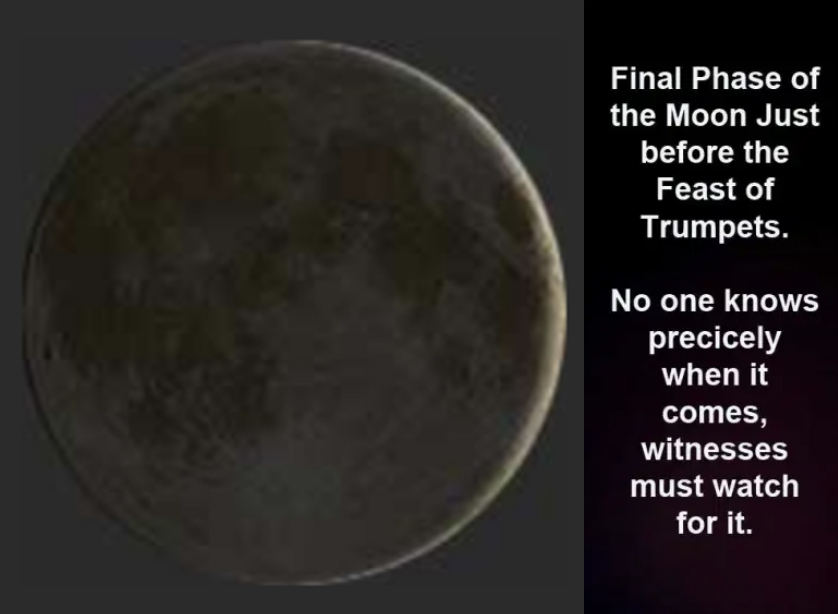
Once the two witnesses had been thoroughly evaluated for their truthful account of the new moon, the President of the Sanhedrin would announce the beginning of the “Rosh Chodesh” (new month), with the words: “Sanctified.” Following his proclamation, all the people would answer: Sanctified.”
I will repeat this again: These are times that indicate a specific event: watching for the beginning of the thin silver horns of the moon that begins the Feast of Trumpets. “At evening, at midnight, before dawn, or a daybreak,” are the specific times when the moon is at the precise phase that the Feast of Trumpets can be declared. Is this a further hint by Jesus of the time when He will return?
Jesus did not describe a daytime event, but one that requires an event that must take place at night. It is during the darkness of night that the two witnesses are watching for the moment when the Moon reaches the “final phase” (above), that they can declare that the Feast of Trumpets, “Rosh Chodesh,” has arrived.
Because no man knew the day or the hour for the beginning of the Feast of Trumpets, this became its secondary name. When Jesus said, “But of that day and hour no one knows,” this precise process for determining the beginning of this feast was what He had in mind.
It is for this reason that we cannot say precisely what day or hour Jesus will return for His church at the Rapture. With this in mind, and reading what Peter recorded from Jesus in Mark 13:34, was this a further hint from Jesus that the time of His return is during the fifth Feast of Trumpets?
Jesus never said that we wouldn’t know when He is coming; He told us that we won’t know the specific day or the hour. When we understand that the time of His arrival will be at different times of the day and even on different days, depending on where we are located on the earth, we realize what He was saying. There is no possible way that we can know the precise time or day when He will come.
The timing for the beginning of the Feast of Trumpets is based upon Jerusalem time, not the specific time where we live in the world. We watch for the beginning of Trumpets according to the time when the moon enters its final phase, by Jerusalem time.

Phases of the Moon For The Feast of Trumpets 2025
As you can see from the above chart of the Moon phases for September, 2025, Rosh Hashanah, or the Feast of the Trumpets, begins on 6 pm (Jerusalem time), September 22 during the New Moon.[4] At this state the moon cannot be seen at all, the sky is black.
During the next two days of the Feast of Trumpets, the “waxing crescent” is seen on September 24. This is the moment that the two witnesses appointed by the Sanhedrin would proclaim, “Rosh Chodesh” (new month), with the words: “Sanctified.” Following the Nassi or President of the Sanhedrin, all the people would answer: Sanctified.”
This would be the official moment that Jesus could arrive to remove His church. It should be noted, however, that anytime during the two days from 6 pm September 22, to 6 pm September 24, Jesus’ arrival would still be during the Feast of Trumpets. It is for this reason that “no man knows the day or the hour.”
This means that Jesus could come anytime during this two-day period of September 22-24, 2025, if this is the time when He has determined to return this year.
Can we not also know the prophecies, the signs we see today, and the conditions of the world and the hearts of people, that cause us to say this is the time of Jesus’ return for His church, as He promised?
This is the exact parallel that Scripture invites us to draw. While Jesus said plainly that “no one knows the day or the hour” (Matthew 24:36; Mark 13:32), He also rebuked the people of His generation for not discerning the “signs of the times” (Matthew 16:3).
Matthew 16:2-3 “Jesus replied, “You know the saying, ‘Red sky at night means fair weather tomorrow; red sky in the morning means foul weather all day.’ You know how to interpret the weather signs in the sky, but you don’t know how to interpret the signs of the times!”
Jesus does not tell us the precise moment He will arrive, but He does tell us the time when He will come for His church: The Feast of Trumpets, the next feast after the last feast He fulfilled, the Feast of Pentecost. Jesus expects every believer in Him to be watching, waiting, and living their lives like they believe He could come for us at any moment.
1 John 3:2-3 “Beloved, now we are children of God; and it has not yet been revealed what we shall be, but we know that when He is revealed, we shall be like Him, for we shall see Him as He is. And everyone who has this hope (His soon return) in Him purifies himself, just as He is pure.
A constant expectation that Jesus could come for us at any moment has the effect of causing us to live in a way that is apart from sin, and ready to meet our Lord.
The First Arrival of Jesus as a Model
At Jesus’ first arrival, the exact day and hour were not given. Except, that for the diligent student of the Bible, we know today that the precise day was given to the world in Daniel’s prophecy.
In Daniel 9:25, the Lord is giving Israel the precise day the Messiah will come to Jerusalem. First, a command will be given. Then seven weeks, then sixty-two weeks…until the Messiah the Prince will come.
- In the first seven weeks (49 years), the Temple will be rebuilt in Jerusalem.
- In the second sixty-two weeks (434 years), the Messiah will arrive.
- The trigger for the countdown of this prophecy is the command to restore and rebuild Jerusalem.
The purpose of this prophecy from Daniel 9:25 is to give us the exact day the Messiah will arrive. When we examine the historical record, we see that what Daniel wrote was fulfilled and the exact day the prophecy required. The countdown for this prophecy is a command to rebuild and restore Jerusalem.
Encyclopedia Britannica records that Artaxerxes Longimanus issued this command to release the captives of Israel that were in Babylon, on March 14, 445 BC.1 So named “Longimanus” by the Greeks because his right hand was longer than his left.[1]
The Babylonian calendar was based upon 360 days per year cycle. 360 days per year times 483 years equals 173,880 days, taking into account the calendar year change over from 1 BC to 1 AD because there is no “0” year, adding 116 days for leap years.
483 X 360 days = 173,880
173,880 days plus 116 years for leap years, added to March 14, 445 BC, we come to the date of April 6th, the year 32 AD.
Was There Any event of Importance on April 6, 32 AD?
Luke 19:29-42: “And it came to pass, when Jesus came near to Bethphage and Bethany, at the mountain called Olivet, that He sent two of His disciples, saying, “Go into the village opposite you, where as you enter you will find a colt tied, on which no one has ever sat. Loose him and bring him here. And if anyone asks you, ‘Why are you loosing it?’ thus you shall say to him, ‘Because the Lord has need of it.’ “So those who were sent went their way and found it just as He had said to them. But as they were loosing the colt, the owners of it said to them, “Why are you loosing the colt?” And they said, “The Lord has need of him.” Then they brought him to Jesus. And they threw their own clothes on the colt, and they set Jesus on him.”
On April 6, 32 AD, Jesus told His disciples to go over to Bethphage and find for Him “the foal of a donkey.” They were to bring this young animal back to Jesus. A foal is an unbroken young horse or donkey that has never had a man sit upon his back. Under normal circumstances, this young foal would throw the first person who attempted to ride him. Amazingly, this young donkey submits to Jesus and allows Him to ride into Jerusalem on April 6, Palm Sunday. As Jesus makes His way into Jerusalem, He allows the assembled crowd to hail Him as “The Son of David”—a clear title for the Messiah.
Matthew 21:8-9: “And a very great multitude spread their clothes on the road; others cut down branches from the trees and spread them on the road. Then the multitudes who went before and those who followed cried out, saying: “Hosanna to the Son of David! ‘Blessed is He who comes in the name of the LORD!’ Hosanna in the highest!”
It is interesting that up to this point, Jesus had refused all requests by His disciples to announce to the world that He was the promised Messiah.
John 7:3-6: “Jesus’ brothers therefore said to Him, “Depart from here and go into Judea, that Your disciples also may see the works that You are doing. For no one does anything in secret while he himself seeks to be known openly. If You do these things, show Yourself to the world.” For even His brothers did not believe in Him. Then Jesus said to them, “My time has not yet come, but your time is always ready.”
Jesus was waiting for this one specific day that Daniel had predicted the Messiah would come to Jerusalem.
There was no mistake in who the people were declaring Jesus to be. The crowd was shouting, “Hosanna to the Son of David,” and the Pharisees understood what they were saying. The people believed Jesus was the promised Messiah, and He was receiving their praise in acceptance of the fact, that He had arrived in Jerusalem in fulfillment of Daniel’s prophecy.
Luke 19:39-40: “And some of the Pharisees called to Him from the crowd, ‘Teacher, rebuke Your disciples.” But He answered and said to them, “I tell you that if these should keep silent, the stones would immediately cry out.”
Jesus said, “If you had known this your day…”
This was one unique day in all the history of the world when the Son of God would come to Jerusalem and be hailed as the Messiah. The book of Psalms contains specific text directed at this event:
“This is the day the LORD has made; We will rejoice and be glad in it. Save now, I pray, O LORD; O LORD, I pray, send now prosperity. Blessed is he who comes in the name of the LORD!” Psalms 118:24-26
The Jews in Luke 3:15 were right to be in “expectation,” because prophecy, history, and circumstance all came together at once on April 6, 32, AD
Remember that Simeon and Anna in Luke 2 were waiting at the Temple for the arrival of the Messiah. This demonstrates that for some, those watching, studying, waiting for Jesus, they will know when He is about to return as He promised.
Jesus Commanded Every Believer To “Watch”
The New Testament is saturated with imperatives to “watch” and “be ready.”
- Matthew 24:42 – “So you, too, must keep watch! For you don’t know what day your Lord is coming.”
- Matthew 24:44 – “You also must be ready all the time.”
- Luke 21:28 – “When these things begin to take place, stand up and lift up your heads, because your redemption is drawing near.”
- 1 Thessalonians 5:4–6 – Believers are not “in darkness” that the day should overtake us as a thief, but are to be awake and sober.
These texts assume that there will be some who are faithfully watching and will recognize the prophetic conditions even if they cannot mark a specific calendar date.
Signs in the Last of the Last Days
Just as Israel in the first century looked for prophecies to unfold, we see the same dynamic today:
- Israel was restored as a nation (1948) – fulfillment of Ezekiel 36–37.
- Jerusalem under Jewish sovereignty (1967) – predicted in Zechariah 12.
- Global communication, technology, and control – Revelation 13’s economic system is now possible.
- Moral decline and Global lawlessness and rebellion against God – 2 Timothy 3:1–5; Romans 1.
- Global violence, evil wars, and rumors of wars – Matthew 24:6–8.
These function as current signs telling us we are close to Jesus’ return for His church (1 Thessalonians 4:13-18).
The Parallel With John the Baptist
Before Jesus arrived the first time, John cried out, “Prepare the way of the Lord.”
Today, the church carries that same prophetic role—announcing Jesus’ return at any moment.
Hebrews 10:25 says that every believer should gather often as we see the day of Jesus arrival closer every day.
This implies that believers can see the return of Jesus approaching.
The “Season” of His Return
Jesus compared His return to the fig tree budding (Matthew 24:32–33): We cannot know the exact day that summer will start, but we can know the season is here by the signs of spring all around us. For this reason we can also understand that the day of Jesus arrival is here, when we look around us and see the condition of the world and people.
The Balance of Present Evidence With Past Prophecies
We cannot predict the day or hour. Date-setting is not correct. But we can and must discern the time as we watch what is happening all over the world. Failing to recognize what is happening can cause spiritual blindness. The purpose of prophecy is to cause us to be ready for Jesus’ return all of the time.
 Just as the Jews of the first century could know the prophetic season, so too can believers today know that His return for those who love Him is near. The convergence of prophecy, world events, and the spiritual state of people all testify to the soon arrival of Jesus
We cannot say that Jesus will arrive to remove His church from Earth on a specific date, but we can discern that what is taking place on earth right now, provides us with evidence His return is very close.
- The Link Between The Feast Of Trumpets And The Rapture
- Why The Rapture Is Called:; “No Man Knows The Day or the Hour”
- Where We Are Today In The Prophetic Fulfillment Of All Prophecies Of The Last Days
See: “Days of Wrath: The Final Sign,” written in response to all of the current events that are happening all over the Earth, and how they give us evidence that Jesus could arrive to remove His church from earth at any moment.

Click on the Image to Look Inside the Book
Sources and Citations:
[1] 1. Encyclopedia Britannica, 1990 Edition. 2. Olmstead, History of the Persian Empire, pp 289–290. 3. Plutarch, Artaxerxes, l. 1. c. 1. 11:129 – cited by Ussher, Annals, para. 1179.
[2] Midrash Rabbah Numbers, Vol 2.21.25, p. 852
[3] Moed Rosh HaShanah, Chapter 3, Mishnah 1
[4] Moon Phases Chart: https://catalina.lpl.arizona.edu/moon-phases/month/2025-09
Categories: Robert Clifton Robinson
 Robert Clifton Robinson
I agree with everything here. But at trivial part has me wondering…
how do we come up with adding 116 days for leap years? Shouldn’t it be closer to 120?
LikeLike
Thanks, Brian. Show me the math.
LikeLike
483÷4= 120.75
leap year is every 4th year unless I am mistaken on something
LikeLike
Prophetic events are predicated on the 360 calendar used at the time Daniel’s prophecy was given:
The reason it is 116 leap years, not 120, is because the calculation corrects for the difference between prophetic years (360-day) and actual solar years (365.2422), as well as the Julian-to-Gregorian drift. A flat division of 483 ÷ 4 = 120 assumes a perfect 4-year leap cycle without these corrections, which would overshoot the actual astronomical calendar. The more precise conversion shows 116 leap days are needed to make Daniel’s 69 Weeks land exactly on April 6, AD 32.
LikeLike
We are watching … we are waiting … all for the arrival of the Lord. Thank you brother Rob for restoring my lantern with fresh oil. May God bless you always.
The Beginning is TRULY NEAR!
LikeLiked by 1 person