Jesus said, On Three occasions: “You have said it.” What Did He Mean By This Statement?
The phrase “you have said it” (Greek: *σὺ εἶπας, su eipas), which occurs in the Gospels, is not merely a casual reply but reflects a distinctly Jewish way of responding in the first-century context.

Occurrences in the Gospels
The expression “you have said it” (or “you say so”) is found in key trial and interrogation moments:
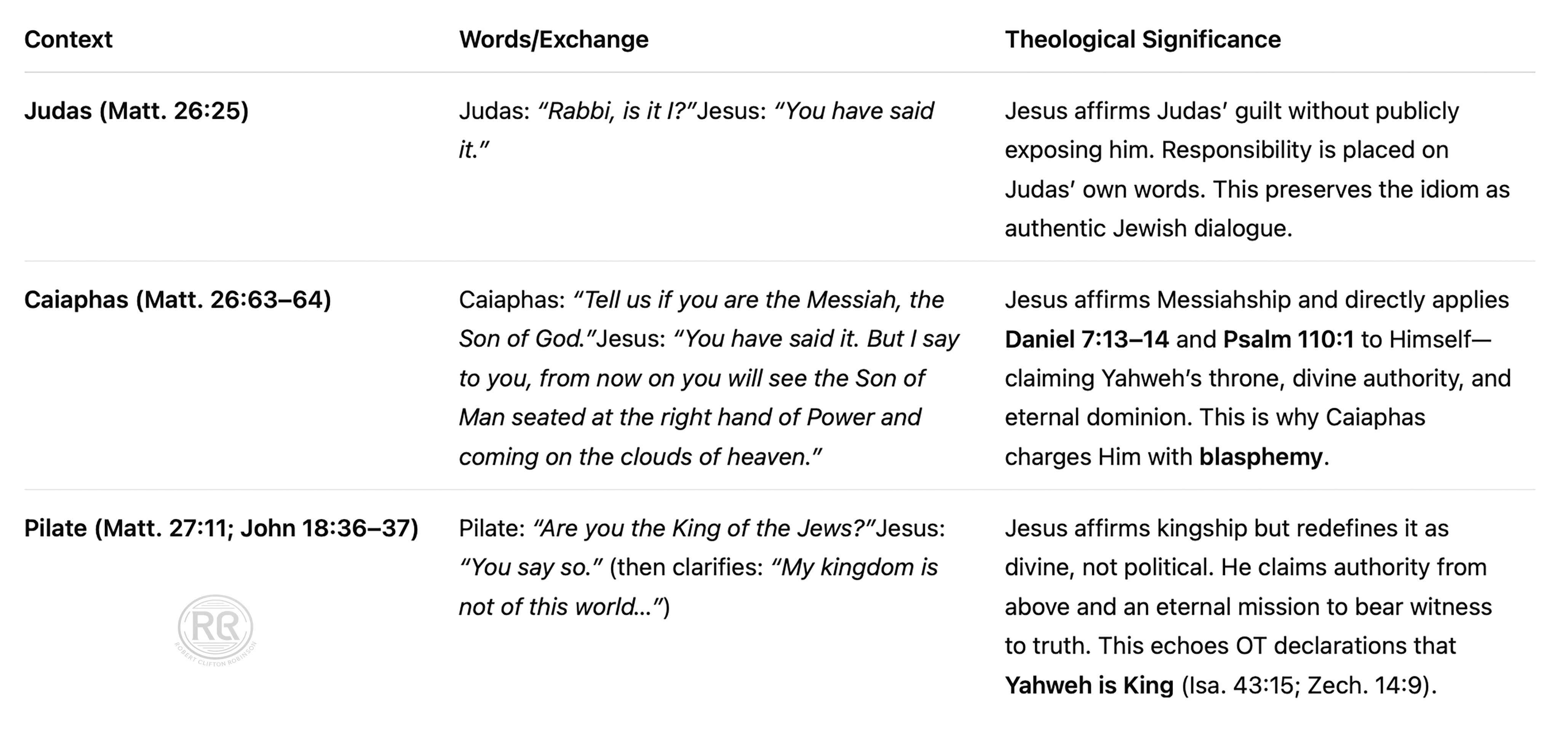
- Matthew 26:25 – Judas asks, “Rabbi, is it I?” Jesus replies, “You have said it.”
- Matthew 26:64 – The High Priest asks if Jesus is the Messiah, the Son of God. Jesus answers, “You have said it.”
- Matthew 27:11; Mark 15:2; Luke 23:3; John 18:37 – Pilate asks, “Are you the King of the Jews?” Jesus replies, “You have said so.”
These appear at moments of accusation, testing, or acknowledgment of His identity.
Meaning in Jewish Idiom
The phrase is a Semitic idiom reflecting a polite but indirect affirmation.
Not a simple “yes” – In Jewish and Near Eastern communication, it was often considered disrespectful, dangerous, or too blunt to state something outright when the hearer already knew the truth.
Affirmation with weight: “You have said it” places the emphasis back on the questioner: “What you have said is correct,” but in a way that acknowledges the responsibility of the speaker.
Protective ambiguity: In trial settings (before Caiaphas and Pilate), this phrasing allowed Jesus to affirm the truth without incriminating Himself in terms that could be twisted. It is a way of saying, “That is your statement, and it is true, but I will not reduce the truth to your limited categories.”
Rabbinic and Jewish Parallels
In rabbinic discourse, indirect affirmations were common. Rabbis would often respond with a counter-statement or acknowledgment that highlighted the interlocutor’s role. For example, Talmudic responses sometimes affirm indirectly with, “You have said,” implying agreement without blunt declaration.
In Jewish courts, self-incrimination was avoided. One could affirm truth by reflecting it back to the accuser, a way of confirming without volunteering direct testimony against oneself.
Scriptural Purpose in the Gospels
Jesus and Judas (Matt 26:25) – Jesus affirms Judas’ guilt without openly exposing him before the other disciples. The responsibility is laid at Judas’ own words.
Before Caiaphas (Matt 26:64) – Jesus confirms He is the Messiah, but in the form of an idiomatic affirmation that Caiaphas cannot deny. Jesus then expands: “From now on you will see the Son of Man seated at the right hand of Power.”
Before Pilate (Matt 27:11; John 18:37) – Jesus acknowledges His kingship, but in a way that shows Pilate’s categories (“King of the Jews”) are insufficient. He then clarifies: “My kingdom is not of this world.”
These facts clarifies the reason Jesus used this Jewish idiom: as a bridge between affirmation and clarification, simultaneously acknowledging truth while redefining it in God’s terms.
The phrase “you have said it” in the Gospels is:
- A Jewish idiom meaning “What you have said is true.”
- A protective rhetorical device that avoids crudeness or self-incrimination.
- A scriptural tool: Jesus affirms His identity while exposing the limits of human categories.
- A judicial reply: shifting the weight of responsibility to the accuser’s words, while still upholding truth.
When Jesus says “You have said it,” He is both affirming the truth and holding the hearer accountable for recognizing it. Jesus was not being evasive; it was a deliberate way of affirming the truth of God’s Word in a courtroom or accusatory setting without surrendering the higher meaning.
This Brings Us To Additional Questions Regarding Jesus’ Use of “You have said it.”
- If the Gospel narratives were a “fabrications” as critics assert, would this term, “You have said it,” be used?
- How does this term, “You have said it,” prove that Jesus claimed to be Yahweh/God?
Would “You Have Said It” Appear in a Fabrication?
If the Gospels were later “fabrications” (as critics often claim), the use of this subtle Jewish idiom would be highly unlikely for several reasons:
The Authenticity of Jewish Speech
The Koine Greek, “σὺ εἶπας (su eipas), you have said it” reflects Semitic idiom (Hebrew/Aramaic thought-patterns), not Greek or Roman style. A later Greek-speaking writer inventing a story would almost certainly use a blunt “Yes, I am” (Greek: egō eimi), which was simple, clear, and direct in Hellenistic narratives.
Instead, the Gospels preserve the Jewish indirect affirmation—evidence that it is rooted in Palestinian Jewish courtroom culture, not later Christian invention.
Consistency In All Contexts
This Jewish idiom, “you have said it,” appears not only before Pilate but also in dialogue with Judas and Caiaphas. This is a consistent Jewish rhetorical style that demonstrates historical memory rather than literary invention.
If the Gospels were fabricated, the authors could have embellished Jesus’ trial scenes with direct, dramatic confessions (“Yes, I am the Christ, the Son of God, and King!”). This would have simplified the texts and made it clear by the writer that Jesus claimed to be God. Instead, the writers of the four Gospels preserve a subtle courtroom idiom—something only someone familiar with first century Jewish legal settings would know.
Embarrassment Criterion
In apologetics, the criterion of embarrassment says writers inventing a story would not include details that appear ambiguous, potentially evasive, or confusing.
“You have said it” could be seen as evasive or unclear. A forger would prefer a direct “I am the Christ!” for maximum impact. The fact that the historical eyewitnesses kept this subtle idiom in their texts is strong evidence of its authenticity. This is iexactly the kind of awkward historical truth that survives in genuine testimony.
The presence of “You have said it” argues strongly against fabrication. It reflects an authentic, first-century Jewish way of speaking that later Gentile writers would not have invented.
How Does “You Have Said It” Prove Jesus Claimed to Be Yahweh/God?
At first glance, “You have said it” might look like a weak affirmation. But in context, it becomes a powerful self-revelation.
Caiaphas’ Question (Matthew 26:63–64)
- Caiaphas: “Tell us if you are the Messiah, the Son of God.”
- Jesus: “You have said it. But I say to you, from now on you will see the Son of Man sitting at the right hand of Power, and coming on the clouds of heaven.”
By This Statement To Caiaphas Jesus accomplishes three things:
- He affirms Caiaphas’ statement with the idiom.
- He identifies Himself with Daniel 7:13–14 – the “Son of Man” who comes with the clouds and receives universal worship.
- He places Himself at God’s right hand (Psalm 110:1), the position of divine authority.
For a Jewish audience, this is undeniably a claim that Jesus is claiming to be Yahweh/God:
- Only Yahweh rides the clouds (cf. Isaiah 19:1; Psalm 104:3).
- Only Yahweh shares His throne (Daniel 7 presents the Son of Man as receiving divine prerogatives).
- To claim this role was to claim equality with Yahweh.
Caiaphas understood what Jesus was claiming: He is God—he tore his garments and accused Jesus of blasphemy (Matt. 26:65).
Before Pilate (John 18:36–37; Matt. 27:11)
- Pilate: “Are you the King of the Jews?”
- Jesus: “You say that I am.”
- Then Jesus adds: “My kingdom is not of this world … For this I was born and for this I came into the world—to bear witness to the truth.”
Here, Jesus acknowledges Pilate’s political term (“King of the Jews”), but redefines kingship in terms that identifies Himself a s Yahweh/God from the Old Testament. His kingship is from above, not from earthly politics. This indirect claim aligns with Old Testament prophecies of Yahweh Himself being Israel’s King (Isaiah 43:15; Zechariah 14:9).
The Scriptural Weight of Jesus’ Statement
- “You have said it” means: Yes, but your words do not capture the fullness of what I mean.
- To Caiaphas: Jesus affirms Messiahship and directly claims Yahweh’s throne of authority.
- To Pilate: Jesus affirms kingship but redefines it in terms of divine truth and eternal authority.
In both cases, the idiom functions as a bridge: it affirms their words, but then Jesus expands the claim to unmistakable deity.
Authenticity: If the Gospel accounts were fabricated, the idiom “You have said it” would almost certainly not appear. It is an authentic Jewish courtroom idiom preserved only because it actually happened.
Claim to Deity: By using “You have said it” and then expanding with the Messianic texts of Daniel 7 and Psalm 110, Jesus absolutely identifies Himself as Yahweh’s equal—the divine Son who shares God’s throne, judgment, and worship.
That is why both Caiaphas (Jewish court) and Pilate (Roman court) reacted as they did: they recognized that Jesus had just claimed the unique prerogatives of God.
Sources and Citations
Historical and Linguistic Evidence
Semitic idiom:
- The phrase σὺ εἶπας (su eipas, “you have said [it]”) reflects a Semitic thought pattern more than a Greek one. It parallels Hebrew/Aramaic indirect affirmations, where one confirms by echoing the speaker’s words rather than bluntly saying “yes.”
- Joachim Jeremias, Jerusalem in the Time of Jesus (Philadelphia: Fortress, 1969), notes that Jewish courtroom language often used indirect affirmation.
- David Flusser, Jewish Sources in Early Christianity (Adama Books, 1987), highlights that “answering in the words of the accuser” was a known rabbinic device.
Rabbinic parallels:
- Mishnah Sanhedrin 4:5 shows the legal sensitivity in Jewish trials to prevent self-incrimination; indirect replies were preferred.
- The Babylonian Talmud (Berakhot 4a) records examples where agreement is expressed by reflecting the other’s words rather than direct assertion.
The Scriptural Texts
Judas: Matthew 26:25: “Judas, the one who would betray him, also asked, ‘Rabbi, am I the one?’ And Jesus told him, ‘You have said it.’”
Caiaphas: Matthew 26:63–64: “But Jesus remained silent. Then the high priest said to him, ‘I demand in the name of the living God—tell us if you are the Messiah, the Son of God.’ Jesus replied, ‘You have said it. And in the future you will see the Son of Man seated in the place of power at God’s right hand and coming on the clouds of heaven.’”
This combines Psalm 110:1 (“Sit at my right hand…”) and Daniel 7:13–14 (the Son of Man who comes with the clouds and receives authority, glory, and worship).
Pilate: Matthew 27:11: “Now Jesus was standing before Pilate, the Roman governor. ‘Are you the king of the Jews?’ the governor asked him. Jesus replied, ‘You have said it.’”
John 18:36–37 expands: “Jesus answered, ‘My Kingdom is not an earthly kingdom… Pilate said, ‘So you are a king?’ Jesus responded, ‘You say I am a king. Actually, I was born and came into the world to testify to the truth.’”
Scholarly and Apologetic Citations
Blasphemy charge and divine claim:
- Larry Hurtado, Lord Jesus Christ: Devotion to Jesus in Earliest Christianity (Eerdmans, 2003), pp. 168–174, explains that Jesus’ use of Daniel 7 + Psalm 110 was understood as a direct claim to divine prerogatives.
- N.T. Wright, Jesus and the Victory of God (Fortress, 1996), argues that Jesus deliberately framed His identity in terms of Yahweh’s authority and eschatological kingship.
- Darrell Bock, Blasphemy and Exaltation in Judaism and the Final Examination of Jesus (Jewish Studies Quarterly, 1998), shows that Caiaphas’ reaction proves the Jewish leaders heard Jesus’ words as a claim to deity.
- Criterion of embarrassment (authenticity of the idiom):
- John P. Meier, A Marginal Jew: Rethinking the Historical Jesus, vol. 1 (Doubleday, 1991), pp. 168–172, notes that the indirect phrase “you have said it” would not be invented by Christians since it appears evasive and is awkward—thus it likely preserves historical truth.
- Craig Blomberg, The Historical Reliability of the Gospels (IVP Academic, 2007), pp. 240–242, stresses that idiomatic phrases like this confirm early Jewish origin and authenticity.
Scriptural Importance
Claiming divine identity:
By affirming Caiaphas’ words and then adding Daniel 7 and Psalm 110 imagery, Jesus places Himself on Yahweh’s throne, receiving worship and eternal authority. This is why the high priest tears his robe (Matt. 26:65). This moment shows Jesus is not just claiming to be Messiah in a national sense but to be Yahweh’s co-regent, sharing God’s unique glory.
Categories: Robert Clifton Robinson
 Robert Clifton Robinson
It is interesting to me that Jehovah’s Witnesses rejected the Deity and Divinity of The Christ by claiming, falsely, that Jesus is Michael the Archangel. Most Witnesses will run from the discussion when the following scriptures are shown:
Isaiah 44:6
Isaiah 48:12
Yahweh (Jehovah) is stating directly that He is the First and the Last and that beside Him there is no God.
Now see what Jesus said about Himself:
Revelation 22:12:13
Jesus is claiming to be the First and the Last. How could Jesus make this claim if He were not God? This is why the correct translation of John 1:1 is necessary in order to understand the Deity and Divinity of The Christ as fully man and Fully God.
I recommend the Book above. I own it and it is packed full of valuable information concerning our Lord and Savior Jesus Christ.
I would also recommend the following Book:
We thank the Holy Spirit for Brother Rob. Prayers and Blessings always.
LikeLike