The Historical Reality of An Earlier And Later Fulfillment of the Same Prophecy:
The “Abomination That Brings Desolation” (Daniel 9:27, Matthew 24:15) Will Happen Twice: Once in 167 BC, Again During The Time of The Antichrist
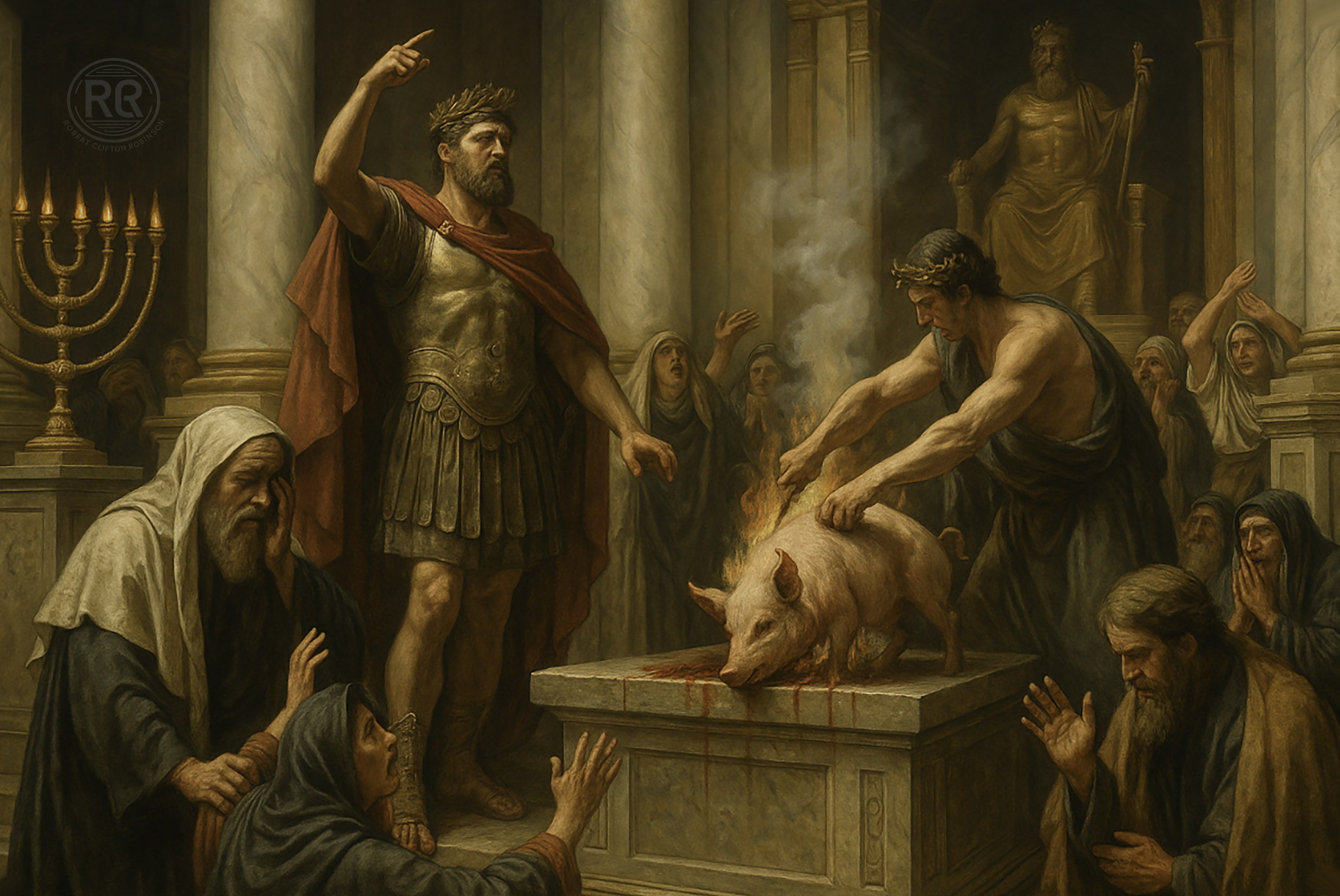
When Antiochus Epiphanes appeared in the historical record around 167 BC, he began works that were later referred to as fulfillments of biblical prophecy. Antiochus sent forces into Jerusalem, plundering the Temple treasury and outlawing Jewish religious practices (circumcision, Sabbath observance, sacrifices according to the Law). He erected an altar (or image) of Zeus Olympios inside the Temple, directly on the altar of burnt offerings (cf. 1 Maccabees 1:54; 2 Maccabees 6:1–5). He committed pagan sacrifices, including a pig’s flesh (an unclean animal by Jewish law), which were offered on the altar.
This sacrilege is described as the “abomination that causes desolation” in Daniel’s prophecy (Daniel 9:27; 11:31; 12:11), which the Maccabean authors and later Jewish tradition understood as fulfilled in Antiochus’ actions.
The problem with assigning the actions of Antiochus as the complete fulfillment of Daniel’s prophecy is that we know today, it was not. Jesus arrived in the first century and described a future “abomination that causes desolation,” confirmed by the Hebrew scholar, Paul, in 2 Thessalonians 2.
Matthew 24:15-16 “Therefore when you see the abomination of desolation,’ spoken of by Daniel the prophet, standing in the holy place” (whoever reads, let him understand), 16 “then let those who are in Judea flee to the mountains.”
2 Thessalonians 2:1-4 “Now, brethren, concerning the coming of our Lord Jesus Christ and our gathering together to Him, we ask you, 2 not to be soon shaken in mind or troubled, either by spirit or by word or by letter, as if from us, as though the day of Christ had come. 3 Let no one deceive you by any means; for that Day will not come unless the falling away comes first, and the man of sin is revealed, the son of perdition, 4 who opposes and exalts himself above all that is called God or that is worshiped, so that he sits as God in the temple of God, showing himself that he is God.”
What we learn from this example, and many others in scripture, is that the God of the Bible often presents us with an earlier and later fulfillment of the same prophecy. The earlier historical events give us hints about the later, and more important fulfillment of the same prophecy.
An example of this is seen in two texts from the Old and New Testaments.
In three of the Gospels (Synoptics), Jesus is recorded as returning to His hometown of Nazareth and going to the synagogue where He was invited to read from the scroll of Isaiah the prophet.
Matthew 13:54–58, Mark 6:1–6, and Luke 4:16-30 record Jesus coming to Nazareth, but only Luke writes and tells us about the scroll of Isaiah, and Jesus reading this text at the synagogue of Nazareth.
As the attendant handed Jesus the scroll of Isaiah, Jesus opened it to Isaiah 61.
This is interesting for us because, at the time Jesus took the scroll and opened it, the text He was reading was all the way at the end of the scroll of Isaiah.
This is important because the scroll of Isaiah is about 24 feet long and rolled up on two sides. In order for Jesus to read from the section we know today as the 61st chapter, it will take a little time to go to this section.
Either Jesus went to this section Himself intentionally, or the attendant who handed it to Jesus had already opened the scroll to this section. The text says that “He found the place where it was written…”
When people in the first century would quote from a particular section of the Hebrew Bible, they would not cite a chapter and verse. They would cite the texts as “from the section where the prophet says…”
Luke 4:16-20: “So Jesus came to Nazareth, where He had been brought up. And as His custom was, He went into the synagogue on the Sabbath day and stood up to read. And He was handed the book of the prophet Isaiah. And when He had opened the book, He found the place where it was written: “The Spirit of the LORD is upon Me,…”
Examining the original text recorded by Isaiah:
Isaiah 61:1-3
1 “The Spirit of the Lord GOD is upon Me, Because the LORD has anointed Me To preach good tidings to the poor; He has sent Me to heal the brokenhearted, To proclaim liberty to the captives, And the opening of the prison to those who are bound;
2 To proclaim the acceptable year of the LORD, And the day of vengeance of our God; To comfort all who mourn, 3 To console those who mourn in Zion, To give them beauty for ashes,
The oil of joy for mourning, The garment of praise for the spirit of heaviness; That they may be called trees of righteousness, The planting of the LORD, that He may be glorified.”
New Testament Confirmation and a dual fulfillment:
When Jesus arrived at Nazareth, He entered the synagogue and was handed the scroll of Isaiah. Jesus opens chapter 61 and informs those in attendance that He is fulfilling the words of Isaiah’s prophecy at that precise moment.
The Old Testament Prophecy:
Isaiah 61:1-62: “The Spirit of the Lord GOD is upon Me, Because the LORD has anointed Me To preach good tidings to the poor; He has sent Me to heal the brokenhearted, To proclaim liberty to the captives, And the opening of the prison to those who are bound; To proclaim the acceptable year of the LORD, And the day of vengeance of our God…”
Compare Isaiah’s words to those spoken by Jesus when He came to the synagogue at Nazareth and quoted from this verse found in Isaiah 61:
Luke 4:16-20: “So Jesus came to Nazareth, where He had been brought up. And as His custom was, He went into the synagogue on the Sabbath day, and stood up to read. And He was handed the book of the prophet Isaiah. And when He had opened the book, He found the place where it was written: “The Spirit of the LORD is upon Me, Because He has anointed Me To preach the gospel to the poor; He has sent Me to heal the brokenhearted, To proclaim liberty to the captives And recovery of sight to the blind, To set at liberty those who are oppressed; To proclaim the acceptable year of the LORD.” Then he closed the book, gave it back to the attendant and sat down. And the eyes of all who were in the synagogue were fixed on Him.”
Notice that Jesus omitted the text: “And the day of vengeance of our God…”
Why?
At Jesus’ first arrival on earth, He was coming to proclaim the “acceptable year of the Lord,” as the suffering servant of God—the Lamb who would lay down His life for the sins of the world. At Jesus’ second appearance on earth, at the end of the seven-year Tribulation, He is coming as King of kings and Lord of lords, to bring judgment at the “day of vengeance.”
When Jesus finished reading the words of Isaiah Chapter 61, He rolled up the scroll and handed it back to the attendant. Luke 4:21: “As He sat down, the eyes of all those in the synagogue were transfixed on Jesus. Then He said these words: Today this Scripture is fulfilled in your hearing.”
Those who heard Jesus speak in the synagogue were utterly astonished. The words of these prophecies, from Isaiah Chapter 61, could only be fulfilled by the coming of the Messiah. By stating that this prophecy had been fulfilled as Jesus spoke, He was claiming to be the Messiah. Jesus said that He would fulfill the first part of Isaiah 61—the acceptable year of the Lord—during His first arrival, and then the day of vengeance of our God at His return.
Jesus revealed something to us that was hidden in verse 12 of Isaiah 61: There were two parts to the fulfillment of this prophecy.
Isaiah 61:2: (Part 1) To proclaim the acceptable year of the LORD, (Part 2) And the day of vengeance of our God…
Part one: to fulfill the acceptable year of the Lord—the time when God would pardon the sins of anyone who came to Jesus and believed in Him as their Savior.
Part two: the day of vengeance, would be fulfilled at the end of the seven-year Tribulation, when Jesus would return to earth with His church (Revelation 19) and rule over the whole earth for one thousand years as absolute King and Lord.
This example from Isaiah 61, which is partially fulfilled in Luke Chapter 4, demonstrates that there can be an earlier fulfillment as well as a later fulfillment of the same prophecy.
The Prophetic Significance of an Earlier and Later Fulfillment of the Same Prophecy:
The book of Daniel foretold this event centuries earlier: Daniel 11:31 – “His army will take over the Temple fortress, pollute the sanctuary, put a stop to the daily sacrifices, and set up the sacrilegious object that causes desecration”.
Jewish and Christian biblical expositors see this as a type or foreshadowing of a greater, future “abomination of desolation” (Matthew 24:15; Mark 13:14; 2 Thessalonians 2:4; Revelation 13).
The historical “abomination of desolation” under Antiochus IV Epiphanes (167 BC) was the desecration of the Jerusalem Temple by erecting an altar to Zeus and sacrificing swine on it, combined with outlawing Jewish practices.
This event fulfilled Daniel’s prophecy by an earlier fulfillment of the same later event predicted by Jesus and expanded on by Paul, sparked the Maccabean revolt, leading to the rededication of the Temple in 164 BC (Hanukkah). It also serves as a prophetic type pointing to a future fulfillment in eschatology
The Principle of Earlier and Later Fulfillment of the Same Prophecy
Biblical prophecy often functions on two levels:
- An immediate or near fulfillment in the prophet’s own historical context (to validate the prophecy and speak to the audience of that time).
- An ultimate or future fulfillment in the person and work of the Messiah, or in eschatological events tied to the end of the age.
This is why some prophecies appear “partially fulfilled” in the Old Testament era, yet are reapplied and expanded in the New Testament to describe Jesus’ first or second coming.
This is an important principle because it gives us a historical confirmation that the prophecies we are reading in the Bible are reliable. For an Old Testament prophet to make an earlier prophecy, if that prophecy did not happen precisely as he wrote, then he would be a “false prophet,” stoned to death. All of his prophecies would be stricken from his record.
The fact that these earlier prophecies remain in the Bible today tells us that these prophets made predictions that are verified in their earlier application. This means that we are certain to see the fulfillment of the earlier prophecy, at a later days also.
The prophets themselves often saw both fulfillments as part of a single prophetic horizon—like looking at two distant mountain peaks that appear side by side, but which are separated by a vast valley of time.
The Precise Example of Isaiah 61
- Isaiah 61:1–2a (“The Spirit of the Lord is upon Me… to proclaim the acceptable year of the Lord”) was fulfilled at Jesus’ first coming (Luke 4:16–21).
- Isaiah 61:2b (“the day of vengeance of our God”) remains unfulfilled until His second coming, when He judges the nations and establishes His kingdom (Revelation 19:11–21).
The fact that Jesus deliberately stopped mid-verse in Luke 4 is one of the clearest demonstrations that a single prophecy can contain two chronological horizons.
The Abomination of Desolation Described by Daniel
There was an Earlier Fulfillment: Daniel 11:31 was historically fulfilled in 167 BC by Antiochus IV Epiphanes, who set up an altar to Zeus in the Temple and sacrificed swine (1 Maccabees 1:54). This event became known as the “abomination of desolation.”
There was a Later Fulfillment: Jesus cites this prophecy as yet future in Matthew 24:15 (“When you see the abomination of desolation spoken of by Daniel…”).
- Paul expands on this in 2 Thessalonians 2:3–4, describing the Antichrist who will set himself up in God’s temple, declaring himself to be God.
- John in Revelation 13 portrays the Beast demanding worship from the whole world.
For these reasons, Antiochus was a type of the coming Antichrist, but not the final fulfillment. His actions foreshadowed a greater, climactic desecration.
Antiochus IV (Epiphanes) as a Type of the Antichrist
The Historical reality: Antiochus desecrated the Temple in 167 BC, outlawed Torah observance, and demanded worship of Zeus.
The Prophetic type: Though not the Antichrist, Antiochus was a forerunner, or shadow-type, displaying the characteristics the final Antichrist will embody in their fullest form.
The Witness of Scripture: Daniel 11:31 speaks directly of Antiochus, but Jesus in Matthew 24:15 extends this prophecy beyond him—showing that the ultimate fulfillment awaits until the last of the Last Days.
The Principle: A historical “abomination” foreshadowed the ultimate “abomination of desolation, much later.”
The Characteristics of the Antichrists in Daniel and Revelation
Who is the antichrist? No one knows. We do know what the Bible says about this man and what his attributes will be. Do we see anyone on earth today who exhibits the attributes of the antichrist?
- He will be a peacemaker.
- He will be a master negotiator.
- He will be a financial genius.
- He will be a military genius.
- He will be a political genius.
- He will be boastful and arrogant.
Is it possible that we will see an earlier before the later revealing of the antichrist?
It is important to remember that before he is known as the antichrist, he will be a wonderful world leader who will accomplish the first five items in the above list.
These are all good works that will cause the world to proclaim him as the greatest leader the world has ever known. He will come during a time of great political and military conflict and set out to make peace and prevent wars.
There are other Historical Similarities to the coming antichrist that we have seen in the past
- Nebuchadnezzar (Daniel 3–4): demanded worship, consolidated empire.
- Antiochus IV (167 BC): desecrated the Temple, outlawed true worship.
- Roman emperors like Nero and Domitian persecuted Christians and demanded divine honors.
- Modern leaders: figures who gain global influence through politics, military might, and economics may reflect the pattern without being the ultimate fulfillment.
This is why John said of the coming antichrist: “You have heard that the antichrist is coming, and already many antichrists have appeared” (1 John 2:18).
The spirit of antichrist manifests repeatedly, but the final antichrist is still future.
A Contemporary Parallel
When we examine the good works of President Donald Trump, he may be the world leader described by Daniel 9:27 in the Bible. He is accomplishing the first five attributes that scripture defines for the coming world leader of the Last Days.
President Trump’s rise to power and prominence demonstrates how a leader can command massive loyalty, wield political and economic strength, and influence global conversations. These modern dynamics of a world leader illustrate how the final world system will work: a single charismatic leader whose political, military, and financial prowess secures worldwide dominance.
In this regard, just as Antiochus was a preview of the ultimate abomination, contemporary leaders may not be the antichrist, while they demonstrate the same power, skill, abilities, and prominence that the coming world leader Daniel predicted.
Why Does God Allow Typological Previews?
To Validate Prophecy: Earlier fulfillment proves that God’s Word is trustworthy.
To Prepare the Saved for the Rapture: Preparation of Believers who are taught by scripture to recognize patterns and not be surprised when the final fulfillment comes.
A Warning to the world: Each historical echo is a reminder that God’s Word will be completed in the ultimate sense.
Antiochus Epiphanes was not the antichrist, but his deeds foreshadowed the antichrist to come. In the same way, modern leaders—like President Trump—can exhibit striking parallels to the traits described in Daniel and Revelation.
This doesn’t mean that President Trump is the world leader specified by Daniel 9:27, only that he is currently doing many of the things that the Prophecies of the Old Testament say the world leader will do.
This reinforces the biblical principle of earlier and later fulfilment of the same prophecy.
What Scripture Says About the antichrist
The Bible provides very specific characteristics of the final antichrist (also called “the man of sin,” “the Beast,” etc.):
These facts of the antichrist will happen after the middle of the Seven-Year Tribulation
- Global Dominion: He will be given authority “over every tribe and people and language and nation” (Revelation 13:7).
- Temple Desecration: He will sit in the temple of God, declaring himself to be God (2 Thessalonians 2:3–4; Daniel 9:27; 11:36–37).
- Demand Worship as God: The world will worship him and the image of the Beast (Revelation 13:4, 15).
- Economic Control: He will enforce the “mark” to buy or sell (Revelation 13:16–17).
- Supernatural Empowerment: His rise will be empowered by Satan himself, with lying signs and wonders (2 Thessalonians 2:9–10).
These are not vague qualities—these are concrete markers. Until a leader fits them all, they cannot be definitively identified as the antichrist.
What We Cannot Say With Certainty
We cannot definitively exclude any present or future leader from being a candidate, since prophecy is not yet fully unfolded.
We cannot assert dogmatically who the antichrist is until the prophetic markers are in place (especially the covenant of Daniel 9:27, the desecration of the Temple, and global dominion).
This is why Paul tells us: “that day will not come until the rebellion occurs and the man of lawlessness is revealed” (2 Thessalonians 2:3, NIV). The word “revealed” implies that until a certain point in time, his identity is not fully knowable.
What We Can Say With Confidence
Leaders like Antiochus Epiphanes, Roman emperors, and modern figures often foreshadow the antichrist because they display the same qualities of charisma, political and military power, economic control, and anti-God policies. These persons are real previews of what is to come, but they are not always the final fulfillment of the prophecy. The question of whether Donald Trump, as the President of the United States, is a preview of the world leader to come, described by the texts of Daniel and other prophecies, is still under review.
Until the antichrist performs the specific actions predicted in prophecy, we cannot say with certainty that any person is or is not the antichrist.
The Correct Biblical Position
As students of the Bible, we are followers of Jesus. He leads us, we follow Him. Jesus said to “watch,” and not speculate. Jesus told us to watch for the signs of His arrival (Matthew 24:42), not to jump to premature conclusions. This does not, however, prevent us from discussing these issues and comparing scripture with current events.
Pattern recognition: We should note that when leaders show antichrist-like qualities, we should pay attention and ask if we are entering the time when the world leader/antichrist will appear.
Confidence in God’s sovereignty: The antichrist will be fully recognized and rise until “that which hinders is taken out of the way,” (2 Thessalonians 2:6–7).
We cannot definitively say at this point in 2025 that Donald Trump (or any leader) is or is not the world leader who is later know at the midpoint of the seven year Tribulation as the antichrist. What we can say is that Trump is displaying the first five attributes of the World-Ruler who will perform great works during the first three and a half years of the Seven-Year Tribulation.
WORLD-LEADER: The First three and a half years: a peacemaker, a master negotiator. A financial genius, a military genius, a political genius.
ANTICHRIST/BEAST: The Second three and a half years: enter the Temple and be proclaimed as “God,” command to worship him, set up a monetary system where no one can buy or sell anything without the “mark of the beast,” behead all people who profess Christ as Savior, cause global war, death, pestilence, meet Jesus with armies at the Valley of Megiddo to fight against Him.
The question for us at this point in history is whether Donald Trump is exhibiting the first five attributes of the World-Leader specified by prophecy. The answer is “yes.” This does not, however, mean that he is the coming antichrist/beast. We will have to wait and see what transpires.
It is interesting that at this present time, Trump has instituted a “Peace Plan” that resembles the Seven Year Peace Plan specified by Daniel 9:27: “He (the antichrist) shall confirm a covenant (of peace) with many nations for one week (7 years).
The Hidden Phase of the World Leader Before His Revelation as the antichrist
Paul writes: “That day will not come until the rebellion occurs and the man of lawlessness is revealed” (2 Thess. 2:3): “For the mystery of lawlessness is already at work; only he who now restrains will do so until he is taken out of the way. Then the lawless one will be revealed” (2 Thess. 2:7–8).
- The antichrist is active before he is revealed, as a world leader.
- His rise seems beneficial at first — he is not instantly recognizable as “evil.”
- The world welcomes him because he appears to solve the very problems people long to have solved.
His Initial Public Image: A Savior, Not a Tyrant
Scripture hints that the antichrist will be celebrated initially as a genius leader who brings the world what it needs:
- Peace-Maker – Daniel 9:27 speaks of a covenant (“peace treaty”) with Israel and many nations.
- Political Genius – Daniel 7:8, 20 depicts him as a “little horn” that grows to dominate larger powers — subtle, persuasive, and shrewd.
- Economic Prosperity – Revelation 13:16–17 shows his eventual control of global commerce, but it likely begins as financial order and prosperity that impresses the world.
- Stopping Lawlessness/Chaos – He will appear to bring stability during a time of turmoil, winning global admiration (Revelation 13:4: “Who is like the beast? Who can fight against him?”).
At first, he doesn’t come with open oppression but with solutions. His evil is cloaked in apparent righteousness.
The Pattern of Deceptive Forerunners
This deceptive pattern is exactly what we saw in former historical leaders:
- Antiochus Epiphanes came under the guise of stabilizing the Seleucid empire but turned to desecration.
- Roman Emperors were hailed as “saviors of the world” before demanding worship as gods.
- Modern leaders often rise by promising peace, unity, and prosperity, only to reveal corruption later.
- The antichrist will be the manifestation of this historical pattern.
Why the World Will Miss His True Identity
Deceptive Appearance: The World-Leader initially comes not with horns and terror, but as a charismatic, “reasonable” leader. Later, at the mid-point of the seven-year Tribulation, he manifests:
- Satanic Power: 2 Thessalonians 2:9 says his rise is accompanied by lying signs and wonders.
- Delusion of the World: God allows a “strong delusion” so that those who reject truth will believe the lie (2 Thessalonians 2:10–12).
- Timing of Revelation: Only after he breaks his covenant of peace, desecrates the Temple, and demands worship as God (Daniel 9:27; Matthew 24:15; Revelation 13) will the world see his true nature as satan incarnate.
The antichrist will be praised before he is feared.
The Church Jesus birthed in Acts 2, if it is still present at the early period before the Seven-Year Tribulation, may see the World-Leader who will be the antichrist/beast, before he is known to the world. The Apostle John wrote: “Even now many antichrists have come” (1 John 2:18) — there will always be leaders who look like him, but the final antichrist is hidden until God’s appointed time.
Before the antichrist is “revealed,” he will appear to be a hero: making peace, stopping chaos, creating prosperity, and winning political victories. This deception explains why the world will embrace him — and why Jesus and Paul warn us to watch carefully. His “wonderful” achievements will precede his unveiling as the Beast of Revelation.
Prophecies of the antichrist’s Military Power
Scripture repeatedly highlights his military strength and success:
- Daniel 7:8, 20–21 – As the “little horn” antichrist overcomes the other horns (nations/rulers), subduing them by force.
- Daniel 8:24 – “He will become very strong, but not by his own power. He will destroy mighty men and the holy people.”
- Daniel 11:38–39 – He honors the “god of fortresses” (military might), conquers strongholds, and rewards his supporters.
- Revelation 13:4 – The world marvels, saying: “Who is like the beast? Who is able to wage war against him?”
Clearly, his ability to wage war is one of the features that gains him global admiration.
The Sequence of the antichrist’s Military Success
The Early Stage – “Peaceful” victories
- Like Antiochus Epiphanes, he may initially win by political cunning and alliances.
- Daniel 8:25 says, “By peace he shall destroy many” (KJV), implying he uses diplomacy as a weapon.
Middle Stage – Subduing rivals
- Daniel 7:24 says he will uproot three kings out of ten — consolidating power by military force.
- These “three horns” could represent three nations or leaders he defeats decisively.
Later Stage – Global dominance
- Revelation 13 and 17 describe him ultimately commanding worldwide submission, not just politically but militarily, with no rival able to resist him.
Why The Followers of Jesus Must Watch
To the watching world, his military victories will be seen as heroic achievements; to the saved, his early achievements will be an indication of this arrival and deception
- He will end wars others could not.
- He will defeat enemies seen as unstoppable.
- He will establish “order” in a time of chaos.
This is why people will say: “Who is like the beast?” (Rev. 13:4). His rise will look like the coming of a savior, not a destroyer.
The Historical Parallels
- Alexander the Great – Won impossible victories, uniting nations under one empire.
- Antiochus Epiphanes – Used both intrigue and war to expand his power.
- Modern Leaders (Napoleon, Hitler, etc.) – At first admired for brilliance, later revealed as destructive.
The initial World-Leader who will later be the antichrist will combine the charisma of a politician, the strategy of a general, and the cunning of a diplomat — making him appear unstoppable.
The Two Phases of His Military Career
- Admired Phase – Achieves stunning victories that the world interprets as miraculous.
- Revealed Phase – Turns his military might against God’s people (Israel, Tribulation saints), leading to his ultimate defeat at Christ’s return (Revelation 19:19–21).
The World-Leader/antichrist’s rise will be marked by military genius — early victories that bring admiration and unite nations under his leadership. These triumphs will appear to solve humanity’s problems, reinforcing his image as a savior. Only later will it be clear that this same power is turned against God and His people.
The point is that at this place in history, we do see Trump accomplishing many of the earlier works of the world leader just before and during the first three and a half years of the Tribulation, but we do not see the terrible things the antichrist will do after he goes into the rebuilt temple and is proclaimed as God, after satan entered him.
Although Trump cannot be designated at this point as the antichrist, he is showing early achievements that the world leader of Daniel 9:27 will make. This holds the possibility that Trump is an earlier look at the coming antichrist (preview), or he is the man that Daniel and Revelation describe. We watch and wait.
See Rob’s New Book That Details All the Current Events of the Trump Peace Plan: “Days of Wrath: The Final Sign“

Click on the Image to Look Inside the Book
Sources and Citations
The Jewish Response: The Maccabean Revolt
- This desecration triggered the Maccabean Revolt (167–160 BC) led by Mattathias the priest and his sons, especially Judas Maccabeus.
- The revolt succeeded in reclaiming Jerusalem, cleansing the Temple, and restoring proper sacrifices in 164 BC.
- This rededication is celebrated annually in Hanukkah (Feast of Dedication), commemorating the purification of the Temple after Antiochus’ defilement (John 10:22 refers to this feast in the New Testament).
Historical Sources
- 1 Maccabees 1:41–64 describes Antiochus’ decree outlawing Jewish practices and the abomination placed on the altar.
- 2 Maccabees 6–7 gives details of the persecutions, including martyrdoms of those who refused to eat pork or worship idols.
- Josephus, Antiquities of the Jews, Book 12, Chapter 5–7 also records Antiochus’ desecration and the Maccabean resistance.
Categories: Robert Clifton Robinson
 Robert Clifton Robinson
I post this hear to illustrate an example of the Third Seal Judgement (Revelation 6:5-6). Imagine this happening globally everyday to everyone.
https://www.cnn.com/2025/10/18/americas/made-in-guatemala-working-conditions-as-equals-intl-cmd
Prayers and blessings to all.
LikeLike
I really wasn’t sure which essay this new article would benefit more. All probably. So I will place it here. The Arc de Trump is coming.
https://www.foxnews.com/politics/trump-reveals-arc-de-triomphe-style-monument-americas-250th-anniversary
LikeLiked by 1 person