When Jesus Arrived on Earth He Said That The Truth He Delivered To The World, Was Complete, No Updates Are Required
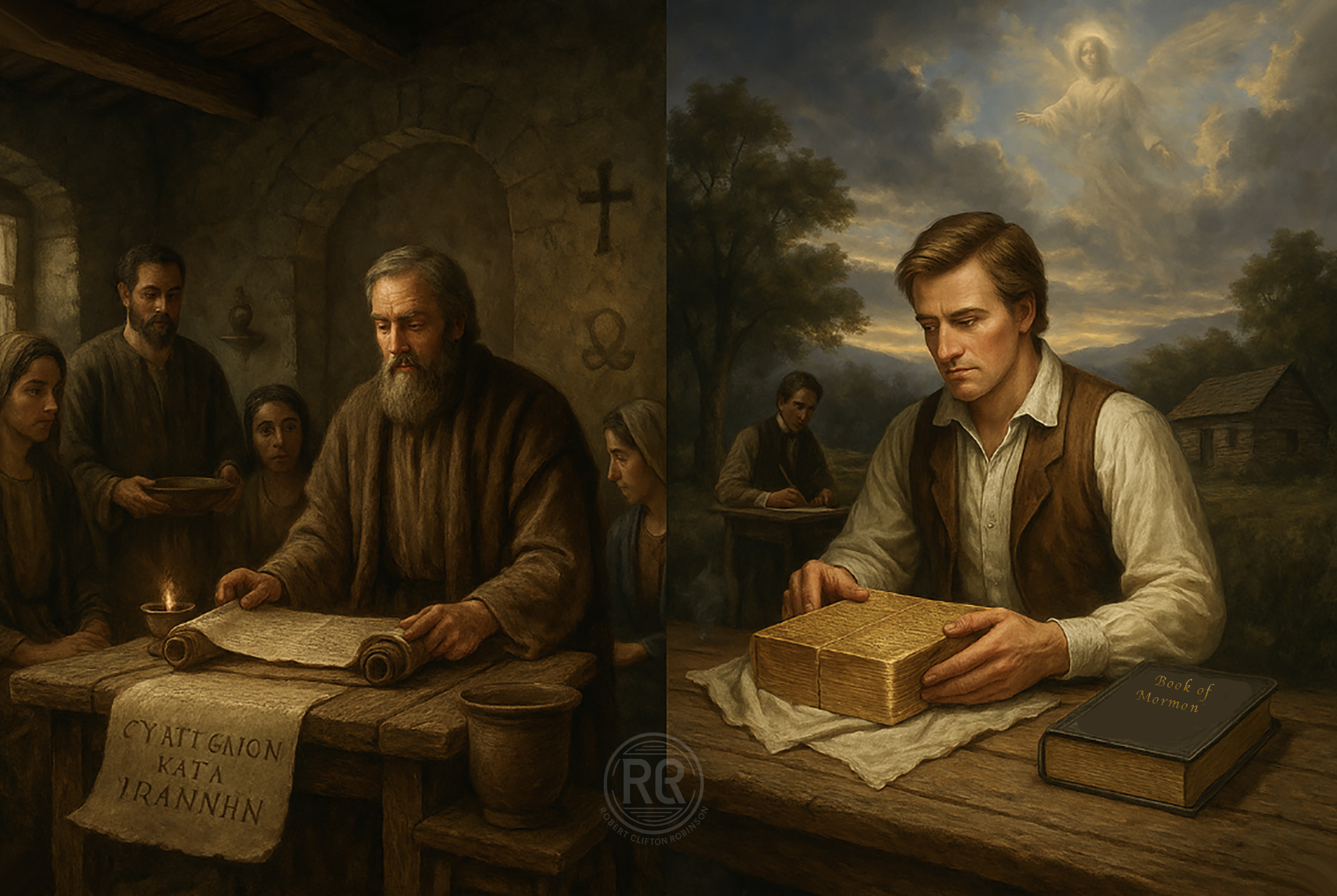
In fact, Jesus concluded the New Testament with the words that we should not ever add or remove anything that has once and for all been delivered to us by Him and the first century men He called to write the New Testament:
Revelation 22:18-19 “For I testify to everyone who hears the words of the prophecy of this book: If anyone adds to these things, God will add to him the plagues that are written in this book; and if anyone takes away from the words of the book of this prophecy, God shall take away his part from the Book of Life, from the holy city, and from the things which are written in this book.”
Mormons object to the idea that the New Testament is complete, stating that there are thousands of Christian sects that disagree with each other. In this regard, Mormons are correct, but Jesus didn’t tell anyone to follow a religion, sect, or other leader. Jesus said, 23 times in the New Testament: “Follow Me.”
Matthew 9:9: “As Jesus passed on from there, He saw a man named Matthew sitting at the tax office. And He said to him, “Follow Me.” So he arose and followed Him.”
Jesus didn’t come to earth to establish a new religion. He came to call people out from this world to follow Him. The creation of thousands of denominations and sects, was never Jesus’ idea. Jesus birthed one church forever, in 32 AD, detailed in Acts chapter 2.
We follow only Jesus and the words, doctrines and principles set forth in the 260 chapters of the New Testament.
The Core Issue: Need
Joseph Smith’s Precise Words Justifying the Need for a New Church: The claim that “all churches” had apostatized
Joseph Smith—History 1:18–19
“I asked the Personages who stood above me in the light, which of all the sects was right…
I was answered that I must join none of them, for they were all wrong; and the Personage who addressed me said that all their creeds were an abomination in His sight; that those professors were all corrupt; ‘they draw near to me with their lips, but their hearts are far from me; they teach for doctrines the commandments of men…’”
This is the foundation of Mormonism’s claim that the church had vanished and needed to be restored.
Smith’s explicit declaration of a “total apostasy” requiring restoration
Doctrine and Covenants 1:30 (written as Christ’s own words through Smith)
“And also those to whom these commandments were given, might have power to lay the foundation of this church, the only true and living church upon the face of the whole earth, with which I, the Lord, am well pleased.”
Joseph Smith’s Claim that the priesthood authority had been lost from the earth
Doctrines and Covenants 13 – Restoration of Aaronic priesthood
“Upon you… I confer the Priesthood of Aaron… and this shall never be taken again from the earth, until the sons of Levi do offer again an offering unto the Lord in righteousness.”
History of the Church 1:40–41 – Smith’s account of angelic ordination
“…John the Baptist… said that the Aaronic Priesthood had not been upon the earth since the days of Christ…”
Thus according to Smith, Christianity lacked valid priesthood authority for roughly 1,700 years.
Joseph Smith’s Words Justifying the Need for New Revelation
Jesus allegedly tells Joseph that Christianity has no true church or authority
Joseph Smith—History 1:19
“…that all their creeds were an abomination in his sight…”
Smith used this to argue that the gospel had been corrupted and required restoration.
Smith’s claim that God called him because “none doeth good”
Doctrine and Covenants 1:15–17
“They have strayed from mine ordinances, and have broken mine everlasting covenant…
none doeth good, no not one…Wherefore, I the Lord… called upon my servant Joseph Smith, Jun., and spake unto him from heaven…”
This is Joseph’s explanation for why the Lord allegedly had to start again.
Smith asserts that the canon of Scripture is open and continuous
Doctrine and Covenants 1:38
“Whether by mine own voice or by the voice of my servants, it is the same.”
Doctrines and Covenants 76:114–118 – On “new revelation”
“But great and marvelous are the works of the Lord… which God hath revealed unto us… the end hath not yet been revealed; wherefore, he will show unto us greater things.”
Smith repeatedly used this to argue that the Bible was insufficient.
Joseph Smith’s Words Justifying the Need for the Book of Mormon: Claim that the Bible was corrupted and incomplete
1 Nephi 13:26–29 (Book of Mormon, attributed to Joseph Smith’s translation)
“…plain and precious things had been taken away from the book… because of these things which are taken away… an exceedingly great many do stumble…”
This is the heart of the justification: a corrupted Bible needs supplementation.
The Claim that another record (Book of Mormon) would restore truth
1 Nephi 13:40
“…the Lamb of God is the Son of the Eternal Father, and the Savior of the world; and… shall make known the plain and precious things which have been taken away from them…”
Joseph’s own description of the Book of Mormon as “the fulness of the everlasting gospel”
Doctrine and Covenants 20:8–9
“Which contains a record of a fallen people… And also to the convincing of the Jew and Gentile that Jesus is the Christ… which was given by inspiration, and is confirmed to others by the ministering of angels, and is the fulness of the gospel…”
Joseph Smith’s explanation of why the plates were revealed to him
Joseph Smith—History 1:34–35
“He [the angel] said there was a book deposited, written upon golden plates… He also said that the fulness of the everlasting Gospel was contained in it, as delivered by the Savior…”
Smith’s reason he claimed the Book of Mormon was necessary
History of the Church 4:461 (also canonized in Teachings of the Prophet Joseph Smith)
“I told the brethren that the Book of Mormon was the most correct of any book on earth,
and the keystone of our religion, and a man would get nearer to God by abiding by its precepts than by any other book.”
This asserts superiority over the Bible.
Joseph Smith’s Justifications for creating a new church in His Own Words:
Why a new church?
- “All their creeds were an abomination” (JS-H 1:19)
- “All their professors were corrupt” (JS-H 1:19)
- “The only true and living church on earth” (D&C 1:30)
Why new revelation?
- “They have strayed from mine ordinances… broken mine everlasting covenant” (D&C 1:15)
- “Called upon my servant Joseph Smith…” (D&C 1:17)
- “He will yet reveal many great and important things” (Articles of Faith 1:9)
The Reason Joseph Smith Asserted We Need The Book of Mormon:
- “Plain and precious things were taken away [from the Bible]” (1 Nephi 13:28)
- “The fullness of the everlasting gospel” is in it (JSH 1:34; D&C 20:9)
- “Most correct book on earth” (HC 4:461)
Joseph Smith’s Made It Clear:
- The church Jesus founded has vanished.
- The Bible was corrupted.
- Authority was lost.
- Joseph Smith alone restored the gospel, revelation, priesthood, and scripture.
In This Essay I Will Present Evidence That All of Jospeh Smith’s Claims, Above, Are False
The foundational question is not whether Mormonism exists—it does—but whether it is needed as a replacement, supplement, or correction to the New Testament faith that has existed since the first century.
In former essays I detail that not only is the Mormon religion and the book of Mormon not necessary because of the New Testament, the Book of Mormon is a deceptive fabrication that has been thoroughly impeached by archeology, literary scholarship, and historical facts.
New Testament Christianity claims:
- The faith was “delivered once for all” to the saints (Jude 3).
- The gospel is unchangeable; even “an angel from heaven” cannot introduce another (Gal. 1:6–9).
- The church Jesus established would endure and never be overcome (Matt. 16:18).
- Scripture is complete and sufficient (2 Tim. 3:15–17).
When we examine the texts of the 260 chapters of the New Testament we find that everything necessary for any person to find God, know Him, and obtain the forgiveness of their sins, has existed for 2,000 years.
Mormonism claims:
- The Christian church became apostate shortly after the apostles.
- The gospel was lost from the earth.
- Joseph Smith restored the “true church” in 1830.
- New revelations, new scriptures, new doctrines, and new priesthood authority were needed.
These facts as stated in the record brings us to the question: Did Christianity lose the gospel, the church, authority, and Scripture—making Mormonism necessary?
This claim must be evaluated historically, biblically, textually, and doctrinally.
The Historical Problem With Mormonism’s Claim of a Universal Apostasy
There is No Historical Evidence of a Total Apostasy
Mormon founders taught that every denomination became corrupt and that no true believers remained on earth until Joseph Smith.
The Historical Record Proves That New Testament Christianity Presents Is With:
- A continuous, documented church from the first century to the present day.
- Extensive 24,593 extant manuscripts that provide us with evidence that the entirety of the New Testament has been preserved for 2,000 years, across the entire ancient world.
- Early church fathers quoting almost the entire New Testament by 150–180 AD.
- No historical record anywhere—Christian, Jewish, Roman, or otherwise—of a disappearance of true believers or a collapse of original Christian doctrine.
If a universal apostasy happened, someone should have recorded it. There is nothing in the historical record that proves the assertion of Mormonism that claims:
- The Christian church became apostate shortly after the apostles.
- The gospel was lost from the earth.
In fact and supported by a massive record of history, the church Jesus founded in 32 AD, has always existed exactly as He founded it.
The Promise of Jesus That Apostasy Could Not Destroy His Church
- “The gates of Hades will not prevail against it.” (Matthew 16:18)
- “I am with you always, to the end of the age.” (Matthew 28:20)
- “His kingdom shall have no end.” (Luke 1:33)
These are explicit promises by Jesus that His church in the 32 AD form, would endure, not disappear.
The Mormon Textual Problem: The Bible Never Went Missing
Mormonism requires us to believe that:
- The gospel disappeared
- The priesthood authority disappeared
- Scripture was corrupted
- True doctrine vanished
Again, the historical record proves that this is a false claim, false basis for creating a new revelation of Jesus Christ that Mormon’s assert
There are 24,593 Extant Manuscript Copies of the New Testament
“We proclaim to you, Jesus, the one who existed from the beginning, whom we have heard and seen. We saw him with our own eyes and touched him with our own hands. He is the Word of life.” (1 John 1:1)
In the 27 letters of the New Testament, we have the greatest surviving written testimony of antiquity that has ever been recorded for one person. Contrary to critics, who seek to impugn the reliability of the authors for the New Testament, the writers themselves state 203 times that what they are recording, they saw with their eyes, heard with their ears, and they are telling the truth.
1 John 1:1-4: “We saw him with our own eyes and touched him with our own hands…We proclaim to you what we ourselves have actually seen and heard…”
When we read the texts for ourselves, we find that these narratives are really just personal letters written by men who had firsthand knowledge of Jesus or had personally interviewed those who had seen and heard Jesus.
The Witness Of Historical Narratives
When we evaluate these texts with modern historical methods used for determining whether events from history are true, we find that the New Testament meets and exceeds every literary requirement for accurate and reliable historical events.
When we use modern forensic techniques utilized by the FBI to determine the validity of written testimony and apply these methods to the New Testament, we can verify that the writers are telling the truth. Within the four Gospels, there are variations of narrative that define these texts as genuine accounts. In every instance where multiple witnesses are present at the same scene, there will always be details that one witness will mention while others do not.
Critics of the New Testament often define these differences in statements as discrepancies or inconsistencies in the story. In truth, they are the very artifacts of written text that indicate truth. In the chapter, “The New Testament Is Filled With Contradictions,” you will see how this method is applied to the New Testament and proves that the narratives are truthful.
The New Testament exists today in the largest body of ancient manuscripts ever to survive time and decay. Contrary to critics, who state that these texts have been altered or are inconsistent with each other, we find that all 24, 593 manuscript copies tell us the same primary details about Jesus’ miracles, crucifixion, and resurrection.
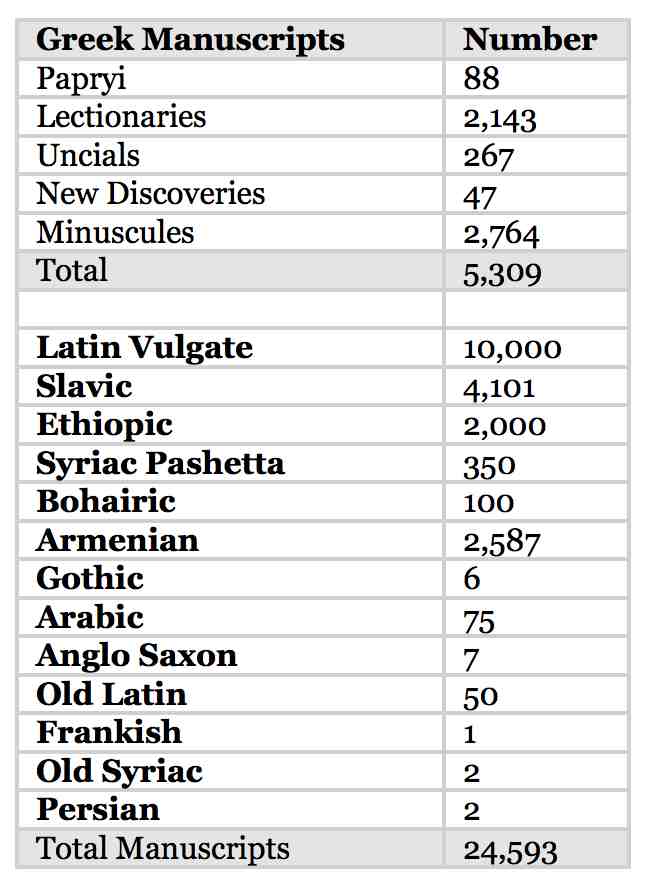
These manuscripts are written in fourteen different languages and come from all over the world, yet maintain a uniformity in their text, telling the same story. The only way this would be possible is if the texts were considered so important that preserving what was written was paramount. There are no other ancient texts in all of antiquity that exhibit this distinctive preservation of a singular story in so many surviving manuscripts.
When we examine the entire body of New Testament manuscripts, we find that they are all consistent with the primary details of Jesus found today in our modern New Testament.
203 Eyewitness Statements About Jesus In The New Testament
One of the assertions made by critics of the New Testament is the idea that what is written in the Synoptic Gospels, was penned long after Jesus appeared on earth. Atheists often write that men who never saw Jesus, created the narratives about Jesus, late in the first century. These adversaries of the New Testament say these men were not eyewitnesses, and a majority of the things attributed to Jesus—He never said or did.
The problem with these statements is that the actual 24,593 extant manuscript copies of the New Testament from the historical record, documents that these men saw and heard what they chronicle. The entire New Testament is a compilation of 27 letters that record 203 instances of eyewitness testimony in the 260 chapters of the New Testament.
Not once in the entire record of antiquity is there any evidence that proves the writers were not eyewitnesses, and they wrote late in the first century.
If we conduct a personal investigation concerning the Canonical Gospels of the New Testament, we quickly discern that we are reading testimony from men who were present when Jesus said and did the things recorded in these texts. These men state repeatedly that they saw and heard Jesus and there is no ambiguity in what they meant:
- Paul: 1 Corinthians 9:1: “Am I not an apostle? Haven’t I seen Jesus our Lord with my own eyes?
- Peter: 1 Peter 1:16: “We saw his majestic splendor with our own eyes.”
- John: 1 John 1:1: “We saw him with our own eyes and touched him with our own hands.”
- James, Paul, all the Apostles: 1 Corinthians 15:7: “Then Jesus was seen alive by James and later by all the apostles. Last of all, as though I had been born at the wrong time, I also saw him.”
- Mary Magdalene: John 20:18: “Mary Magdalene found the disciples and told them, “I have seen the Lord!”
- Peter: Acts 5:29-32: “But Peter and the apostles replied… We are witnesses of these things…”
- John: 1 John 1:2-3: “This one who is life itself was revealed to us, and we have seen him. And now we testify and proclaim to you that he is the one who is eternal life. He was with the Father, and then he was revealed to us. We proclaim to you what we ourselves have actually seen and heard so that you may have fellowship with us.
You can find a list of all 203 of these eyewitness statements found in the New Testament, in an essay located on my website: https://robertcliftonrobinson.com/2022/06/24/203-eyewitness-statements-about-jesus-in-the-new-testament/
Early First Century Writing of the Synoptic Gospels
Jesus told His Disciples: “But you will receive power when the Holy Spirit comes upon you. And you will be my witnesses, telling people about me everywhere—in Jerusalem, throughout Judea, in Samaria, and to the ends of the earth.” (Acts 1:8)
When the synoptic Gospels of Jesus Christ were written is of paramount importance. Liberal scholars assert that they were written late in the first century by non-eyewitnesses. If this is true, then the entire premise of the New Testament is lost. Ancient texts were written decades after the events took place by people who did not see what they were writing would be of very little value today.
Fortunately for our generation, we have surviving manuscript copies of nearly the entire New Testament that are dated as early as 175 AD.[1] The existence of manuscript copies from 175 AD demands that the original autographs must have been written early in the first century. The reason we do not have these original autographs is due to the survivability of papyrus under the brutal conditions that existed in antiquity.[2] What we do have today is 24,593 surviving manuscript copies of the original autographs, that fully validate the events described in the New Testament as sworn by the writers of the four Gospels.
“And he who has seen has testified, and his testimony is true; and he knows that he is telling the truth, so that you may believe.” (John 19:35)
This chapter establishes that there is credible evidence in the historical record to prove that the synoptic Gospels were written early in the first century, beginning immediately after Jesus ascended back to heaven. The very words of Jesus Himself state that He expected these men to write a testimony of what they had seen and heard, and that Jesus would send the Holy Spirit to remind them of these things so they could accurately write.[3]
Jesus commanded these men to take their testimony to the entire world. This would not be possible unless there was a written testimony that was sent out by courier to the churches in Asia Minor and then dispatched to the rest of the world. Jesus told the Apostle John: “I am the Alpha and the Omega, the First and the Last,” and, “What you see, write in a book and send it to the seven churches which are in Asia: to Ephesus, to Smyrna, to Pergamos, to Thyatira, to Sardis, to Philadelphia, and Laodicea.” (Revelation 1:11)
In John 9:4, Jesus told the disciples, “We must quickly carry out the tasks assigned to us by the one who sent us.” Jesus did not want these men to delay their witness to the world. Jesus intended that the men who saw and heard Him, would “quickly carry out the task” of telling the world what they had witnessed. They did this by writing on papyrus the things they had seen and heard and sending them out to the Christian churches that already existed in Asia Minor. These churches copied the letters of testimony written by the men who saw Jesus, and they distributed them all over the Roman Empire.
The reason Jesus emphasized the urgency of sending out a written testimony is clear: God wanted the whole world to know that salvation was available to everyone. God had kept His promise to send the world a Savior, and He desired that every person would have a chance to hear what Jesus had done and be saved. Jesus wanted the people who were alive at that time, in every distant land of the world, to also have the opportunity to receive Jesus and obtain salvation. The idea that the Gospels would not be written for decades, or that Jesus did not intend that the Apostles would write a testimony about Him and send it to the world, is preposterous.
Critics of the New Testament seek to assert that the four Gospels were written late in the first century, long after the eyewitnesses had perished but never provide evidence to prove this hypothesis. In every book, article, and comment written by progressive scholars, you will not find any valid evidence to prove a late-date writing for the synoptic Gospels. All of these statements in books and articles are merely the opinion of these atheist and progressive scholars.
It is possible to prove a very early writing of the synoptic Gospels, by empirical evidence. This chapter provides this evidence, beginning with archeological evidence for the date when Paul was under trial by a Roman-appointed representative at Caesarea. From this certain date, we can accurately prove all the other dates of the New Testament, and establish when the synoptic Gospels were written.
In 59 AD Paul is before Porcius Festus, the Procurator of Judea, while Paul is a prisoner at Caesarea. We know that Festus was here on this date because of coinage that has survived history, with the Provincial coinage of Judea attesting to Nero’s 5th year.[4] This documents Porcius Festus in Judea at 58-59 AD, with Paul before him. Josephus records this same event in Antiquities, Book XX, Chr. 8, § 9: “Now when Porcius Festus was sent as successor to Felix by Nero, the principal of the Jewish inhabitants of Cesarea.”[5]

Paul experienced his final hearing before Festus, in Acts 24:27. In Acts 25:12, Festus instructs Paul to go to Jerusalem to be tried. Paul states that he is a Roman citizen and requests that he be sent to Caesar for trial. Festus orders Paul to be taken to Rome for trial before Nero.
After a shipwreck and a three-month delay on Malta, Paul arrived in Rome about February, 60 AD (Acts 28:1-16). While in Rome, Paul meets with the Jews, in Acts 28:15-28.
Eusebius writes that Paul was beheaded by Nero early in 68 AD.[6] This is verified by Eusebius, as he records the death of Nero on June 8, 68 AD.[7] Nero, unable to garner the courage to take his own life, requested that his secretary Epaphroditos should kill him.[8] These facts of the historical record allow us to understand other dates in the New Testament.
Substantial Secular Confirmation
We know that the text of Luke was written before Acts, his second book. In Acts, Luke details the missionary journeys of Paul in Asia Minor. In Acts 11:27-28, Luke writes: “During this time some prophets traveled from Jerusalem to Antioch. One of them named Agabus stood up in one of the meetings and predicted by the Spirit that a great famine was coming upon the entire Roman world.” (This was fulfilled during the reign of Claudius).
This reference to Roman Emperor Claudius allows us to date this verse from the book of Acts. Tiberius Claudius Caesar Augustus Germanicus was emperor from 41-54 AD. Agabus said that this famine was fulfilled during the reign of Claudius. In the fourth century, Roman historian, Orosius, writes that this famine described by Agabus took place in 46 and 47 AD. A translation from Orosius is found in the historical record written by King Alfred of England during the Middle Ages in the Anglo-Saxon Chronicle.
This Chronicle lists British history from 1 AD to 1154 AD and contains the following text: “AD 46. In this year, Claudius, the second Roman emperor to invade Britain, put much of the island under his control and added the Orkneys to Rome’s kingdom. This took place in the fourth year of his rule. In this same year, a great famine in Syria took place which Luke mentions in his book, ‘The Acts of the Apostles.’ Due to his incompetence, Emperor Claudius Nero almost lost control of the British Isle.”
Jewish historian, Josephus, also records in Antiquities 20 chapter 1.3-2.5: “Herod, the brother of Agrippa who had perished, was allowed to govern over Chalcis. He asked Claudius Caesar for control over the temple along with the sacred treasury, and the ability to choose the high priests, and he was given all that he had asked for.” Around this time lived Queen Helena of Adiabene, along with her son Izates. They both began to follow the Jewish way, turning away from their past lifestyle . . . Her arrival was of great help to the masses in Jerusalem, for there was a famine in the land that overtook them and many people died of starvation.
Queen Helena sent some of her stewards to the city of Alexandria to purchase as much grain as possible. She sent others to the island of Cyprus to bring back dried figs. Helena’s efforts to save many people left a legacy in the historical record, that allows us to verify the date of this famine described by Luke in the book of Acts.
Roman historian, Suetonius, also mentions this same famine in his writing, “Life of Claudius” Chapter 18: “There was a scarcity of food, which was the result of bad harvests that occurred during several years.”
Roman historian, Tacitus, also writes in describing the famine, in his Annals, Chapter 11:4: “A vision that came to him at night was the reason charges were filed against the man. In this dream, he claimed to have seen Claudius crowned with a wreath made of wheat, the ears of which were folded downward. And from this vision, he predicted lean harvests to come.”
This presents us with a substantial secular and Biblical confirmation that the text of Acts, written by Luke, is not only accurate but confirmation that Luke’s Gospel of Christ was written by 44 A.D.
Accurate Forensic Examination
Paul wrote his letter to the Galatians in 49 AD. In this letter, Paul describes a conversation he had with Peter and James 14 years before, in 35 AD. Paul penned the text in Galatians just before he appeared before Festus, in 49 AD.
After Paul had completed his first eighteen months of missionary journey through Asia Minor, he received a report that the believers at Galatia were struggling due to false teachings that had crept into their church. Some of the Judaizers had tried to convince the Christians of Galatia that in addition to trusting in Jesus, they must also keep the laws of Moses. In response to this difficulty, Paul wrote to confirm his former words—that no Christian must keep the laws of Moses to be saved.
This issue continued to be a problem amongst the new Christian churches, which precipitated the meeting with the Jerusalem Council, also in 49 AD, that is seen in Acts 15:1-30. During this meeting of the early church leaders, it was determined that only three laws would be imposed upon new Christians: “(1.) abstain from things polluted by idols, (2.) from sexual immorality, (3.) from things strangled, and from blood.”
Again we are learning the correct dates for the events of the New Testament and eventually, the time of writing for the synoptic Gospels, starting with the coinage of Festus, and the statement of Paul in Galatians 2. These verified events allow us to forensically determine additional accurate dates for many other events in the New Testament.
The texts for the Book of Mormon cannot come close to the historical, eyewitness, forensic evidence presented to us by the surviving New Testament Manuscripts.
Manuscripts Evidence For The New Testament
How could Paul prove that the Gospel of Christ was authentic and reliable if he did not have a written text from an eyewitness who had seen and heard Jesus? In 1 Thessalonians 2:13, the Gospels are described as the word of God—scripture equal to those of the Old Testament: “For this reason, we also thank God without ceasing, because when you received the word of God which you heard from us (the Gospels), you welcomed it not as the word of men, but as it is in truth, the word of God, which also effectively works in you who believe.”
It is clear from this text that Paul had the Gospels with him as he went from town to town, telling people about Jesus and all that He had said and done.
It would be impossible to convince people that Jesus was the true Messiah if Paul could not produce the Gospel scriptures and demonstrate, from these texts, how Jesus had fulfilled every Messianic prophecy of the Hebrew scriptures. Jesus gave an example of how this would be possible after He had risen from the dead when He met two of the disciples on the road to Emmaus: Then Jesus said to them, “These are the words which I spoke to you while I was still with you, that all things must be fulfilled which were written in the Law of Moses and the Prophets and the Psalms concerning Me.” And He opened their understanding, that they might comprehend the Scriptures.” (Luke 24:44-45)
The entire basis of the testimony about Jesus in the New Testament is founded upon what the Hebrew prophets had written about the Messiah. Jesus ordered His life perfectly so that He would fulfill every prophecy written for the Messiah. On the road to Emmaus, Jesus showed the two disciples He met precisely how He had fulfilled these prophecies. Then Jesus told these two men something spectacular. In addition to the prophets writing that Messiah would suffer, die, and rise again, the message of His death and resurrection would be proclaimed to all the nations: “Then Jesus opened their minds to understand the Scriptures. And he said, “Yes, it was written long ago that the Messiah would suffer and die and rise from the dead on the third day. It was also written that this message would be proclaimed in the authority of his name to all the nations, beginning in Jerusalem: ‘There is forgiveness of sins for all who repent.’ You are witnesses of all these things.” (Luke 24:45-48)
What these men had seen and heard, they were commanded by Jesus to immediately tell the entire world. This could only be accomplished if the testimony was written in letters and dispatched to the world. They could not simply tell people orally; this would not accomplish a worldwide ministry. The text had to be written and sent out just as the letters of Paul had been dispatched. Jesus instructed the Apostle John: “Write what you see in a book and send to the seven churches which are in Asia” (Revelation 1:11). This was the method used by the early Christian church to convey news of Jesus and the teaching of His Gospel to people in distant lands.
The Apostles who saw Jesus rise from the dead were commanded by Him to be His witnesses to the entire world. In Acts 1:8, after Jesus had risen, He told the Apostles: “You will be my witnesses, telling people about me everywhere—in Jerusalem, throughout Judea, in Samaria, and to the ends of the earth.”
Although critics claim that the narratives written about Jesus in the New Testament were written at too great a distance from the events, to be considered credible, this is not the finding of the historical record.
There are surviving manuscripts of complete books of the New Testament from 175-225 AD. Manuscript copies of nearly the entire New Testament as early as 175 AD demand that the original autographs were certainly written by 50 or 60 AD.
There are fragments of Matthew’s Gospel that have been validated by scientific Paleographic examination that dates these texts to 60 AD. In Paul’s letter to Timothy, chapter 5, verse 18, he quotes from Luke’s gospel: “The laborer is worthy of his wages.” When we examine Luke’s gospel, we find that Paul was referencing a quote by Luke in the letter he wrote to Timothy.
This means that Luke’s gospel must have already been written by the time Paul wrote 1 Timothy: “for the laborer is worthy of his wages” (Luke 10:7). Eusebius wrote that Paul was beheaded under Caesar Nero, who was assassinated in 68 AD. After Paul’s fifth missionary journey ended in 67 AD, Eusebius states that Paul was beheaded by the Romans under Emperor Nero.
This date was near May or June of 68 AD. Nero forced his private secretary, Epaphroditos, to kill him on June 9th of 68 AD. Since Paul died in 68 AD, and he wrote a text that came from Luke’s Gospel, Luke certainly penned these words before 68 AD. Luke probably wrote his gospel near the same writing of Matthew’s Gospel, in 60 AD.
These facts of history are empirical evidence that Luke’s Gospel was already written while Paul was still alive. By this corroboration from the historical record, we learn that Luke’s Gospel is certified as written before 68 AD when Paul was killed. Confirmation of these facts is made by a letter from Eusebius.
I have also documented in New Testament Apologetics that we have most of the New Testament in extant manuscript form, dated between 175-225 AD. In this essay I will document for you the manuscript evidence we have today that proves a very early first century writing for the original autographs of the testimony about Jesus.
The Major Papyri (175–225 AD)
P46 (Chester Beatty II)
- Contents: Pauline epistles — Romans, Hebrews, 1–2 Corinthians, Ephesians, Galatians, Philippians, Colossians, 1 Thessalonians, 2 Thessalonians (partial), missing Pastorals.
- Date: c. 175–225 AD.
- Significance: One of the earliest large collections of Paul’s letters.
- Source: “Papyrus 46 is commonly dated between 175 and 225.” (Metzger & Ehrman, The Text of the New Testament, 4th ed., 2005, p. 52).
P45 (Chester Beatty I)
- Contents: The Gospels (Matthew, Mark, Luke, John) and Acts.
- Date: c. 200–250 AD (most scholars narrow to c. 200–225 AD).
- Significance: Earliest substantial witness containing portions of all four Gospels plus Acts.
- Source: “Papyrus 45 … generally assigned to about 200–250.” (Metzger & Ehrman, 2005, p. 52).
P66 (Bodmer II)
- Contents: Gospel of John (nearly complete).
- Date: c. 200 AD.
- Significance: Almost the entirety of John’s Gospel, providing extremely early textual witness.
- Source: “Papyrus 66 … is generally dated about 200.” (Metzger & Ehrman, 2005, p. 52).
P (Bodmer XIV–XV)
- Contents: Large portions of Luke and John.
- Date: c. 175–225 AD.
- Significance: Extremely important for text of Luke and John, very close to Codex Vaticanus.
- Source: “Papyrus 75 … dated around 175–225.” (Metzger & Ehrman, 2005, p. 52).
Coverage of the New Testament Gospels by 175–225 AD
- The Gospels and Acts: P45 (all four Gospels + Acts), 𝔓^66 (John), 𝔓^75 (Luke & John).
- Pauline Corpus : P46 (9–10 letters, incl. Hebrews).
- Revelation: P47 (mid-3rd century, c. 250 AD, slightly later than your 225 cutoff but still very early).
By 225 AD, we have substantial witnesses for: All four Gospels (45, 66, 75).
- Acts (45).Pauline epistles incl. Hebrews (46).
- Revelation (47, just after 225).
What’s missing in papyri from this precise period are substantial fragments of the Catholic Epistles (James, 1–2 Peter, 1–3 John, Jude). These appear in slightly later papyri (3rd–4th century), though very small fragments of 1 Peter (𝔓^72) exist in the Bodmer collection, usually dated 3rd/4th century.
By 175–225 AD, extant papyri demonstrate that most of the New Testament—the Gospels, Acts, nearly all Pauline epistles (including Hebrews), and parts of John in multiple witnesses—was already being copied and circulated. This means that within about 150 years of Jesus’ death, the majority of the New Testament corpus is represented in manuscript form.
- P45 → Gospels + Acts (c. 200–225)
- P46 → Pauline epistles + Hebrews (c. 175–225)
- P66 → John (c. 200)
- P75 → Luke & John (c. 175–225)
The Book of Mormon does not have this chain of evidence for the texts Joseph Smith alleges were written by aid of an Angel.
These extant manuscript copies prove the New Testament never disappeared and was never “lost.”
Early Christian Church Citations
Greek Philosopher, Celsus: Second Century. The first Christian Apologist, Origen, wrote a complete impeachment of all Celsus’ attempts at refuting Jesus in the New Testament in 248 AD. Often Origen quoted Celsus verbatim, paraphrasing, frequently referring to the New Testament letters that existed at that time where Celsus attempted rebuttal. Origen restates many of Celsus’ arguments, with his refutation. Accuracy was crucial to Origen’s refutation of The True Doctrine, leaving history with the reliable source for what Celsus said, and how easy it was for Origen to refute every assertion that atheists presented at such an early date.
- Celsus derided Jesus in his writings, His origin, and those who followed Him.
- Celsus makes comments about statements that are made in the Hebrew Toledot Yeshu, further confirming that the Jews also recorded Jesus in their texts.
- We can reconstruct nearly the entire text and narratives of the New Testament, just from the commentary and rebuttals of Origen. This is substantial evidence that the New Testament was fully intact by 248 AD, and regarded as accurate and reliable testimony about Jesus, His death, and resurrection.
Greek Satirist, Lucian: In the second century, recorded many derisions against Jesus and His followers.
- Lucian said that early believers in Jesus were naive and lacking good judgment; easily deceived by charlatans, giving large sums of money to support the cause of Jesus.
- Lucian writes that Jesus was crucified and those who believe in Him believed that they would live forever.
- Lucian stated that early Christians worshiped Jesus as God.
- Lucian said that those who believed in Jesus studied His teachings in context with the Greek language, comparing Him to early Greek philosophers.
- Lucian wrote that the followers of Jesus believed in Him by faith.
- Lucian said that the followers of Jesus sold their possessions to gain money to care for other less fortunate believers.
- Lucian stated that the early Christian church relied upon the writings of letters that were distributed to various places, for their doctrine and teaching.
- Lucian refers to Jesus as “a crucified sage.”
- Lucian writes that those who followed the teaching of Jesus were easily taken advantage of, because of their tender hearts.
Syrian, Mara Bar-Serapion: between the first and third century, writes from prison about the man called Jesus and His teaching.
- Asks the question: “What advantage did the Jews gain from executing their wise King?”
- Questioned if the destruction of Jerusalem in 70 AD was a direct result of their denial of Jesus.
- Alleges that the Jews were driven from their land as a result of denying Jesus as their Messiah.
- The suggestion that Jesus was unjustly killed.
Gnostic teacher, Valentinus: From the first century. Clement of Alexandria said that Valentinus was a follower of Theudas, who was a follower of Paul, a writer of the New Testament. Gnosticism is generally regarded as contrary to the teachings of the New Testament regarding the true nature of Jesus.
- Discusses the historical reality of Jesus in Israel.
- Refers to Jesus as “the Son of God.”
- Describes Jesus as teaching His followers about His Father.
- Be careful to deny that Jesus came as God in the flesh, which is the basis of all Gnostic doctrine.
- Calls Jesus “the Word.”
- Speaks of Jesus’ death on a tree, which is an early manner of speaking to describe crucifixion.
- States that the followers of Jesus believed that His death brought salvation to those who believed.
- Writes that the followers of Jesus affirm that He was resurrected from the dead.
The Acts of Pontius Pilate: Described by Justin Martyr and Tertullian from 150-200 AD. There are later historical records known by the same name, which are known fabrications of this genuine record.
- Justin Martyr described the descriptions of Jesus’ crucifixion as validated in the report by Pilate.
- The term “they pierced my hands and my feet,” as used in Psalm 22, describing the event of Jesus’ crucifixion 1,000 years later, is included in Pilate’s report.
- Pilate’s report also references the prophecy in Isaiah 53, describing the gambling of Jesus’ clothing by the Roman soldiers.
- Pilate’s report details several of Jesus’ miracles and His assertion that He is God, brought to the attention of the Roman Senate by Emperor Tiberius. Because the Roman Senate did not endorse Jesus, they rejected his proposal to include these matters in the Senate record.
Phlegon of Tralles: a freed slave of Emperor Augustus Caesar or Emperor Hadrian, born in 80 AD. His writings are preserved by other historical documents, primarily Origen.
- Phlegon describes Jesus’ ability to accurately predict events of the future, that were later confirmed by history as fulfilled.
- Phlegon describes Jesus’ prediction of Peter’s future death by crucifixion.
- Phlegon describes the crucifixion of Jesus at Jerusalem.
- Phlegon describes an alleged solar eclipse that took place during the time of Emperor Tiberius, during the time of Jesus’ crucifixion.
- Phlegon describes the earthquakes that took place during Jesus’ crucifixion.
- Phlegon states that Jesus retained wounds from the crucifixion after He was resurrected.
Rheginos, who is possibly Valentinus: Author of The Treatise on Resurrection. From the second century.
- Rheginos stated that Jesus, the man, was also fully God, as He is the Son of God.
- Rheginos said that through Jesus’ death as the Son of God, He defeated death.
- Rheginos records the facts of Jesus’ death.
- Rheginos wrote the facts of Jesus’ resurrection.
- Rheginos said that since Jesus has been raised, Rheginos is also encouraged to count himself as raised.
What all this information means to you, the reader: The man called “Jesus of Nazareth” is a genuine person from the historical record.
This historical documentation of the Christian Church in operation, with the New Testament being recognizes and used by every generation, impeaches Jospeh Smith’s claim that the church Jesus founded was lost.
This makes the Mormon claim of scriptural corruption historically impossible.
The Doctrinal Problem: Mormonism’s Teachings Contradict the New Testament
To accept Mormonism, a person must believe doctrines that contradict the New Testament on essential issues:
The Nature of God
- Mormonism: God the Father was once a man who became a god; humans can become gods.
- Christianity: God is eternal, uncreated, and unchanging (Psalm 90:2; Malachi 3:6; John 1:1–3).
The Trinity
- Mormonism: Three separate gods.
- Christianity: One God in three Persons.
Who Raised Jesus From The Dead?
GOD:
Acts 2:24 — “But God released him from the horrors of death and raised him back to life, for death could not keep him in its grip.”
2 Corinthians 4:14 “God who raised the Lord Jesus…”
The New Testament records that the Father, Son, and Holy Spirit raised Jesus from the dead, because all three are God.
1. The Father, As God, Raised Jesus From The Dead:
Romans 6:4 — “…just as Christ was raised from the dead by the glorious power of the Father, now we also may live new lives.”
Galatians 1:1 — “…Jesus Christ and God the Father, who raised him from the dead.”
2. The Son, As God, Raised Himself From The Dead:
Jesus claimed that He had the authority to raise Himself from the dead;
John 2:19–21 — Jesus said, “Destroy this temple, and in three days I will raise it up.”
John 10:17–18 — “I sacrifice my life so I may take it back again. No one can take my life from me. I sacrifice it voluntarily. For I have the authority to lay it down when I want to and also to take it up again.”
3. The Holy Spirit, As God, Raised Jesus From The Dead:
Both Peter and Paul state that the Holy Spirit raised Jesus from the dead.
Romans 8:11 — “The Spirit of God, who raised Jesus from the dead, lives in you.”
1 Peter 3:18 — “He suffered physical death, but he was raised to life by the Spirit.”
The Trinitarian Unity
These verses are not contradictory. Instead, they demonstrate the Trinitarian harmony in the resurrection:
- The Father as God, willed and determined the resurrection of Jesus.
- The Son as God, exercised His authority to raise Himself from the dead.
- The Spirit as God was the agent who applied resurrection power to Jesus’ body.
The resurrection of Jesus is the work of the entire Godhead, displaying the unity and cooperative action of Father, Son, and Spirit.
These texts prove that the Father, the Son, and the Holy Spirit are One God. These texts from the Bible prove that Mormon and Jehovah’s Witness doctrine regarding the Trinity is in error.
The Early Christian Church Stated That The Father, Son, and Holy Spirit Raised Jesus From The Dead:
Irenaeus (c. 180 AD)
“He [Christ] suffered, and rose again, and ascended into the heavens in the flesh… this is the faith which the Church has received.”⁸
Irenaeus emphasizes that the Father raised Christ, but always in unity with the Son as also God.
Tertullian (c. 200 AD)
“It was the whole Trinity, who raised Christ from the dead: the Father by His authority, the Son by His power, the Spirit by His energy.”⁹
Origen (c. 250 AD)
“He rose again by the divinity dwelling in Himself, yet also by the power of the Father, and the operation of the Holy Spirit.”¹⁰
Augustine (c. 400 AD)
“The Father raised Him, the Son raised Himself, and the Holy Spirit raised Him: it is one work of the Trinity.”¹¹
This demonstrates the historical continuity that the Father, Son, and Spirit are all three, One God.
Scripture
- Mormonism: 4 scriptures (Bible, Book of Mormon, Doctrine and Covenants, Pearl of Great Price).
- Christianity: The canon of the New Testament, closed with the apostles early in the first century.
Salvation
- Mormonism: Exaltation to godhood through temple ordinances, works, and obedience.
- Christianity: Salvation by grace alone through faith (Ephesians 2:8–9; Titus 3:5).
No faithful obedient Mormon has any assurance that they have eternal life. This right is reserved exclusively by Joseph Smith:
Brigham Young wrote – “No man or woman… will ever enter into the celestial kingdom of God without the consent of Joseph Smith.”
The Exact Quote
“No man or woman in this dispensation will ever enter into the celestial kingdom of God without the consent of Joseph Smith.
He holds the keys of that kingdom for the last dispensation…”
Citation: Brigham Young, Journal of Discourses 7:289 (Delivered October 9, 1859, Salt Lake Tabernacle)
Brigham Young – “Joseph Smith… stands at the gate”
Exact Quote:
“From the day that the Priesthood was taken from the earth to the winding up scene, Joseph Smith stands at the head of this dispensation, and he stands there like a great prophet…
and I tell you, he will hold the keys of this dispensation in time and in eternity.”
Citation: Brigham Young, Journal of Discourses 6:308. (Delivered December 20, 1857)
This is often paired with the previous quote to reinforce the “gatekeeper” idea.
George Q. Cannon:
“You cannot get in without Joseph Smith’s permission”
Exact Quote:
“If we get our salvation, we shall have to pass by him; and if we do enter into our glory, it will be because he has permitted us to pass.”
Citation: George Q. Cannon, Journal of Discourses 13:49. (Delivered June 23, 1867)
Orson Hyde – “Joseph Smith holds the keys… your salvation hangs upon his decision”
Exact Quote
“Joseph Smith holds the keys of this last dispensation, and your salvation and mine depends on his decision.”
Citation: Orson Hyde, Journal of Discourses 6:117. (Delivered January 17, 1858)
The Most Often Cited Statement:
“No man or woman in this dispensation will ever enter into the celestial kingdom of God without the consent of Joseph Smith.” — Brigham Young, Journal of Discourses 7:289
This is the exact wording most frequently cited in Christian–LDS debates.
Mormon Salvation Is Works-Based: Requires obedience to LDS ordinances and teachings (works doctrine), not grace alone through faith (Eph. 2:8–9).
Mormon Salvation by works and obedience is in direct conflict with the words of Jesus and the entire body of the New Testament that states there is nothing we can do to obtain eternal life. Our salvation rests upon the completed work of Jesus on the cross, and our reliance upon what Jesus did for us, not any of our works or obedience.
Mormonism does not “complete” Christianity—it replaces it.
The Reliability Problem: The Book of Mormon Has No Historical Support
Unlike the Bible—which is supported by archaeology, geography, manuscripts, and eyewitness accounts—the Book of Mormon has:
- No confirmed cities
- No confirmed people groups
- No confirmed languages
- No confirmed coins, temples, or artifacts
- No external ancient sources
- No manuscript history between 400 AD and 1827
Every culture described in the Book of Mormon is archaeologically unattested, there is no proof in the archeological or historical record that any of the ancient cities listed in the Book of Mormon, have ever been found..
“Not one prophecy fulfilled”
The critique
Critics assert that no prophecy in the BoM can be clearly verified as historically fulfilled outside the text, or that prophecies are too vague or conditional to count as fulfilled. For example, some say the prophetic material in the BoM is either internal (prophecy → fulfillment later in the BoM text) or not sufficiently specific or verifiable by independent means.
One writer argues: “There exists no credible archaeological evidence … the BoM is not a record of highly literate ancient American people of Hebrew descent.”
Another states that certain BoM prophecies are “ambiguous” and not convincingly fulfilled.
Source: https://puritanboard.com/threads/mormon-prophecies.73519/?utm_source=chatgpt.com
LDS response
LDS-friendly sources assert that the BoM does contain numerous fulfilled prophecies—for instance, “internally-fulfilled” within the book, and also some they believe correspond to external realities. For example, one article says: “The Book of Mormon records the fulfillment of more than 100 prophecies.”
On archaeology LDS advocates state that lack of discovery of a specific city does not mean prophecy hadn’t been fulfilled—some prophecies are conditional, and some events may yet be located.
“Not one ancient city ever discovered”
The Issue
The claim is that the Book of Mormon mentions numerous large cities (e.g., Zarahemla, Nephi, etc.) inhabited by tens or hundreds of thousands, yet none of these have been definitively identified by mainstream archaeology as corresponding to ancient American sites, is a serious omission.
For example, one (non-Mormon) critique says: “As far as I know there is not one professionally trained archaeologist, who is not a Mormon, who sees any scientific justification for believing the historicity of the Book of Mormon.”
Source: https://en.wikipedia.org/wiki/Archaeology_and_the_Book_of_Mormon?utm_source=chatgpt.com
Another says “We still don’t know where the cities mentioned in the Book of Mormon are located.”
LDS response
LDS apologists often respond:
Archaeology is ongoing and absence of proof is not proof of absence.
Some possible correlates or consistent patterns have been found: e.g., ancient highways, burial sites, place-names like “Nahom” in Arabia (for Lehi’s journey) which they argue correspond to BoM geography. 
Source: https://www.ldsliving.com/tag/archaeology?utm_source=chatgpt.com
It should also be noted that many of the statements in the Book of Mormon, these details are consistent with what is known of ancient American civilization (according to LDS scholars).
Assessment: The Strengths of the argument:
It is correct that mainstream archaeology has not accepted a specific city as “Zarahemla” or “Nephi” with universal consensus.
Concerning the validation of the New Testament, in past history, because many of the cities, people, and events described by the Book of Acts, were not found in archeology, the New Testament was defined as a work of fiction.
Today a majority of the cities, persons, and events described by the Book of Acts, have been validated by archeology.
If we apply these same historical standards of archeological verification to the Book of Mormon, we cannot validate anything in these texts as historical proven true.
Many of the described features (e.g., large populations, certain animals, technologies) are disproven by non-LDS archaeology.
The weaknesses of the LDS response:
The LDS position that “search continues” is intellectually modest (though whether it gains traction depends on the evidence quality). The possibility of limited-geography models or reinterpretation of BoM setting complicates the “none discovered” statement (if locations may not match earlier models).
The statement “not one ancient city described in the Book of Mormon has ever been discovered” is correct under the standards used to validate the Bible and other important works of history.
The Bible, by contrast, is the most archaeologically supported ancient text in history.
One of the world’s greatest archeologists and historians is Sir William Ramsay. Notice how Dr. Ramsay describes the accuracy and detail of Luke’s historical references—as existing, without a single error.
“I began with a mind unfavorable to (the accuracy of the New Testament) but more recently I found myself brought into contact with the Book of Acts as an authority for the topography, antiquities, and society of Asia Minor. It was gradually borne upon me that in various details the narrative showed marvelous truth.”[9]
Dr. Ramsay believed at the onset that the accounts described in the Gospel of Luke and the Book of Acts were inaccurate. Over 100 years ago, he undertook an expedition to Asia to try and refute the New Testament—only to become so overwhelmed by the evidence, that he became a follower of Jesus Christ.
“Luke is a historian of the first rank; not merely are his statements of fact trustworthy…this author should be placed along with the very greatest historians.”[10]
Archeological Accuracy Confirms Literary Accuracy
Since Luke’s description of cities, names, places, and customs are perfect in their historical accuracy, certainly, the accounts of Jesus’ life, death, and resurrection are also accurate and reliable.
The fact that Luke has been confirmed as a scholarly historian of specific details regarding the history of the first century, it is certain that he also recorded the specific events of Jesus’ ministry with the same precision. Luke’s integrity as a historical scholar demands that we accept with confidence his testimony of Jesus’ resurrection, which is the foundation of the entire Christian church.
One of the criticisms of Luke’s account of Jesus’ life is found in his description of the census that he says was ordered by Caesar Augustus.
Luke 2:1-3: “And it came to pass in those days that a decree went out from Caesar Augustus that all the world should be registered. This census first took place while Quirinius was governing Syria. So all went to be registered, everyone to his own city.”
Because no previous archeological discovery had ever verified that such a census took place, Luke was regarded as having embellished this story. A later discovery regarding the taxes of the kingdom of the Roman government revealed that the taxpayers were enrolled every 14 years by the use of a census. Archeology has uncovered facts that verify Caesar Augustus did conduct the precise census described during the period Luke specified, near the birth of Jesus at Bethlehem.[11]
Further, an inscription discovered in Antioch describes Quirinius in 7 BC, who was the governor of Syria on two occasions, 7 BC and 6 AD—a fact that is confirmed by the Jewish historian, Josephus.[12]
An archeological discovery in Egypt uncovered a Papyrus that specifically describes the details of this census, spoken of by Luke, under Caesar Augustus:
“Because of the approaching census, it is necessary that all those residing for any cause away from their homes should at once prepare to return to their own governments in order that they may complete the family registration of the enrollment and that the tilled lands may retain those belonging to them.”[13]
In his book, Archeological Confirmation of the New Testament, Dr. F. F. Bruce describes a problem that was present in Luke’s description of the Tetrarch of Abilene, in Luke 3:1:
Luke 3:1: “Now in the fifteenth year of the reign of Tiberius Caesar, Pontius Pilate being governor of Judea, Herod being tetrarch of Galilee, his brother Philip tetrarch of Iturea and the region of Trachonitis, and Lysanias tetrarch of Abilene.”
Previously, there was no record of anyone called “Lysanias” as the tetrarch of Abilene during the time Luke specified he was there. In recent history, an archeological discovery made in Damascus, Syria describes a person called the “Freedman of Lysanias the Tetrarch.” Scholars date this inscription between 14 AD and 29 AD.6 This is the same period in which Luke had written in his gospel describing Lysanias.
An interesting discovery in 1910 by Sir William Ramsay debunked the secular record of Cicero of the Romans, who described Iconium as being in Lycaonia. Luke describes Lystra and Derbe as being in Lycaonia.
Acts 14:6: “…they became aware of it and fled to Lystra and Derbe, cities of Lycaonia, and to the surrounding region.”
This secular record was erroneously held as more reliable and accurate than the Biblical record in history. Today, we know that the Bible was correct all along. This continues to be a common error that is frequently repeated today. The facts bearing witness—the Bible is always right in matters of history, and the secular record is consistently wrong. This truth has been confirmed by archeological discoveries over the entire course of human history all over the world.
Other noted scholars such as Dr. Adrian Nicholas Sherwin-White, a British historian and scholar regarding Ancient Rome, wrote his doctoral thesis on the treatment of the New Testament from the point of view of Roman law and society.
Dr. Sherwin-White said this regarding the work of Dr. Ramsay’s conclusions on the book of Acts:
F. F. Bruce: “Any attempt to reject its (the New Testament’s) basic historicity even in matters of detail must now appear absurd. Roman historians have long taken it for granted.”[14]
Dr. Sherwin-White examined the records of Rome and concluded that their history proved the narrative of the New Testament scriptures regarding the death and resurrection of Jesus Christ.[15]
Of all four gospel writers, Luke exhibits the greatest precision in recording specific details. This has allowed for the verification of every statement Luke has made in his account of Jesus. As a result of Luke’s meticulous record, and the verification of his writing as accurate and reliable, we have great confidence as the readers of this gospel that what Luke recorded is true. When a man takes the time to ensure that everything he writes is accurate, we can be certain that even events that seem unlikely to us are truthful. Because Luke is classified as a scholarly historian by accomplished experts, we can have great confidence that his accounts of Jesus’ resurrection are also truthful.
In the case of Luke, we find that every word he recorded for us about the specific events of the period he was writing about is true. Integrity is a quality a person either has or they don’t have. Luke’s integrity as a historian is unparalleled amongst the writers of the New Testament. Although all the men who penned the pages of scripture that are in our Bible today were men of honor, integrity, and honesty, Luke exceeds every standard of excellence.
If a man tells the truth about the smallest details, he can be relied upon when he describes magnificent details. If Luke exercised such honesty in preserving the details of his gospel, we can also trust that what he said about Jesus’ resurrection from the dead is also a true account.
The Book of Mormon Cannot Match The Historical Accuracy and Attestation of the New Testament
The Theological Issue: The New Testament Does Not Predict a New Religion
Mormonism claims to be a “restoration of lost Christianity,” yet:
- Jesus never predicted the gospel would vanish.
- The apostles never predicted the church would cease.
- No New Testament text points toward a future new prophet restoring lost scripture.
- Instead, the New Testament warns against new gospels (Gal. 1:8–9), new prophets (Matt. 24:24), or new revelations that alter the original message.
The Final Question: Why would God abandon the world for 1,700 years?
Mormonism requires belief that:
- From roughly AD 100 to 1820
- Everyone on earth was without forgiveness, without the gospel, without a true church, without priesthood, and without salvation.
This contradicts the words of Jesus and the entire body of the New Testament:
- Biblical teaching
- Historical record
- Manuscript evidence
- God’s character
- The promises of Jesus
If God intended a new religion to begin in 1830, He would have:
- Stated this in Scripture
- Prepared Israel for it
- Given prophets predicting it
- Preserved evidence for it
Conclusion: Why We Do Not Need a 200-Year-Old Replacement for 2,000-Year-Old Christianity?
New Testament Christianity
- Historically continuous
- Textually preserved
- Prophetically grounded
- Doctrinally consistent
- Eyewitness-based
- Christ-centered
- Supported by archaeology
- Rooted in the apostles
- Promised by Jesus to endure
Mormonism
- Historically late (1830)
- Doctrinally contradictory
- Archaeologically unsupported
- Based on one man’s unverifiable revelations
- Requires belief in a vanished church and vanished Scripture
- Alters the nature of God, salvation, and Scripture
- Cannot be reconciled with the New Testament record
Therefore, nothing in Scripture, history, archaeology, or manuscript evidence gives any reason to believe humanity “needs” Mormonism.
The New Testament faith has never disappeared, never needed restoring, and never required replacement.
See “New Testament Apologetics,” by Robert Clifton Robinson, For Extensive Evidence That Fully Impeaches The False Assertions of Jospeh Smith, That The Christian Church Failed, and He Restored the Church To Jesus’ Intended Church
Sources and Citations
1. P46 is the earliest New Testament Codex Manuscript in existence, dated at 175-225 A.D. It contains the following letters written by Paul:
- Romans 1:1–5:17
- Romans 5:17–6:14
- Romans 6:14–8:15
- Romans 8:15–11:35
- Romans 11:35–14:8
- Romans 14:9–15:11
- Romans 15:11–Hebrews 8:8
- Hebrews 8:9–9:10
- Hebrew 9:10–26
- Hebrews 9:26–1 Corinthians 2:3
- 1 Corinthians 2:3–3:5
- 1 Corinthian 3:6–2 Corinthians 9:7
- 2 Corinthian 9:7–end, Ephesians, Galatians 1:1–6:10
- Galatians 6:10–end, Philippians, Colossians, 1 Thessalonians 1:1–2:3
- 1 Thessalonians 2:3–5:5
- 1 Thessalonians 5:5, 23–28
- 1 Thessalonians 5:28–2 Thessalonians, Philemon; 1–2 Timothy, and Titus
P45, P46, and P47, From 200 A. D. contain surviving manuscript copies from all four gospels, and Acts (P45), with 30 references to Jesus’ death and resurrection.
P46: From 200 A.D.,Contains Roman 6:5-14, Confirming Jesus’ Crucifixion And Resurrection
2. It is certain that the original autographs were written early in the first century. Under the conditions that these original autographs were subjected to during the first century, very few papyrus documents survived more that two hundred years.
Egyptologist Kenneth Kitchen, estimated that about 99 percent of the original papyri that are dated from 3000 B.C. through the 400 B.C., have been lost to time and decay.
In the Greco-Roman world, Roman soldiers were traditionally paid three times a year. These payments were documented by pay receipts that were written on papyrus. Of the estimated 225 million pay receipts that were given to Roman soldiers during the reigns of Augustus and Diocletian, from 27 B.C., to 305 A.D., only two fragments have survived.
Source: Kitchen, Kenneth A. The Third Intermediate Period in Egypt. Warminster, U.K.: Aris & Phillips, 1986.
3. Jesus commanded the apostles to immediately take the Gospels to the entire world: And you are my witnesses, telling people about me everywhere—in Jerusalem, throughout Judea, in Samaria, and to the ends of the earth. ~Acts 1:8
Jesus told the 12 Apostles that they would have the ability to remember everything they had seen and heard, after Jesus returned to heaven and He had sent them the Holy Spirit: But when the Father sends the Holy Spirit—he will teach you everything and will remind you of everything I have told you. ~John 14:26
4. 1. F.F. Bruce, New Testament History, 1983, pp. 345.
2. Antiquities, Book XX, Chr. 8, § 9 “Now when Porcius Festus was sent as successor to Felix by Nero, the principal of the Jewish inhabitants of Cesarea.” Josephus, Flavius. The Complete Works of Flavius Josephus: Josephus’s work, translated by William Whiston in 1737. Kindle Edition.
3. Yamazaki-Ransom, K., The Roman Empire in Luke’s Narrative, Continuum, 2010, p. 145 [26]F.F. Bruce, New Testament History, 1983, pp. 345.
5. 1. F.F. Bruce, New Testament History, 1983, pp. 345.
2. Antiquities, Book XX, Chr. 8, § 9 “Now when Porcius Festus was sent as successor to Felix by Nero, the principal of the Jewish inhabitants of Cesarea.” Josephus, Flavius. The Complete Works of Flavius Josephus: Josephus’s work, translated by William Whiston in 1737. Kindle Edition.
3. Yamazaki-Ransom, K., The Roman Empire in Luke’s Narrative, Continuum, 2010, p. 145 [26]F.F. Bruce, New Testament History, 1983, pp. 345.
6. Eusebius Ecclesiastical History 3.39.16
7. Bunson, Matthew (2009). Encyclopedia of the Roman Empire. Infobase Publishing. ISBN 978-1-4381-1027-1. Archived from the original on 2016-05-07. Retrieved 2015-12-27.
8. ibid.
[9] 1. William M. Ramsay, St. Paul the Traveler and the Roman Citizen, 1982, page 8.
2. William M. Ramsay, St. Paul the Traveler and the Roman Citizen, 1982, page 8.
3. William M. Ramsay, The Bearing of Recent Discovery on the Trustworthiness of the New Testament, 1915, page 222.
4. 1. John Elder, “Prophets, Idols and Diggers.” Indianapolis, New York: Bobbs-Merrill,1960. Pages 159, 160.
[10].Joseph Free,. “Archaeology and Bible History.” Wheaton: Scripture Press Publications, 1969, Page 285.
[11]. Elder, John. Prophets, Idols and Diggers. Indianapolis, New York: Bobbs-Merrill,1960, Page 160.
[12]. 1. Elder, John. Prophets, Idols and Diggers. Indianapolis, New York: Bobbs-Merrill,1960, Pages 159, 160.
2. Free, Joseph. Archaeology and Bible History. Wheaton: Scripture Press Publications, 1969, page 285.
[13]. F. F. Bruce, “Archaeological Confirmation of the New Testament.” Revelation and the Bible. Edited by Carl Henry. Grand Rapids: Baker Book House, 1969. Page 321.
[14]. Adrian Nicholas Sherwin-White, Roman Society and Roman Law in the New Testament, 1963, page 189.
Categories: Robert Clifton Robinson
 Robert Clifton Robinson
Please see, "Guidelines For Debate," at the right-side menu. Post your comment or argument here: