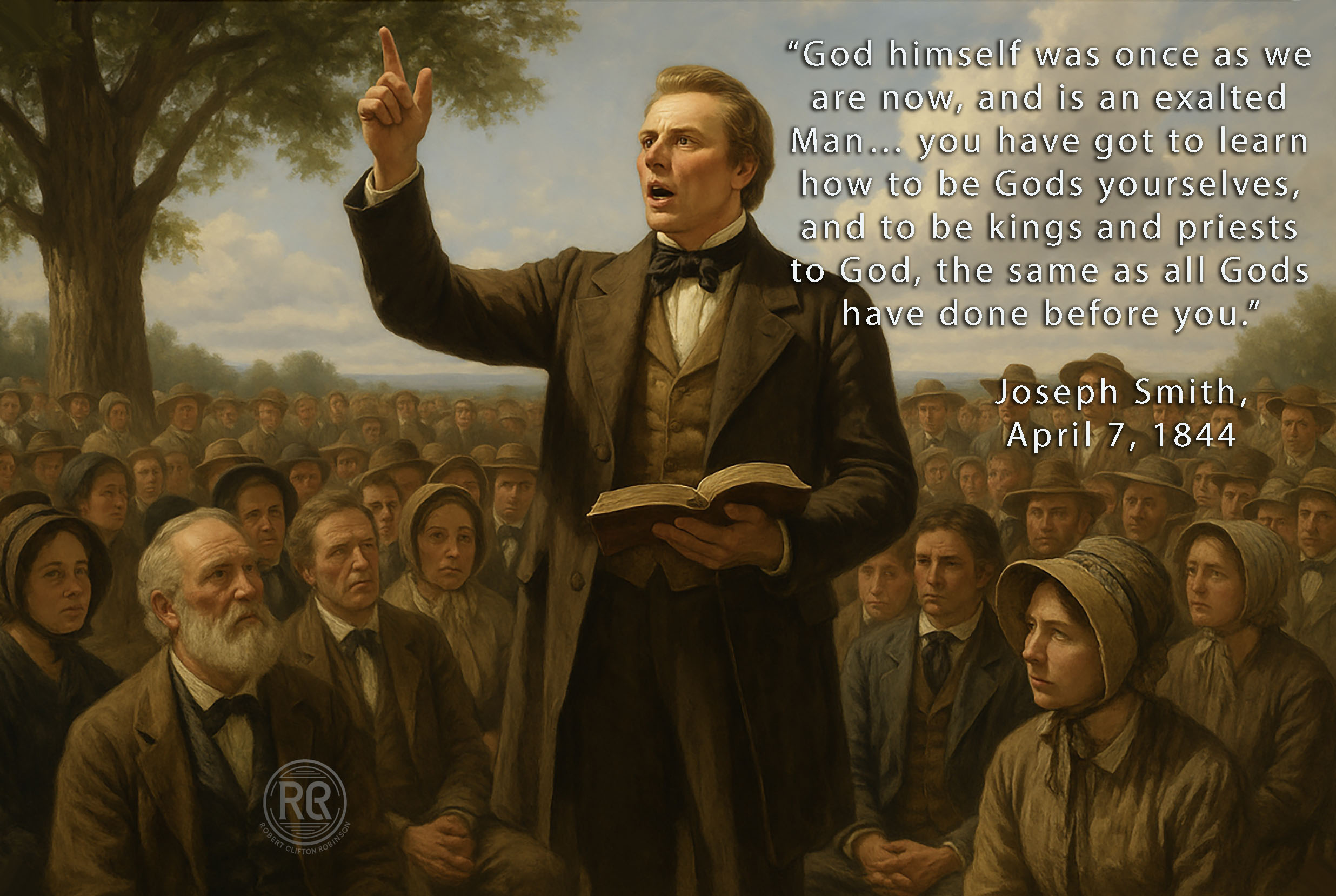
One of the most distinctive and controversial doctrines within Latter-day Saint theology is the teaching that faithful Mormon men may ultimately become gods. This belief is not speculation, nor is it the result of careless interpretation by critics. It arises directly from Joseph Smith’s own words, and these words were canonized into LDS scripture, reiterated by subsequent prophets, and continue to be taught in official Mormon church instructional materials. The doctrine is internally consistent within Mormon theology, but it represents a radical departure from historic biblical teaching, redefining both the nature of God and the destiny of humanity.
The clearest articulation of this doctrine originates in Joseph Smith’s final major sermon, delivered at the funeral of Elder King Follett in April 1844. In this discourse, Joseph Smith explicitly rejected the classical Christian understanding of God as eternally divine and instead asserted that God the Father Himself progressed into deity.
Smith declared that “God himself was once as we are now, and is an exalted Man,” and then proceeded to exhort his listeners that they must learn “how to be Gods yourselves… the same as all Gods have done before you.”¹ This statement is foundational, not merely because it claims that humans may become gods, but because it asserts that God the Father achieved His title as God through the same process now available to faithful men. The implication is unmistakable: God is not ontologically unique, but rather part of an eternal chain of exalted beings.
This sermon was not an isolated moment of extreme statements by Joseph Smith. It was preserved, published, and endorsed by the LDS Church in its official historical records. The King Follett discourse appears in Teachings of the Prophet Joseph Smith and in the multi-volume History of the Church, confirming that the Church regards these statements as authentic representations of Joseph Smith’s theology.² The LDS Church has never disavowed this sermon; instead, it has repeatedly affirmed it as a correct and authoritative expression of Smith’s doctrinal view of man’s exaltation as gods.
“You Are Gods”: The Argument from the Lesser to the Greater in John 10
What Joseph Smith proclaimed in the King Follett sermon was later codified into LDS canon. Doctrine and Covenants section 132, a text regarded by Latter-day Saints as direct revelation from God, explicitly teaches that exalted men and women “shall be gods.”³ The passage describes these exalted beings as possessing eternal existence, unlimited power, and authority over angels, attributes traditionally reserved for God alone. The text does not employ symbolic or metaphorical language; it speaks in literal terms of divine status, divine authority, and divine eternity. Within the LDS framework, exaltation is not merely moral perfection or eternal fellowship with God, but the attainment of godhood itself.
Doctrine and Covenants 132:19–20 (Canonical LDS Scripture)
“Then shall they be gods, because they have no end; therefore shall they be from everlasting to everlasting… Then shall they be gods, because they have all power, and the angels are subject unto them.”
This same doctrine is reinforced elsewhere in LDS scripture. Doctrine and Covenants 76 describes the highest degree of salvation as a state in which the redeemed are definitively identified as gods.⁴ These exalted beings are said to inherit God’s glory, become one with Him in power, and participate fully in the divine realm. The language is categorical, not aspirational. The text does not say they will be like gods in a limited sense, but that “they are gods,” sharing in the same order of existence as the Father.
Doctrine and Covenants 76:58 (Exaltation Defined)
“Wherefore, as it is written, they are gods, even the sons of God.”⁴
Do LDS Women Also Become Gods?
Women Are Exalted as Goddesses—But Only Through Their Husbands. LDS doctrine teaches that exalted women become goddesses, but never independently and never apart from an exalted husband.
Doctrine and Covenants 132 ties exaltation directly to eternal marriage, with the husband presiding:
“Then shall they be gods… then shall they be gods, because they have all power.” (Doctrine and Covenants 132:19–20.)
In LDS interpretation, the plural “they” does not indicate equal divine authority. Rather, it reflects joint participation in exaltation, with the husband functioning as the god and the wife as a goddess under his headship.
This hierarchy is explicitly taught in LDS manuals and prophetic commentary.
Brigham Young stated:
“A woman must be sealed to a righteous man to attain exaltation.” (Brigham Young, Journal of Discourses, vol. 18, 213.)
There is no parallel statement anywhere in LDS theology that a man must be sealed to a woman to become a god.
Following Joseph Smith’s death, later LDS leaders did not retreat from these claims. On the contrary, they confirmed and popularized what Smith said. Lorenzo Snow, the fifth president of the LDS Church, summarized the doctrine in a now-famous couplet: “As man now is, God once was; as God now is, man may be.”⁵ This statement is not treated as speculative theology within Mormonism. It has been repeatedly affirmed by the Church as an accurate expression of Joseph Smith’s teachings and is included in official LDS instructional materials for members worldwide.
The unchanged and consistent teaching of this doctrine in modern LDS teaching is undeniable. The Church’s official manual, Gospel Principles, used globally to instruct members in foundational doctrine, defines exaltation as receiving “the kind of life God lives” and states plainly that those who receive exaltation “will become gods.”⁶ The manual goes on to describe exalted men and women as eternal beings who live in family units, have spirit offspring, and participate in divine rule. This is not presented as a speculative hope or distant metaphor, but as the ultimate goal of faithful obedience within the LDS plan of salvation.
Official LDS Church Manual (Gospel Principles)
“Exaltation is eternal life, the kind of life God lives. Those who receive exaltation will become gods.”⁶
Even when confronted by public scrutiny, modern LDS leaders have declined to repudiate the doctrine. In a widely cited interview with Time magazine, President Gordon B. Hinckley responded cautiously when asked whether Mormons believe men can become gods, stating that he did not know that the Church emphasized the doctrine.⁷ Yet he did not deny its truth, nor did he reject Lorenzo Snow’s formulation when directly referenced. The hesitation was rhetorical, not theological. The doctrine remained intact.
In the LDS church, maintaining an important fact of Mormon foundational theology, that members can become gods, yet the President of the LDS church stated that “he did not know that the church emphasized the doctrine,” is a statement and premise of deception. Something as insidious as men becoming a god is a serious error that every LDS member should know exists in the church they attend. I know that as a 51-year member of Calvary Chapel, which places great priority on teaching accurately from the Bible as a foundation of the church, if at any time I suddenly learned that the church was teaching that as followers of Jesus we can someday become gods, I would immediately leave Calvary Chapel.
Taken together, these firm statements and doctrines in the LDS church demonstrate that the belief in human deification is neither incidental nor optional within Joseph Smith’s theology. It is a coherent and recurring theme that shapes the LDS understanding of God, humanity, salvation, and eternity.
In Mormon theology and teaching, God the Father is not eternally God in the classical sense, but a being who advanced to deity. Mormon leaders believe that humanity’s highest destiny is not eternal worship of a unique, uncreated God, but eventual participation in the same divine status that God attained. LDS teaching is that God was once a man and that He achieved His place as God by exaltation, that all Mormon members may also achieve.
In the entire 4,450-year history of the Bible, never has God ever stated that human beings can become gods
- God is eternally God (Psalm 90:2)
- God was never a man (Numbers 23:19)
- God is unique, with no gods before or after Him (Isaiah 43:10; 44:6; 45:5)
In this LDS system, there is no final, singular God; instead, there is an infinite progression of gods, each exalted from a prior state.
See Part 2 of this discussion: “The Problem of Eternal Progression.”
This doctrine marks a decisive theological break from biblical monotheism. Whereas Scripture presents God as eternally God, uncreated, immutable (unchangeable), and without rival, Joseph Smith’s theology redefines deity as a status that can be achieved, multiplied, and extended endlessly. The issue is not merely one of terminology, but of fundamentally different conceptions of who God is and what it means to be the biblical God, the Only God that exists. The LDS teaching that men may become gods stands as one of the clearest examples of how Joseph Smith’s theology departs from the historic faith it claims to restore.
God Alone Is God: A Biblical Impeachment of Human Deification in LDS Theology
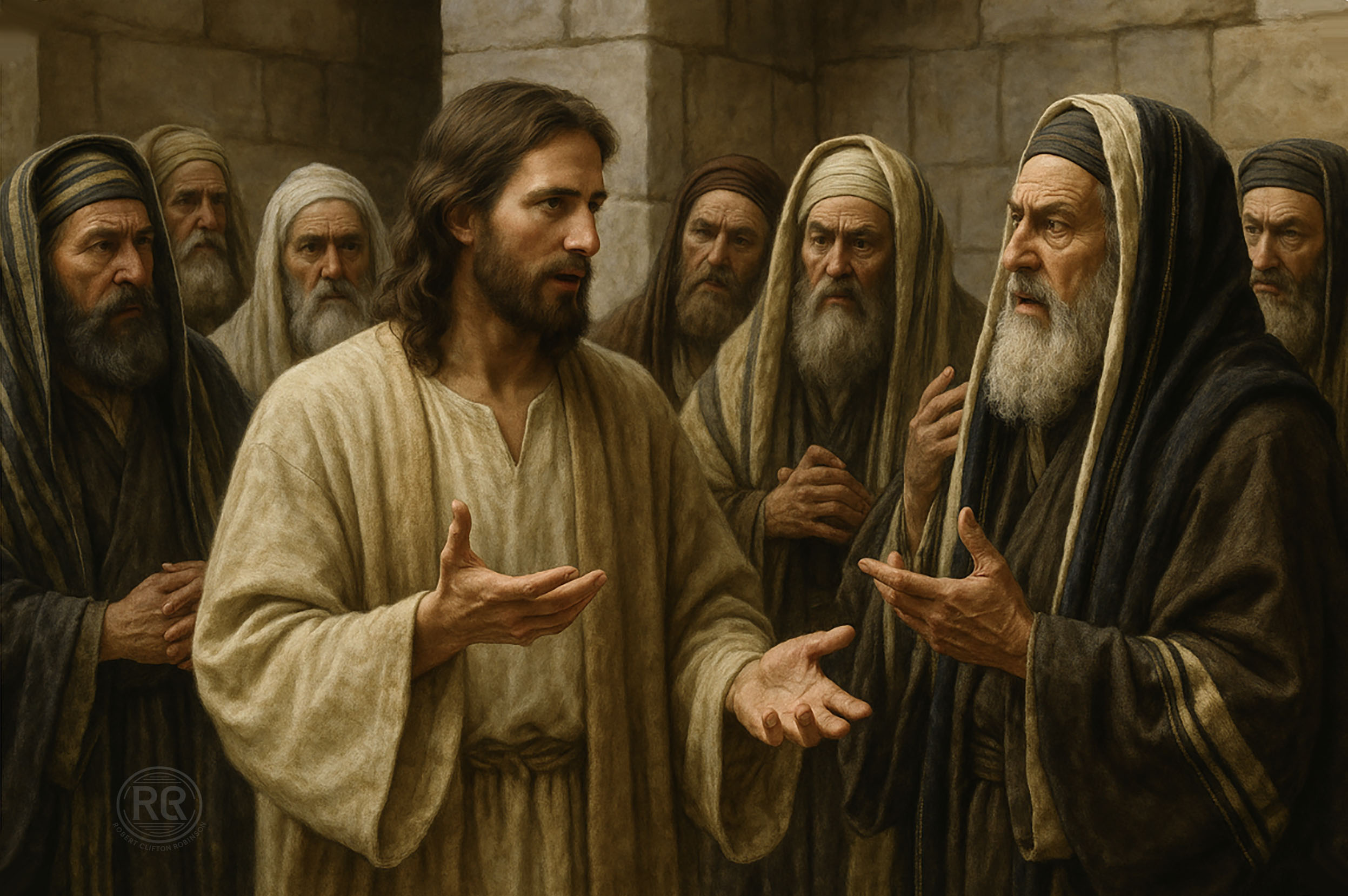 The LDS doctrine that faithful men may become gods rests upon a fundamentally different definition of deity than that found in the Bible. Whereas Joseph Smith’s theology understands godhood as an attained status within an eternal progression, Scripture presents God as eternally God by nature, uncreated, self-existent, and utterly unique. The disagreement is not an outlying statement or a matter of words misunderstood; it concerns the very identity of God and the meaning of worship in the LDS church. When the biblical text is allowed to speak on its own terms, the concept of men becoming gods collapses under the weight of God’s own self-revelation in the Bible.
This is why it is dangerous to become a part of any church that distinguishes itself as a “restored church,” while denying the very foundational principles of the Bible.
The Bible consistently affirms that God did not become God, nor did He progress into deity. He is eternally God, without origin, predecessor, or developmental process. Moses declares that before the mountains were formed, before the earth existed, God already was God, “from everlasting to everlasting.”¹ This statement is not a poetic exaggeration but a declaration of divine aseity. God’s existence is not contingent upon time, matter, or prior states of being. He does not enter godhood; He simply is.
Psalms 90:2 “Before the mountains were brought forth, Or ever You had formed the earth and the world, even from everlasting to everlasting, You are God.”
This eternal self-existence is reinforced when God reveals His covenant name to Moses. Yahweh identifies Himself as “I AM,” a statement of absolute being rather than achieved status.² The name, “I AM” itself signifies God’s uncaused existence and unchanging identity. God does not say, “I became,” or “I progressed,” but “I AM,” I have always existed as God. Any theology that portrays God as once non-divine necessarily contradicts the God of the Bible in His own definition of Himself.
Exodus 3:14 “And God said to Moses,“I AM WHO I AM.” And He said, “Thus you shall say to the children of Israel, I AM has sent me to you.’ ”
Isaiah 42:8 “I am the LORD, that is My name; and My glory I will not give to another.”
1 Kings 8:60 “That all the peoples of the earth may know that the LORD is God; there is no other.”
Isaiah 44:6-8 “I am the First, and I am the Last; Besides Me there is no God…Indeed, there is no other Rock; I know not one.’ ”
Biblical scripture also denies that God was ever a man.
Numbers 23:19 states clearly that God “is not a man, that He should lie, nor a son of man, that He should repent.”³
This distinction is not related to the fundamental nature of existence, reality, or being itself. God is not a more advanced version of humanity; God is categorically different, separate, unique, and distinct.
Hosea 11:9 restates the same truth when God Himself declares, “I am God, and not a man.”⁴
These statements do not allow for the LDS reinterpretation without violence to the text. In the LDS declarations about exalted men, they deny the Eternal God His singular right as the Only God that exists. I cannot think of anything that a human could say that is more horrendous than to say that God is merely a man who was exalted to the place of God. And yet, this is a historical and present-day doctrine of the LDS church. Most Mormons don’t know these things because it is not a doctrine or principle that is taught publicly in the LDS church. If it were often taught, tens of thousands of LDS members would likely depart the church.
I have personally experienced this lack of knowledge by LDS members when I ask them about whether they believe they will become a god. A Majority tell me that I am lying, that they have never heard this in the church.
The Bible further affirms that God is the sole, unique God, with no gods before Him and none after Him. In Isaiah 43, Yahweh declares, “Before Me there was no God formed, nor shall there be after Me.”⁵ This is not a statement about worship preference or covenant loyalty; it is a declaration about reality itself. God denies the existence of any prior gods and forecloses the possibility of future gods.
These statements in the Bible directly contradict Joseph Smith’s assertion of an eternal lineage of gods and the LDS expectation of future gods arising from humanity.
Isaiah continues this theme with increasing force. Yahweh proclaims, “I am the LORD, and there is no other; there is no God besides Me.”⁶ He does not say there are many gods but one supreme God; He denies the existence of any others altogether. Later, He states plainly, “I am God, and there is none like Me.”⁷ The uniqueness of God is not a matter of degree but of kind.
There is no category of being into which God fits alongside others. He alone is God.
The New Testament affirms the same theology without qualification. Jesus Himself prays to the Father as “the only true God,” excluding the possibility of other true gods existing alongside Him or arising after Him.⁸ Paul echoes this truth, stating that there is “one God and Father of all, who is above all, and through all, and in you all.”⁹ The apostle does not describe God as one among many, nor as the highest in a hierarchy of gods, but as the singular divine being from whom all else derives.
The writings of the Apostles also reject the assertion that God’s attributes can be acquired by humans. God alone possesses immortality inherently, dwelling in unapproachable light.¹⁰ Humans may receive eternal life as a gift, but they do not become eternal by nature. The distinction between Creator and creature is never erased in Scripture. Even in glorification, believers remain redeemed creatures, not newly minted gods.
A frequent LDS counterargument appeals to biblical language describing believers as “sons of God” or references to “partakers of the divine nature.” Yet these expressions do not imply ontological deification; the fundamental nature of existence, reality, or being itself.
To be a child of God is to belong to Him by adoption, not to become what He is by nature.¹¹
Peter’s statement concerning participation in the divine nature refers to moral transformation and fellowship, not accession to godhood.¹² At no point does Scripture suggest that redeemed humans receive God’s attributes of self-existence, omnipotence, or sovereignty over creation.
Most decisive of all is Scripture’s repeated insistence that worship belongs to God alone. God declares that He will not give His glory to another.¹³ Yet LDS theology teaches that exalted men will receive glory, rule worlds, and exercise divine authority. This inevitably divides the glory Scripture reserves exclusively for God. The Bible does not merely discourage this idea; it explicitly forbids it.
If we attend a church where a foundational doctrine is that men will receive glory, rule worlds, and exercise divine authority as a god, we can expect that the One God revealed by the Bible will count this as an abomination.
The biblical doctrine of salvation is fundamentally incompatible with the LDS doctrine of exaltation.
In biblical scripture, salvation restores relationship; it does not alter our nature of existence, reality, or being. Humans are redeemed, forgiven, glorified, and conformed to the image of Christ, but they never cross the infinite boundary between Creator and creature. God remains God alone, eternally and uniquely so.
The issue, then, is not whether Joseph Smith’s theology is internally coherent, but whether it aligns with the God who has revealed Himself in Scripture. By redefining God as an exalted man and presenting godhood as a reachable destination, LDS theology replaces biblical monotheism with an entirely different conception of reality. The Bible does not permit such a redefinition. God does not emerge from humanity, and humanity does not ascend into deity. God alone is God, and He always has been.
See Part 2 of this discussion: “The Problem of Eternal Progression.”
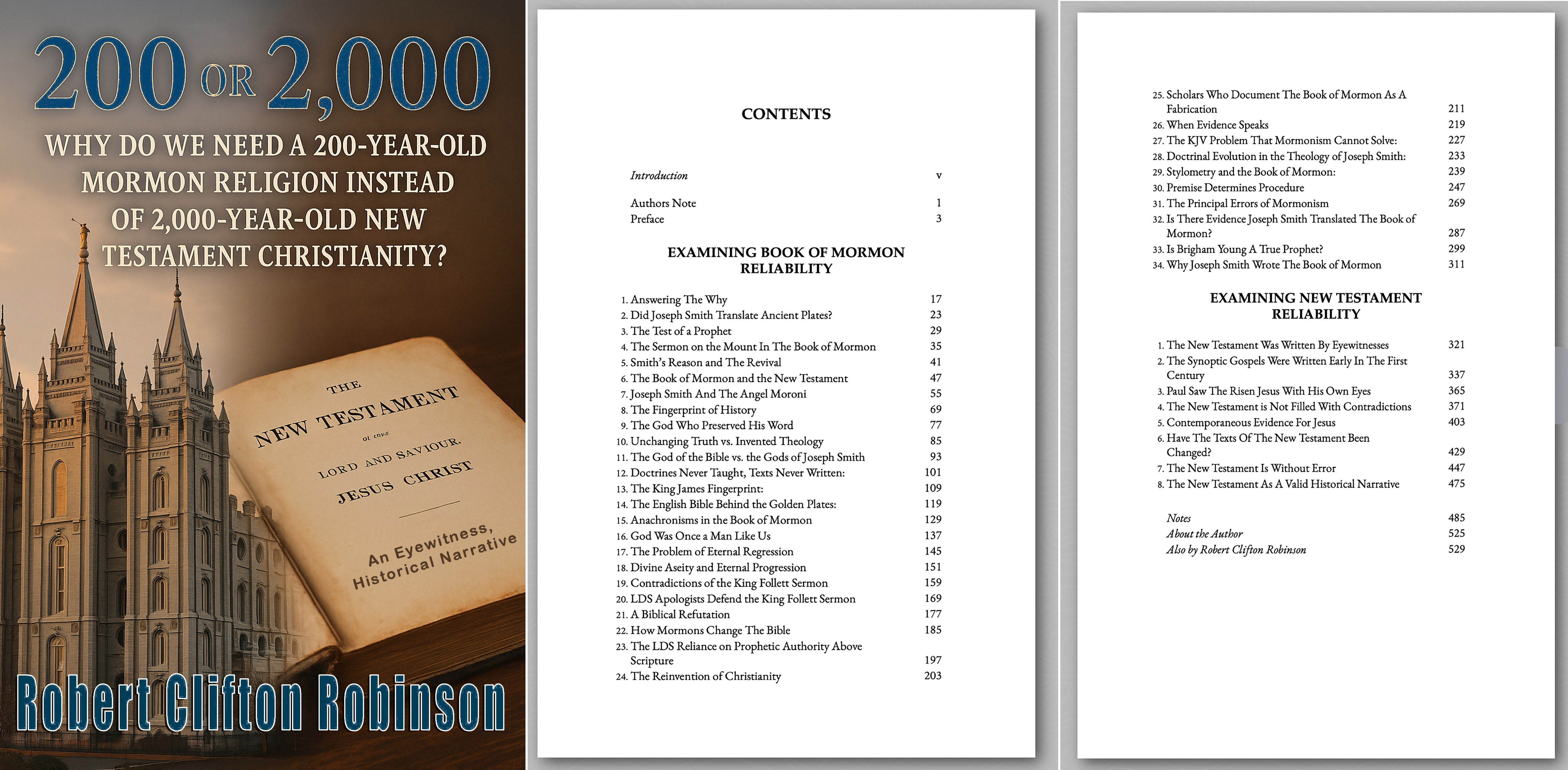
See Rob’s New Book Detailing All of the Departures From Truth in the LDS church that are in direct opposition to biblical scripture, the True Word of God.
Available in Kindle eBook (Now) and Paperback (Tuesday, December 16, 2025)
“200 Or 2,000: Why Do We Need a 200-Year-Old Mormon Religion Instead of 2,000-Year-Old New Testament Christianity?“
Sources and Citations: “Men Becoming God’s”
- Psalm 90:2.
- Exodus 3:14.
- Numbers 23:19.
- Hosea 11:9.
- Isaiah 43:10.
- Isaiah 45:5.
- Isaiah 46:9.
- John 17:3.
- Ephesians 4:6.
- 1 Timothy 6:15–16.
- Romans 8:15–17.
- 2 Peter 1:4.
- Isaiah 42:8.
Sources and Citations For “A Biblical Impeachment”
- Joseph Smith, Teachings of the Prophet Joseph Smith, comp. Joseph Fielding Smith (Salt Lake City: Deseret Book, 1976), 345–347.
- Joseph Smith, History of the Church, vol. 6 (Salt Lake City: Deseret Book, 1950), 302–317.
- Doctrine and Covenants 132:19–20.
- Doctrine and Covenants 76:58.
- Lorenzo Snow, quoted in Teachings of Presidents of the Church: Lorenzo Snow (Salt Lake City: The Church of Jesus Christ of Latter-day Saints, 2012), 83.
- Gospel Principles (Salt Lake City: The Church of Jesus Christ of Latter-day Saints, 2011), chap. 47.
- Gordon B. Hinckley, interview, Time Magazine, August 4, 1997.
Categories: Robert Clifton Robinson
 Robert Clifton Robinson
Please see, "Guidelines For Debate," at the right-side menu. Post your comment or argument here: