Among all the doctrines introduced by Joseph Smith during the final years of his life, none is more devastating to the internal coherence of Mormon theology—than the claim that God the Father was once a mortal man who lived on another world, progressed through obedience to higher laws, and eventually achieved godhood.

This teaching, articulated most famously in the King Follett discourse and preserved in the Times and Seasons, became the foundational basis for the Latter-day Saint doctrine known as “eternal progression.”
According to this system, deity is not an eternal, unchanging attribute of an uncreated Being but a status attainable by exalted mortals who themselves were once spirit children of a prior God.
The implications of this teaching are vast, extending into questions of metaphysics, the nature of salvation, the eternity of matter, and the very definition of God Himself. Above all, it raises a question so fundamental that the LDS system cannot answer it: If God the Father was once a mortal man, where did the very first man come from who became the very first God?
The LDS Redefinition of God as a Created Being Who Progressed to Godhood Constitutes Blasphemy
Joseph Smith declared explicitly, “God himself was once as we are now, and is an exalted man.”[1]
In the same sermon, he urged his listeners to learn “how to be Gods yourselves,” insisting that the process through which God achieved His own status is the same path mortals must follow.[2]
Later prophets embraced and expanded this concept. Lorenzo Snow summarized the idea in his doctrinal couplet: “As man now is, God once was; as God now is, man may be.”[3]
Brigham Young echoed this teaching, asserting that God “was once a man” and that He Himself had a Father before Him.[4]
John Taylor elaborated that humans could progress “in worlds without end” until they too gained the “exaltation and the position of a God.”[5]
Spencer W. Kimball, in the modern era, reaffirmed that “man is a god in embryo,” whose ultimate destiny is to become like the Father.[6]
Taken at face value, these statements establish the framework of LDS cosmology: every God was once a man, every man was once a spirit child, every spirit child was organized by a prior God, and this chain stretches backward into eternity. It is this very notion—the eternal regression of gods and men—that creates a philosophical crisis.
Mormonism confidently asserts that God the Father had a Father, and that Father had a Father, yet it offers no explanation for how the first man came into being who could initiate the chain of exalted beings.
If God became God, He was not always God; and if He was not always God, then the LDS system has no eternal, uncreated Deity upon whom existence depends.
The biblical conception of God as the self-existent “I AM” is entirely replaced by a genealogy of deities, none of whom are eternal in the strict sense, because each acquires godhood through progression.
The central question: Where did the first man come from?—is unavoidable. If every exalted God is dependent upon a prior God to create His spirit body, organize His world, grant Him a probationary state, and exalt Him to godhood, then no God in the LDS system is self-existent.
Each deity derives His being and authority from a predecessor. But if each God requires a prior God, and none are eternal by nature, then the LDS cosmos contains no ultimate source of existence.
It consists instead of an infinite regress of dependent beings, none of whom possess the metaphysical attributes necessary to ground reality itself. In classical philosophy, this is called the problem of the infinite regress of contingencies: an endless chain of contingent beings cannot explain its own existence.
There must be a First Cause that is uncaused, a Being whose existence is necessary, eternal, and independent. The God of the Bible fulfills this role; the god of Mormonism does not.
Brigham Young attempted to articulate this eternal regression more clearly, but he only deepened the problem. In one of his most explicit sermons, Young taught: “He [God] was once a man. Brother Kimball quoted a saying of Joseph the Prophet, that he would not worship a God who had not a Father; and I do not know that he would.”[7]
Young envisioned a universe populated by an infinite chain of Gods, none of whom were first, each dependent upon the previous. But this vision collapses under the weight of its own logic. If God has a Father, and that Father has a Father, and the chain extends eternally backward, then there is no original Creator.
Without an original Creator, there is no explanation for why anything exists at all. The LDS system eliminates the possibility of an uncreated Being and replaces it with an infinite series of exalted creatures—each of whom was at one time powerless, mortal, and ignorant.
The philosophical impossibility of such a regress is immediately apparent. An infinite chain of contingent beings cannot produce a universe. It cannot produce matter, spirit, laws, or order. It cannot explain consciousness, intelligence, morality, or meaning. A dependent being cannot account for its own existence, and a universe composed entirely of dependent beings remains eternally unexplained.
The LDS doctrine of eternal progression therefore leaves the origin of everything unanswered. It is a cosmology without a beginning, a theology without an ultimate God, and a metaphysics without a foundation.
Some modern LDS apologists have attempted to escape this dilemma by suggesting that God the Father’s mortal life may not have been “fallen” in the same sense as ours.
They argue that although Smith said God was “as we are now,”[8] this might refer only to possessing a physical body, not to moral imperfection. But this interpretation contradicts both Scripture and Mormon cosmology. Mortal existence, according to 2 Nephi, is a “probationary state” characterized by sin and temptation.[9]
A being who lived a mortal life without the possibility of sin or suffering would not be “as we are now.” Smith’s own language leaves no ambiguity; he meant that God passed through a mortal existence analogous to the human condition. Without that premise, the entire doctrine of eternal progression collapses, for human exaltation depends entirely on the idea that God’s path to godhood is the same path mortals must follow.
Other LDS thinkers have suggested that perhaps God the Father was created not by a God identical to Himself but by a higher-order Deity, unknown to us, who initiated the process. This merely relocates the problem one step higher. If the higher Deity existed eternally, then LDS doctrine is false, for Smith taught emphatically that God became God. If the higher Deity also became God, then we are back to the infinite regress. This model resolves nothing and contradicts the explicit teaching of the King Follett sermon.
The modern LDS Church, aware of these difficulties, no longer emphasizes the first half of Snow’s couplet. The official Gospel Topics essay titled “Becoming Like God” focuses exclusively on human exaltation and avoids any mention of God’s mortal past.[10]
In spite of these insurmountable difficulties, the Mormon Church continues to affirm historical doctrines without disavowing them. The omission is strategic, not theological. The doctrine is still embedded in the teachings of Joseph Smith, Brigham Young, Lorenzo Snow, and Spencer W. Kimball, all of whom the Church regards as prophets whose inspired statements guide the faith.
Because these foundational leaders are wrong in their view of God in nature and being, the Church finds itself in a doctrinal tension: it must affirm the teachings of earlier prophets to preserve prophetic authority while simultaneously avoiding explicit discussion that exposes the internal contradictions of those teachings.
In stark contrast, Scripture reveals a God who is uncreated, unchanging, eternal, and self-existent. The Bible affirms that God is “from everlasting to everlasting,”[11] that He is the Creator of all things,[12] that He alone is God and there is no other,[13] and that He does not change.[14]
Jesus Christ, the perfect revelation of God, is described as eternally God, “the same yesterday, today, and forever.”[15]
Nowhere does Scripture suggest that God was once a mortal being who progressed to deity. The very notion is excluded by every attribute Scripture ascribes to Him. The desire to “be like the Most High,” far from being a righteous aspiration, is portrayed as the essence of Lucifer’s rebellion.[16] What LDS theology calls exaltation, Scripture calls pride.
The LDS doctrine of eternal progression, therefore, stands in opposition not only to biblical revelation but to the most fundamental principles of logic and metaphysics.
A universe populated by evolving deities is a universe without a Creator. A God who became God is not God at all. A chain of Gods without a beginning is a chain without an explanation.
The Mormon conception of deity fractures under its own premises, leaving the most basic questions unanswered. Where did the first man come from? Where did the first God come from? Who created the first world? Who established the laws that govern exaltation? These questions expose an unbridgeable gap at the heart of LDS theology.
Christian theism provides answers that are both coherent and revealed. God is eternal. God is uncreated. God is the necessary foundation of all existence. He does not become; He is. He is not one God among many but the only God who exists.
He does not share His glory with another, nor does He surrender His uniqueness. Salvation is not the path to divinity but the gift of eternal life given by grace to sinners who cannot save themselves. The God of Scripture is everything the God of Mormonism is not.
The LDS teaching that God the Father was once a mortal man stands as one of the most theologically destructive doctrines ever offered under the name of Christianity. It reduces God to a contingent being, strips Him of eternity, removes Him from the role of Creator, and transforms salvation into a program of self-exaltation patterned after Lucifer’s rebellion.
Once the doctrine is fully understood, the question of the first God becomes impossible to avoid—and impossible to answer. Eternal regression is not a doctrine that needs refinement; it is a doctrine that cannot be true.`
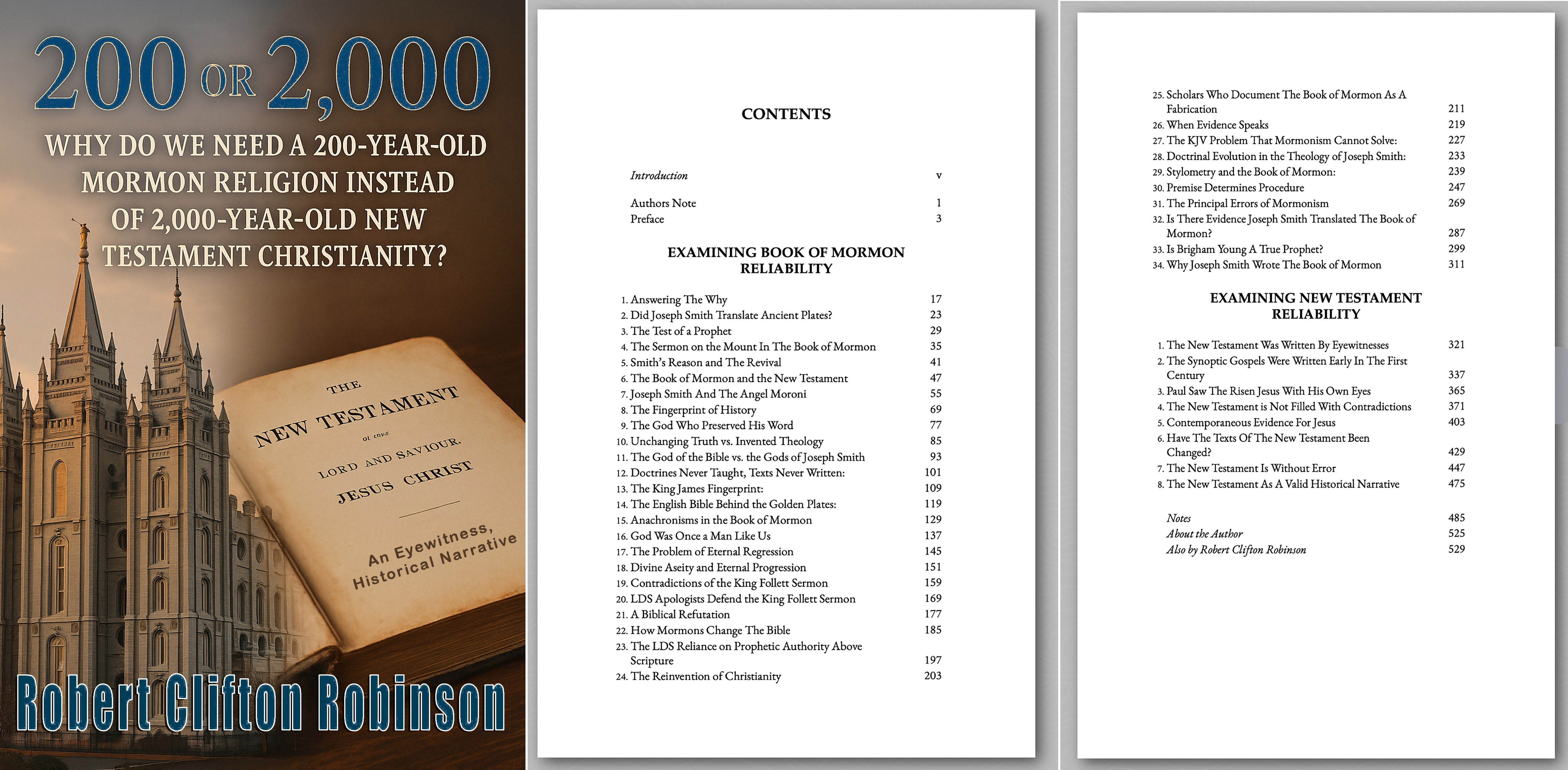
See Rob’s New Book Detailing All of the Departures From Truth in the LDS church that are in direct opposition to biblical scripture, the True Word of God.
“200 Or 2,000: Why Do We Need a 200-Year-Old Mormon Religion Instead of 2,000-Year-Old New Testament Christianity?“
Sources and Citations:
1. Joseph Smith, Times and Seasons 5 (August 15, 1844): 613–14.
2. Joseph Smith, Times and Seasons 5 (August 15, 1844): 613–14.
3. Lorenzo Snow, Teachings of Presidents of the Church: Lorenzo Snow, ch. 5.
4. Brigham Young, Journal of Discourses 9:286 (1862).
5. John Taylor, Journal of Discourses 8:1 (1860).
6. Spencer W. Kimball, Teachings of Presidents of the Church: Spencer W. Kimball, ch. 1.
7. Brigham Young, Journal of Discourses 9:286.
8. Smith, Times and Seasons 5:613–14.
9. 2 Nephi 2:21.
10. “Becoming Like God,” Gospel Topics, Church of Jesus Christ of Latter-day Saints.
11. Psalm 90:2.
12. Isaiah 44:24.
13. Isaiah 43:10.
14. Malachi 3:6.
15. Hebrews 13:8.
16. Isaiah 14:12–15.
Categories: Robert Clifton Robinson
 Robert Clifton Robinson
Well. I am reading that statement while reflecting on the assured disappointment that this very same God stated that He was the First and the Last. I guess that means no other man will ever achieve this status of God-ness. I wonder why?
Only if men like these Mormons understood that the very lie they believe was in essence the exact same lie that Adam and Eve believe the moment before they ate from the Forbidden Tree. We have seen with our own eyes the historicity of that disaster.
The God of the Heavens is revealing the Truth about these beliefs, with Pastor Rob’s writings for the sake of all souls, just has He has done from the beginning. So I ask the question again. What is one to do when the delusion you are under comes from God (2 Thessalonians 2:9-12)?
Thank you Brother Rob for all that you do. I cannot imagine the hate you must be receiving personally for these words of TRUTH. Remember Alexander the Coppersmith (2 Timothy 4:14).
So to any Mormon reading this post. Please answer the question: If God the Father was once a mortal man, where did the very first man come from who became the very first God?
We shall be waiting right here for your reply.
Prayers and blessings to all who follow Christ for He is the way, the truth and the life for there is NO OTHER but HIM.
LikeLiked by 1 person