If You Ask ChatGPT If The Book of Mormon Is True and Reliable: The Answers Will Shock You

The leadership of the Latter-day Saints (LDS Church) has asked its members not to use AI
SALT LAKE CITY – “The Church of Jesus Christ of Latter-day Saints is asking its members to refrain from using artificial intelligence technology when writing their sacrament talks in a letter released to local leaders Saturday morning. The letter comes following an increase in the popularity of breakthrough AI technology from OpenAI and their platform ChatGPT.”
“This new, cutting-edge technology is very powerful, but like all technology, should be used with great care,” Brother Chuck Babbage, director of Church Meeting Procedures wrote. “Effective immediately, we are inviting members to refrain from using this new technology to write sacrament talks, conduct firesides, seminary lessons, and even general conference talks. It is counterproductive to the personal growth of members of the Church of Jesus Christ of Latter-day Saints.” In the release, the church director specifically mentioned ChatGPT as well as Bard, and Bing.”
The Real Reason The LDs Church Doesn’t Want It’s Members To Use ChatGPT, Is That When Anyone Asks AI Questions About The Mormon Church, They Very Quickly Learn That This Church Is Not What It Claims To Be
Is Joseph Smith a True Prophet of God?
The question of whether the prophets of the Church of Jesus Christ of Latter-day Saints—beginning with Joseph Smith in 1830 and continuing through the line of presidents who followed him—are true prophets of the God of the Bible is a matter that must be answered by objective standards, not personal sentiment.
Scripture does not leave God’s people to guess whether a man speaks with divine authority. It gives measurable, verifiable criteria that distinguish the true prophet from the false one.
When these biblical standards are applied to Joseph Smith and the subsequent LDS prophetic line, a pattern emerges that is neither ambiguous nor disputable: the founders of Mormonism fail every biblical, historical, and evidentiary test that identifies a true prophet of God.[1]
The first and most uncompromising standard is the test of prophetic accuracy. God declares in Deuteronomy 18:22 that if a prophet speaks in His name and what he predicts does not occur, “that is a message the LORD has not spoken,” and the people are not to fear or follow that prophet.[2]
The rule is absolute. Scripture does not grant the prophet a margin of error. The God of the Bible, who cannot lie, cannot inspire a prophecy that fails. For this reason, a single false prophecy is sufficient to expose the prophetic claimant as false.
Joseph Smith did not fail merely once, but repeatedly, and in ways that are demonstrable by the historical record. In 1832, Smith declared that a war beginning in South Carolina would escalate into global conflict, “pouring out war upon all nations,” and culminating in the destruction of the United States government (Doctrine and Covenants 87:1–6).[3]
Although the American Civil War did begin in South Carolina, the U.S. government was not destroyed, nor did the war expand into a worldwide conflict of nations in Smith’s lifetime.[4] The prophecy failed in its central claim.
That same year, Smith also prophesied that a temple would be constructed “in this generation” upon a specific consecrated lot in Independence, Missouri (D&C 84:2–5).[5]
Nearly two hundred years have passed, and the property remains undeveloped, its promised temple unbuilt.[6] This failure is particularly significant because Smith tied the fulfillment to the lifetime of the people living in 1832. Their generation has died, and the prophecy remains unfulfilled.
A third failed prediction came in 1835, when Smith declared that the Lord would return before he reached the age of eighty-five (History of the Church 2:182).[7]
Smith died at age thirty-eight, and the year 1891 passed without the Second Coming.[8] These are not obscure or secondary statements. They were delivered publicly, written into official documents, and preserved by the church as authoritative. And they did not occur. According to the standards God Himself gave, this alone ends the prophetic claim of Joseph Smith.[9]
Yet the biblical tests do not end with predictive accuracy. Scripture also requires theological continuity: the prophet of God must proclaim the same message and the same God already revealed in Scripture. Paul warned that even an angel from heaven must be rejected if he proclaims another gospel (Galatians 1:8–9).1[0]
Where Are The Metal Plates Joseph Smith Translated The Book of Mormon From?
According to Joseph Smith’s own narrative, the origin of the Book of Mormon began on the night of September 21, 1823, when the angel Moroni allegedly appeared in his bedroom and revealed the existence of ancient gold plates buried in a hill near his home in Palmyra, New York. Smith stated that Moroni was the last prophet of a once-great ancient American Christian civilization, a people known as the Nephites, who had migrated from Jerusalem around 600 B.C.
Moroni supposedly entrusted to Joseph the responsibility of retrieving the plates and translating them “by the gift and power of God.” The plates, recorded in what Smith described as “Reformed Egyptian,” were said to contain a sacred history of ancient peoples who inhabited the Western Hemisphere for nearly a thousand years before perishing in a climactic battle at the Hill Cumorah in A.D. 421.
Joseph Smith further claimed that the angel commanded him not to show the plates to anyone until the time was right and that he would be divinely enabled to produce a translation that would become the Book of Mormon.
Smith’s description of the plates and his translation process have been one of the most controversial elements of the story. He asserted that he used sacred interpreters—two stones set in a frame, often referred to as the “Urim and Thummim”—along with a seer stone placed in the bottom of a hat.
Eyewitnesses such as Martin Harris and Emma Smith later confirmed that Joseph would put his face into the hat to block out the light, and in the darkness, he claimed that the English words of the translation miraculously appeared before him.
Throughout this process, the gold plates were often not physically present in front of him; they were reportedly wrapped in a cloth or sometimes located in another room. Smith maintained that the English text was dictated word-for-word as it appeared through divine means, rather than the result of natural linguistic or scholarly translation.
This was remarkable given that “Reformed Egyptian” Smith claimed the ancient gold plate was written in, is a language unknown to any linguist, unattested in any ancient body of written texts, and unattested as a writing system used by Jewish exiles from Jerusalem.
Smith also declared that the plates were ultimately taken back by Moroni after the translation was completed, leaving no physical evidence for anyone to examine.
Where are these plates that Joseph Smith claimed he translated? LDS records show that Joseph Smith said the plates were taken back to heaven by the angel who brought them to Smith.
When Moses came down from Mount Sinai, he carried with him the two stone tablets of the Law to prove that God had given these texts to him. When Jesus arrived on earth to prove that he is the Messiah, He brought the Hebrew scrolls of the Messianic Prophecies written for Him, as proof that He was the fulfillment of these texts. When Jesus birthed His church and called the men who saw and heard Him to write a testimony about Him, 24,593 manuscript copies of the New Testament were given to the world to prove that these men saw and heard Jesus and everything written about Him is true.
Only in the case of the LDS church are they given a pass, where they don’t have to prove to us that Joseph Smith translated ancient metal plates into the English text for the Book of Mormon. There are no plates, the very foundation for the LDS church, that rest upon these texts that Joseph Smith claims he translated from metal plates.
If God truly gave Joseph Smith this new revelation of His Word, He would have confirmed it by the same physical evidence He gave to Moses, Jesus, and the world through the New Testament.
Was The Book of Mormon Fabricated by Joseph Smith?
How could the Sermon on the Mount be found in the Book of Mormon, with essentially the same wording we find in the 1611 edition of the King James Version of Matthew 5–7?[11]
What the Book of Mormon claims, and where the Sermon on the Mount is found
The Book of Mormon presents itself as a record of people who left Jerusalem around 600 BC, who kept records on metal plates in their own language (“reformed Egyptian”), whose history continues down to about AD 421.
Within that narrative, Jesus is said to appear in the New World of early America after His resurrection. During that visit (3 Nephi 11–18), He delivers a sermon that is, in long stretches, virtually identical to the Sermon on the Mount in Matthew 5–7.[12]
In the LDS assertion, the events of 3 Nephi’s sermon are post-resurrection, not pre-Christian. But the textual form we have in the Book of Mormon is alleged to be the translation of an ancient New World record into 19th-century English by Joseph Smith.
That means, if the story in the Book of Mormon is authentic, the underlying language was something like “Nephite” (written in “reformed Egyptian”), reporting a sermon Jesus gave in Aramaic/Greek-era Palestine, then preached again in the Americas, then abridged by Mormon, then translated by Joseph Smith in the 1820s.
The key question is not “could Jesus preach similar content twice?” (He certainly could), but why does the Book of Mormon reproduce the King James English of Matthew 5–7, including its translation quirks, as if Joseph simply copied out of his Bible?[13]
What we actually see: A KJV duplication, not an independent witness
When you compare Matthew 5–7 (KJV) with 3 Nephi 12–14, three things stand out:
Long strings of identical wording – sometimes entire verses match the KJV word-for-word for extended stretches.[14]
Same verse order and paragraph structure – the internal structure follows Matthew’s arrangement, not some independent tradition with its own order.[15]
King James–style translation features – including archaic idioms (“thou,” “ye,” “whosoever”), and in multiple places, the Book of Mormon appears to carry over the KJV’s translation decisions rather than a fresh rendering from an ancient language.[16]
If the Book of Mormon were an independent, ancient record of the same sermon, we would expect an overlap at the level of ideas and themes, but with different wording, different ordering, and distinct local emphases, the way multiple ancient witnesses usually diverge (e.g., how Luke’s “Sermon on the Plain” differs from Matthew’s Sermon on the Mount).
Instead, we see something that looks exactly like a 17th-century English translation (KJV) being duplicated in a 19th-century text that claims to be a translation from an entirely different language and culture. These problems in the Joseph Smith texts prove he fabricated the Book of Mormon to make it look like an authentic new text from 600 BC.
This is why people like Wesley Walters, the Tanners, and Grant Palmer treat this created narrative by Smith as clear dependence on the KJV—Joseph Smith is not translating an ancient record; he is reusing his English Bible.[17]
The problem of KJV translation quirks
It’s one thing to say, “Maybe God wanted the English to sound like the Bible.” LDS apologists often argue that God allowed (or directed) Joseph to render the ancient text “in the language of the King James Bible” so it would feel familiar and authoritative.
But that explanation runs into serious problems when we notice that the Book of Mormon appears to reproduce very specific, human translation choices that belong to the KJV translators—choices that reflect their own Greek, Hebrew, and theological assumptions.[18]
Examples that critics point to:
Archaic English idioms that are not “timeless revelation” but specific to early-modern English.
Places where the KJV’s translation reflects a particular reading of the Greek text, yet the Book of Mormon mirrors that exact reading, rather than giving an independent translation.[19]
In other biblical quotations in the Book of Mormon (Isaiah, etc.), there are places where KJV italics (words that the KJV translators added with no Hebrew/Greek equivalent) show up in the Book of Mormon as though they were part of the original inspired text.[20]
If Joseph were truly translating from “reformed Egyptian” by divine gift, there is no reason those 17th-century English translation artifacts (italics) should be found in the resulting 19th-century text. The fact that they are there proves that Joseph’s source for the Book of Mormon was the English KJV, not ancient plates.
Earl Wunderli’s and Walter’s analyses both stress this point: the pattern of KJV dependence in the Book of Mormon looks exactly like plagiarism from a printed English Bible, not like a fresh translation from an unknown ancient language, as Joseph Smith claimed.[21]
Things Joseph Smith Cites In The Book of Mormon That Didn’t Exist
The most famous and widely discussed anachronism is the mention of horses, an animal that appears in multiple Book of Mormon passages and plays a functional role within the societies described. Nephi reports discovering “the horse” in the New World shortly after arriving around 590 B.C.[22]
The Book of Mormon later describes Lamanite kings maintaining “horses and chariots,” which they prepared before traveling or receiving guests.[23] The Nephites likewise gather “their horses” among other animals during war preparations.[24]
Although the Book of Mormon treats horses as domesticated livestock similar to those known in the ancient Near East, archaeology tells a different story.
Horses became extinct in the Americas around 10,000 B.C. and did not reappear until Europeans reintroduced them in the sixteenth century. No bones of domesticated horses, no bridles, no harnesses, no corrals, and no cultural depictions exist from Book of Mormon time periods.
The presence of horses in the text of the Book of Mormon is a direct contradiction of all known scientific evidence and reflects an Old World species unknown to pre-Columbian peoples. This fact by itself is a historical impossibility for the Book of Mormon’s authenticity.
Closely connected to horses is the Book of Mormon’s mention of chariots, a hallmark of Old World warfare and transport. The text records that a Lamanite king commanded his servants to “prepare his horses and chariots” before traveling.[25]
In another narrative, the king’s servants care for “horses and chariots,” implying established infrastructure and cultural familiarity.[26] The problem is that no ancient American civilization—whether Olmec, Maya, Zapotec, Mixtec, or any other—used or had wheeled transportation for animals.
While Mesoamerican (early American) cultures invented the wheel for children’s toys, this technology was never applied to carts, wagons, or chariots. The absence of suitable draft animals makes the presence of chariots also impossible. The Book of Mormon’s references to wheeled vehicles mirror Old World military traditions rather than any New World archaeological reality.
Another major anachronism involves Old World metallurgy, specifically steel and iron.
The Book of Mormon attributes to Lehi’s descendants a sophisticated level of metalworking, stating that Nephi taught his people to work in “all manner of iron, and copper, and brass, and steel.”[27]
Laban, the Jerusalem military officer killed by Nephi, is said to possess a sword “of the most precious steel.”[28]
The Jaredite record, allegedly thousands of years older, also describes kings forging “steel swords.”[29]
This level of iron and steel production is entirely unknown in ancient America.
Although Early American cultures practiced limited copper and gold metallurgy, true iron smelting and steel production never existed in the pre-Columbian world.
Steel requires controlled high-temperature furnaces, carbon bonding, and refined bloomery or crucible techniques, none of which have left any archaeological trace in the Americas.
The complete absence of iron tools, steel weapons, smelting sites, or slag pits stands in stark contrast to the Book of Mormon’s detailed descriptions of Old World metalworking. As a result of these historical facts, Smith’s references to steel represent clear evidence that his narrative is not true.
If You Ask AI These Questions, You Get the Response I Wrote In This Essay
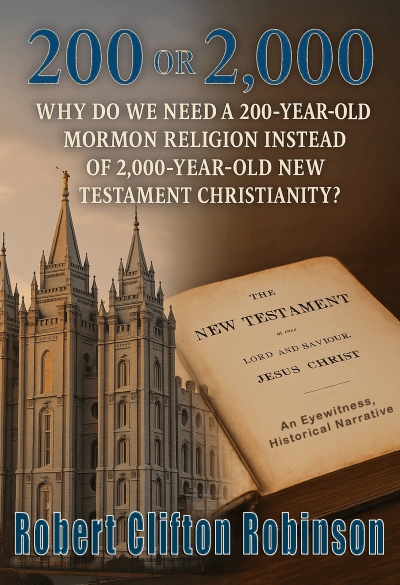
See The New Scholarly, Documented Book That Details The True Facts of Joseph Smith and The Book of Mormon: “200 Or 2,000: Why Do We Need a 200-Year-Old Mormon Religion Instead of 2,000-Year-Old New Testament Christianity?“
Sources and Citations
1. The Bible establishes objective tests for discerning true from false prophets, most clearly articulated in Deuteronomy 13 and 18, Matthew 7, Galatians 1, and 1 John 4.
2. Deuteronomy 18:22 sets an absolute standard requiring prophetic accuracy.
3. Doctrine and Covenants 87:1–6 (1832), predicting a global war beginning in South Carolina that would destroy the U.S. government.
4. The Civil War (1861–1865) began in South Carolina but did not expand into a global conflict nor destroy the U.S. government.
5. Doctrine and Covenants 84:2–5 (1832), predicting a temple built “in this generation” on the Independence, Missouri lot.
6. As of 2025, nearly two centuries later, the temple Smith prophesied has not been constructed on that site.
7. History of the Church 2:182, reporting Smith’s statement that the Lord would come before he turned eighty-five.
8. Smith died in 1844; 1891 passed with no Second Coming.
9. According to the Deuteronomy 18 standard, one failed prophecy disqualifies the prophetic claimant.
10. Galatians 1:8–9 prohibits acceptance of any new gospel, even if delivered by an angel, that contradicts previously revealed biblical truth.
11. For an overview of this problem in critical literature, see the discussions in Fawn Brodie, No Man Knows My History, and Wesley P. Walters’ work on Old Testament and New Testament usage in the Book of Mormon.
12. The 3 Nephi sermon is widely recognized, even by LDS scholars, as closely paralleling Matthew 5–7 structurally and verbally.
13. Walters, Palmer, and the Tanners all emphasize that the issue is not simply parallel teaching, but near-verbatim KJV reproduction.
14. Jerald and Sandra Tanner, in their side-by-side charts, show verse-by-verse agreements between Matthew 5–7 (KJV) and the corresponding Book of Mormon chapters.
15. Jerald and Sandra Tanner, in their side-by-side charts, show verse-by-verse agreements between Matthew 5–7 (KJV) and the corresponding Book of Mormon chapters.
16. Walters’ “Use of the Old Testament in the Book of Mormon” and Earl Wunderli’s An Imperfect Book discuss how KJV idioms and translator decisions reappear in the Book of Mormon.
17. Walters’ thesis, Palmer’s An Insider’s View of Mormon Origins, and Utah Lighthouse Ministry publications all argue that this is direct dependence on the KJV.
18. See standard textual-critical treatments of the KJV’s New Testament to appreciate how many decisions belong to that translation tradition and not to any hypothetical Nephite original.
19. Examples include particular renderings of Greek phrases that are debated in scholarship but reproduced exactly as in the KJV in the Book of Mormon.
20. The presence of KJV italic-word patterns in other Book of Mormon Bible quotations is a frequently cited point in Wunderli’s and the Tanners’ analyses.
21. Earl M. Wunderli, An Imperfect Book: What the Book of Mormon Tells Us About Itself; Wesley P. Walters, “The Use of the Old Testament in the Book of Mormon.”
22. 1 Nephi 18:25.
23. 2 Alma 20:6.
24. 3 Nephi 3:22.
25. Alma 20:6.
26. Alma 18:9–12.
27. 2 Nephi 5:15; Jarom 1:8.
28. 1 Nephi 4:9.
29. Ether 7:9.
Categories: Robert Clifton Robinson
 Robert Clifton Robinson
Please see, "Guidelines For Debate," at the right-side menu. Post your comment or argument here: