The claim that “there is no evidence for God” is best understood not as a neutral conclusion made after a fair examination of the truth, but as a rhetorical maneuver—a redefinition of what counts as evidence that subtly excludes God in advance. When we examine this tactic closely, the argument functions as a ruse in several specific but related ways.
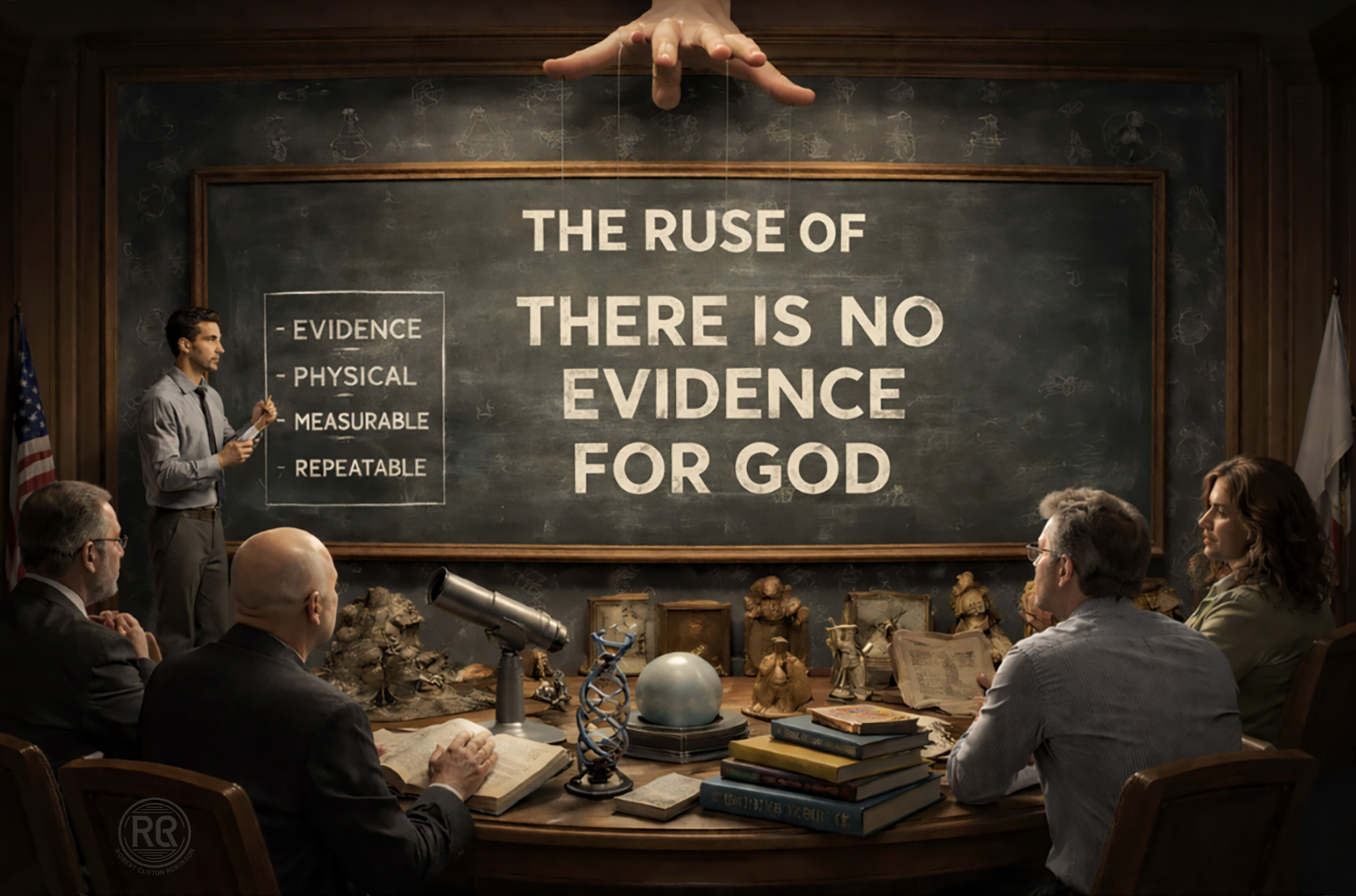
This Claim Redefines What Constitutes “Evidence”
In ordinary reasoning, evidence is anything that reasonably points beyond itself to an explanatory cause. We infer invisible realities constantly: gravity, quarks, minds, moral obligations, historical events, and even other persons’ consciousness. None of these is directly observable, yet no serious thinker denies their reality because of that.
The “no evidence for God” claim typically limits evidence to repeatable, laboratory-based, material measurements. But this definition is not neutral—it is philosophical naturalism smuggled in as methodology. God, by definition, is not a material object inside the universe, so demanding material detection of a non-material cause is like demanding a microscope to prove the existence of logic or a telescope to find the law of non-contradiction.
The ruse works like this:
- Redefine evidence as “physical, measurable, repeatable.”
- Exclude God from the category by definition.
- Declare victory: “No evidence for God.”
That is not discovery; it is category error.
This Claim Confuses “Scientific Evidence” with “All Evidence”
Science is powerful, but it is not exhaustive. Science answers questions about regular processes in nature, but it does not answer why questions about existence itself, meaning, morality, consciousness, or the origin of natural laws.
If the atheist claim that “there is no evidence for God were true in principle, then the following would also lack evidence:
- Objective moral truths
- Logical laws
- Mathematical entities
- Historical events beyond direct observation
- Human free will
- The existence of other minds
Yet even the strongest critics of theism rely on all of these every day.
The ruse lies in selective skepticism: demanding scientific proof for God while accepting non-scientific evidence everywhere else in life.
This Claim Ignores Cumulative Evidence by Demanding a Single “God Particle”
The argument often assumes that unless there is one decisive, undeniable piece of proof—something like a photograph of God—then there is no evidence at all. But this is not how rational belief works in any field. No major conclusion in history, science, or law rests on a single piece of evidence. Instead, we rely on converging lines of evidence. God is supported in exactly this way:
- Cosmological evidence: the universe began to exist and requires a cause beyond space, time, and matter
- Teleological evidence: extreme fine-tuning of physical constants for life
- Moral evidence: objective moral duties that transcend human preference
- Rational evidence: the intelligibility of the universe and the reliability of human reason
- Historical evidence: eyewitness testimony and historical claims surrounding Jesus
- Experiential evidence: consistent, cross-cultural testimony of divine encounter
Each line alone may be debated; together they form a cumulative case. The ruse dismisses all of this by pretending that unless God can be isolated like a chemical element, none of it counts.
This Argument Shifts the Burden of Proof
The statement “there is no evidence for God” is not neutral—it is a universal negative claim. Yet atheists who make this demand, “show me the evidence,” almost never defend it. Instead, they shift the burden to the theist: “Show me the evidence.”
This is intellectually dishonest unless the atheist first explains:
- What would count as evidence?
- Why the existing categories of evidence are invalid?
- Why alternative explanations are superior?
Atheists never explain these 3. The claim functions rhetorically, not analytically.
This Claim Confuses “Evidence” with “Compulsion”
Often what is really meant is not “there is no evidence” but “there is no evidence that forces me to believe.” But evidence does not compel belief; it invites judgment. Two people can examine the same evidence and reach different conclusions based on prior commitments. This distinction is crucial. Refusing to follow evidence where it leads does not make the evidence disappear. It only reveals that the resistance is volitional, not intellectual.
As Blaise Pascal observed, unbelief is often rooted not in lack of light, but in lack of willingness to see.
This Argument Ignores the Preconditions of Reason Itself
Reason, science, and evidence presuppose things that cannot be justified by materialism alone:
- The uniformity of nature
- The reliability of human rational faculties
- The existence of objective truth
If the universe is the product of unguided processes aimed at survival rather than truth, then confidence in reason itself is undermined. The very act of arguing against God relies on philosophical assumptions that make far more sense in a theistic framework.
For these reasons, the ruse becomes self-defeating: it uses God-grounded tools to deny God.
This Argument Treats God as a Hypothesis Within the Universe Rather Than the Explanation Of the Universe
God is not proposed as a competing cause alongside gravity or electromagnetism. God is proposed as the ground of all causes, the explanation for why anything exists at all rather than nothing. Demanding evidence for God the way we demand evidence for a new particle misunderstands the claim entirely. This is not science versus God; it is metaphysics preceding science.
The argument that “there is no evidence for God” succeeds rhetorically only by:
- Redefining evidence to exclude God
- Confusing the scientific method with total knowledge
- Ignoring cumulative and historical reasoning
- Shifting the burden of proof
- Equating evidence with coercion
- Presupposing the very things it cannot explain
The Argument that “there is no evidence for God is not the conclusion of careful reasoning but the starting assumption of philosophical naturalism. Once that assumption is exposed, the ruse collapses—and the real question emerges, not whether there is evidence for God, but whether one is willing to follow the evidence wherever it leads.
Why Atheists Will Not Engage In A Genuine Debate of What Constitutes Evidence
Atheists often rely on the assertion “there is no evidence for God” rather than engaging the kinds of evidence you have documented for a reason that is less about data and more about control of the intellectual frame. When examined carefully, this strategy functions psychologically, philosophically, and rhetorically—and it explains why your published evidence is frequently bypassed rather than refuted.
Atheists Know That Examining the Evidence Threatens the Governing Worldview
Atheism is not merely the absence of belief; in practice, it is usually tethered to philosophical naturalism—the conviction that nature is all that exists. Once this commitment is made, the evidence you describe is not evaluated neutrally but is filtered through a prior exclusion.
These categories of evidence point beyond nature:
- A cause beyond space-time-matter
- Purpose embedded in physical constants
- Moral obligations that transcend biology
- Rational faculties that aim at truth rather than survival
- Historical testimony that claims divine action
- Universal human experience of transcendence
To seriously examine these is to risk the collapse of naturalism itself. For many atheists, that cost is too high. It is safer to deny the category of evidence altogether than to follow it where it leads. For this reason, the claim “there is no evidence” functions as pre-emptive insulation, not a conclusion.
Atheists Refuse To Examine Real Evidence Because It Also Avoids the Need to Think About Their Philosophy That No God Exists
Engaging real evidence requires philosophical competence. It requires wrestling with metaphysics, epistemology, ethics, and historiography—not merely science popularization.
- The cosmological argument forces us to confront causation, contingency, and the impossibility of infinite regress.
- Fine-tuning requires probability theory and explanation beyond chance or necessity.
- Moral realism demands an account of oughtness that biology cannot supply.
- Rational intelligibility exposes the self-referential failure of evolutionary naturalism.
- Historical eyewitness testimony must be evaluated by the same standards applied to all ancient history.
Most atheists—especially those influenced by internet-level skepticism—are simply not equipped or willing to engage in this type of debate at depth. It’s much easier to declare “no evidence” because this allows the atheist to opt out of the conversation entirely while sounding intellectually confident.
Cumulative Evidence Is Harder to Dismiss Than a Single Claim
- Cosmological evidence: the universe began to exist and requires a cause beyond space, time, and matter
- Teleological evidence: extreme fine-tuning of physical constants for life
- Moral evidence: objective moral duties that transcend human preference
- Rational evidence: the intelligibility of the universe and the reliability of human reason
- Historical evidence: eyewitness testimony and historical claims surrounding Jesus
- Experiential evidence: consistent, cross-cultural testimony of divine encounter
The argument for evidence that proves God exists is multifaceted. It does not rest on a single argument but on converging lines of evidence. That is precisely what makes an evidentiary argument for Tod powerful—and precisely what makes it inconvenient for atheists.
Cumulative evidence cannot be dismissed with talking points. With the six points of evidence that atheists cannot refute, this requires multiple rebuttals, consistency across several scientific disciplines, and an alternative explanation that accounts for all the data these six points provide. A majority of atheists have the ability to meet these demands. If you try to pin down the average atheist on these six points, they will quickly change the subject and not answer any of these questions. Often, they refuse to engage any single argument at all by claiming there is “nothing to engage.” This is not accidental. It is far easier to knock down a caricature than to dismantle a structure.
Atheists Will Not Participate In Debate Because Moral and Existential Issues Are Involved
The preceding moral and historical evidence carries repercussions that go beyond abstract belief. If objective moral duties exist, then human beings are accountable. If Jesus rose from the dead, then Christianity is not merely one worldview among many—it is true, and truth makes demands.
For many atheists, the resistance is not evidential but existential. To examine your evidence honestly would require confronting questions of:
- Moral responsibility
- Personal autonomy
- Judgment
- Repentance
- Authority
The “no evidence” claim allows a person to remain morally unencumbered while appearing rational. Every atheist can immediately find sufficient evidence to know for certain that One God exists, but evidence is not their problem.
Experiential Evidence Is Uncomfortable but Ubiquitous
The truth is that atheists are threatened by the massive evidence for God that we have today because it will force them to admit that they are accountable for how they live the life God gave them. This is the real issue, not that there is “no evidence for God.”
For an atheist to dismiss the evidence that exists today for God, they are required to do one of two things:
- Admit that billions of people across history are either delusional or irrational
- Reclassify all such experience as meaningless by definition
Most atheists choose the second option. It is not that the evidence is weak; it is that it is too strong to control.
The Argument That No Evidence Exists For God Shifts the Burden Without Carrying One
Saying “there is no evidence for God” sounds like a conclusion, but it is actually an assertion that carries its own burden of proof—one that is almost never defended. To justify the claim that no evidence for God exists, a person must show that:
- Cosmological origins do not require a transcendent cause
- Fine-tuning is plausibly explained without intelligence
- Moral realism is an illusion
- Reason can be trusted if unguided by truth-aimed design
- Historical testimony is uniquely unreliable when it points to God
- Human religious experience is universally deceptive
Very few atheists attempt this argument. It is easier to declare the case closed than to argue it.
This Common Argument of “No Evidence For God” Is Rhetorically Effective but Logically Empty
Atheists use this phrase to shut down the conversation and put the theist on the defensive. Atheists think this tactic makes them look smart, but the opposite occurs in the view of an educated apologist.
If you press the atheist to define what they mean by “evidence,” they often reveal that they have defined it in such a way that nothing outside physical properties or measurable behaviors could ever qualify. The common definition for evidence is almost always physical and scientific in nature: “physical, measurable, repeatable.”
Things like logic, mathematics, moral reality, consciousness, meaning and intentionality, truth, causation, or free will. All of these are real, but they are not physical, yet they are necessary for intelligibility, and they cannot be explained by matter alone.
The reality of what atheists demand as evidence, this argument collapses into circularity: “I do not believe in God because I only accept explanations that exclude God.” This is no longer skepticism. It is dogma.
Atheists often use the “no evidence” argument not because the evidence you have published is weak, but because it is dangerous to their worldview. Engaging it honestly would require philosophical rigor, moral reflection, and intellectual humility—qualities that are far more demanding than dismissal.
The persistence of this argument that “no evidence for God exists” is not a sign of the absence of evidence, but a refusal of atheists to examine the evidence.
- Evidence For God
- Impeaching The Assertion Of A Universe From Nothing: A Causal Agent Is Necessary, Before The Universe Began
- Fine-Tuning Of The Universe And Quantum Mechanics: A Discussion
- Leading Atheists Admit That A Fine-Tuned Universe Is Evidence For God
- Evidence For Fine-Tuning Of The Universe: 209 Physical Constants That Make Life On Earth Possible
- Scientific Evidence From The Universe That Proves The Existence Of God
- The New Testament Is An Eyewitness Account Of True Events, Documented By The Synoptic Gospels, Written By 44 AD
- Translators Of The Early Koine Greek Texts Of The New Testament, Understood That Jesus Was Yahweh/Jehovah Of The Old Testament
- Atheists And Critics Have The Burden Of Proof To Disprove The Historical Eyewitness Narrative Of The New Testament
See The Evidence For God That I Have Compiled Over The Past 51 Years

Available In Kindle eBook, Paperback, and Hardback Editions
Click On Image To Look Inside
Categories: Robert Clifton Robinson
 Robert Clifton Robinson
Please see, "Guidelines For Debate," at the right-side menu. Post your comment or argument here: