The Founder of the Latter-Day Saints Church, Joseph Smith, Said: “God himself was once as we are now, and is an exalted man.”— Joseph Smith, King Follett Discourse (1844)
 This doctrine is foundational to LDS theology and inseparable from eternal progression, exaltation of men to god, and the plurality of gods.
What this doctrine means is that God the Father was once a man, as all men on earth are now. He was exalted to God, as are all men who are members of the Latter-Day Saints Church. This essay presents the statements of an LDS Apologist who has obtained a Phd.
I received the following comment from an LDS apologist who doesn’t believe The Father is an Eternal Spirit:
“In the Greek text of John 4:24, the phrase πνεῦμα ὁ θεός (pneuma ho Theos) isn’t talking about God being a spirit in the Greek. Because “pneuma” (spirit) lacks the definite article and is placed at the beginning of the sentence for emphasis, Greek grammarians (such as Colwell or Wallace) argue that it functions qualitatively. It is describing God’s nature or character rather than defining His “substance” as being strictly an invisible.”
This LDS apologist’s comment is a classic example of using correct Greek terminology to reach an incorrect theological conclusion. What is being argued sounds technical, but it collapses under careful grammatical, lexical, and contextual analysis—especially when the whole of Johannine theology is considered.
The Problem of Eternal Progression
The Following Is A Scholarly Response And Impeachment of the LDS Doctrine The Above Apologist Presented:
The Greek Text of John 4:24 reads:
πνεῦμα ὁ θεός, καὶ τοὺς προσκυνοῦντας αὐτὸν ἐν πνεύματι καὶ ἀληθείᾳ δεῖ προσκυνεῖν
The Literal English translation is:
“Spirit is God, and those who worship Him must worship in spirit and truth.”
This English translation Is Unanimous: “God is spirit” (ESV, NASB, NIV, NRSV); “God is a Spirit” (KJV, NKJV)
The LDS debate concerns πνεῦμα lacking the article and appearing first in the clause.
The Qualitative Predicate Argument — What It Actually Means
The LDS apologist is appealing to qualitative predicate nominatives, often associated with E. C. Colwell (Colwell’s Rule), and Daniel B. Wallace (Greek Grammar Beyond the Basics) A qualitative predicate nominative emphasizes nature or essence, not merely a description or behavior. Wallace defines it as expressing “the nature or essence of the subject”, not something temporary or metaphorical.
Regarding the text in question from John 4:23-24 Jesus said that the Father does not have a body, He is Spirit:
“But the time is coming—indeed it’s here now—when true worshipers will worship the Father in spirit and in truth. The Father is looking for those who will worship him that way. For God is Spirit, so those who worship him must worship in spirit and in truth.”
In John 4:24, πνεῦμα (Spirit is God) is qualitative; it means that God’s essential nature is Spirit. He is not a mood, a role, a metaphor, or a mode of action.
The Critical Point: Qualitative is not equal to non-ontological
This is where the LDS argument fails. To say the construction is qualitative does not weaken the ontological force of the statement—it strengthens it.
Jesus is saying that “God Is Spirit” and this is Ontological by Necessity
In the Greek texts, Predicate Position does not deny substance. Greek translators regularly use anarthrous predicate nouns to express what something truly is, especially with abstract or immaterial nouns. Examples:
- ὁ θεὸς ἀγάπη ἐστίν — “God is love” (1 John 4:8)
- ὁ θεὸς φῶς ἐστιν — “God is light” (1 John 1:5)
No serious scholar argues that God merely acts lovingly but is not love, or that God merely behaves as light but is not light
In the same way, God does not merely behave spiritually; God’s being is spirit
John 4:24 in Immediate Context: Jesus is explaining why location and physical structures are irrelevant to worship.
“Neither on this mountain nor in Jerusalem…” (John 4:21)
Why? God is spirit. That is, He is not spatially confined, not embodied, not localized, not material. If the Father had a physical body—as LDS theology asserts—Jesus’ argument collapses entirely.
A corporeal being has location, occupies space, and can be approached physically. Jesus’ reasoning only works if God is immaterial by nature.
The LDS Argument Commits a Category Error. The LDS apologist attempts to separate nature from being, but in biblical theology, what God is by nature is what God is in being. To say “God’s nature is spirit, but He is not ontologically spirit” is incoherent. Spirit is not an attribute like mercy or patience. Spirit is a mode of existence.
The Johannine Theology Elsewhere, John is consistent:
John 1:18 – “No one has ever seen God.”
John 5:37 – “You have neither heard His voice at any time nor seen His form.”
1 John 4:12 – “No one has seen God at any time.”
These statements are categorical, not conditional. They are false if the Father has a visible body, the Father possesses physical form.
Wallace Explicitly Rejects the LDS Conclusion. Daniel Wallace explicitly warns against exactly this misuse of the qualitative argument.
He states that qualitative predicates often emphasize essence, not abstraction or metaphor. Applied to John 4:24, Wallace affirms: God’s essential nature is spirit. There is no grammatical warrant—none—for reading:
“God is spirit-like.”
“God possesses spiritual qualities.”
“God is a spirit among other things.”
Why This Argument Exists in LDS Apologetics: This interpretation exists solely to protect a pre-existing theological commitment:
That the Father has a glorified physical body of flesh and bone. But this doctrine: originates in Joseph Smith, contradicts biblical monotheism, requires reinterpreting clear biblical texts. The grammar of John 4:24 does not support LDS corporealism. It directly contradicts it.
The claim that John 4:24 merely describes God’s “character” rather than His ontological nature misunderstands both Greek grammar and Johannine theology. The anarthrous predicate nominative πνεῦμα is qualitative, emphasizing essence—not diminishing substance. Jesus’ argument depends upon God being immaterial, non-localized, and incorporeal by nature. Any reading that allows the Father to possess a physical body collapses the logic of the passage and contradicts the wider testimony of Scripture. The grammatical appeal to Colwell and Wallace, when properly understood, affirms—not denies—that God’s very being is spirit.
The following is a direct, side-by-side, publication-ready contrast between biblical teaching (anchored in John 4:24 and Johannine theology) and authoritative LDS sources. This is written so it can be inserted as an apologetic appendix or polemical section with minimal editing.
God Is Spirit vs. God Has a Body
A Direct Contrast Between Biblical Teaching and LDS Authoritative Sources: Biblical Teaching: God’s Being Is Spirit (Ontological, Not Merely Qualitative) John 4:24 (Greek and Theology)
Jesus’ statement, “God is spirit” (πνεῦμα ὁ θεός), is not a comment on God’s behavior, mood, or worship preferences. It is the ground of His argument that worship is no longer tied to physical location. God’s mode of existence is non-corporeal, non-localized, and invisible.
As demonstrated earlier, the qualitative predicate nominative emphasizes essence, not metaphor. In Johannine theology, this places God in a category fundamentally different from embodied beings.
This understanding is reinforced throughout Scripture:
- God is invisible by nature (John 1:18; 1 John 4:12)
- God has no form that humans can perceive (John 5:37)
- God is not confined to space (1 Kings 8:27)
- God is not flesh and bones (Luke 24:39 contrasts spirit with body)
- Spirit, in biblical usage, is not an attribute layered onto a physical organism. It is a mode of being. To be spirit is to be non-material.
LDS Authoritative Teaching: God the Father Has a Physical Body
In clear contrast, LDS theology teaches that God the Father is an exalted man with a tangible body of flesh and bones.
Joseph Smith: “The Father has a body of flesh and bones as tangible as man’s; the Son also…” (Doctrine and Covenants 130:22)
This is not a vague LDS speculation. It is canonized scripture within Mormonism.
Joseph Smith also taught: “God himself was once as we are now, and is an exalted man.” (Joseph Smith, King Follett Discourse,1844)
This doctrine is foundational to LDS theology and inseparable from eternal progression, exaltation, and the plurality of gods.
Why the LDS Appeal to Greek Grammar Fails
LDS apologists often claim that John 4:24 refers only to God’s character, not His being, in order to preserve the doctrine of divine corporeality. But this move fails for three reasons:
Grammar Does Not Separate Nature from Being: In Greek—and in biblical metaphysics—nature defines being. To say “God’s nature is spirit” is to say:
God exists as spirit
God is not embodied
God is not material
There is no biblical category for a being who is essentially spirit yet ontologically corporeal. That distinction is imposed, not derived.
Jesus’ Argument Depends on Immateriality
Jesus explicitly ties God’s being spirit to the irrelevance of sacred geography: “Neither on this mountain nor in Jerusalem…” If God had a body:
- He would occupy space
- He would have location
- Worship would be spatially conditioned
- Jesus’ reasoning collapses if LDS theology is true.
Johannine Theology Explicitly Denies Divine Corporeality
John does not say:
“No one has seen God recently.”
“No one has seen God fully.”
“No one has seen God except the prophets.”
John says:
“No one has seen God at any time.” (John 1:18)
This statement is categorical and incompatible with a God who possesses a visible body.
Biblical Christianity V. LDS Theology
Bible: God is spirit by nature. LDS Theology: God is an exalted embodied man
Bible: God is invisible. LDS Theology: God has a visible, tangible body
Bible: God is not localized. LDS Theology: God occupies space
Bible: God is eternally unique. LDS Theology: God is one among many gods
Bible: Worship transcends location. LDS Theology: God has a physical residence
These are not semantic disagreements. They are mutually exclusive worldviews. LDS Theology is in direct opposition and contradiction to Biblical Christianity. This is why the LDS church is not a Christian church.
The LDS Redefinition of God as a Created Being Who Progressed to Godhood Constitutes Blasphemy
Why LDS Apologetics Reinterpret John 4:24
The reinterpretation of John 4:24 is not driven by Greek grammar. It is driven by doctrinal necessity. If John 4:24 is allowed to mean what it plainly states: the Father cannot have a body, Joseph Smith’s teaching is false, LDS cosmology collapses. Therefore, the text must be re-engineered.
John 4:24 stands as one of the clearest ontological statements about God in Scripture. The qualitative predicate πνεῦμα affirms God’s essential mode of existence as immaterial, invisible, and non-corporeal. LDS theology, by contrast, canonizes the belief that God the Father possesses a tangible body of flesh and bones. These positions cannot be harmonized. The LDS appeal to Greek grammar does not weaken the biblical doctrine of divine incorporeality; it inadvertently strengthens it. The conflict is not linguistic but theological, and the text of John 4:24 decisively favors the biblical view that God’s being is spirit.
- The Problem of Eternal Progression
- Destroying LDS Doctrine: God Was Once A Man; Moses, Isaiah, John, and Jesus Disagree With LDS Theology
- Are Mormons Christians? See What They Believe About Jesus: Statements About Jesus From LDS Publications
- Who Wrote The Book of Mormon? Is This Text A Credible, Reliable Representation of Truth?
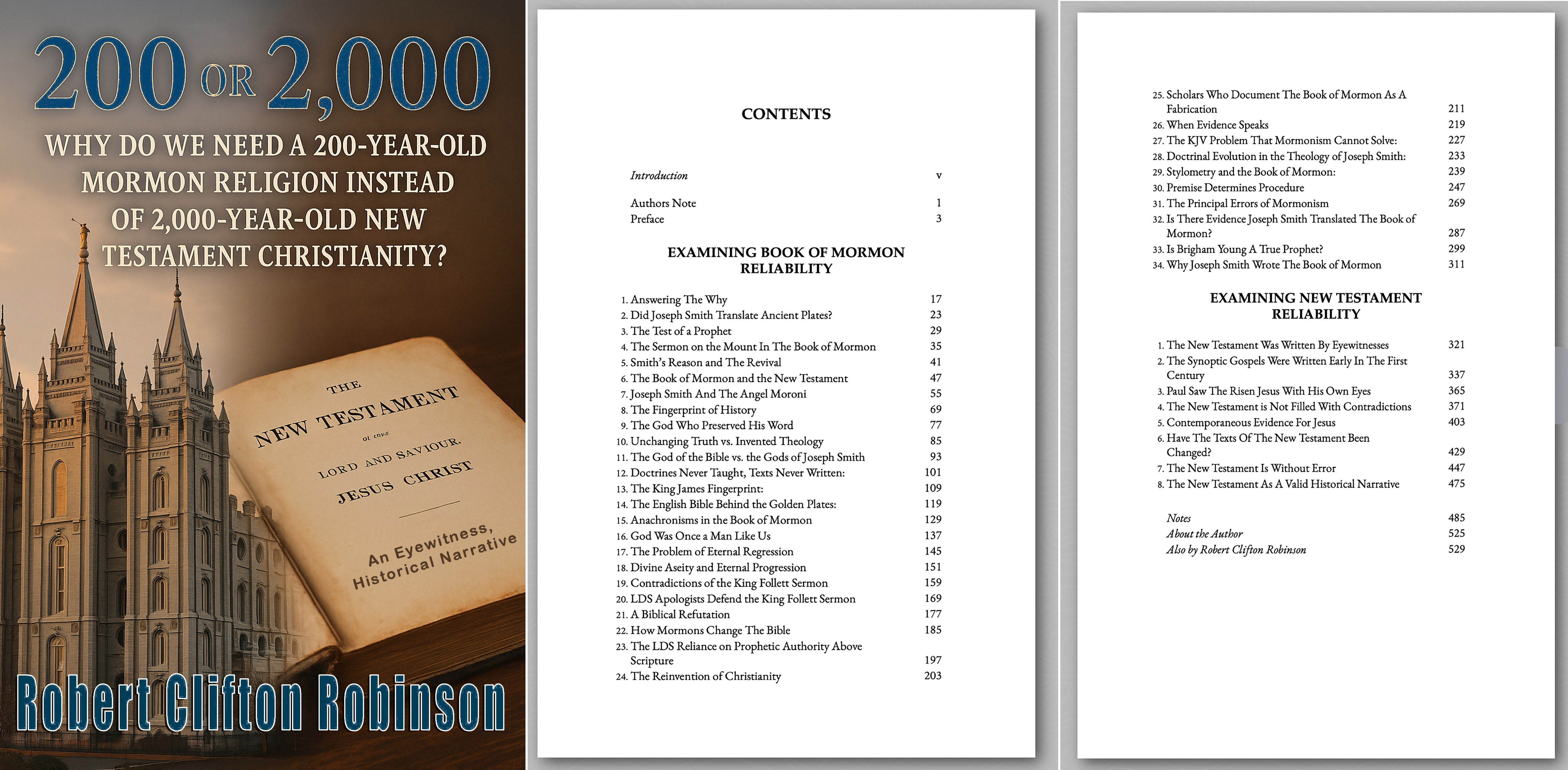
See Rob’s New Book That Explores The True Facts of the LDS Church and the Book of Mormon:
Categories: Robert Clifton Robinson
 Robert Clifton Robinson
To reinterpret John 4:24 to force a specific theological world view is a kin to what the Jehovah’s Witnesses have done to John 1:1, John 1:18 and Colossians 1:16.
In John 1:1 they state a similar Greek grammatical case to state that Jesus is only a god not God. And in doing so fail to recognize the polytheistic nature of the translation which violates who Jesus said He was in Revelation 22:13.
In John 1:18 they translate Jesus as being the only begotten-god indicating a created god which fails monotheism.
In Colossians 1:16, the word other is added to that verse to suggest that Christ created all other things not just all things. Because they believe Jesus is a created being, He simply could not have created Himself thus they add the add the word other.
They do this because they fundamentally deny the Trinity but have no way to truly explain the Son therefore they reinterpret and add to the NWT Bible they use to make Him out to be Michael the Archangel.
These religions are Satanic cults and this is why Jesus forewarned with Matthew 7:21-23. How can you say you know Jesus when the first thing you do is Deny His Deity and in the Mormon’s case Deny who God even is.
This is exactly what Satan is looking for … a Mormon or Jehovah Witness apologist.
Jesus warned us not to be deceived. Anything that is denying His Deity that we believe is in fact a case where were are being deceived. It is not Brother Rob, nor myself, who(m) is warning you; but, it is JESUS HIMSELF.
We must all free ourselves from the deception of Satan and his world.
Thank you Brother Rob for all you do.
LikeLike