What Does The Constitution Say Regarding The Enforcement of Federal Immigration Law, And Cases Where Federal Agents Must Use Deadly Force?

The Supremacy Clause — Text and Legal Meaning, Constitutional Text
The Supremacy Clause is found in Article VI, Clause 2 of the United States Constitution:
“This Constitution, and the Laws of the United States which shall be made in Pursuance thereof; and all Treaties made, or which shall be made, under the Authority of the United States, shall be the supreme Law of the Land; and the Judges in every State shall be bound thereby, any Thing in the Constitution or Laws of any State to the Contrary notwithstanding.”
Core Legal Effects
- The Supremacy Clause establishes four controlling principles:
- Federal Constitutional supremacy over all state law
- Federal statutes (when constitutionally enacted) override conflicting state statutes
- Treaties ratified under federal authority override state law
- State courts and officials are bound by federal law, regardless of state constitutions or statutes
- This clause is not optional, conditional, or cooperative—it is mandatory and hierarchical.
Immigration as an Exclusively Federal Power, Constitutional Foundations
Although the Constitution does not use the word “immigration,” the Supreme Court has consistently held that immigration authority arises from:
- The Naturalization Clause (Art. I, §8, cl. 4)
- The Foreign Commerce Clause (Art. I, §8, cl. 3)
- The Foreign Affairs Power
- The Sovereignty of national borders
From the earliest cases forward, the Court has ruled that immigration is an inherent federal power, inseparable from national sovereignty.
Federal Preemption Doctrine (How Supremacy Is Applied)
Under Supremacy Clause jurisprudence, state immigration laws are invalid if they conflict with federal law. Courts analyze this using three forms of preemption:
Express Preemption: Congress explicitly states that federal law displaces state law.
Field Preemption: Congress so thoroughly regulates a field (like immigration) that states are excluded entirely, even without express language.
Conflict Preemption: State law:
- Makes compliance with federal law impossible, or
- Stands as an obstacle to federal objectives
Immigration law triggers all three.
Supreme Court Rulings on Immigration Enforcement, Core Holding (Repeated for Over a Century)
States may not create, enforce, or supplement immigration law.
Key rulings establish that:
- Immigration enforcement affects foreign relations
- National uniformity is constitutionally required
- State interference undermines federal priorities
The Court has repeatedly invalidated state attempts to:
- Create state-level immigration crimes
- Conduct independent removal schemes
- Enforce federal immigration law without authorization
The controlling principle is this: Even state laws that mirror federal immigration law are unconstitutional if the state acts independently of federal authorization.
What States MAY and MAY NOT Do
States MAY:
- Cooperate with federal authorities only when authorized by Congress
- Share information voluntarily (8 U.S.C. §1373)
- Enforce neutral criminal laws unrelated to immigration status
- Decline to use state resources for federal enforcement (anti-commandeering doctrine)
States MAY NOT:
- Deport or remove aliens
- Create immigration classifications
- Criminalize unlawful presence
- Conduct immigration arrests without federal delegation
- Override federal enforcement priorities
This is why both sanctuary mandates and state crackdowns are constitutionally constrained, though for different reasons.
Federal Enforcement Authority, Federal Agencies with Primary Authority
- Department of Homeland Security (DHS)
- Immigration and Customs Enforcement (ICE)
- Customs and Border Protection (CBP)
- U.S. Citizenship and Immigration Services (USCIS)
Only the federal government may:
- Admit or exclude non-citizens
- Grant asylum or refugee status
- Issue visas or work authorization
- Execute removal orders
States cannot compel federal enforcement, nor can they substitute for it.
Anti-Commandeering vs. Supremacy (Key Distinction), A frequent confusion arises here.
Supremacy Clause:: States cannot contradict federal law
Anti-Commandeering Doctrine: The federal government cannot force states to enforce federal law
- States must not interfere
- States are not required to assist
This balance preserves federal supremacy without destroying state sovereignty.
Why This Matters Constitutionally: Immigration enforcement is not merely policy—it is a constitutional structure.
If states could independently enforce immigration law:
- Foreign nations would face 50 immigration systems
- Federal treaties would be undermined
- National borders would cease to be national
The Framers explicitly rejected this outcome, which is why immigration has always been treated as a federal monopoly of authority.
The Supremacy Clause makes federal immigration law supreme
- Immigration enforcement is exclusively federal
- States cannot enforce, supplement, or contradict immigration law
- States may cooperate only with federal authorization
- States may refuse participation—but may not obstruct
Use of Deadly Force In Self Defense By Federal Immigration Officers
Federal law explicitly authorizes federal immigration officers to use force—including deadly force—when necessary to defend themselves or others while enforcing federal immigration law. Below is a precise, citation-ready breakdown, grounded in statute, regulation, and controlling Supreme Court doctrine.
Statutory Authority to Carry Firearms and Use Force: 8 U.S.C. § 1357 — Powers of Immigration Officers and Employees
This is the primary federal statute governing immigration enforcement authority.
Under 8 U.S.C. § 1357(a), authorized immigration officers may:
- Interrogate aliens
- Make arrests for immigration violations
- Execute warrants
- Perform enforcement functions delegated by the Attorney General / DHS
Crucially, § 1357(a)(5)(B) expressly authorizes immigration officers to carry firearms:
“…have power without warrant—(5)(B) to carry firearms…”
Congress does not authorize firearms without authorizing their lawful defensive use. Courts uniformly hold that the authority to carry arms necessarily includes the right to use them in lawful self-defense while executing federal duties.
Federal Use-of-Force Authorization (Executive & Regulatory Law):
DHS Use of Force Policy (Binding on ICE & CBP)
Federal immigration agents operate under DHS-wide use-of-force standards, which are legally enforceable administrative law.
Key governing rule: Federal officers may use reasonable force, including deadly force, when they reasonably believe such force is necessary to protect themselves or others from imminent danger of death or serious bodily harm.
This standard mirrors the constitutional rule articulated by the Supreme Court (see Section IV).
Criminal Immunity for Lawful Acts by Federal Officers: 18 U.S.C. § 111 — Assaulting, Resisting, or Impeding Federal Officers
This statute criminalizes force against federal officers:
“Whoever forcibly assaults, resists, opposes, impedes, intimidates, or interferes with any person designated in section 1114 while engaged in or on account of the performance of official duties…”
If a federal immigration officer is attacked while enforcing immigration law:
- The attacker commits a federal felony
- The officer’s responsive use of force is presumptively lawful if reasonable
This statute exists precisely because federal officers are expected to defend themselves while performing federal duties.
Constitutional Standard Governing Self-Defense by Federal Officers: Supreme Court of the United States — Objective Reasonableness Doctrine
The controlling constitutional standard comes from Graham v. Connor (1989):
Use of force by law enforcement is evaluated under an “objective reasonableness” standard under the Fourth Amendment.
This applies fully to:
- ICE agents
- CBP agents
- Federal task-force officers
- All federal law-enforcement personnel
If a reasonable officer in the same circumstances would believe force was necessary, the force is constitutionally lawful.
Federal Preemption Protects Immigration Agents Acting in Self-Defense
Under the Supremacy Clause, states may not:
- Criminalize lawful federal enforcement actions
- Arrest or prosecute federal officers acting within federal authority
- Second-guess federal use-of-force standards
This doctrine was established in In re Neagle (1890), which held that federal officers are immune from state prosecution when acting pursuant to federal law and authority.
A federal immigration agent enforcing federal law cannot be prosecuted under state law for defending himself, provided the force used was reasonable under federal standards.
A federal immigration officer may use deadly force (including shooting) only if a reasonable officer in the same situation would believe the driver’s actions pose an imminent threat of death or serious bodily injury to the officer or others, and deadly force is necessary to stop that threat.
What you described—a driver accelerating a truck toward an officer after refusing lawful commands—can meet that standard, because a vehicle being driven at an officer can constitute a deadly weapon and an imminent deadly threat. But whether the shooting is legally justified turns on details like distance, speed, officer positioning, availability of retreat, and whether the officer could safely move out of the vehicle’s path.
The controlling constitutional standard: objective reasonableness
Graham v. Connor (1989)
All law-enforcement uses of force during a seizure—including federal agents—are judged under the Fourth Amendment’s “objective reasonableness” standard, assessed from the perspective of a reasonable officer on the scene, not hindsight.
Tennessee v. Garner (1985) Deadly force is constitutionally permitted only when the officer has a reasonable basis to believe the suspect poses a significant threat of death or serious physical injury to the officer or others.
If the truck is accelerating toward the officer such that it presents an imminent risk of killing or seriously injuring the officer (or another person), Garner/Graham allow deadly force if necessary to stop that threat.
Federal use-of-force policy (relevant because DHS follows it) DOJ deadly-force rule (widely used as the federal benchmark)
DOJ policy states deadly force may be used only when necessary, meaning the officer reasonably believes the subject poses an imminent danger of death or serious physical injury to the officer or another person.
DHS directive (governs DHS components like ICE/CBP)
DHS’s Department Policy on Use of Force likewise anchors force decisions to constitutional standards and limits deadly force to life-threatening circumstances.
Many law-enforcement policies—including federal-aligned guidance—generally discourage shooting at moving vehicles when the threat can be avoided by moving out of the way, unless there is an imminent deadly threat that cannot otherwise be addressed. (This issue has been highlighted in recent reporting specifically about ICE/vehicle shootings.)
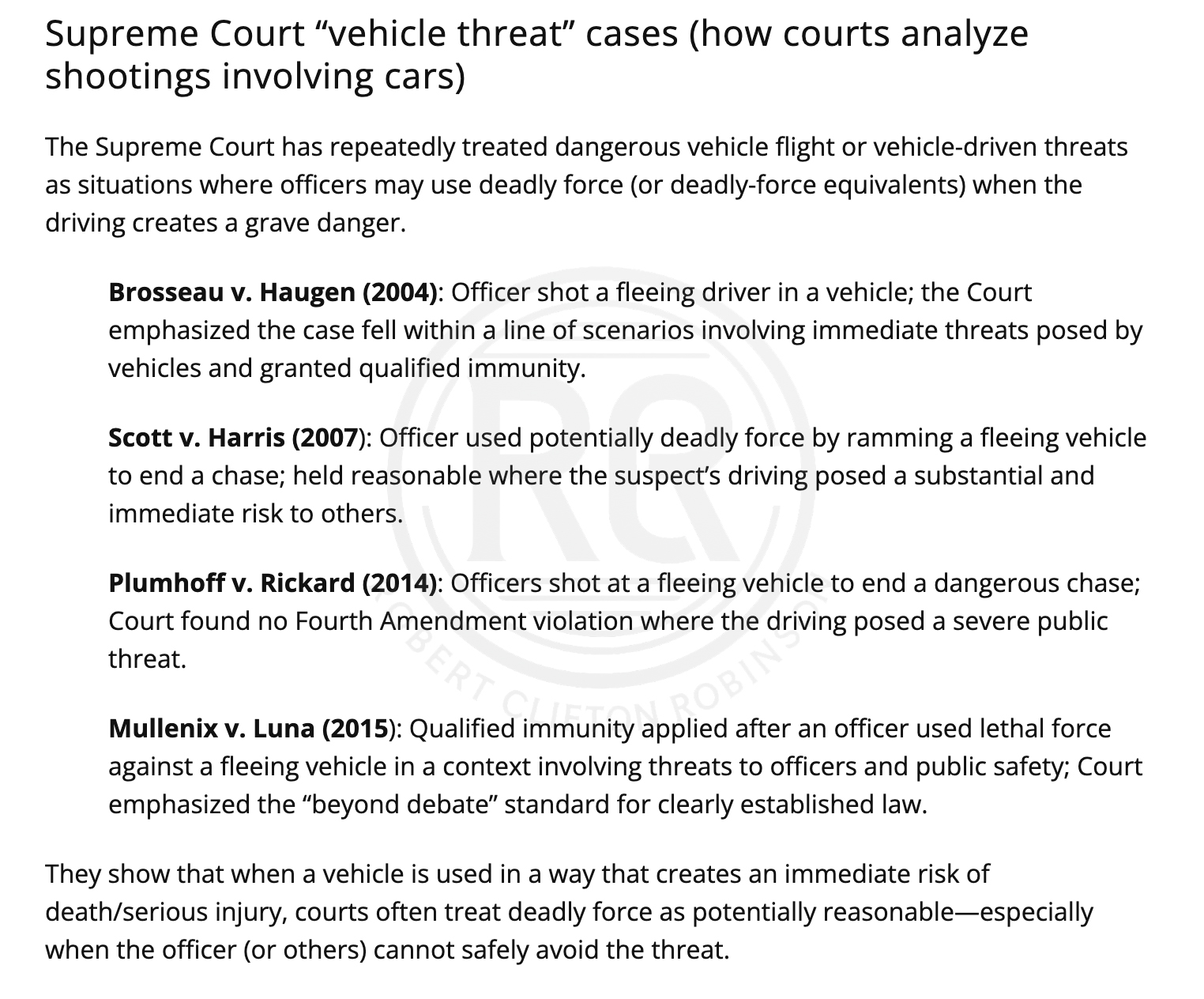
Supreme Court “vehicle threat” cases (how courts analyze shootings involving cars)
The Supreme Court has repeatedly treated dangerous vehicle flight or vehicle-driven threats as situations where officers may use deadly force (or deadly-force equivalents) when the driving creates a grave danger.
Brosseau v. Haugen (2004): Officer shot a fleeing driver in a vehicle; the Court emphasized the case fell within a line of scenarios involving immediate threats posed by vehicles and granted qualified immunity.
Scott v. Harris (2007): Officer used potentially deadly force by ramming a fleeing vehicle to end a chase; held reasonable where the suspect’s driving posed a substantial and immediate risk to others.
Plumhoff v. Rickard (2014): Officers shot at a fleeing vehicle to end a dangerous chase; Court found no Fourth Amendment violation where the driving posed a severe public threat.
Mullenix v. Luna (2015): Qualified immunity applied after an officer used lethal force against a fleeing vehicle in a context involving threats to officers and public safety; Court emphasized the “beyond debate” standard for clearly established law.
They show that when a vehicle is used in a way that creates an immediate risk of death/serious injury, courts often treat deadly force as potentially reasonable—especially when the officer (or others) cannot safely avoid the threat.
Immigration-officer “right” to shoot is not a special immigration rule—it’s the same Fourth Amendment rule
ICE/CBP agents are federal law-enforcement officers within DHS. Their enforcement authority (including being armed) arises from federal law and DHS regulations/policy, but the decision to use deadly force is controlled by Graham/Garner reasonableness and DHS use-of-force policy.
Based on the scenario of a woman in a truck, intentionally moving in the direction of the Federal officer, the officer may have lawful authority to shoot if these elements are met:
Imminence: the truck is close enough and moving in a way that presents an immediate threat of death/serious bodily injury;
Reasonable perception: a reasonable officer would perceive the threat as life-threatening (not merely noncompliance or flight);
Necessity: deadly force is necessary—i.e., the officer cannot safely move out of the path or use a lesser alternative in time;
Proportionality/reasonableness: force used is proportional to stopping the deadly threat.
Summary of Legal Authority (Point-by-Point): Federal immigration agents may lawfully defend themselves because:
- 8 U.S.C. § 1357 authorizes them to carry firearms while enforcing immigration law
- DHS regulations authorize reasonable and deadly force when necessary
- 18 U.S.C. § 111 criminalizes assaults on them, presupposing lawful defensive response
- Supreme Court doctrine establishes objective reasonableness as the standard
- The Supremacy Clause bars state interference or prosecution
This authority is not discretionary, novel, or controversial. It is settled federal law.
The Clear Legal Rule:
A federal immigration agent has full legal authority to use necessary and reasonable force—including deadly force—in self-defense while enforcing federal immigration law, and is constitutionally immune from state interference when acting within that authority.
I. INTRODUCTION
The constitutional allocation of authority over immigration enforcement implicates some of the most fundamental structural principles of American constitutional law: federal supremacy, preemption, national sovereignty, and the lawful use of force by federal officers executing federal law. Recent disputes between state governments and federal immigration authorities have revived claims that states possess residual sovereign authority to obstruct, supplement, or punish federal immigration enforcement, including through state criminal prosecution of federal officers. These claims are incompatible with the Constitution’s text, structure, and controlling precedent.
This Article demonstrates that immigration enforcement is an exclusively federal function; that federal officers are statutorily authorized to enforce immigration law and to defend themselves while doing so; and that the Supremacy Clause categorically bars state interference, including state criminal prosecution, when federal officers act within the scope of federal authority and constitutional reasonableness.
II. THE SUPREMACY CLAUSE AND CONSTITUTIONAL HIERARCHY
Article VI, Clause 2 of the Constitution provides that the Constitution, federal statutes enacted pursuant to it, and treaties constitute the “supreme Law of the Land,” binding state judges notwithstanding contrary state law.¹ This clause establishes not merely a conflict-of-laws rule, but a structural hierarchy essential to national governance. From the Founding forward, the Supreme Court has recognized that federal supremacy is indispensable where federal action concerns national sovereignty, foreign relations, and the execution of federal law.²
Absent supremacy, states could nullify federal law by obstruction or punishment, converting the Union into a patchwork of competing sovereignties. The Framers explicitly rejected this outcome.³ Immigration enforcement lies at the core of the supremacy principle.
III. IMMIGRATION AS AN EXCLUSIVELY FEDERAL DOMAIN
Although the Constitution does not expressly use the term “immigration,” the Supreme Court has consistently held that authority over the admission, exclusion, and removal of non-citizens flows from multiple sources: the Naturalization Clause,⁴ the Foreign Commerce Clause,⁵ the federal government’s exclusive authority over foreign affairs,⁶ and the inherent sovereignty of the nation.⁷
In Hines v. Davidowitz, the Court invalidated a state alien-registration scheme, holding that immigration regulation requires a single national system and that state laws—even complementary ones—are preempted where Congress has occupied the field.⁸ Decades later, Arizona v. United States reaffirmed this principle, invalidating state provisions that attempted to criminalize unlawful presence or create parallel enforcement regimes.⁹
Arizona made clear that even state laws designed to “assist” federal enforcement are unconstitutional where they disrupt federal discretion or priorities.¹⁰ Immigration enforcement decisions necessarily involve sensitive judgments affecting diplomacy, humanitarian policy, and national security—judgments constitutionally committed to the federal political branches.
IV. PREEMPTION AND FEDERAL ENFORCEMENT DISCRETION
Federal preemption operates through express, field, and conflict preemption.¹¹ Immigration law implicates all three. Congress has enacted a comprehensive statutory framework governing immigration enforcement through the Immigration and Nationality Act (“INA”), leaving no room for independent state enforcement regimes.¹²
Moreover, federal enforcement discretion is itself a component of federal law. As the Supreme Court has recognized, the Executive Branch must retain discretion over whom to arrest, detain, and remove.¹³ State interference—whether permissive or punitive—undermines this constitutionally required uniformity.
V. STATUTORY AUTHORITY OF FEDERAL IMMIGRATION OFFICERS
Congress has expressly authorized federal immigration officers to enforce immigration law. Section 287 of the INA, codified at 8 U.S.C. § 1357, grants designated officers authority to interrogate non-citizens, make arrests, execute warrants, and, pursuant to regulation, carry firearms while performing federal duties.¹⁴
The authority to carry firearms necessarily includes the authority to use reasonable force in self-defense. Federal law does not arm officers symbolically; it arms them because enforcement duties foreseeably involve dangerous encounters. Congress further reinforced this reality by criminalizing assaults on federal officers in 18 U.S.C. § 111, which makes it a felony to forcibly assault, resist, or impede federal officers engaged in official duties.¹⁵
These provisions presuppose lawful defensive responses by federal officers during enforcement operations.
VI. CONSTITUTIONAL STANDARDS GOVERNING USE OF FORCE
The legality of force used by federal officers is governed by the Fourth Amendment. In Graham v. Connor, the Supreme Court held that all claims of excessive force arising from arrests or seizures must be analyzed under an “objective reasonableness” standard, judged from the perspective of a reasonable officer on the scene.¹⁶
In Tennessee v. Garner, the Court further held that deadly force is constitutionally permissible when an officer has probable cause to believe the suspect poses a significant threat of death or serious bodily harm to the officer or others.¹⁷ These standards apply uniformly to all law-enforcement officers, including federal immigration agents.
Department of Homeland Security use-of-force policies incorporate these constitutional requirements, authorizing deadly force only where necessary to protect life. When federal immigration officers act within these boundaries, their actions are lawful as a matter of constitutional law.
VII. SUPREMACY CLAUSE IMMUNITY FROM STATE PROSECUTION
The Supremacy Clause bars states from criminally prosecuting federal officers for acts taken pursuant to federal authority. In In re Neagle, the Supreme Court held that a federal officer could not be prosecuted under state law where the officer acted under federal authority and performed what he reasonably believed to be necessary and proper to carry out his duties.¹⁸
Modern courts have consistently applied this doctrine. In Clifton v. Cox, the Ninth Circuit held that the Supremacy Clause immunity applies where a federal officer was authorized to act and reasonably believed the conduct was necessary to perform federal duties.¹⁹ The Tenth Circuit reaffirmed this framework in Wyoming v. Livingston.²⁰
Accordingly, when a federal immigration officer uses reasonable force in self-defense while enforcing federal law, state prosecution is constitutionally barred.
VIII. FEDERAL OFFICER REMOVAL AS STRUCTURAL SAFEGUARD
Congress has further protected federal supremacy through the federal-officer removal statute, 28 U.S.C. § 1442, which permits federal officers to remove state criminal prosecutions or civil actions to federal court.²¹ This statute reflects Congress’s judgment that disputes over federal authority must be resolved in a federal forum insulated from local political pressures.
IX. REBUTTING “STATE SOVEREIGNTY” OBJECTIONS
Proponents of state interference often invoke the Tenth Amendment, arguing that states retain sovereign authority to regulate or punish immigration enforcement within their borders. This argument fails for three independent reasons.
First, the Tenth Amendment reserves only those powers “not delegated to the United States.”²² Immigration enforcement, as demonstrated above, is delegated—explicitly and implicitly—to the federal government. There is therefore no residual state authority to reclaim.
Second, the Supreme Court has repeatedly held that states may not invoke sovereignty to obstruct federal law. In McCulloch v. Maryland, the Court rejected state efforts to burden federal operations, famously declaring that “the power to tax involves the power to destroy.”²³ The same logic applies to state prosecution of federal officers: the power to punish involves the power to nullify.
Third, allowing states to criminalize federal enforcement would fracture national sovereignty. Fifty different enforcement regimes, subject to fifty different political pressures, would render national borders incoherent and foreign policy impossible. The Constitution does not permit such fragmentation.
X. CONCLUSION
The Constitution establishes a clear and coherent rule: immigration enforcement is an exclusively federal function; federal immigration officers are lawfully authorized to enforce federal law and to defend themselves while doing so; and states are constitutionally barred from obstructing, supplementing, or punishing those enforcement actions.
This conclusion is compelled by the Supremacy Clause, federal preemption doctrine, statutory authorization, and controlling Supreme Court precedent. It is not a matter of policy preference, but of constitutional necessity. A nation that permits states to criminalize federal law enforcement ceases to be a nation governed by law.
FOOTNOTES (BLUEBOOK)
- U.S. CONST. art. VI, cl. 2.
- See McCulloch v. Maryland, 17 U.S. (4 Wheat.) 316, 426–27 (1819).
- See THE FEDERALIST NO. 44 (James Madison).
- U.S. CONST. art. I, § 8, cl. 4.
- U.S. CONST. art. I, § 8, cl. 3.
- See United States v. Curtiss-Wright Exp. Corp., 299 U.S. 304, 319–20 (1936).
- See Chae Chan Ping v. United States (The Chinese Exclusion Case), 130 U.S. 581, 603–04 (1889).
- Hines v. Davidowitz, 312 U.S. 52, 66–67 (1941).
- Arizona v. United States, 567 U.S. 387, 401–07 (2012).
- Id. at 409–10.
- See Crosby v. Nat’l Foreign Trade Council, 530 U.S. 363, 372–73 (2000).
- See 8 U.S.C. §§ 1101–1537.
- See Arizona, 567 U.S. at 396.
- 8 U.S.C. § 1357(a); 8 C.F.R. § 287.5.
- 18 U.S.C. § 111.
- Graham v. Connor, 490 U.S. 386, 396–97 (1989).
- Tennessee v. Garner, 471 U.S. 1, 11–12 (1985).
- In re Neagle, 135 U.S. 1, 75–76 (1890).
- Clifton v. Cox, 549 F.2d 722, 728 (9th Cir. 1977).
- Wyoming v. Livingston, 443 F.3d 1211, 1222–23 (10th Cir. 2006).
- 28 U.S.C. § 1442(a)(1).
- U.S. CONST. amend. X.
- McCulloch, 17 U.S. (4 Wheat.) at 431.
Sources and Citations:
Primary Federal Authorities for Immigration Enforcement (Statutes + Regulations)
Immigration officer enforcement powers (INA § 287)
8 U.S.C. § 1357 (“Powers of immigration officers and employees”) is the central statutory delegation of arrest/search/interrogation authority and authorizes officers (under regulations) to carry firearms.
Firearms authority by regulation (designated immigration officers)
The implementing regulations identify which immigration officers are designated to exercise specific INA § 287 powers, including authority to carry firearms. The most accessible official PDF version is here:
(Parallel text version: )
Criminal immigration enforcement example (smuggling / harboring)
For the criminal side of immigration enforcement, 8 U.S.C. § 1324 (bringing in, transporting, harboring certain aliens) includes arrest/enforcement provisions and is often charged by federal prosecutors in coordination with DHS components.
Federal Statutes Protecting Federal Officers During Enforcement (Shows Congress anticipates confrontation)
Assaulting / resisting / impeding a federal officer
18 U.S.C. § 111 criminalizes forcibly assaulting, resisting, impeding, etc., federal officers while they are performing official duties.
Killing / attempting to kill protected federal officers
18 U.S.C. § 1114 provides protection for federal officers/employees (and those assisting them) while performing official duties.
These statutes do not themselves define “self-defense,” but they are part of the overall legal architecture recognizing that federal officers will face force and must respond lawfully.
Executive-Branch Use-of-Force Policies (Binding operational standards for DHS/DOJ officers)
DHS Department Policy on Use of Force (applies across DHS components, including CBP/ICE)
DHS policy (Directive 044-05) sets the department-wide standards and ties them to Supreme Court excessive-force doctrine.
CBP Use-of-Force Policy (component-level implementation)
CBP publishes its component policy reflecting the DHS framework.
DOJ use-of-force policy (useful comparator; also articulates the “imminent danger of death or serious bodily injury” deadly-force standard)
While DOJ policy is not DHS policy, it is frequently cited for the classic federal deadly-force formulation.
The Constitutional Use-of-Force Standard (Self-Defense in Federal Enforcement Encounters)
Even when an officer is acting under federal statutory authority, the Constitution (Fourth Amendment) supplies the controlling standard for evaluating force used during a seizure.
Graham v. Connor, 490 U.S. 386 (1989)
All claims of excessive force in the course of arrest/stop/seizure are analyzed under the Fourth Amendment’s “objective reasonableness” standard.
Tennessee v. Garner, 471 U.S. 1 (1985)
Deadly force is constitutionally limited; it is justified only where the officer has probable cause / reasonable basis to believe the suspect poses a significant threat of death or serious physical injury to the officer or others.
Practical relevance to your question:
When a federal immigration agent uses force in self-defense during enforcement, the legality of that force is assessed primarily under Graham/Garner (objective reasonableness; imminent serious threat), and secondarily under applicable DHS component policy.
Supremacy Clause “Officer Immunity” (Protection from State Prosecution When Acting Under Federal Authority)
In re Neagle, 135 U.S. 1 (1890)
The classic Supremacy Clause immunity case: the Court held a federal officer could not be held by the state when the officer acted under federal authority and performed what was necessary and proper to carry out federal duties.
Modern federal appellate application: Clifton v. Cox, 549 F.2d 722 (9th Cir. 1977)
A leading modern articulation applying Neagle: the immunity inquiry focuses on whether the officer was authorized to act and whether the officer did no more than what he reasonably believed was necessary and proper in performing federal duties.
Another modern appellate application: Wyoming v. Livingston, 443 F.3d 1211 (10th Cir. 2006)
Discusses Supremacy Clause immunity as governing the extent to which states may impose liability (civil or criminal) on federal officials for acts undertaken in the course of federal duties.
What this means for “defending themselves while enforcing federal immigration law”:
If a federal immigration agent uses force in the course of federal duties and the state attempts criminal prosecution, the defense framework commonly traces through Neagle and its progeny (like Clifton and Livingston)—with the key factual hinge being whether the officer’s actions were authorized and objectively reasonable/necessary and proper in context.
Federal Officer “Removal” to Federal Court (Procedural protection when states sue/prosecute)
Even when immunity is contested, Congress provides a procedural safeguard:
28 U.S.C. § 1442 (Federal officer removal statute)
Allows removal of certain civil actions and criminal prosecutions commenced in state court against federal officers (or those acting under them) to federal court—designed to preserve the supremacy of federal law in a neutral federal forum.
Supremacy Clause and Federal Preemption in Immigration (Core immigration “supremacy” cases)
These cases are the standard “spine” for explaining why immigration regulation/enforcement is primarily federal and why conflicting state schemes are preempted.
Arizona v. United States, 567 U.S. 387 (2012)
The Court held multiple provisions of Arizona’s SB 1070 were preempted; it is the modern flagship decision on federal preemption in immigration enforcement.
Hines v. Davidowitz, 312 U.S. 52 (1941)
Classic obstacle/field preemption applied to alien registration; emphasizes federal primacy where Congress has occupied the field or where state law frustrates federal objectives.
De Canas v. Bica, 424 U.S. 351 (1976)
Explains that not every state law “touching aliens” is immigration regulation, and supplies a frequently-cited preemption framework (later refined through cases like Arizona).
Kansas v. Garcia, 589 U.S. ___ (2020)
A modern example showing preemption boundaries in the employment/identity-theft context: the Court allowed certain state prosecutions not preempted by IRCA under the facts presented, underscoring that preemption analysis is specific and statute-driven.
Why these sources “fit together” legally (one-paragraph synthesis)
- 8 U.S.C. § 1357 + 8 C.F.R. § 287.5 provide the positive federal authority for immigration officers to execute federal duties (including carrying firearms under regulation).
- If force is used during enforcement, its legality is judged under Graham and Garner (objective reasonableness; deadly force only for serious imminent threats), and under DHS component policy.
- If a state attempts to prosecute a federal officer for actions taken in the course of those duties, the Supremacy Clause framework from In re Neagle and later appellate cases (e.g., Clifton, Livingston) supplies the principal immunity analysis, while 28 U.S.C. § 1442 supplies removal to federal court.
- And the overall federal primacy in immigration is reinforced by Arizona, Hines, De Canas, etc.
I. CONSTITUTIONAL USE-OF-FORCE STANDARDS (CONTROLLING LAW)
Graham v. Connor, 490 U.S. 386, 396–97 (1989). Establishes the Fourth Amendment “objective reasonableness” standard for all law-enforcement uses of force.
Tennessee v. Garner, 471 U.S. 1, 11–12 (1985). Limits deadly force to situations where the officer has probable cause to believe the suspect poses a significant threat of death or serious physical injury.
II. SUPREME COURT CASES INVOLVING VEHICLES AS DEADLY THREATS
Brosseau v. Haugen, 543 U.S. 194, 200–01 (2004) (per curiam). Recognizes that shootings involving fleeing vehicles fall within a class of cases involving immediate threats; grants qualified immunity.
Scott v. Harris, 550 U.S. 372, 383–86 (2007). Holds that potentially deadly force to stop a dangerous vehicle chase is reasonable where the driver poses an imminent threat to public safety.
Plumhoff v. Rickard, 572 U.S. 765, 776–78 (2014). Affirms that officers may use deadly force to end a dangerous vehicle pursuit when the driver’s conduct poses a grave risk to others.
Mullenix v. Luna, 577 U.S. 7, 11–15 (2015) (per curiam). Applies qualified immunity where an officer used lethal force against a fleeing vehicle posing an imminent threat.
III. FEDERAL STATUTORY AUTHORITY (IMMIGRATION & OFFICER PROTECTION)
8 U.S.C. § 1357(a). Statutory authority for federal immigration officers to interrogate, arrest, and (by regulation) carry firearms while enforcing immigration law.
8 C.F.R. § 287.5(c). Designates which immigration officers are authorized to exercise enforcement powers, including carrying firearms.
18 U.S.C. § 111. Criminalizes forcibly assaulting, resisting, or impeding federal officers engaged in official duties.
18 U.S.C. § 1114. Protects federal officers and employees from killing or attempted killing while performing official duties.
IV. SUPREMACY CLAUSE & FEDERAL OFFICER IMMUNITY
In re Neagle, 135 U.S. 1, 75–76 (1890). Establishes Supremacy Clause immunity for federal officers acting pursuant to federal authority and performing necessary and proper acts.
Clifton v. Cox, 549 F.2d 722, 728–30 (9th Cir. 1977). Modern application of Neagle; immunity applies where officer was authorized and reasonably believed the action was necessary.
Wyoming v. Livingston, 443 F.3d 1211, 1222–24 (10th Cir. 2006). Reaffirms Supremacy Clause immunity and limits state prosecution of federal officers.
28 U.S.C. § 1442(a)(1). Federal-officer removal statute allowing state prosecutions to be removed to federal court.
V. FEDERAL USE-OF-FORCE POLICY (EXECUTIVE BRANCH)
U.S. Dep’t of Justice, Attorney General’s Policy on the Use of Force (rev. Jan. 18, 2021).
Authorizes deadly force only when necessary to protect against imminent danger of death or serious bodily injury.
U.S. Dep’t of Homeland Sec., Directive 044-05, Use of Force Policy (Oct. 19, 2020).
Governs DHS components (ICE, CBP); incorporates Graham/Garner standards.
U.S. Customs & Border Protection, National Use of Force Policy, Guidelines and Procedures Handbook (current ed.).
Component-level application of DHS use-of-force standards.
VI. IMMIGRATION SUPREMACY & PREEMPTION (BACKGROUND AUTHORITY)
Arizona v. United States, 567 U.S. 387, 394–407 (2012). Affirms federal primacy in immigration enforcement and preemption of state interference.
Hines v. Davidowitz, 312 U.S. 52, 66–67 (1941). Establishes field and obstacle preemption in immigration regulation.
Chae Chan Ping v. United States (The Chinese Exclusion Case), 130 U.S. 581, 603–04 (1889). Recognizes immigration control as an incident of national sovereignty.
VII. FOUNDATIONAL STRUCTURAL AUTHORITY
U.S. CONST. art. VI, cl. 2 (Supremacy Clause).
McCulloch v. Maryland, 17 U.S. (4 Wheat.) 316, 426–31 (1819). States may not obstruct or punish the execution of federal law.
Federal law permits a federal immigration officer to use deadly force only when, under the Fourth Amendment’s objective-reasonableness standard, the officer reasonably believes such force is necessary to stop an imminent threat of death or serious bodily injury. Graham v. Connor, 490 U.S. 386 (1989); Tennessee v. Garner, 471 U.S. 1 (1985). Vehicles may constitute deadly weapons when driven toward officers or others. Scott v. Harris, 550 U.S. 372 (2007); Plumhoff v. Rickard, 572 U.S. 765 (2014). When federal officers act within that authority, state prosecution is barred by Supremacy Clause immunity. In re Neagle, 135 U.S. 1 (1890).
Categories: Robert Clifton Robinson
 Robert Clifton Robinson
Let’s pray that the decision, this woman made to get involved which cost her her earthly life, did not also cost her her eternal life.
LikeLiked by 1 person