Luke Records The Historical Eyewitness Testimony of 8 Apostles
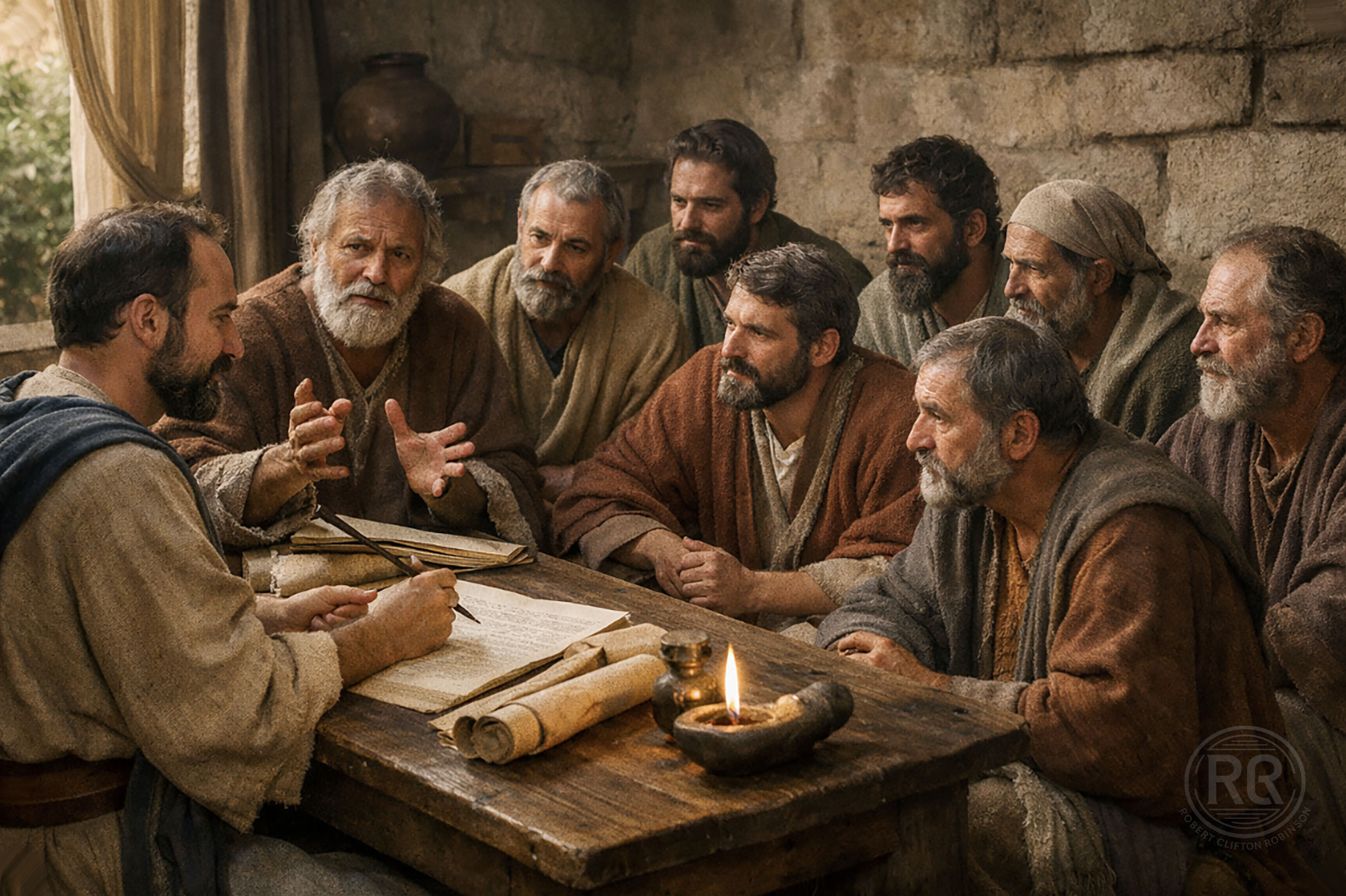
Luke begins his Gospel narrative about Jesus with the following:
Luke 1:1-4 “Many people have set out to write accounts about the events that have been fulfilled among us. 2 They used the eyewitness reports circulating among us from the early disciples. 3 Having carefully investigated everything from the beginning, I also have decided to write an accurate account for you, most honorable Theophilus, 4 so you can be certain of the truth of everything you were taught.”
There were 8 Apostles who did not write their own Gospel about Jesus. Luke indicates that he is the historian who took the eyewitness testimony of these men and wrote a Gospel that bears his name.
The identification of the author of the Gospel of Luke and the Acts of the Apostles as “Luke the Greek physician, companion of Paul” has long been part of Christian tradition. Modern critical scholarship, however, often challenges the certainty of this conclusion, not primarily on theological grounds, but on methodological ones. The question is not whether Luke–Acts is historically careful or literarily sophisticated—points widely acknowledged—but whether the evidence allows historians to move from textual data and early tradition to a confident identification of the author. A careful examination shows that while the conclusion is indeed inferential, it rests on evidence that meets, and in many cases exceeds, the standards used to identify authorship in other works of antiquity.
Colossians 4:14 and the Question of Pauline Authorship
Colossians 4:14 famously refers to “Luke, the beloved physician.”[1] This verse establishes several facts that are not seriously disputed: a historical individual named Luke existed, he was known personally to Paul, and he was identified by profession as a physician. The debate arises not over the verse itself, but over two secondary questions: whether Colossians is authentically Pauline, and whether the Luke mentioned there can be identified with the author of Luke–Acts.
Regarding Pauline authorship, it is true that modern scholarship is divided. Some scholars question Colossians on stylistic or theological grounds, while many others continue to affirm its authenticity, citing early attestation, coherence with undisputed Pauline letters, and allowance for amanuensis usage.[2] Importantly, Colossians is universally treated as Pauline in the second century, appearing without dispute in early canonical lists and being cited as such by figures like Irenaeus, Clement of Alexandria, Tertullian, and Origen.[3] No alternative author is ever proposed in antiquity.
Even if one grants Pauline authorship, Colossians does not explicitly state that this Luke authored the Gospel or Acts. That point is conceded. The identification therefore does not rest on a direct self-attribution but on correlation: the Luke known to Paul is the same Luke consistently named in later tradition as the author of Luke–Acts. This step is inferential, but inference is not the same as speculation, especially when it is supported by multiple independent lines of evidence.
The Absence of a Counter-Text and Historical Attribution
It is correct to say that the absence of a counter-text does not, by itself, prove authorship. Ancient historians do not require contradictions to withhold judgment; they require positive evidence. However, ancient authorship attribution rarely depended on internal signatures. Most works from antiquity—including those of Tacitus, Polybius, Josephus, and Plutarch—do not explicitly name their author within the text. Authorship is instead established by early attribution, consistency of tradition, lack of rival claims, and coherence between the work and the attributed author.[4]
Luke–Acts meets all four criteria. From the late second century onward, the attribution to Luke is universal. The Muratorian Fragment explicitly names Luke as the author of both the Gospel and Acts.[5] Irenaeus affirms the same identification while emphasizing Luke’s connection to Paul.[6] Clement of Alexandria, Tertullian, Origen, and later Eusebius all repeat the attribution without hesitation.[7] It’s important that no alternative author is ever proposed—not by orthodox writers, not by heretical groups, and not by pagan critics. In ancient historiography, such unanimity is rare and carries substantial weight.
Greek Style, Education, and the “Medical Vocabulary” Debate
Luke–Acts is written in some of the finest Greek in the New Testament, demonstrating familiarity with Septuagintal Greek, Hellenistic historiography, and literary conventions such as prefaces and source citation.[8] This clearly indicates a well-educated author who was fluent in Greek and comfortable within the broader Greco-Roman literary world.
Earlier arguments attempted to prove the author’s medical profession by isolating technical medical vocabulary. While pioneering, these arguments were later shown to be overstated, as many so-called medical terms also appear in non-medical authors.[9] Modern scholarship rightly rejects vocabulary alone as diagnostic of profession.
However, the physician identification does not rest on vocabulary alone. It rests on convergence. The author displays sustained interest in healing narratives, careful attention to physical conditions, and precision in describing illness, recovery, and progression.[10] When this narrative profile is combined with the explicit identification of Luke as a physician in Colossians, the hypothesis that the author of Luke–Acts was Luke the physician fits the data more naturally than the alternative proposal of an otherwise unknown, highly educated Greek Christian coincidentally sharing the same name.
Methodological Limits and Historical Conclusions
It is methodologically sound to say that identifying the author of Luke–Acts as “Luke the Greek physician, companion of Paul” goes beyond what the internal text alone can demonstrate. The Gospel and Acts are formally anonymous. Yet anonymity does not equal uncertainty. Ancient historical conclusions are regularly drawn on the basis of early external testimony combined with internal coherence.
Crucially, the attribution of Luke–Acts to Luke does not originate in a later faith framework attempting to shore up authority. It arises within the first generations of Christian historiography, at a time when eyewitnesses and their immediate associates were still remembered.[11] Moreover, Luke was not an apostle, not a central theological authority, and not an obvious figure to invent for prestige. His identification as author adds credibility, not rhetorical power.
Thus, while the conclusion is inferential, it is not fragile. By the standards consistently applied to ancient texts, the identification of Luke as the author of Luke–Acts is historically responsible, well supported, and stronger than many attributions routinely accepted in classical studies. Recognizing this does not require theological commitment; it requires methodological consistency.
Critical Scholarship, Worldview Commitments, and the Authorship of Luke–Acts
Modern debates over the authorship of Luke–Acts rarely arise from newly discovered ancient evidence. Rather, they stem from methodological decisions made within contemporary New Testament scholarship—decisions that are often shaped, explicitly or implicitly, by the scholar’s worldview. The recurring objections to identifying the author of Luke–Acts as Luke the Greek physician and companion of Paul typically concern four areas: the Pauline authorship of Colossians, the inferential nature of linking Luke in Paul’s letters to the Gospel author, the limits of stylistic and “medical vocabulary” arguments, and the weight assigned to early patristic testimony. To understand why scholars reach divergent conclusions on these matters, it is essential to identify who is advancing these criticisms and to examine how underlying philosophical commitments influence historical judgment.
Critical Scholars and Their Worldviews
The most influential critics of traditional Lukan authorship within modern scholarship largely emerge from agnostic or secular academic contexts. Among the most prominent is Bart D. Ehrman, who openly identifies as an agnostic. Ehrman rejects Pauline authorship of Colossians, treats Luke–Acts as formally anonymous, and argues that later church attribution cannot establish certainty. Crucially, he also maintains that historians, as historians, cannot affirm supernatural events regardless of eyewitness testimony.[12] This methodological naturalism functions as a controlling assumption, shaping how evidence is weighed long before conclusions are reached.
A similar approach is found in the work of Raymond E. Brown, whose position reflects a liberal Catholic historical-critical framework. Brown accepts Luke–Acts as a unified literary work but resists identifying its author with Luke the physician, emphasizing the anonymity of the text and the inferential nature of later attribution.[13] While more cautious than Ehrman in philosophical rhetoric, Brown nonetheless subordinates early ecclesiastical testimony to internal literary criteria, thereby limiting the probative force of patristic evidence.
Another influential voice is Joseph A. Fitzmyer, who likewise acknowledges Luke–Acts as an accomplished historical composition yet declines to affirm Luke’s identity with confidence. Fitzmyer’s work reflects a commitment to the historical-critical method shaped by Greco-Roman literary analysis, often treating apostolic proximity as theologically interesting but historically secondary.[14]
Within the German critical tradition, Hans Conzelmann exemplifies a form-critical and redaction-critical approach that interprets Luke–Acts primarily as theological historiography. Conzelmann’s skepticism regarding traditional authorship is grounded less in new data than in a Bultmannian framework that views apostolic attribution as a product of later ecclesial reflection.[15]
In contrast, evangelical scholars—often cited selectively by skeptics—frequently accept the same methodological cautions while arriving at different conclusions. I. Howard Marshall openly rejects exaggerated claims about medical vocabulary while nonetheless affirming Luke as the author of Luke–Acts on cumulative historical grounds.[16] Marshall’s work illustrates that methodological rigor does not require abandoning traditional conclusions.
Similarly, Darrell L. Bock defends Pauline authorship of Colossians and the traditional identification of Luke, emphasizing the unanimity of early patristic testimony and the coherence of Luke’s association with Paul.[17] Colin J. Hemer goes further by demonstrating that the historical, geographical, and nautical precision of Acts strongly supports authorship by a traveling companion of Paul rather than by a distant later compiler.[18]
At the far end of the spectrum are scholars whose conclusions are shaped by explicit atheism. Gerd Lüdemann, for example, rejects apostolic authority as a category and treats miracle accounts as legendary by definition.[19] In such frameworks, early church testimony is dismissed not because it is late or contradictory, but because it affirms events deemed impossible a priori.
Worldview and Methodological Outcomes
These differing conclusions cannot be explained solely by disagreements over evidence. They are best understood as the result of differing worldviews that determine what kinds of evidence are admissible. Evangelical scholars generally allow for the possibility that God may act in history and that eyewitness testimony—even when reporting miraculous events—constitutes legitimate historical data. As a result, they give substantial weight to early, unanimous attribution and to the convergence of internal and external evidence.
Agnostic or secular scholars, by contrast, typically operate within methodological naturalism. While often described as neutral, this approach excludes supernatural causation by definition. Consequently, miracle-affirming texts are treated with heightened suspicion, and early Christian testimony is frequently discounted as theological rather than historical. The resulting conclusions are more restrained, but the restraint is philosophical as much as evidential.
Atheist scholars go further by denying the existence of God outright. In such cases, conclusions are effectively determined before textual analysis begins. Apostolic attribution is assumed to be invented, and early tradition is reinterpreted as propaganda rather than remembrance. This is not historical skepticism in the classical sense, but philosophical exclusion.
The Question of Double Standards
The influence of worldview becomes especially clear when Luke–Acts is compared with other ancient historical works. For Tacitus, Josephus, or Plutarch, early attribution, lack of competing claims, and internal coherence are considered sufficient to establish authorship. In the case of Luke–Acts, however, these same criteria are often judged inadequate. Tradition is labeled “too theological,” inference “too speculative,” and anonymity “disqualifying.” Such selective skepticism reveals that the debate is not primarily about historical method, but about where that method is allowed to lead.
The identification of the author of Luke–Acts as Luke the Greek physician and companion of Paul is indeed an inference. Yet it is an inference grounded in early, unanimous testimony, corroborated by internal evidence, and consistent with ancient historiographic practice. The primary reason this conclusion is resisted by many modern scholars is not the weakness of the evidence, but the philosophical commitments that govern its evaluation. Recognizing this distinction does not diminish the value of critical scholarship; rather, it clarifies the terms of the debate and exposes the often-unspoken assumptions that shape its outcomes.
The Scholarly Wisdom of Letting the New Testament Speak for Itself
Modern critical scholarship often approaches the New Testament with a posture of suspicion, assuming that the texts cannot be what they present themselves to be: historical, eyewitness testimony concerning genuine events. As a result, layers of speculative theory—about anonymous communities, theological evolution, and late redaction—are frequently imposed upon the texts before their own claims are allowed to be heard. Yet a growing body of historical, literary, and forensic analysis suggests that the more responsible scholarly approach is to take the New Testament documents seriously on their own terms and to evaluate them as they present themselves: as truthful testimony to real events, written by men who saw and heard what they recorded, and who intended their accounts to be read as history.
The Texts Self-Identify as Eyewitness Testimony
The New Testament repeatedly and explicitly presents itself as grounded in eyewitness testimony. The Gospel of Luke opens with a formal historiographic prologue, stating that its author carefully investigated events “from the beginning” and relied upon those who were “eyewitnesses and ministers of the word.”[20] This is not the language of myth, legend, or theological reflection divorced from history; it is the language of Greco-Roman historical method. Similarly, the author of the Fourth Gospel insists that “he who saw it has borne witness—his testimony is true,” explicitly anchoring the narrative in personal observation.[21]
The epistles echo the same claim. Peter insists that the apostles did not follow “cleverly devised myths,” but were “eyewitnesses of His majesty.”[22] John begins his first letter by emphasizing what was “heard,” “seen,” and “touched,” grounding theology in sensory experience.[23] These are not incidental remarks; they are repeated, emphatic assertions that the truth claims of Christianity rest on testimony about real events in space and time.
Early Dating and the Impossibility of Legendary Accretion
Critical scholarship often assumes that the New Testament texts were written too late to preserve accurate memory. Yet the evidence points in the opposite direction. Paul’s letters, universally dated to the 40s and 50s AD, contain creedal material that scholars recognize as originating within a few years of the crucifixion. The resurrection creed in 1 Corinthians 15, which lists named eyewitnesses—many of whom were still alive—places the core proclamation of Jesus’ death, burial, resurrection, and appearances extremely early.[24]
The Gospels themselves reflect a world still embedded in first-century Judaism, prior to the destruction of Jerusalem in AD 70. They show no awareness of that cataclysmic event as past history, something inexplicable if they were written generations later.[25] When the texts are allowed to stand without speculative redating, the window for legend simply disappears.
Historical Candor and the Marks of Truthful Testimony
Another reason the New Testament should be taken seriously as truthful testimony is its consistent pattern of historical candor. The texts include embarrassing details that no propagandist would invent: Peter’s denial of Jesus, the disciples’ cowardice, the women as primary witnesses of the resurrection in a culture where female testimony was discounted, and the apostles’ repeated misunderstandings of Jesus’ mission.[26] Such features are classic indicators of authentic testimony rather than theological fabrication.
Moreover, the writers frequently name living individuals, geographic locations, and public events that could be verified—or falsified—by contemporaries. Luke, in particular, anchors his narrative in rulers, governors, and cities known from external sources, inviting scrutiny rather than avoiding it.[27] This is not the behavior of authors creating symbolic or mythic narratives.
Jesus Presented as Yahweh, Not Merely Interpreted as Divine
When the New Testament is read as it presents itself, Jesus is not portrayed as a mere teacher later exalted by the church. He is identified directly with Yahweh, the God of Israel. Old Testament texts that speak of Yahweh alone are applied to Jesus without hesitation. Isaiah’s declaration that every knee will bow to Yahweh is applied by Paul to Jesus.[28] Joel’s statement that “everyone who calls on the name of Yahweh shall be saved” is applied directly to calling upon Jesus.[29]
These identifications are not later theological embellishments; they are embedded in the earliest strata of Christian proclamation. The simplest explanation is that the apostles were reporting what they believed they had witnessed: that the risen Jesus possessed divine authority, received worship, forgave sins, and identified Himself with the God of Israel.[30]
The Problem with Superimposed Critical Reconstructions
Critical scholarship often replaces the testimony of the texts with hypothetical reconstructions: anonymous communities shaping traditions, evolving Christologies, and editorial layers with no manuscript evidence. These reconstructions are rarely derived from explicit data; they are inferred from philosophical assumptions about what “must have happened.”[31] Ironically, such approaches frequently violate the very historical method they claim to uphold by privileging speculation over direct testimony.
In contrast, historians routinely accept ancient texts at face value unless compelling evidence demands otherwise. No one begins by assuming Tacitus fabricated Roman history or that Josephus invented Jewish events wholesale. To apply a radically different standard to the New Testament is not scholarly caution; it is methodological bias.
The Scholarly Value of a Plain-Sense Reading
Taking the New Testament as it presents itself does not mean abandoning critical thinking. It means allowing the documents to function as historical witnesses before subjecting them to philosophical filtering. When evaluated by the same criteria applied to other ancient sources—early dating, multiple attestation, eyewitness proximity, historical coherence, and willingness to include inconvenient facts—the New Testament fares remarkably well.[32]
Indeed, the simplest explanation for the existence of Christianity itself remains the one the texts provide: that Jesus of Nazareth was crucified, buried, rose from the dead, and was seen alive by many witnesses who were willing to suffer and die rather than deny what they had seen.[33] Complex critical theories do not explain the data better; they explain it away.
The scholarly wisdom of taking the New Testament texts seriously lies in methodological consistency and intellectual honesty. When the texts are allowed to speak for themselves, they present a coherent, early, eyewitness account of genuine historical events, centered on the claim that Jesus is Yahweh-God and the promised Messiah. Critical scholarship that begins by excluding this possibility does not refine the evidence; it distorts it. The most historically responsible approach remains the simplest one: to read the New Testament as what it claims to be—truthful testimony about real events—and then to weigh its claims accordingly.
See All of Rob’s Published Books that document the Historical Eyewitness Testimony of the Men who Saw and Heard Jesus
“New Testament Apologetics: Proving The Historical Jesus by Documentary Evidence”
One Gospel: Matthew, Mark, Luke, and John, Combined As One Incredible Story (5 book series)

Sources and Citations
[1] Col 4:14.
[2] Douglas J. Moo, The Letters to the Colossians and to Philemon (Grand Rapids: Eerdmans, 2008), 40–51.
[3] Irenaeus, Against Heresies 3.14.1; Clement of Alexandria, Stromata; Tertullian, Against Marcion; Origen, Homilies on Luke.
[4] Martin Hengel, The Four Gospels and the One Gospel of Jesus Christ (London: SCM Press, 2000), 48–52.
[5] Muratorian Fragment, lines 2–8.
[6] Irenaeus, Against Heresies 3.1.1.
[7] Eusebius, Ecclesiastical History 3.4.6.
[8] Loveday Alexander, The Preface to Luke’s Gospel (Cambridge: Cambridge University Press, 1993).
[9] Henry J. Cadbury, The Style and Literary Method of Luke (Cambridge, MA: Harvard University Press, 1920), 39–72.
[10] Colin J. Hemer, The Book of Acts in the Setting of Hellenistic History (Tübingen: Mohr Siebeck, 1989), 415–427.
[11] Richard Bauckham, Jesus and the Eyewitnesses (Grand Rapids: Eerdmans, 2006), 358–367.
[12] Bart D. Ehrman, Jesus Before the Gospels (New York: HarperOne, 2016), 143–147; idem, Forgery and Counterforgery (Oxford: Oxford University Press, 2013), 23–27.
[13]Raymond E. Brown, An Introduction to the New Testament (New York: Doubleday, 1997), 226–232.
[14] Joseph A. Fitzmyer, The Gospel According to Luke I–IX (New York: Doubleday, 1981), 35–38.
[15]Hans Conzelmann, The Theology of St. Luke (Philadelphia: Fortress Press, 1961), 1–12.
[16]I. Howard Marshall, Luke: Historian and Theologian (Grand Rapids: Zondervan, 1970), 21–38.
[17] Darrell L. Bock, Acts (Grand Rapids: Baker Academic, 2007), 33–41.
[18] Colin J. Hemer, The Book of Acts in the Setting of Hellenistic History (Tübingen: Mohr Siebeck, 1989), 415–427.
[19] Gerd Lüdemann, The Resurrection of Jesus (Minneapolis: Fortress Press, 1994), 10–15.
[20] Luke 1:1–4.
[21] John 19:35; 21:24.
[22] 2 Peter 1:16.
[23] 1 John 1:1–3.
[24] 1 Corinthians 15:3–8; see James D. G. Dunn, Jesus Remembered (Grand Rapids: Eerdmans, 2003), 855–870.
[25] N. T. Wright, The New Testament and the People of God (Minneapolis: Fortress Press, 1992), 443–450.
[26] Mark 14:66–72; Luke 24:11; Richard Bauckham, Jesus and the Eyewitnesses (Grand Rapids: Eerdmans, 2006), 300–305.
[27] Acts 18:12; 24:27; Colin J. Hemer, The Book of Acts in the Setting of Hellenistic History (Tübingen: Mohr Siebeck, 1989), 104–120.
[28] Isaiah 45:23; Philippians 2:10–11.
[29] Joel 2:32; Romans 10:9–13.
[30] Mark 2:5–12; John 8:58; Larry W. Hurtado, Lord Jesus Christ (Grand Rapids: Eerdmans, 2003), 99–110.
[31] Bart D. Ehrman, Jesus Before the Gospels (New York: HarperOne, 2016), 140–155.
[32] Craig L. Blomberg, The Historical Reliability of the Gospels (Downers Grove, IL: IVP Academic, 2007), 247–258.
[33] Acts 4:19–20; Tacitus, Annals 15.44
Categories: Robert Clifton Robinson
 Robert Clifton Robinson
Please see, "Guidelines For Debate," at the right-side menu. Post your comment or argument here: