The Status of 252 Venezuelan Illegal Aliens Who Were Deported to a Salvadoran Prison in March of 2025, According to the 1798 Alien Enemies Act
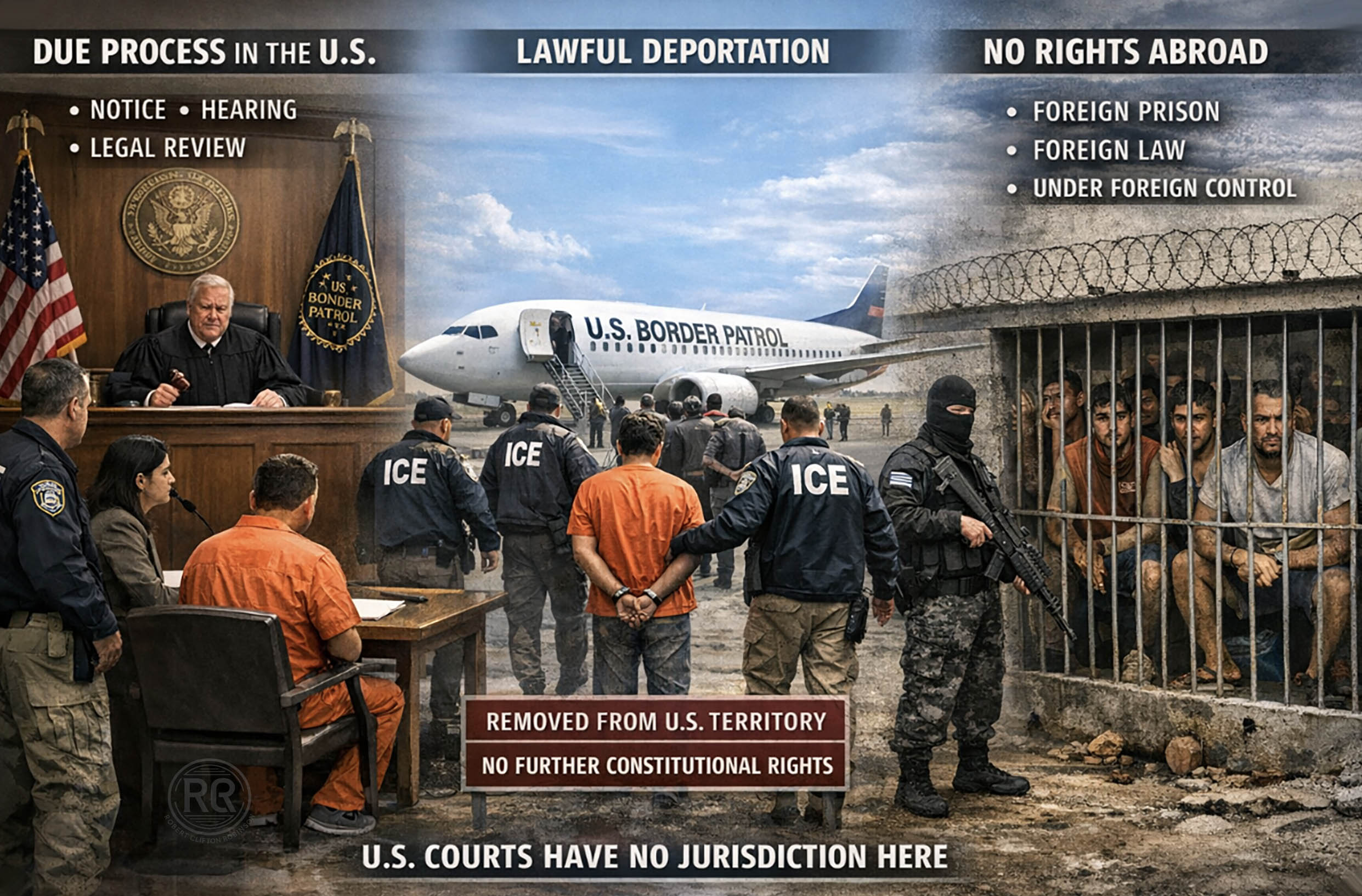
This deportation has brought the issues of Illegal Aliens removed from the United States to the forefront of public interest. Does the Trump administration have the legal authority under the law to give no further due process to these individuals?
This issue is currently being tested by U.S. District Judge James Boasberg, who is presiding over the Alien Enemies Act case, in opposition to the Trump administration. The Justice Department has defined the Trump Administration’s actions after the deportation of these 252 Illegal Aliens as final.
The Justice Department believes that the Trump administration owes no further due process to these illegal aliens. If the lower courts determine that these individuals are entitled to further due process, the Department of Justice will quickly seek intervention from the Supreme Court
Due process is territorial and jurisdictional. The Fifth Amendment states:
“No person shall be deprived of life, liberty, or property, without due process of law.”
The Supreme Court has consistently held that Due process protections apply fully to “persons” within the territorial jurisdiction of the United States, including illegal aliens while physically present. Those protections sharply diminish — and generally terminate — once the person is removed from U.S. territory.
The controlling principle
Due process is owed before removal, not after removal.
Once an alien has been physically removed pursuant to a lawful removal order, the U.S. government no longer exercises custodial or territorial authority over that individual in a constitutional sense.
What due process is owed to illegal aliens before deportation
This is well-settled law. Illegal aliens inside the U.S. are entitled to:
- Notice of charges
- An opportunity to be heard
- A neutral adjudicator
- Review under the Immigration and Nationality Act (INA)
Prominent case law:
- Yamataya v. Fisher (1903) – basic procedural due process applies to aliens already inside the U.S.
- Zadvydas v. Davis (2001) – limits on indefinite detention inside the U.S.
- Demore v. Kim (2003) – detention during removal proceedings is constitutional
Once those procedures occur and removal is executed, due process is satisfied.
What happens to due process after deportation
This is where the DOJ’s position is legally strong.
The Supreme Court precedent
The Supreme Court has repeatedly held that aliens outside the U.S. generally have no constitutional due process rights:
- Johnson v. Eisentrager (1950): Enemy aliens detained abroad have no Fifth Amendment rights.
- United States v. Verdugo-Urquidez (1990): Constitutional protections do not apply extraterritorially to non-U.S. persons.
- Hernandez v. Mesa (2020): No constitutional rights for foreign nationals injured outside U.S. territory.
Once deported, the alien is legally equivalent to any other foreign national abroad.
The Alien Enemies Act does not expand due process rights
The Alien Enemies Act of 1798 is a wartime statute that authorizes the executive to detain, remove, or restrain nationals of hostile foreign powers. It does not create new procedural rights — it restricts them. Courts have historically deferred to the political branches under this statute, especially where national security, foreign policy, and hostile state actors are implicated.
Why Judge Boasberg’s inquiry is legally controversial
James Boasberg is attempting to answer a question courts rarely confront:
Can U.S. courts impose ongoing procedural obligations on the Executive Branch for aliens who are no longer in U.S. custody or territory? That question runs directly into the separation of powers, foreign affairs authority, and the limits of Article III jurisdiction.
Once removal is complete, the court cannot compel foreign sovereigns. The court cannot supervise executive actions abroad. The court cannot manufacture new constitutional rights.
That is why DOJ is signaling an immediate appeal.
The Only Narrow Exception: unlawful or mistaken removal
There is one limited category where courts have intervened post-removal: If the deportation itself was unlawful, e.g.: U.S. citizen was wrongly deported, or removal in violation of a court-ordered stay, or fraud or constitutional violation in the removal process.
Even then, the issue is the legality of the removal, not ongoing due process abroad. Relief is typically limited to facilitating return, not supervision. This does not create a general right to post-deportation due process.
Applying this to the Venezuelan detainees
Based on the facts as reported, they were illegal aliens. They were removed from U.S. territory. They are now detained by a foreign sovereign
Under controlling law:
- Due process was owed before removal
- No further constitutional due process is owed after removal
The DOJ’s position — that the Constitution does not require a post-deportation process — aligns with Supreme Court precedent.
The deeper constitutional issue at stake
This case is not really about migrants. It is about whether Article III courts can project constitutional process beyond U.S. borders, and whether judges can override executive authority in foreign affairs, create extraterritorial constitutional obligations, or supervise deportation consequences indefinitely.
If that theory were accepted, no deportation would ever truly end, because courts could demand a continuing process wherever the alien lands.
- That would collapse the distinction between:
- Immigration law
- Asylum law
- Foreign detention
- Wartime authority
According to U.S. law as it currently stands:
- Illegal aliens are entitled to due process while inside the United States
- Once lawfully deported, they are owed no further constitutional due process
- U.S. courts generally lack jurisdiction to impose ongoing obligations abroad
- The DOJ’s position is doctrinally sound and historically supported
See All 45 of Robert Clifton Robinson’s Books:

Click on the Images
Categories: Robert Clifton Robinson
 Robert Clifton Robinson
Please see, "Guidelines For Debate," at the right-side menu. Post your comment or argument here: