The Constitutionality of Whether The United States Is a Christian Nation is a Hotly Debated Subject That Requires Careful Historical Examination:
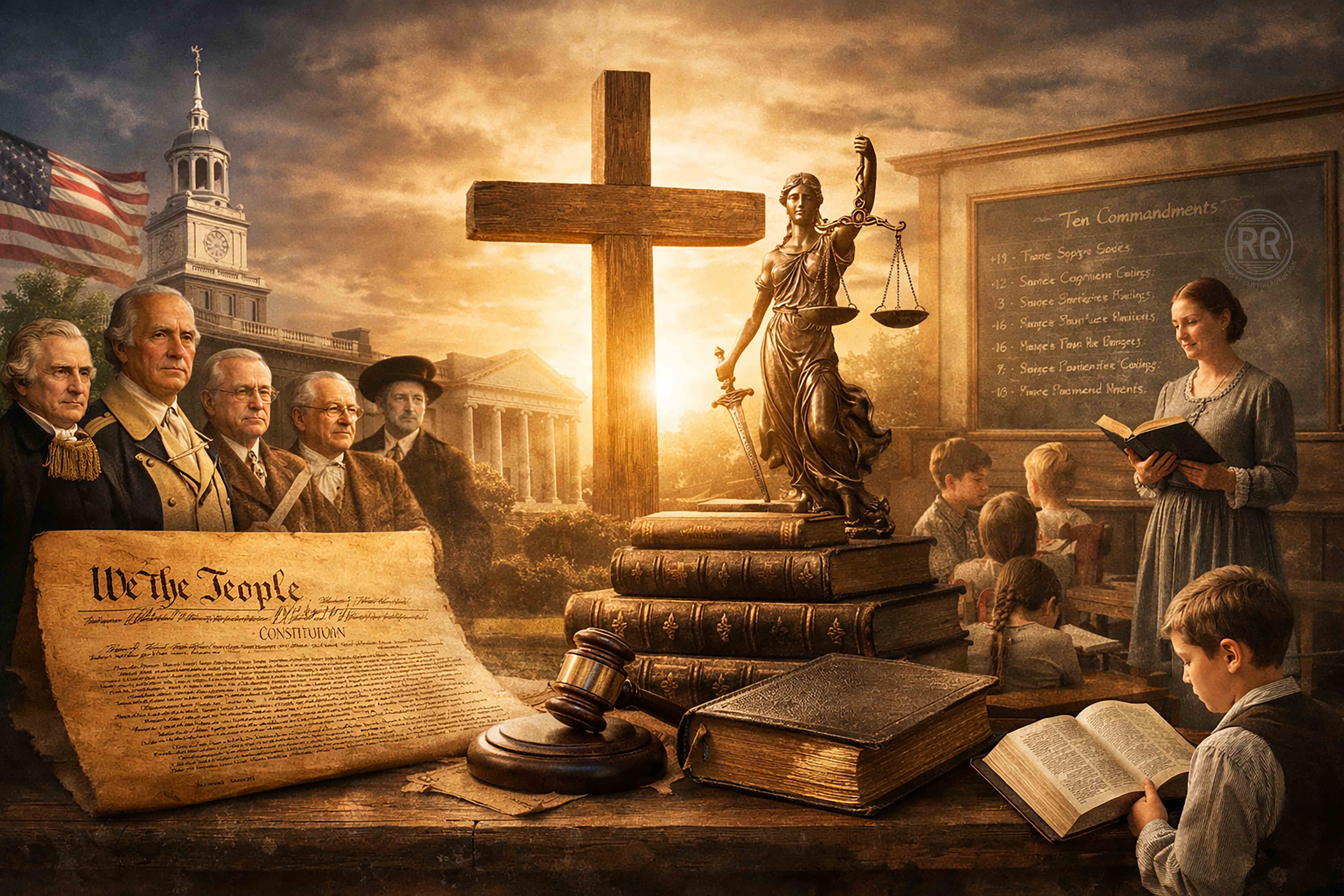
The answer to whether the founders of America intended this as a Christian Nation depends on how the phrase “Christian nation” is defined.
If we mean a nation with an established national church governed by Christian doctrine, the founders clearly did not intend this. If the phrase means a nation whose moral, legal, and cultural foundations were deeply shaped by the Bible and Christianity, then the historical evidence proves this is true.
This essay examines the historical evidence of America’s founding. The records that exist reveal that the founders created a constitutional government without an official church, while simultaneously assuming that Christian moral principles would shape the character of the nation and its citizens.
The Legal Foundation of American Law Was Influenced by Christianity
American law developed primarily from English common law, which was deeply influenced by Christian Biblical teaching. The most influential legal authority for the founders was Sir William Blackstone, whose Commentaries on the Laws of England was the primary legal textbook used in colonial America and the early United States.
Blackstones Commentary on the Law
Blackstone wrote: “Upon these two foundations, the law of nature and the law of revelation, depend all human laws.” — William Blackstone, Commentaries on the Laws of England (1765)
Blackstone explicitly argued that human law must align with God’s law revealed in Scripture. His works were studied by many American founders, including John Adams, James Wilson, and Alexander Hamilton. Because of the influence of Blackstone, many early American legal scholars viewed Christianity as a foundation for the moral structure of law, even though they did not require formal religious adherence by the state.
125 Biblical Laws That Are The Foundation Of Our Legal System
The Constitution Created No National Church
The founders intentionally avoided creating a government-controlled church. The First Amendment states: “Congress shall make no law respecting an establishment of religion, or prohibiting the free exercise thereof.” This clause prevented the United States from becoming like England, where the Church of England was the official state church.
The founders had seen religious persecution in Europe and wanted to ensure that religion would remain free from government control. This principle was supported by figures such as James Madison and Thomas Jefferson. Jefferson wrote in 1802 about a “wall of separation between church and state,” meaning the government could not control religion. Jefferson did not mean that religion should be excluded from public life; rather, the state should not dictate religious practice.
Many of the Founders Believed Christianity Was Necessary for Public Morality
Although they avoided establishing a national church, many founders believed that Christian morality was essential to maintaining liberty. George Washington wrote in his 1796 Farewell Address: “Of all the dispositions and habits which lead to political prosperity, religion and morality are indispensable supports.”
Similarly, John Adams wrote: “Our Constitution was made only for a moral and religious people. It is wholly inadequate to the government of any other.”
These statements show that many founders assumed that religion—especially Christianity—would form the moral character necessary for republican government.
Early Government Practices Reflected Christian Influence
In practice, early American government frequently acknowledged God and Christian practices. Examples include:
- Congress appointed chaplains to open sessions with prayer.
- Presidents issued national days of prayer and thanksgiving.
- The Northwest Ordinance of 1787 declared that religion, morality, and knowledge were necessary for good government.
Even the first Congress that adopted the First Amendment also approved this statement in the ordinance:
“Religion, morality, and knowledge being necessary to good government and the happiness of mankind, schools and the means of education shall forever be encouraged.”
This reflects the belief that religion (primarily Christianity in that era) contributed to the moral stability of the nation.
The Treaty of Tripoli Statement
Critics often cite one passage from the 1797 Treaty of Tripoli, which states: “The Government of the United States of America is not, in any sense, founded on the Christian religion.” This statement appears in Article 11 of the treaty ratified during the presidency of John Adams.
Historians widely agree that this line was written to reassure Muslim nations that the United States had no religious conflict with Islam, rather than to describe the philosophical foundations of American society.
The statement refers to the government structure, not the cultural or moral background of the nation.
Christianity Was the Primary Foundation
At the time of the founding (late 1700s), over 95% of Americans identified as Christian. Most colonies had originally been established by Christian groups. Biblical language and ideas permeated political discourse. Many political speeches referenced Scripture, and early education frequently included Bible reading.
While the Constitution is religiously neutral, the society in which it was created was overwhelmingly shaped by Christian beliefs and values.
The Historical Record Proves Three Facts of America’s Founding:
- The United States was not founded as a theocracy or a nation with an official church.
- The founders assumed that religion, especially Christianity, would shape the moral character of citizens.
- American law and culture were strongly influenced by Christian moral principles.
For these reasons, historians often describe the United States as a secular government within a predominantly Christian culture.
The founders did not establish America as a Christian state governed by church authority, but neither did they envision a purely secular society divorced from religion. Instead, they created a constitutional system where religious liberty was protected from government, while the moral framework of the nation was expected to be sustained by religious belief.
This is the reason that scholars often say the United States was founded not as a Christian government, but within a Christian civilization whose ethical foundations were deeply rooted in biblical principles.
How the phrase “Christian nation” was actually used by the U.S. Supreme Court in 1892 in the case of Church of the Holy Trinity v. United States
In 1892, a decision by the Supreme Court revealed how Americans historically understood the nation’s religious identity.
The phrase “Christian nation” entered American legal history most famously through the 1892 decision of the United States Supreme Court in Church of the Holy Trinity v. United States. This case has been widely cited in discussions about the religious character of the United States because the Court stated specifically that “this is a Christian nation.” Understanding what the Court meant requires examining the case and the reasons used by the justices to arrive at their decision, as well as the historical evidence they cited.
The Background of the Supreme Court Case
This case arose from a dispute involving a New York church that had hired an English minister. The church involved was the Church of the Holy Trinity, an Episcopal congregation in Manhattan. The church had invited E. Walpole Warren, a clergyman from England, to serve as its rector.
The federal government claimed that the church had violated the Alien Contract Labor Law of 1885, which prohibited American organizations from importing foreign laborers under contract. The government argued that the law applied to all labor, including clergy. The church argued that Congress clearly did not intend to prohibit churches from bringing ministers to the United States.
This Dispute Went All The Way to the Supreme Court
The Supreme Court ruled unanimously in favor of the church. Justice David Josiah Brewer wrote the opinion. The Court determined that although the wording of the law appeared broad, the intent of Congress was to restrict the importation of manual laborers, not clergy.
To explain why Congress could not have intended to exclude ministers, Brewer examined the religious history and culture of the United States. This led to one of the most frequently quoted statements in American jurisprudence. Justice Brewer wrote:
“These and many other matters which might be noticed add a volume of unofficial declarations to the mass of organic utterances that this is a Christian nation.”
Evidence the Court Cited
Justice Brewer did not simply assert this claim; he listed numerous historical examples to support it. Among the examples he cited were:
References to God in Founding Documents. Brewer noted that the foundational documents of the nation refer to God.
The United States Declaration of Independence refers to: “Nature’s God, Creator, and Divine Providence.” These references suggested to the Court that the nation’s founders acknowledged a theistic worldview.
Religious Language in State Constitutions
Many early state constitutions referred to Christianity or required officeholders to affirm belief in God. For example, several states originally required affirmation of the Christian faith for public office. Although these provisions later disappeared, they demonstrated the religious assumptions present during the nation’s founding.
The Prevalence of Churches and Christian Institutions
Brewer pointed to the widespread presence of churches and Christian organizations throughout American society. He noted that Churches existed in nearly every community. Christian charities and missionary societies were widespread. Public life often involved prayer and religious observances.
Government Recognition of Religion
The Supreme Court also cited governmental practices such as the opening of legislative sessions with prayer, Presidential proclamations of days of thanksgiving, and the presence of chaplains in Congress and the military. These common practices suggested that American public life acknowledged religion.
The Oath System
The Court also noted that American legal systems traditionally allowed witnesses to swear oaths on the Bible, invoking God as a witness to truthfulness. This further reflected the religious assumptions embedded in American institutions.
What the Supreme Court Meant by “Christian Nation”
It is important to note that the Court did not mean that the United States had an established national church or was governed by Christian doctrine. Justice Brewer clarified this later in his own writings. In 1905, Justice Brewer published a book titled The United States: A Christian Nation, where he explained the meaning of the Court’s statement.
Brewer wrote:
“In what sense can the United States be called a Christian nation? Not in the sense that Christianity is the established religion… but because Christianity has so largely shaped the institutions and morals of the people.”
Brewer meant that American culture, law, and moral assumptions were historically shaped by Christianity, not that the government enforced Christian doctrine.
The Legal Significance of the Case
The ruling in Church of the Holy Trinity v. United States did not establish any religious doctrine in law. Instead, the case is important for two reasons. First, it demonstrates how the Supreme Court interpreted the cultural and historical context of American law in the late nineteenth century. Second, it illustrates the principle that statutory interpretation should consider the broader intentions of lawmakers, not merely the literal wording of a statute.
Because of this reasoning, the Court concluded that Congress could not have intended to restrict churches from hiring ministers.
How Historians View the Decision
Modern historians and legal scholars interpret the decision of the Supreme Court in 1892 as a reflection of the religious culture of nineteenth-century America, rather than a constitutional declaration of religious identity. In other words, the Court was describing the historical reality of American society, not redefining the Constitution. This distinction is critical.
The Constitution itself does not declare the United States to be a Christian nation, but the Court recognized that Christianity had played a major role in shaping American society and institutions. The Supreme Court decision in Church of the Holy Trinity v. United States remains one of the most frequently cited legal references in discussions about America’s religious identity. In that decision, Justice David Josiah Brewer argued that the historical practices, institutions, and moral traditions of the United States demonstrated that the nation had developed within a Christian cultural framework.
However, the Court did not mean that the Constitution established Christianity as the official religion of the state. Instead, the decision recognized a historical reality: that American law and public life emerged in a society whose moral and cultural foundations were deeply influenced by Christianity.
Several Early Colonial Charters (1600s) Stated that the Purpose of the Colonies Was to Spread the Gospel of Jesus Christ
The historical foundations of the American colonies reveal that many of the earliest settlements in North America were specifically established with Christian purposes in mind. Long before the United States Constitution was written in 1787, colonial charters and founding documents frequently declared that one of the central purposes of colonization was the spreading of the Christian faith. These early charters do not represent the constitutional framework of the later United States government, but they do demonstrate the Christian worldview that shaped the earliest political and social institutions in America.
The charters of several major colonies—Virginia, Massachusetts, Connecticut, and others—contain specific references to Christianity and the desire to spread the Gospel of Christ. These documents provide important historical context for understanding the religious environment in which the later American republic emerged.
The earliest example appears in the charter granted by King James I for the Virginia colony. The Virginia Charter of 1606 authorized the establishment of England’s first permanent colony in North America. Among the stated purposes of the colony was the propagation of Christianity among the indigenous peoples of the region. The charter declared that the undertaking was intended to bring the inhabitants of the region to “the knowledge of God and the Christian religion.”[1]
This statement reveals that the founding of the Virginia colony was not viewed merely as a commercial enterprise. Although economic interests certainly played an important role, the charter explicitly linked colonization with missionary goals, making Jesus known. English leaders believed that the establishment of colonies would allow them to spread Christianity to people who had not yet understood who Jesus was and what He had accomplished for them.
A similar purpose appears in the charter of the Massachusetts Bay Charter of 1629, which authorized the Puritan settlement in New England. The charter stated that the colonists intended to bring the “knowledge and obedience of the only true God and Savior of mankind” to the native inhabitants of the region.[2]
The Massachusetts colonists were particularly motivated by religious concerns. Many of the settlers were Puritans who believed that the Church of England had not been sufficiently reformed. Their migration to New England was partly motivated by the desire to build a society organized around biblical principles and Christian morality. John Winthrop, the first governor of the colony, famously described the colony as a “city upon a hill,” a phrase that conveyed the belief that the colony should serve as an example of Christian society to the world.[3]
The Connecticut Fundamental Orders also reflect the religious worldview of early colonial governance. Often considered the first written constitution in America, the document begins by affirming that civil government exists to maintain the peace and purity of the Gospel of Jesus. The preamble declares that the settlers entered into this civil order so that the liberty and purity of the Gospel of Jesus Christ might be preserved among them.[4]
The language of the Fundamental Orders demonstrates that early colonial leaders viewed political institutions as serving moral and religious purposes. Civil government was understood as a mechanism for maintaining social order consistent with Christian teaching.
Another example appears in the Mayflower Compact, which was signed by the Pilgrim settlers before they disembarked at Plymouth. Although not a royal charter, the compact represents one of the earliest self-governing agreements in American history. The signers declared that their voyage had been undertaken “for the glory of God and the advancement of the Christian faith.”[5]
The Pilgrims who signed the Mayflower Compact were Separatists who believed that the Church of England had become corrupt and that true believers should establish new congregations independent of the state church. Their migration to North America was therefore motivated by both religious freedom and the desire to build a community centered on Christian belief.
Even in colonies founded primarily for economic reasons, references to Christianity were common. The charter of the Charter of Carolina included provisions encouraging the propagation of the Gospel among the native inhabitants.[6] Similarly, the charter for the colony of Georgia referred to the promotion of religion as one of the colony’s purposes.[7]
These statements reflect the broader worldview of seventeenth-century Europe, where religion and political authority were closely intertwined. Most European societies assumed that religion provided the moral foundation necessary for social stability and governance. As a result, colonial charters often included references to Christian objectives alongside economic and political goals.
It is important to recognize, however, that the religious motivations of the colonial era did not translate directly into the constitutional structure of the later United States. By the time the Constitution was written in 1787, the American population had become religiously diverse. Various Protestant denominations, along with Catholics, Jews, and others, were present throughout the colonies. This diversity encouraged the founders to adopt a system that protected religious liberty rather than establishing a single official religion.
The First Amendment prohibited Congress from establishing a national church while simultaneously protecting the free exercise of religion. This arrangement allowed religious belief to flourish in American society while preventing the government from controlling or interfering with religious institutions.
The colonial charters remained historically significant because they reveal the cultural and religious assumptions present during the earliest stages of American development. The founders of the United States inherited a society whose moral and intellectual traditions had been deeply influenced by Christianity. Even though the Constitution itself established a government that was religiously neutral, the cultural environment in which it emerged was shaped by centuries of Christian thought and practice.
For this reason, historians often distinguish between two different ideas: the United States as a Christian government and the United States as a nation whose culture was historically shaped by Christianity.
The colonial charters clearly demonstrate the latter. They show that many early settlers understood their communities to be part of a broader Christian mission, seeking to establish societies that reflected biblical morality and religious devotion.
The historical documentary record from the seventeenth century reveals that several early American colonies were founded with explicitly Christian purposes: to make Jesus known to every person. Charters for Virginia, Massachusetts, and other colonies openly declared that one of their goals was to spread the Christian faith. These statements do not mean that the later United States government was constitutionally established as a Christian state, but they do demonstrate that the early cultural and political foundations of America were deeply connected to Christian belief.
The legal and philosophical foundations of American law were strongly shaped by the work of the English jurist William Blackstone, whose Commentaries on the Laws of England became the primary legal textbook used in colonial America. Blackstone argued that human law ultimately rests upon the law of nature and the law of revelation, meaning that civil law must be consistent with the moral law revealed by God.[8] His writings were studied extensively by American founders and played a significant role in shaping early American legal thought.
The influence of this worldview is visible in the language of the United States Declaration of Independence. The Declaration affirms that all human beings are “endowed by their Creator with certain unalienable rights.”[9] This statement reflects the natural-law philosophy widely accepted among the founders. Rights were not granted by governments but were understood to originate from a Creator. Because these rights came from God, governments existed primarily to protect them rather than to create them.
The founders’ understanding of religion’s role in public life is also reflected in the statements of several leading figures of the American Revolution. George Washington emphasized the importance of religion in maintaining the moral character necessary for self-government. In his Farewell Address of 1796 he wrote that religion and morality are “indispensable supports” of political prosperity.[10] Washington argued that national morality could not prevail without religious principle, suggesting that the success of the American experiment depended in part on the moral influence of religion within society.
Similarly, John Adams observed that the American Constitution was designed for a moral and religious people and would be inadequate for governing any other.[11] Adams believed that the stability of republican government required citizens capable of self-restraint and moral responsibility, qualities that he believed were cultivated by religious belief.
Despite these acknowledgments of religion’s importance, the founders deliberately avoided creating a national church. The First Amendment to the Constitution prohibited Congress from establishing a religion while also protecting the free exercise of religious belief. This arrangement reflected the founders’ desire to prevent the government from controlling religious institutions while simultaneously allowing religion to flourish freely within society.
The distinction between religious influence and religious establishment is essential for understanding the American founding. The founders had witnessed the conflicts and persecutions that arose in Europe when governments controlled religious institutions. By preventing the establishment of a national church, they sought to ensure that individuals could practice their faith freely without coercion. At the same time, they assumed that religious belief would continue to play a vital role in shaping the moral character of the nation.
Evidence of this assumption appears in the Northwest Ordinance, one of the most important early laws passed by the United States Congress. The ordinance declared that “religion, morality, and knowledge” were necessary for good government and the happiness of mankind and therefore should be encouraged.[12] The inclusion of religion alongside morality and education reflects the widespread belief that religious principles contributed to the stability and prosperity of society.
- America’s Spiritual Heritage
- The Words of 52 Christian Men Who Founded the United States of America
- America’s Spiritual Heritage and the Influence of the Bible on America
- The Stunning Evidence Of Americas Moral Decline
See All of Rob’s Books:
Sources and Citations:
[1] Virginia Charter of 1606, in Francis Newton Thorpe, ed., The Federal and State Constitutions, Colonial Charters, and Other Organic Laws of the United States, vol. 7 (Washington, DC: Government Printing Office, 1909), 3783–3785.
[2] Massachusetts Bay Charter of 1629, in Thorpe, Federal and State Constitutions, vol. 3, 1848–1866.
[3] John Winthrop, “A Model of Christian Charity,” 1630 sermon delivered aboard the Arbella.
[4] Fundamental Orders of Connecticut, 1639, in Thorpe, Federal and State Constitutions, vol. 1, 519–523.
[5] Mayflower Compact, 1620, in William Bradford, Of Plymouth Plantation, ed. Samuel Eliot Morison (New York: Knopf, 1952).
[6] Charter of Carolina, 1663, in Thorpe, Federal and State Constitutions, vol. 5, 2743–2756.
[7] Charter of Georgia, 1732, in Thorpe, Federal and State Constitutions, vol. 2, 773–782.
[8] William Blackstone, Commentaries on the Laws of England (Oxford, 1765), Book I.
[9] United States Declaration of Independence.
[10] George Washington, Farewell Address, 1796.
[11] John Adams, letter to the Massachusetts Militia, October 11, 1798.
[12 Northwest Ordinance, Article III.
Categories: Robert Clifton Robinson
 Robert Clifton Robinson
Please see, "Guidelines For Debate," at the right-side menu. Post your comment or argument here: