Presidents Donald Trump and Barack Obama have both attacked foreign nations, citing Constitutional Authority that does not require prior authorization from Congress
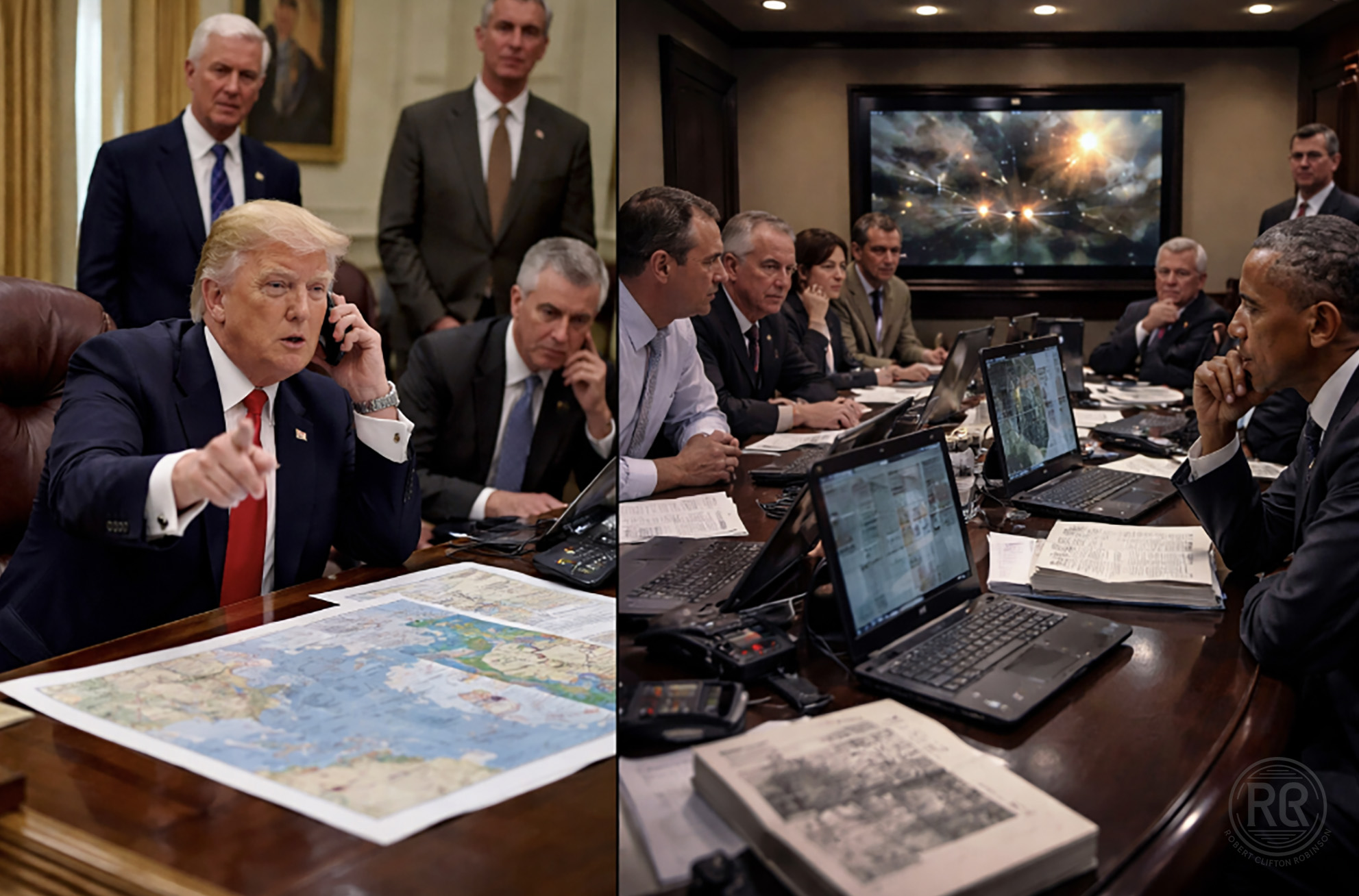
President Donald Trump and President Barack Obama have both acted to attack foreign nations as powers given to them by the Constitution. Trump is accused of violating the War Powers Act; Obama is not.
What the War Powers Resolution Allows a President to Do
The War Powers Resolution (Public Law 93-148) was passed in 1973 after the Vietnam War. Congress intended it to limit a president’s ability to commit U.S. forces to military conflict without congressional approval. Congress passed it over the veto of Richard Nixon. The law establishes three primary rules.
The President Can Use Military Force Immediately in Certain Situations
The president may introduce U.S. forces into hostilities without prior congressional authorization when the United States is attacked, or U.S. forces are attacked, or a national emergency exists. This authority derives from the president’s constitutional role as Commander-in-Chief.
The President Must Notify Congress Within 48 Hours
If U.S. forces are introduced into hostilities, the president must report to Congress within 48 hours explaining the constitutional authority for the action, the circumstances, and the scope and duration of the military involvement.
Military Operations Must End After 60 Days Without Congressional Approval
If Congress does not authorize the action, the president must withdraw forces within 60 days (with a possible 30-day withdrawal period).
The Constitutional Dispute
Almost every president has argued that the War Powers Resolution is constitutionally questionable because it attempts to restrict the president’s Article II authority. Presidents from both parties—including Gerald Ford, Ronald Reagan, Bill Clinton, George W. Bush, Barack Obama, and Donald Trump, have all taken military action without formal congressional declarations of war.
In practice, presidents often comply politically with the reporting requirements while rejecting Congress’s authority to limit operations.
The Obama–Libya Case (2011)
The controversy surrounding Obama and Libya began during the Libyan civil war in 2011. Called the 2011 NATO intervention in Libya. President Obama authorized U.S. forces to participate in NATO air strikes against the regime of Muammar Gaddafi. Congress did not formally authorize the intervention.
The operation continued beyond the 60-day War Powers limit, to 6 months, which led critics—including many Democrats and Republicans—to argue that Obama violated the law.
Obama Administration’s Legal Argument
The Obama administration argued that the War Powers Resolution did not apply because U.S. forces were not engaged in sustained “hostilities.” The U.S. role was limited (air support, intelligence, logistics). NATO partners carried most of the operational burden. The administration claimed the operation was not the kind of “war” envisioned by the War Powers Resolution. This interpretation was controversial.
The Office of Legal Counsel (OLC) in the Justice Department traditionally determines such questions. However, in the Libya case, the White House relied on advice from the State Department Legal Adviser instead. Some constitutional scholars argued that Obama did violate the War Powers Resolution, but Congress never forced the issue.
The Trump Military Actions
President Trump ordered several major military actions during his presidency that triggered War Powers debates.
- The Syria Strike (2017): After the Syrian government used chemical weapons, Trump ordered missile strikes.
- 2017 Shayrat missile strike: Targets included a Syrian airbase connected to the chemical attack.
- Syria Strike (2018): A second coordinated strike with allies followed another chemical weapons attack.
- Iran Strike (2020): Trump ordered the killing of an Iranian General:
- Qasem Soleimani: This occurred during escalating tensions with Iran.
Trump’s Legal Justification: President Trump’s administration argued these actions were lawful because they were limited military engagements, defensive actions protecting U.S. forces, and these actions were within the president’s Commander-in-Chief authority.
In each case, the administration sent War Powers notifications to Congress.
Did Trump Violate the War Powers Resolution?
Legally, the answer depends on interpretation. Arguments That Trump Did NOT Violate It:
Trump Supporters argue: The operations were limited strikes, not wars. The president has the authority to respond to threats to U.S. forces. Congress funded military operations without cutting them off. This mirrors arguments used by previous administrations.
Arguments That Trump DID Violate The War Powers Act. Critics argue: The strikes were acts of war requiring authorization. Congress was bypassed. The Constitution gives Congress the power to declare war. This, in spite of President Obama doing the exact same thing.
Why Obama Was Not Widely Accused of Violating the War Powers Act
The key difference between the two cases resides in how the operations were framed legally.
Obama’s Argument: Obama claimed the Libya operation did not constitute “hostilities.” This allowed the administration to argue that the War Powers clock never started.
The operation began with Operation Odyssey Dawn and later transitioned to a NATO mission called Operation Unified Protector during the 2011 NATO intervention in Libya.
The United States conducted substantial combat operations in the early phase of the war, including:
- Cruise missile strikes (Tomahawk missiles)
- Air strikes against Libyan air defenses
- Bombing of command and control facilities
- Suppression of Libyan military capabilities
During the first days of the campaign alone, the U.S. Navy and Air Force launched over 100 Tomahawk missiles and conducted numerous strike sorties.
The overall campaign lasted approximately six months (March–October 2011).
The Office of Legal Counsel (OLC)—the Justice Department office that normally determines the legality of executive actions—reportedly advised that the War Powers Resolution did apply. However, the White House ultimately relied on the legal opinion of the State Department’s Legal Adviser.
Several constitutional scholars criticized the administration’s argument.
For example, Yale law professor Bruce Ackerman wrote that the administration’s claim that the Libya war was not “hostilities” was “a violation of the War Powers Resolution.”¹
Similarly, Harvard law professor Jack Goldsmith, who had previously served in the Justice Department, described the legal reasoning as “very strained.”²
Trump’s Argument: Trump acknowledged that U.S. forces were involved in military action but argued that the actions were limited and defensive. They were within existing presidential authority. Thus, Trump operated within the War Powers reporting framework, while Obama argued the law did not apply.
Historical Pattern: Presidents of Both Parties
Many presidents have used military force without congressional declarations of war. Examples include:
- Harry Truman — Korean War
- Bill Clinton — Kosovo air campaign
- George W. Bush — multiple counter-terror operations
The United States has issued only five formal declarations of war in its entire history, the last during World War II. Most modern conflicts occur under congressional authorizations, UN mandates, NATO operations, and presidential authority
Why Political Parties Often Reverse Their Position
Criticism over war powers is often political rather than legal. Political scientists have repeatedly noted a pattern that the party out of power tends to demand strict limits on presidential war authority. The party in power tends to defend presidential flexibility.
Democrats criticized Republican presidents (Bush, Trump).
Republicans criticized Democratic presidents (Clinton, Obama).
This pattern is widely documented in congressional voting behavior.
The Real Constitutional Problem
The deeper issue is that the Constitution divides war powers between the two branches. Article I gives Congress the power to declare war and fund the military. Article II makes the president the commander-in-chief.
In modern warfare—especially air strikes and rapid deployments—has blurred the distinction between war and limited military force. Because Congress rarely votes to stop a military action, presidents often act first, and Congress responds afterward.
The accusations that President Trump violated the War Powers Resolution arise from the long-standing tension between presidential military authority and congressional war powers. President Obama’s Libya intervention raised similar concerns, but his administration argued that the operation did not legally constitute “hostilities” under the War Powers Resolution. Trump’s administration instead acknowledged military action but argued it fell within the president’s constitutional authority for limited operations.
In practice, presidents of both political parties have used military force without formal declarations of war for decades, and Congress has rarely enforced the War Powers Resolution strictly. As a result, debates over whether a president has “violated” the law are often shaped as much by political opposition as by constitutional interpretation.
The Central Enforcement Mechanism of the War Powers Resolution
When Congress passed the War Powers Resolution in 1973, it attempted to create a mechanism that would force presidents to end military operations if Congress objected. The law originally allowed Congress to terminate military action by passing a concurrent resolution. A concurrent resolution is a type of congressional action that does not go to the president for signature.
Congress believed this would allow it to vote to end a military operation, void a presidential veto, and force the president to withdraw forces. This mechanism was intended to restore congressional control over war decisions after the Vietnam War.
The Supreme Court Decision That Undermined the Law
In 1983 the U.S. Supreme Court issued a landmark ruling in INS v. Chadha. The Court ruled that legislative vetoes are unconstitutional. A legislative veto occurs when Congress attempts to reverse executive action without passing a law that the president signs. The Court held that this violates the Constitution’s bicameralism and presentment requirements, which require that both houses of Congress must pass legislation. The president must sign it (or Congress must override a veto).
Because of this decision, the War Powers Resolution’s enforcement mechanism—termination by concurrent resolution—was effectively invalidated.
What This Means in Practice
After the Supreme Court decision, Congress lost its easiest method for stopping a military action. Now Congress must pass a law ordering the president to stop military operations and send the law to the president, and override the president’s veto with a two-thirds vote if necessary. This is extremely difficult politically.
As a result, presidents can often continue military operations unless Congress is willing to take the dramatic step of cutting funding for the operation.
The Funding Power: Congress’s Real Constitutional Authority
The Constitution gives Congress its strongest military control through the power of the purse. Article I states that no money may be drawn from the Treasury except by congressional appropriation. This means Congress can end a war by refusing to fund it. Historically, Congress has used this method several times. For example, Congress forced the end of U.S. involvement in Vietnam through legislation limiting funding for combat operations.
However, modern Congresses rarely use this tool because cutting funding for military operations can be politically risky.
The 60-Day Withdrawal Rule
Another debated portion of the War Powers Resolution is the 60-day clock. The law states that if Congress has not authorized military action within 60 days, the president must withdraw forces. Presidents have often challenged this provision. Many administrations argue that the Constitution gives the president independent authority to conduct limited military operations beyond 60 days.
This argument has been made by administrations led by:
- Ronald Reagan
- Bill Clinton
- George W. Bush
- Barack Obama
- Donald Trump
None of these presidents accepted the idea that Congress can automatically terminate military operations simply by letting a deadline expire.
Why Congress Rarely Enforces the War Powers Resolution
In practice, the War Powers Resolution survives largely as a political reporting requirement rather than a binding legal limit. Presidents usually comply with the 48-hour reporting requirement, sending letters to Congress explaining military actions. But the larger restrictions are rarely enforced because the enforcement mechanism was weakened by the Supreme Court.
Congress is often politically divided. Cutting off military funding is politically difficult. For this reason, many legal scholars describe the War Powers Resolution as symbolic rather than enforceable.
Views of Constitutional Scholars
Many constitutional scholars believe the War Powers Resolution conflicts with the Constitution’s design. For example, Yale law professor John Yoo has argued that the president possesses independent authority to use military force when defending U.S. interests abroad.
Similarly, legal scholar Louis Fisher, who worked for the Congressional Research Service, argued that Congress must assert its authority more forcefully if it wants to control war decisions.
Even critics of presidential power acknowledge that the War Powers Resolution has proven ineffective in practice.
Historical Reality: Limited Wars Have Always Been Presidential
Another reason the War Powers Resolution struggles to function is historical. From the earliest days of the republic, presidents have used military force without declarations of war. Examples include: Thomas Jefferson sending naval forces against the Barbary pirates. James Madison ordered naval actions before the War of 1812 declaration. Harry Truman committed U.S. troops to the Korean War without a declaration of war.
For these reasons, the modern practice of presidential military action did not originate in recent decades.
Why War Powers Disputes Continue
Because the Constitution divides authority between the executive and legislative branches, disputes over military power are inevitable. The president must be able to respond quickly to threats. Congress must retain authority to decide when the nation enters major wars.
Modern conflicts—especially air strikes, counter-terror operations, and cyber warfare—often fall somewhere between those two categories. This gray area ensures that debates over the War Powers Resolution will likely continue.
The Practical Reality
Today the War Powers Resolution functions mainly as a notification framework rather than a strict limitation on presidential power. Presidents generally inform Congress of military action, and justify it under constitutional authority. Then they do not continue operations unless Congress actively intervenes. Because Congress rarely passes binding legislation to stop a military action, presidents effectively retain broad discretion.
The Constitutional Design of War Powers
The Constitution deliberately distributes military authority between two branches of government. Congress (Article I) receives authority to declare war, raise and support armies, provide and maintain a navy, make rules governing the military, and ontrol military funding
The President (Article II) is designated as Commander in Chief of the Army and Navy. This division was intended to prevent a single person from unilaterally committing the nation to a large national war, while still allowing the executive to act quickly in emergencies.
The framers were deeply aware of the dangers of monarchy, where kings could take nations into war without restraint. Yet they also recognized that military decisions often require speed and secrecy, which Congress cannot always provide.
James Madison: Congress Decides Major Wars
James Madison was one of the principal architects of the Constitution and is often called the “Father of the Constitution.” He believed the power to initiate major wars should belong to Congress.
Madison wrote in 1793: “The Constitution supposes what the History of all Governments demonstrates, that the Executive is the branch of power most interested in war, and most prone to it. It has accordingly with studied care vested the question of war in the Legislature.”¹
Madison’s point was that the decision to place the nation into a full-scale war should not rest with one person. However, Madison did not believe the president must wait for Congress before responding to threats. During the Constitutional Convention he supported language that allowed the president to “repel sudden attacks.”
The Constitutional Convention Debate
During the Convention in 1787, the original proposal gave Congress the power to “make war.” Madison and others changed this language to “declare war.” The change was important. It acknowledged that the president must be able to respond to hostilities immediately. Madison explained the reason for the wording change: “The Executive should be able to repel sudden attacks.” This distinction between declaring war and responding to attacks has shaped American military practice ever since.
Alexander Hamilton: The President Directs Military Operations
Alexander Hamilton addressed the role of the president in The Federalist Papers, particularly in Federalist No. 69. Hamilton emphasized that the American president was far weaker than a king, but still possessed command authority over the military.
Hamilton wrote: “The President is to be commander in chief of the army and navy of the United States… while that of the British king extends to the declaring of war and to the raising and regulating of fleets and armies.”
Hamilton was explaining that the president commands the military, Congress decides whether a state of war exists. This arrangement was intended to balance democratic control with military effectiveness.
George Washington: The Need for Executive Military Authority
George Washington’s presidency provided the first real test of the Constitution’s war powers. During conflicts with Native American tribes and European powers, Washington often deployed military forces without formal declarations of war. Washington believed that the president must have the authority to act quickly when American interests were threatened.
In a letter to Congress in 1793, Washington wrote: “The Constitution vests the power of declaring war in Congress; therefore no offensive expedition of importance can be undertaken until after they shall have deliberated upon the subject.”
This statement again reflects the distinction between major offensive wars (Congress decides), and limited military responses (president may initiate).
Early Presidents Exercising Military Authority
Several early presidents used military force without formal declarations of war. For example, Thomas Jefferson ordered naval forces to fight the Barbary pirates in North Africa.
First Barbary War: Jefferson wrote to Congress explaining that he had sent naval forces to defend American shipping but awaited congressional authorization for a broader war. Congress later authorized the conflict, but the initial deployment came from presidential authority. This early precedent shows that the founders expected presidents to take limited military action when necessary.
The Founders’ Key Distinction
From the founding period, two categories of military action were understood:
Full National War: These conflicts involve large-scale mobilization, long-term warfare, and major national commitment.
Examples include: The War of 1812, The Mexican-American War, World War I and World War II. These wars were formally declared by Congress.
Limited Military Engagements
These involve: Naval actions, defensive operations, and short-term military responses. These were often initiated by presidents.
Examples include: Naval battles against pirates, protection of American citizens abroad, and unitive strikes. The founders generally believed the president possessed authority in these situations.
The Problem of Modern Warfare
Modern military technology has blurred the distinction between these two categories. In the eighteenth century, wars required months of preparation. Today, a president can order a missile strike anywhere in the world within hours. Because of this change, it is not always clear whether a military action constitutes a limited operation or a war requiring congressional authorization. This ambiguity is at the heart of modern war powers disputes.
Why War Declarations Became Rare
Another important historical development is that Congress gradually stopped issuing formal declarations of war. The last declarations occurred during World War II. Since then Congress has relied on other authorizations, such as the Authorization for Use of Military Force (AUMF) passed after the September 11 attacks.
Authorization for Use of Military Force of 2001
This authorization gave the president broad authority to use force against terrorist organizations. Many U.S. military operations in the Middle East have been justified under this authorization.
The Founders’ Likely View of Modern Conflicts
Most constitutional historians believe the founders would probably view modern limited military actions as falling under presidential authority, provided they do not escalate into full-scale war. However, they would likely insist that Congress retain authority over major wars and long-term military commitments. This balance was central to their constitutional design.
The Founding Fathers did not intend for the president to wage unlimited war independently of Congress. At the same time, they recognized that the executive must possess the ability to respond quickly to threats and conduct military operations. By giving Congress the power to declare war while making the president commander in chief, the Constitution created a system of shared responsibility.
The modern War Powers Resolution attempts to regulate this balance, but its effectiveness has been limited. As a result, disputes over presidential war authority—such as those involving Presidents Obama and Trump—reflect a deeper constitutional tension that has existed since the founding of the United States.
The Debate Over Presidential War Powers in the United States
This subject cannot be understood apart from the constitutional structure established by the Founding Fathers, the statutory framework imposed by Congress through the War Powers Resolution of 1973, and the historical practices of successive administrations. Controversies surrounding recent military actions—particularly those taken by Presidents Barack Obama and Donald Trump—have revived longstanding questions about the extent of executive authority in matters of war and peace. Critics often frame such disputes in political terms, yet the deeper issue is constitutional: how the United States balances the competing responsibilities of Congress and the President when military force is employed abroad.
The Constitution divides authority over war between the legislative and executive branches. Article I assigns Congress the power to declare war, raise and support armies, maintain a navy, and regulate the armed forces. Article II designates the President as Commander in Chief of the armed forces. This dual structure was deliberate. The framers sought to prevent the concentration of war-making authority in a single individual, while also ensuring that the nation could respond quickly to threats. The resulting framework has produced a system of shared responsibility in which Congress authorizes major wars while the President directs military operations and may respond to sudden emergencies.¹
The founders were deeply influenced by their experience under British rule. In the eighteenth century, the British monarch possessed broad authority to commit the nation to war without meaningful parliamentary restraint. The framers of the Constitution sought to prevent such unilateral power in the American system. James Madison, often called the “Father of the Constitution,” warned that executives are historically the branch “most interested in war, and most prone to it.”² For this reason, the Constitution vested the authority to declare war in Congress rather than in the executive. Madison believed that placing this decision in the hands of the legislature would ensure deliberation and public accountability before the nation entered a major conflict.
At the same time, Madison and his colleagues recognized that the executive branch must retain the ability to respond rapidly to immediate threats. During the Constitutional Convention in 1787, the original proposal granted Congress the authority to “make war.” Madison and others altered this phrase to “declare war.” The change was significant. It reflected the understanding that the President must be able to act defensively without waiting for congressional deliberation. Madison explained that the executive should be able to “repel sudden attacks.”³ This distinction between initiating large-scale wars and responding to immediate hostilities has shaped American practice for more than two centuries.
Alexander Hamilton elaborated on the President’s role in Federalist No. 69. Hamilton emphasized that the American presidency was far less powerful than the British monarchy. While the British king could declare war and raise armies, the American President could only command forces once Congress authorized their existence.⁴ Hamilton’s argument highlighted the limited but significant military authority granted to the executive. The President would serve as commander of the armed forces and direct military operations, but Congress retained the power to determine whether the nation entered a formal state of war.
Early American history confirms that the founders expected presidents to exercise limited military authority even in the absence of a formal declaration of war. President George Washington deployed federal troops during conflicts with Native American tribes on the frontier and used naval forces to defend American commerce without seeking declarations of war from Congress. Washington nonetheless acknowledged that major offensive expeditions required legislative authorization. In a message to Congress in 1793, he stated that the Constitution placed the authority to declare war in the legislature and that no major offensive expedition should be undertaken without congressional deliberation.⁵
Thomas Jefferson’s actions during the First Barbary War further illustrate this principle. When Barbary pirates threatened American shipping in the Mediterranean, Jefferson ordered U.S. naval forces to defend American vessels and engage hostile ships. He did so without a declaration of war from Congress. However, Jefferson later requested congressional authorization for expanded military operations. Congress subsequently approved the conflict, demonstrating the cooperative relationship envisioned by the Constitution.⁶
This early precedent established a practical distinction between two categories of military action. The first category consists of major wars involving large-scale mobilization and long-term national commitment. Examples include the War of 1812, the Mexican–American War, World War I, and World War II. These conflicts were formally declared by Congress. The second category involves limited military engagements such as naval actions, defensive operations, and short-term strikes intended to protect American interests. Presidents have historically initiated such operations without formal declarations of war.
The development of modern warfare has complicated this distinction. In the eighteenth century, wars required months of preparation and extensive mobilization of troops. Today, a president can authorize a missile strike or deploy military forces anywhere in the world within hours. Airpower, drones, and rapid-response units allow the executive branch to conduct operations that fall somewhere between limited engagements and full-scale war. As a result, disputes frequently arise over whether a particular military action requires congressional authorization.
Congress attempted to address this ambiguity following the Vietnam War by passing the War Powers Resolution of 1973. The law was enacted over the veto of President Richard Nixon and was intended to restore congressional authority over the use of military force.⁷ The statute requires the President to notify Congress within forty-eight hours whenever U.S. forces are introduced into hostilities or situations where hostilities are imminent. It also establishes a sixty-day limit on military operations unless Congress provides authorization. If authorization is not granted, the President must withdraw forces within sixty days, with an additional thirty-day period allowed for withdrawal.
The War Powers Resolution was designed to prevent presidents from engaging in prolonged military conflicts without congressional approval. However, the law has proven difficult to enforce. Presidents of both political parties have questioned its constitutionality, arguing that it infringes upon the President’s authority as Commander in Chief. Administrations from Ronald Reagan through Donald Trump have complied with the reporting requirements while disputing Congress’s authority to terminate military operations automatically.⁸
One of the central enforcement mechanisms of the War Powers Resolution was invalidated by the Supreme Court in 1983. The law originally allowed Congress to terminate military operations through a concurrent resolution that did not require presidential approval. In the landmark case INS v. Chadha, the Supreme Court ruled that such legislative vetoes violated the Constitution’s requirement that laws be passed by both houses of Congress and presented to the President for signature.⁹ This decision effectively eliminated Congress’s ability to halt military operations through a simple resolution, significantly weakening the enforcement power of the War Powers Resolution.
As a result, the primary constitutional tool available to Congress is its power of the purse. Article I of the Constitution provides that no funds may be drawn from the Treasury except through congressional appropriation. In theory, Congress can end a military conflict by refusing to fund it. In practice, however, this step is politically difficult because legislators are often reluctant to withdraw support from military personnel once operations have begun.
Modern war powers controversies frequently reflect these constitutional tensions. The 2011 military intervention in Libya during the presidency of Barack Obama provides a prominent example. During the Libyan civil war, the United States joined a NATO coalition conducting air strikes against the regime of Muammar Gaddafi. The operation began without formal congressional authorization and continued beyond the sixty-day limit specified by the War Powers Resolution.¹⁰
The Obama administration defended the operation by arguing that the War Powers Resolution did not apply because U.S. forces were not engaged in sustained “hostilities.” According to the administration’s legal interpretation, American involvement consisted primarily of air support, intelligence, and logistical assistance to NATO allies. Because U.S. forces were not conducting ground combat operations, the administration argued that the conflict did not meet the legal definition of hostilities under the War Powers Resolution. This interpretation was controversial and was criticized by both Democratic and Republican members of Congress, yet no legislative action was taken to terminate the operation.
Debates over presidential authority resurfaced during the presidency of Donald Trump. In 2017 and 2018, Trump ordered missile strikes against Syrian military facilities in response to the Syrian government’s use of chemical weapons. The strikes were limited operations conducted without congressional authorization but were justified by the administration as necessary responses to violations of international norms and threats to regional stability.¹¹
Another controversial action occurred in 2020 when Trump ordered the targeted killing of Iranian General Qasem Soleimani during escalating tensions between the United States and Iran. The administration argued that the strike was justified as a defensive action intended to protect American personnel from imminent threats. Congress received formal notifications under the War Powers Resolution, but critics argued that the strike risked provoking a broader conflict with Iran.
The legal arguments surrounding the Obama and Trump actions illustrate the complex and often ambiguous nature of modern war powers disputes. In the Libya intervention, the Obama administration asserted that the War Powers Resolution did not apply because American forces were not engaged in sustained hostilities. In contrast, the Trump administration acknowledged that military force was being used but argued that the operations were limited and fell within the President’s constitutional authority as Commander in Chief.
These differences in legal reasoning did not prevent political controversy. In American politics, war powers debates often reflect partisan dynamics as much as constitutional principles. Members of the party opposing the President frequently argue for stricter limits on executive authority, while members of the President’s party tend to defend broader presidential discretion. This pattern has been observed across multiple administrations and reflects the broader political context in which war powers disputes occur.
The rarity of formal declarations of war in modern history further complicates the issue. The United States has issued only five declarations of war, the last during World War II. Since then, most military operations have been conducted under congressional authorizations for the use of military force or under the President’s constitutional authority. The Authorization for Use of Military Force passed after the terrorist attacks of September 11, 2001 granted the President broad authority to conduct military operations against terrorist organizations and their supporters.¹² This authorization has been cited to justify numerous military actions over the past two decades.
Despite these legal and political complexities, the constitutional principle established by the founders remains clear: war powers are shared between Congress and the President. Congress retains authority to declare war and control military funding, while the President directs military operations and may respond to immediate threats. The War Powers Resolution represents an attempt to regulate this balance, but its effectiveness has been limited by constitutional challenges, judicial decisions, and political realities.
Ultimately, debates over presidential war powers reflect the enduring tension between the need for swift executive action and the constitutional requirement of democratic oversight. As military technology continues to evolve and conflicts arise in new forms, this tension will likely persist. The constitutional framework established by the founders provides guidance, but it leaves significant room for interpretation. Consequently, disputes over the War Powers Resolution and presidential military authority remain a central feature of American constitutional and political life.
See All of the Books Published by the Author of this Essay

Sources and Citations
- James Madison, Letter to Thomas Jefferson, April 2, 1798.
- Alexander Hamilton, The Federalist Papers, No. 69.
- Records of the Constitutional Convention of 1787, edited by Max Farrand.
- George Washington, Message to Congress, 1793.
- Louis Fisher, Presidential War Power, University Press of Kansas.
- John Yoo, The Powers of War and Peace, University of Chicago Press.
- U.S. Constitution, Articles I and II.
- James Madison, letter to Thomas Jefferson, April 2, 1798.
- Max Farrand, The Records of the Federal Convention of 1787, vol. 2 (New Haven: Yale University Press, 1911).
- Alexander Hamilton, The Federalist Papers, No. 69.
- George Washington, Message to Congress on Neutrality, 1793.
- Louis Fisher, Presidential War Power (Lawrence: University Press of Kansas, 2004).
- War Powers Resolution of 1973, Public Law 93–148.
- John Yoo, The Powers of War and Peace (Chicago: University of Chicago Press, 2005).
- INS v. Chadha.
- 2011 NATO intervention in Libya.
- 2017 Shayrat missile strike.
- Authorization for Use of Military Force of 2001.
Categories: Robert Clifton Robinson
 Robert Clifton Robinson
Please see, "Guidelines For Debate," at the right-side menu. Post your comment or argument here: