When I read the comments by critics of God and the Bible, I am often struck by their lack of knowledge as to what the New Testament narratives about Jesus really mean. Instead of treating these texts for what they are, historical eyewitness narratives of events that really happened, they label these texts as “religious” and therefore unreliable.
In forensic examination of literary texts from antiquity, we never distinguish between religious and secular documents for the purpose of verifying reliability. The first attempt we make at certifying any ancient texts is the documents themselves. It matters little if the writers are recounting religious events in comparison to secular events. Secular persons are just as capable of lying as religious writers. What matters is a vast array of internal forensic indicators that tell us whether the writer is telling the truth or fabricating their narrative.
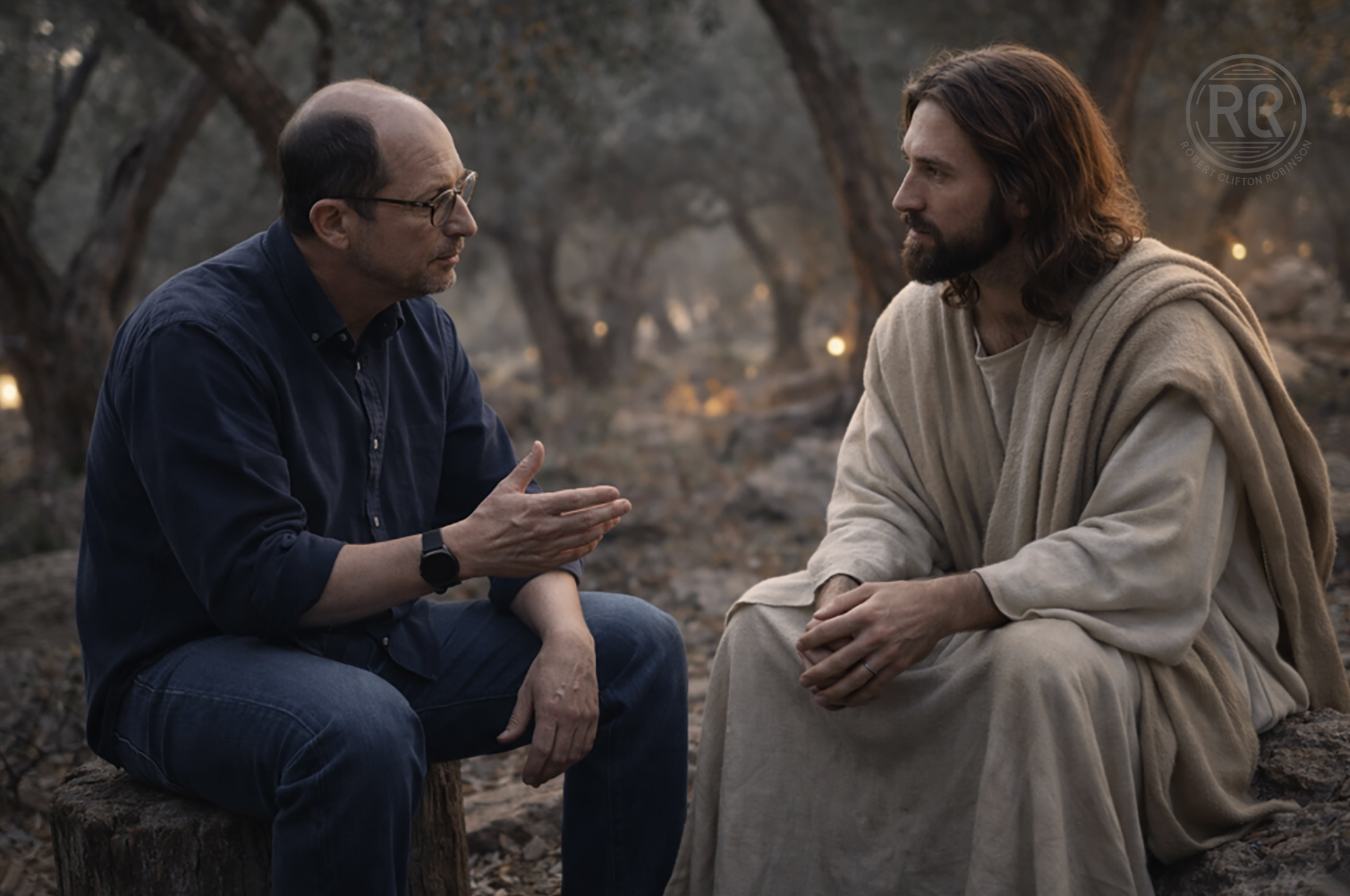
Bart Ehrman Telling Jesus His MIracles Don’t Meet The Historical Standard
Bart Ehrman is known as a preeminent New Testament scholar. When we examine his conclusions about the New Testament, he classifies these texts as non-historical, fabricated narratives. Ehrman rejects the eyewitness testimony because he does not believe miracles are possible, while demanding proof of God that would necessarily involve miracles.
This is classic circular reasoning that says Miracles cannot occur (assumed). Therefore, any testimony reporting miracles is unreliable. Therefore, there is no reliable evidence for God. Therefore, miracles cannot occur. The conclusion is embedded in the premise.
This is not historical skepticism; it is philosophical exclusion. If we applied Ehrman’s method consistently for all extant manuscript evidence, his method would invalidate every ancient claim involving divine action. Any historical account involving supernatural causation. Any worldview claim that transcends materialism.
The fact is that Ehrman does not apply this method universally. He applies it selectively only to surviving manuscript evidence for Christianity.
In the study of ancient history, many non-biblical texts record miraculous, divine, or supernatural events, and these texts are still treated by scholars as valid historical sources for reconstructing ancient history. The miracles themselves may not be affirmed as supernatural by modern historians, but the events, claims, and testimonies are treated as historically relevant data, the opposite treatment we find in evaluating the New Testament texts.
Tacitus – The Healing Miracles of Emperor Vespasian
One of the most famous examples of a miracle recorded in secular Roman history concerns the emperor Vespasian (reigned AD 69–79). The Roman historian Tacitus records that while Vespasian was in Alexandria, two men approached him claiming the god Serapis had instructed them to seek healing from the emperor.
The primary source is from Tacitus, Histories 4.81: “A blind man… threw himself before Vespasian’s knees, praying him to cure his blindness… and begged the emperor to moisten his eyes with his spittle. Another man with a disabled hand asked that Vespasian step upon it to restore it.”
Tacitus adds that physicians examined the men and said the cure might be possible, after which Vespasian performed the actions and the men were healed. The same event is also recorded by Suetonius, Life of Vespasian 7, and Cassius Dio, Roman History 65.8.
This classifies this miracle as attested in Roman historical literature and defined as reliable historical testimony
Atheist Philosopher David Hume cited this event as: “One of the best attested miracles in all profane history.”
Despite describing a miracle, Tacitus remains one of the most trusted historians of the Roman Empire, and his works are used by modern historians for reconstructing Roman history.
Livy – Divine Omens and Miracles in Roman History
The Roman historian Titus Livy (59 BC – AD 17) regularly records supernatural events in his history of Rome. The primary source for these texts is Livy, Ab Urbe Condita (various books), which records numerous miraculous omens. In these historical texts, we find:
- Statues sweating blood
- Cows speaking
- Heavenly voices warning Rome
- Stones raining from the sky
An example of these events: Livy, History of Rome 21.62: “At Arpi it rained stones… voices were heard from the sky.”
These events were reported to the Roman Senate and interpreted as divine warnings from the gods. Modern historians still rely heavily on Livy for early Roman history, even though his narratives contain supernatural events. These miracle reports are considered part of the historical record of Roman religious belief and testimony.
Plutarch – The Apotheosis of Romulus
Greek historian Plutarch (AD 46–120) records the miraculous disappearance and deification of Rome’s founder, Romulus. The primary source for these events is Plutarch, Life of Romulus 27–28: According to the tradition, Romulus vanished in a storm and was later seen ascending into heaven. A Roman noble named Proculus Julius reportedly testified that Romulus appeared to him after his disappearance and declared he had become a god.
Plutarch’s Lives remain standard historical sources for classical antiquity, even though they include divine visions and supernatural events.
Herodotus – Divine Intervention in Historical Events
The Greek historian Herodotus (5th century BC) frequently reports miraculous or divine interventions in historical events. The primary historical source for this event is Delphi’s Miraculous Defense: Herodotus, Histories 8.37–38 describes how Persian troops attacking Delphi were driven away by supernatural phenomena:
- Thunderbolts from heaven
- Falling rocks
- Divine apparitions
Herodotus states that two warriors of supernatural size appeared to defend the temple. Herodotus is often called “the Father of History.” His work is still used extensively in reconstructing the Greco-Persian wars, despite containing supernatural elements.
Josephus – Miraculous Signs Before the Fall of Jerusalem
The Jewish historian Flavius Josephus (AD 37–100) records extraordinary supernatural signs before the destruction of Jerusalem in AD 70. The primary source for these events is Josephus, Jewish War 6.288–300. Josephus describes:
- A star resembling a sword over Jerusalem
- A comet lasting a year
- A bright light shining in the temple
- Voices in the temple declaring departure
- Chariots and armies seen in the clouds
Josephus writes that these phenomena were witnessed by many observers. Josephus is still considered the primary historical source for the First Jewish-Roman War, despite including these supernatural reports.
Suetonius – Miracles and Omens in the Lives of the Caesars
Roman historian Suetonius (AD 69–122) recorded numerous miraculous events surrounding Roman emperors. In Augustus, Suetonius, Life of Augustus 94: A miraculous conception story involving the god Apollo.
In Vespasian, Suetonius also records the healing miracles mentioned earlier. These stories appear within biographies that remain core historical sources for the Roman Empire.
Pliny the Younger – A Documented Haunting
Roman governor Pliny the Younger (AD 61–113) recorded a ghost sighting in Athens. The primary source for these texts is Pliny the Younger, Letters 7.27. In this record, he describes a haunted house where a philosopher reportedly saw the ghost of an old man in chains. When the bones were later discovered and buried, the haunting stopped.
Although clearly supernatural, the account is preserved in one of the most reliable collections of Roman historical letters.
The Greek Healing Inscriptions of Asclepius
Archaeological inscriptions from temples of the healing god Asclepius record miraculous healings. Inscriptions from Epidaurus (4th–2nd century BC) record cures such as:
- Blindness healed
- Paralysis cured
- Tumors disappearing
Patients claimed the god healed them in dreams or temple rituals. These inscriptions are studied by historians as historical evidence of ancient religious healing traditions.
This is historical evidence that the standards Bart Ehrman uses to prove the authenticity of secular events of history are different when he evaluates the texts of the New Testament.
Ancient historians regularly reported supernatural events as part of their historical narratives. Scholars generally treat these accounts in the following way:
- The historian and text remain legitimate historical sources.
- The miracle claim is recorded as part of the historical testimony.
- The event may be interpreted differently (divine, natural, propaganda, etc.).
This means the standard historical method does not exclude sources simply because they record miracles. Ancient historians like Tacitus, Livy, Herodotus, Plutarch, Josephus, and Suetonius are accepted as historical sources even though they record miracles and divine interventions. In spite of these facts, Bart Ehrman argues that New Testament accounts should be dismissed precisely because they include miracles. Historically speaking, this is not how ancient historical sources are normally evaluated. Ancient historians reported what witnesses claimed to have seen, and those reports remain part of the historical record.
The idea that historians cannot prove miracles is false
A true historian records what he sees and hears, and does not interject into his testimony what he thinks or feels. Very often in the 260 chapters of the New Testament, particularly in the case of Luke, he tells us specifically what the men who didn’t write their own Gospels told him, about what they saw Jesus do: tens of thousands of miracles of healing to “everyone who was brought to Jesus.”
These narratives do not record the opinions of the men, except in cases where they cite the Old Testament prophecies that state the Messiah will be Yahweh who will open the eyes of the blind, etc (Isaiah 35), and other places.
In this regard, a historian, if we can establish that they are credible, can tell us about events that we call miracles, but are valid because they were seen by men and women who were there when these miracles took place.
Ehrman’s ignoring of the historical eyewitness testimony of the New Testament simply because he doesn’t believe miracles are possible, while demanding the very evidence to prove God that he denies beforehand.
The claim “historians cannot prove miracles” is not a historical principle — it is a philosophical restriction imposed by a scholar with bias.
A historian’s task is not to decide in advance what can or cannot happen. A historian’s task is to record, evaluate, and transmit testimony about events, based on credibility, proximity, corroboration, and consistency. Historians don’t prove causation in the metaphysical sense; they establish what happened, who said it happened, who witnessed it, and whether those witnesses are credible.
If we examine some of the statements recorded by historians, we see that they are not endorsing religious events; they are faithfully reporting testimony and belief grounded in historical events.
To say that historians cannot record miracle claims as historical events is false. Historians do this all of the time—except in cases when the subject is the God of the Bible. That exception is not historical; it is philosophical. Because men like Bart Ehrman have a preconceived idea that miracles are not possible, this disqualifies any testimony that describes these events.
Eyewitness testimony is historical evidence — even when the event is extraordinary
The New Testament does not present miracles as theological abstractions or symbolic myths. It presents them as events witnessed by named people, in known places, at identifiable times, with social consequences that can be traced historically.
The New Testament writers repeatedly distinguish between what they personally saw and what others told them they saw. Luke opens his Gospel as a model historian. He tells us the historical method he used in evaluating the testimony that the men who saw Jesus told him. Luke states that he didn’t invent these accounts, he didn’t speculate, he interviewed the eyewitnesses, the men who had been with Jesus “from the beginning.”
Luke recorded what the eight Apostles who did not write in their own Gospels. He took their testimony and placed it into a reliable record that was written by a man highly concerned about truth and accuracy.
Luke 1:1-4 “Many people have set out to write accounts about the events that have been fulfilled among us. 2 They used the eyewitness reports circulating among us from the early disciples. 3 Having carefully investigated everything from the beginning, I also have decided to write an accurate account for you, most honorable Theophilus, 4 so you can be certain of the truth of everything you were taught.”
Because of his concern for truth and accuracy, Luke writes what was told him by the men who were there when Jesus said and did the things that took place.
Luke 6:17-19 “When they came down from the mountain, the disciples stood with Jesus on a large, level area, surrounded by many of his followers and by the crowds. There were people from all over Judea and from Jerusalem and from as far north as the seacoasts of Tyre and Sidon. 18 They had come to hear him and to be healed of their diseases; and those troubled by evil spirits were healed. 19 Everyone tried to touch him, because healing power went out from him, and he healed everyone.
Luke writes that there were “people from all over Judea and from Jerusalem and from as far north as the seacoasts of Tyre and Sidon.” Every place Jesus went, thousands of people came to hear Him and often, to be healed. Imagine a person comes on the scene of our modern world, and we hear that he is healing “everyone who is brought to Him.” How many people would show up with sickness, disabilities, and diseases to be healed? The crowds would be immense.
Luke records that when these events took place, “He healed everyone.”
This is not an isolated statement. Luke reports that: “everyone who was brought to Jesus was healed,” entire villages were emptied of sickness, demons were expelled publicly, and the blind, lame, and paralyzed were restored in full view of crowds. He is not offering an opinion.
He is transmitting reported eyewitness testimony, exactly as historians are supposed to do.
It is important that Luke often does not interpret the texts he records into the historical record, as any good Historian does not comment. Luke doesn’t say how Jesus healed. He does not explain why it worked. He simply records that it happened and that the witnesses testified to it.
The New Testament doesn’t argue for miracles — it reports them
This is a key distinction that Ehrman repeatedly ignores. The Gospel writers do not say: “We believe these things happened.” In fact, on many occasions, they write that they didn’t understand what Jesus was doing was a fulfillment of the Messianic Prophecies, until after He had died, risen from the dead, and returned to heaven.
John 12:16: “Jesus disciples didn’t understand at the time that this was a fulfillment of prophecy. But after Jesus entered into his glory, they remembered what had happened and realized that these things had been written about him.”
They say, in effect: “This is what happened, this is who saw it, this is what they said, and this is what followed.” Only secondarily—often when citing the Hebrew Scriptures—do they explain why these events mattered.
For example, Isaiah 35 does not create the miracle narratives.
Isaiah 35:4-6: “Say to those with fearful hearts, “Be strong, and do not fear, for your God is coming to destroy your enemies. He is coming to save you.” 5 And when he comes, he will open the eyes of the blind and unplug the ears of the deaf. 6 The lame will leap like a deer, and those who cannot speak will sing for joy!”
The Fulfillment Recorded in Matthew’s Gospel
Matthew 11:2-5: “John the Baptist, who was in prison, heard about all the things the Messiah was doing. So he sent his disciples to ask Jesus, “Are you the Messiah we’ve been expecting, or should we keep looking for someone else?” Jesus told them, “Go back to John and tell him what you have heard and seen—the blind see, the lame walk, those with leprosy are cured, the deaf hear, the dead are raised to life, and the Good News is being preached to the poor.”
Matthew didn’t understand at the time he recorded this event that Isaiah had predicted 700 years before, precisely what Jesus was doing. Jesus understood what He was doing because John the Baptist wanted to know if Jesus was the Messiah, or if he should continue to look for Him. By citing the text from Isaiah that “you God is coming to you…to open the eyes of the blind and unplug the ears of the deaf, and cause the disabled to walk, Jesus is claiming He is Yahweh from Isaiah’s prophecy that is fulfilling what he wrote, because He is the Messiah.
Luke wasn’t creating a myth; he recorded what he saw, and later realized that this was the fulfillment of Isaiah’s 700-year-old prophecy of the Messiah
Bart Ehrman’s methodological method is circular. It is a flaw of his historical method
Ehrman rejects the eyewitness testimony because he does not believe miracles are possible, while also demanding proof of God that would necessarily involve miracles.
- This is classic circular reasoning. Miracles cannot occur (assumed).
- Therefore, any testimony reporting miracles is unreliable.
- Therefore, there is no reliable evidence for God.
- Therefore, miracles cannot occur.
The conclusion is embedded in the premise.
This is not historical skepticism; it is philosophical exclusion. If applied consistently, this method would invalidate any ancient claim involving divine action (including those already validated), any historical account involving supernatural causation, and any worldview claim that transcends materialism.
Ehrman does not apply this method universally. He only applies it selectively to Christianity.
The historian’s job is not to veto testimony based on personal belief. A historian who says: “I will not accept eyewitness testimony if it describes something I believe cannot happen,” has ceased to be a historian and has become a gatekeeper of metaphysics.
True historians ask:
- Were the witnesses close to the events?
- Were they numerous?
- Were they consistent?
- Were they willing to suffer for their testimony?
- Were they contradicted by hostile contemporaries?
Concerning all of these criteria, the New Testament eyewitnesses score exceptionally high.
Ehrman’s refusal to stipulate this is therefore not evidential—it is a prior metaphysical bias.
Why This Matters As The Real Reason People Do Not Believe in God
The real reason many do not believe in God is not a lack of evidence, but a refusal to allow the kind of evidence God would give. If God exists, the most reasonable way for Him to reveal Himself is through acts that transcend nature, witnessed by real people, recorded in public history, and preserved through multiple independent sources.
That is exactly what the New Testament claims to be
To reject that evidence because it is divine in character is not skepticism—it is prejudgment.
The claim that historians cannot report miracles is false; historians report eyewitness testimony, and when credible men and women testify to extraordinary events they personally witnessed, the historian’s task is to preserve that testimony—not to discard it because it conflicts with a prior philosophical rejection of God.
An Examination of Bart Ehrman’s Statements Regarding Miracles
Ehrman often structures the issue of miracles with his view that “historians can’t demonstrate miracles,” not as an absolute metaphysical claim (“miracles are impossible”). He also speaks in strongly negative terms about miracles as “virtually impossible” and says he personally doesn’t believe in literal miracles.
From Ehrman’s blog: “As most readers of the blog know, I do not believe in miracles. At least in literal miracles as normally understood.”
Then he defines miracle (in the “literal” sense) as something requiring “supernatural intervention… an act of God.”
Ehrman’s core historical-method claim: historians can’t establish miracles: From Jesus, Interrupted (primary text):
“Historians can establish only what probably happened in the past, but miracles… are always the least probable explanation for what happened.”
“If historians can only establish what probably happened… historians cannot establish that miracles have ever probably happened.”
Concerning Jesus’ resurrection specifically:
“There can be no historical evidence for the resurrection because of the nature of historical evidence.”
When pressed: “But what if Jesus did [rise]?”
Ehramn stated, … it’s beyond historical demonstration.”
Ehrman’s probability framing and “virtually impossible” language, Also in his book, “Jesus, Interrupted:
“Miracles… are virtually impossible events.”
“We would call a miracle an event that violates the way nature always, or almost always, works… virtually, if not actually, impossible.”
The question we should as is how this becomes (in practice) a reason to doubt the Gospel narratives? Ehrman’s reasoning is essentially:
- The Gospels contain many miracle claims.
- Miracles are “least probable/virtually impossible.”
- Therefore, historians can’t responsibly affirm them as what “probably happened,” and that affects how the Gospels are treated as “historically accurate” narratives.
Ehrman states this logic bluntly in “Jesus, Interrupted,” when he says that belief in the resurrection would be “not as a historian… but as a believer.”
Ehrman argues that because historians can only establish what is most probable, and miracles are (by definition) the least probable, historians cannot conclude that miracles (including the resurrection) happened—so the New Testament’s central miracle-claims cannot be affirmed as “historical” by the tools of the discipline.
Why that argument fails (and why a true God must be able to do what the Bible calls miracles)
Ehrman’s argument doesn’t fail because he’s unintelligent or insincere; it collapses because it quietly hides a worldview conclusion into a historical method.
“Historians can’t prove miracles” is not the same as “miracles can’t happen.”
Even if we stipulate that a modest claim like “the historian’s tools alone can’t force assent to a miracle,” that does not prove the stronger conclusion that miracle claims are untrustworthy or that the Gospel accounts are not truthful. It simply means that historical inquiry can establish what sources claim, who believed what, what happened to the movement, and what explanations fit the total evidence best. At this point, we can examine a worldview-level reasoning that evaluates whether “God acted” is a viable explanation.
In other words, the dispute is not history vs. faith—it is worldview bias (naturalism vs. theism) governing what counts as “possible” in advance.
When someone says, “Miracles are the least probable by definition,” they often mean: “Given the regularities of nature, miracles are rare.”
But Ehrman’s As He States It:
“Because miracles are rare, they can never be the best explanation, no matter the evidence.”
This is not a neutral historical principle. It functions like a veto: “even if the evidence stacked up unusually strongly, the conclusion is blocked in advance.” That is a philosophical conclusion, not a viable, respectable historical method
This is why major philosophers of probability and testimony have criticized the classic Hume-style approach. For example, John Earman (not writing as a Christian apologist) famously judged Hume’s anti-miracle argument to be “an abject failure.”
The key point is:
Probability is always conditional on background information. If God exists, miracle-probabilities change drastically—because the event is no longer “nature alone,” but “nature plus a personal, purposive agent.”
If God is truly God, miracles are not merely “possible”—they are fitting: God (by definition) is not one more object inside the universe. God is the transcendent ground of the universe’s existence and continuance. Therefore, God is not constrained by the universe’s regularities the way creatures are; those regularities are His ordinary mode of governance.
A “miracle” is not God “breaking” His laws like a delinquent; it is God acting in an unusual way for a revelatory or redemptive purpose.
The real issue is not, “Can God do miracles?” It is: Is there a God? If yes, miracles are not metaphysically absurd; they are the kind of thing a personal Creator could do when He chooses.
A being who cannot act beyond the closed system is not the biblical God
If we define “God” as not omnipotent (able to accomplish His will), not omniscient (able to know all), not transcendent (not beyond space-time-matter), then we have defined something closer to a powerful creature or an impersonal force, not the God described in the Bible.
Ehrman’s “miracles are too improbable” posture is really a way of saying: “I will treat reality as a closed system.” That is a philosophy of nature, not a conclusion of history.
Genesis 1:1 As The Foundational Miracle
If “In the beginning, God created the heavens and the earth,” then matter is not ultimate, the universe is contingent, and natural regularities are derivative (they depend on an ordering intelligence and sustaining will).
Once creation is stipulated, every subsequent miracle is no longer “God doing the impossible.” It is God doing the comparatively easy: altering conditions within a reality He already called into being and upholds.
If someone denies miracles because they deny God, then the debate is not about this or that miracle. It is about whether Genesis 1:1 is true.
Psalm 33:6 And “Command Miracles” in Jesus’s Ministry
Creation by command (God speaks; reality obeys)
Redemption by command (Jesus speaks; sickness, storms, demons, and death obey)
This is not an accident of scripture. It’s a historical fact of God’s authority: the same kind of sovereign speech that establishes order can, at will, re-order circumstances—because the speaker is not merely a prophet but (as you put it) Yahweh acting in history.
This also helps you answer a frequent skeptic move:
Do Miracles Violate The Laws of Nature?
The biblical text does not describe “nature vs. God.” It presents nature as responsive to its Creator, ordinarily through regular patterns, and extraordinarily through direct command.
The Human point of view (epistemic definition)
A miracle is an extraordinary event in the natural world that cannot be adequately explained by natural causes alone (given our best knowledge) and that is reasonably understood as a deliberate act of God with meaning (a “sign”).
C. S. Lewis said that miracles are an “interference with Nature by supernatural power.”
God’s point of view (ontological/theological definition)
For God, miracles are not difficult; they are an everyday, ordinary part of who He is and what He does. The entire Bible presents God as performing miracles through every generation of man. Miracles are not a violation of the natural laws; they are the Creator of these natural laws working within what He knows and understands about the universe. Raising the dead is not a violation of the Laws God created; it is a correction of a defect that occurred when sin entered the perfect world with no death that God originally created.
Ordinary providence = God’s usual way of governing through stable regularities
Miracle = God’s unusual way of governing for a revelatory/redemptive purpose
This is why Augustine’s insight is useful. He said: “What looks ‘against nature’ to us may be ‘against what we know of nature,’ not against God’s power.”
Italian Theologian, Aquinas, said that a “miracle” is “beyond the order/capability of nature,” but is not “God contradicting Himself.”
The “miracles” objection is often a ruse by critics to obscure a deeper prior bias
People aren’t saying, “I followed evidence and arrived at ‘no miracles.’” They are saying, “My picture of reality has no room for God,” and therefore miracle claims are rejected.” The ‘real reason’ is often metaphysical naturalism (or practical naturalism), not the evidence for/against the Gospel accounts.
The Reason for Moral and Existential Resistance of God by Critics:
- If God exists, I’m accountable.
- If I’m accountable, I must change.
- Therefore, I prefer a world where God is not allowed into the explanation.
This is not a false accusation—it’s an anthropological observation about how humans reason when a conclusion threatens autonomy.
The debate over miracles is not first about biology or physics; it is about God. If God is the Creator of all that exists, then miracles are not violations of reality but expressions of the Creator’s authority within reality. The question is not whether miracles are “possible” inside a closed system; the question is whether the system is closed at all.
Ehrman is not merely saying “miracles are impossible.” He is saying that historical methods can’t establish them as what “probably happened,” and that his own philosophical posture strongly resists miracle conclusions.
The idea that historians cannot prove miracles is false. A true historian records what he sees and hears, and does not interject into his testimony what he thinks or feels. Very often in the 260 chapters of the New Testament, particularly in the case of Luke, he tells us specifically what the men who didn’t write their own Gospels told him, about what they saw Jesus do: thousands of miracles of healing to “everyone who was brought to Jesus.”
These narratives do not record the opinions of the men, except in cases where they cite the Old Testament prophecies that state the Messiah will be Yahweh who will open the eyes of the blind, etc (Is 35), and other places.
In this regard, a historian, if we can establish that they are credible, can tell us about events that we call miracles, but are valid because they were seen by men and women who were there when these miracles took place. Ehrman’s ignoring of the historical eyewitness testimony of the New Testament simply because he doesn’t believe miracles are possible, while demanding the very evidence to prove God that he denies beforehand, reveals his internal bias that has simply chosen not to stipulate God must exist based on the historical evidence presented for Jesus in the New Testament.
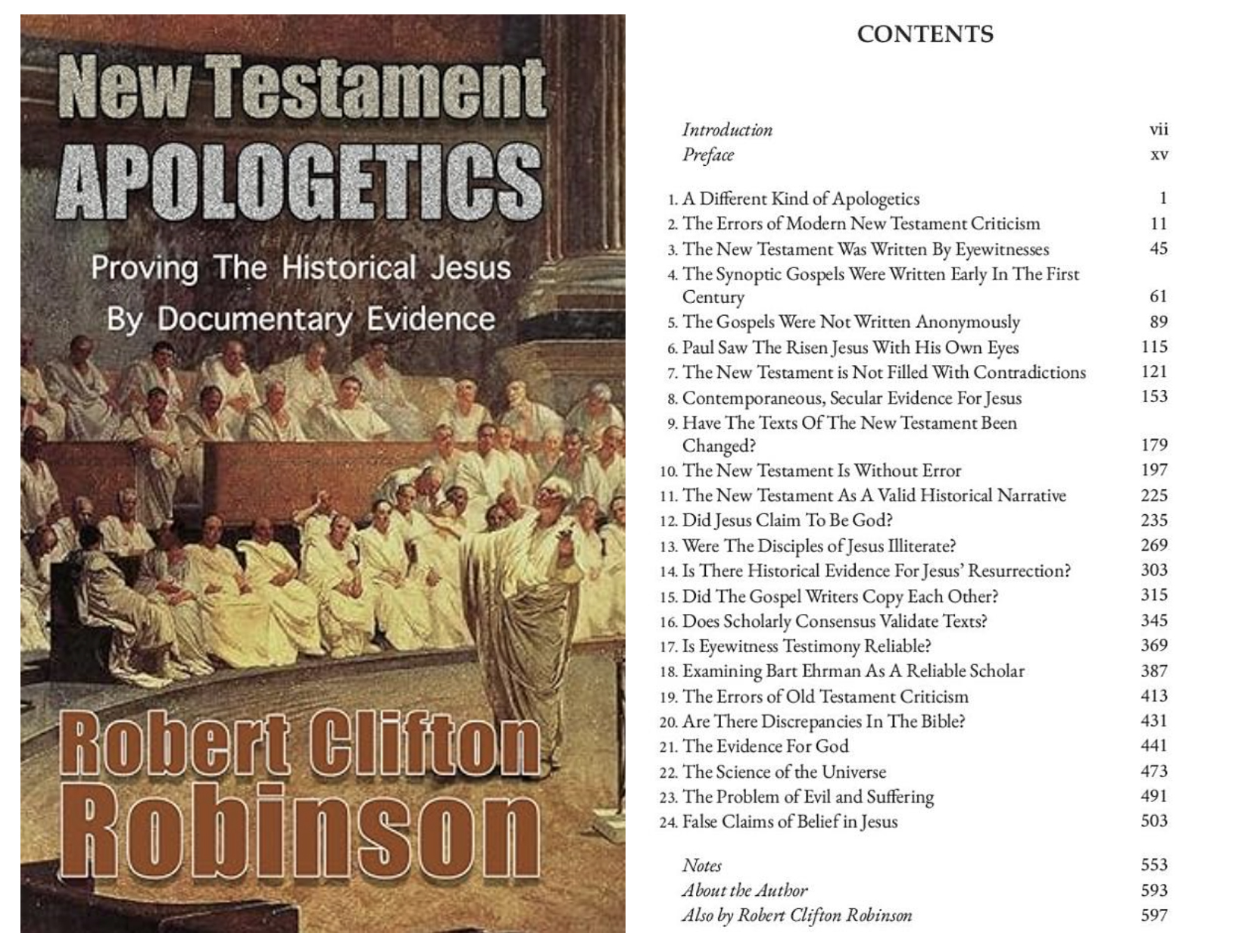
See Rob’s Presentation of the Historical Facts of History That Prove God Exists in the Person of Jesus Christ: “New Testament Apologetics”
Categories: Robert Clifton Robinson
 Robert Clifton Robinson
And, indeed, I would now come to the mystery of the subjective possiblity of revelation, and the miracle of Pentecost, as attested by Luke in Acts of the Apostles. The Holy Spirit! Here is where you and I can stop going round and round with Bart: We believe the Holy Spirit! Read Luther’s Catechisms on the Holy Spirit, and John Calvin, and you can see where we go wrong when we start tuning to the authority of historians regarding the Bible. What do we read about our Holy Scriptures being God-inspired in Timothy, my dear Christian brother, no self-serving claims to human historical objectivity there, right? God bless you! Keep at it, my friend but, start again with God, not Bart. Jim
LikeLike
Hi friend, instead of going outside the Christian Bible, start with the Christian Bible, which does attest the covenant history of God’s revelation to human beings. The problem with Apologetics, and in your form “natural theology,” is that we start first from below and try to move upward rather than starting from above and moving downward. In other words, how can we speak about God at all with our human words, and then God as Creator, without God having revealed God’s own self to us? No doubt, you want to refer us to God’s revelation, but His good creaturely order is distinct from Him, as He created us, from nothing and daily preserves us: there is natural history, but there is also “covenant” history in which God engages us his human partners. Christian theology should start with “thinking after God.” (To quote Karl Barth) God bless you!
LikeLiked by 1 person
Your response here and at FB, tells me you didn’t read the essay. This essay impeaches Bart Ehrman by the New Testament narrative.
LikeLike
Let’s put it this way, you are appealing to The Evangelist Luke, for example, and the NRSV has a much better translation of the Greek when it translates ”eyewitnesses and servants of the word.” (Lk 1:2) That clearly means “message.” You want to speak about the miracles of Jesus but what does Jesus Himself, as attested in the Synoptic Gospels have to say about His miracles and His message or word of the Kingdom of God?
LikeLike
It is unclear to me how this comment relates to the essay.
The essay is about the disingenuous methods used by Progressive scholars that excludes miracles as non-historic.
It seems, as I wrote to you before, that you didn’t read the essay, but are commenting on the title of the essay.
LikeLike
Hi Friend, I’ll give it again a still closer look, but would you disregard any commenting on the title and tone of the essay, which, is it fair to say, is Apologetic, debating Bart apologetically, as though classical historian against classical historian, disregarding the character of the Gospels as Good News and the writers thereof as being Evangelists, as well as the Apostles and Prophets? Isn’t Bart not only resisting the miracles of Jesus but His very character as, by God, in the Coming Kingdom of God, the Royal Man for all others, and not simply another Jewish rabbi with a new spin on things, as Bart wants to say the myths and miracles were added so as to make the revolutionary Jewish Rabbi Jesus, now dead and gone, appealing to the history of the wider Greco-Roman world, in which there was even then growing suspicion about miracles, which you want point out to him, which, as you say, did include accounts of miracles, but you then have neglected to compare how Jesus and miracles, already miracles being questionable even in the wider world, is different than these other miracle workers with their miracles. And thus you with Bart ignore the Mystery to which the Christmas and ultimately the Easter miracles, and all the miracles of Jesus point: “The Word became Flesh and dwelt among us.” John 1 Your picture of Bart and Jesus does not point to us to that Mystery which is our Lord Jesus Christ Himself for Bart and for us all: True God and True Human Being for Bart and for us all. John the Baptist pointed to Him, John 1, not himself, and not as an historian. God bless you! Jim.
LikeLike
Hi Robert,
The grace and peace of God our Father and the Lord Jesus Christ be with you!
Re-read did I what you wrote, but, again, go back to the your beginning sentence: Bart is opposing God by claiming God for Bart’s own self-assertion: Bart’s cause is Bart, thereby turning the power of the Resurrection, the Promise of the Holy Spirit, Bart’s freedom, for God, others and to be himself, God’s claim on him, into his claim on God, demanding that God prove God’s self to him and to us, which, as you and I both know, is testing God. Are we serving God, or, being self-serving, testing God, even or especially as trying to prove God? God bless you! Jim
LikeLike
Jesus Christ is The Faithful Witness. Christian apostate Bart wants to be the Apologetic Pope of his own apostate church of his own modern scholarly self-serving and fabricated “ Historical Jesus” Whatever classical historians may have said or not said, th
LikeLike