Most people understand that not everything that is posted on the internet is true or reliable. This becomes particularly nefarious when the person hosts people who assert the New Testament is not a reliable truth.
Paulogia has written hundreds of false statements about the New Testament and created hundreds of YouTube videos that host atheists and progressives. Atheists love his videos, and they access Paulogia as a reliable source for true facts about the genuine nature of the New Testament narratives about Jesus.
The Problem Is That Most People Who Watch Paul On YouTube, Don’t Know That He Falsely Represents The Truth Of These Texts
The following is just one of hundreds like it—where Paulogia will state his view or opinion about the New Testament, but can’t prove what he says is actually true. In the case of this example, Paul states that he has the consensus of biblical scholars. What he doesn’t tell you is that his scholars are also atheists like himself, or progressives, who don’t believe the Bible is true.
Should we trust an atheist to give us truthful information about God and the Bible?
First Paulogia claims that John in his letters, never says he saw Jesus, or in writing Revelation, Paul didn’t did state that Jesus rose from the dead bodily.
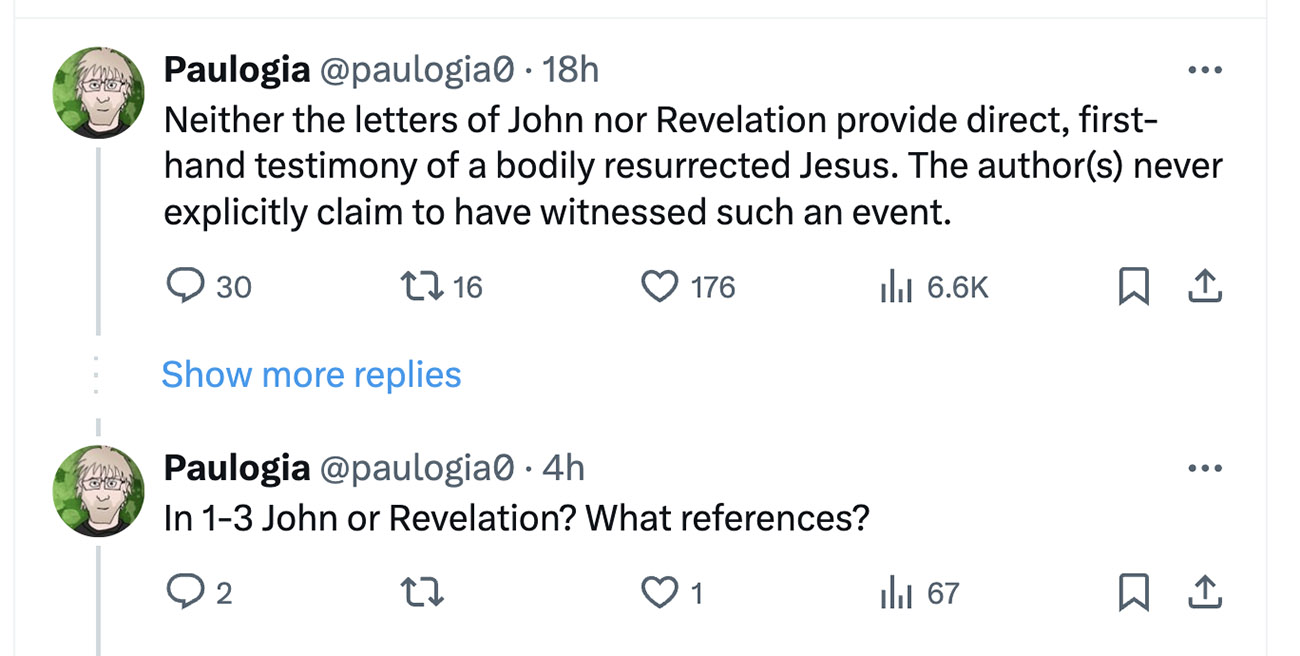

Paulogia claims that he has hosted “scholars” on his YouTube channel who have confirmed that Paul ever saw the risen Jesus, or that he heard of Jesus’ resurrection from the Apostles of Jesus.
My Response to Paul was that the New Testament provides us with the historical eyewitness testimony that Paul and all of Jesus’ Apostles, saw Him alive after He was Crucified. If there are scholars who say otherwise, they must not know what the extant New Testament manuscripts record, or they are wilfully ignorant or deceptive.
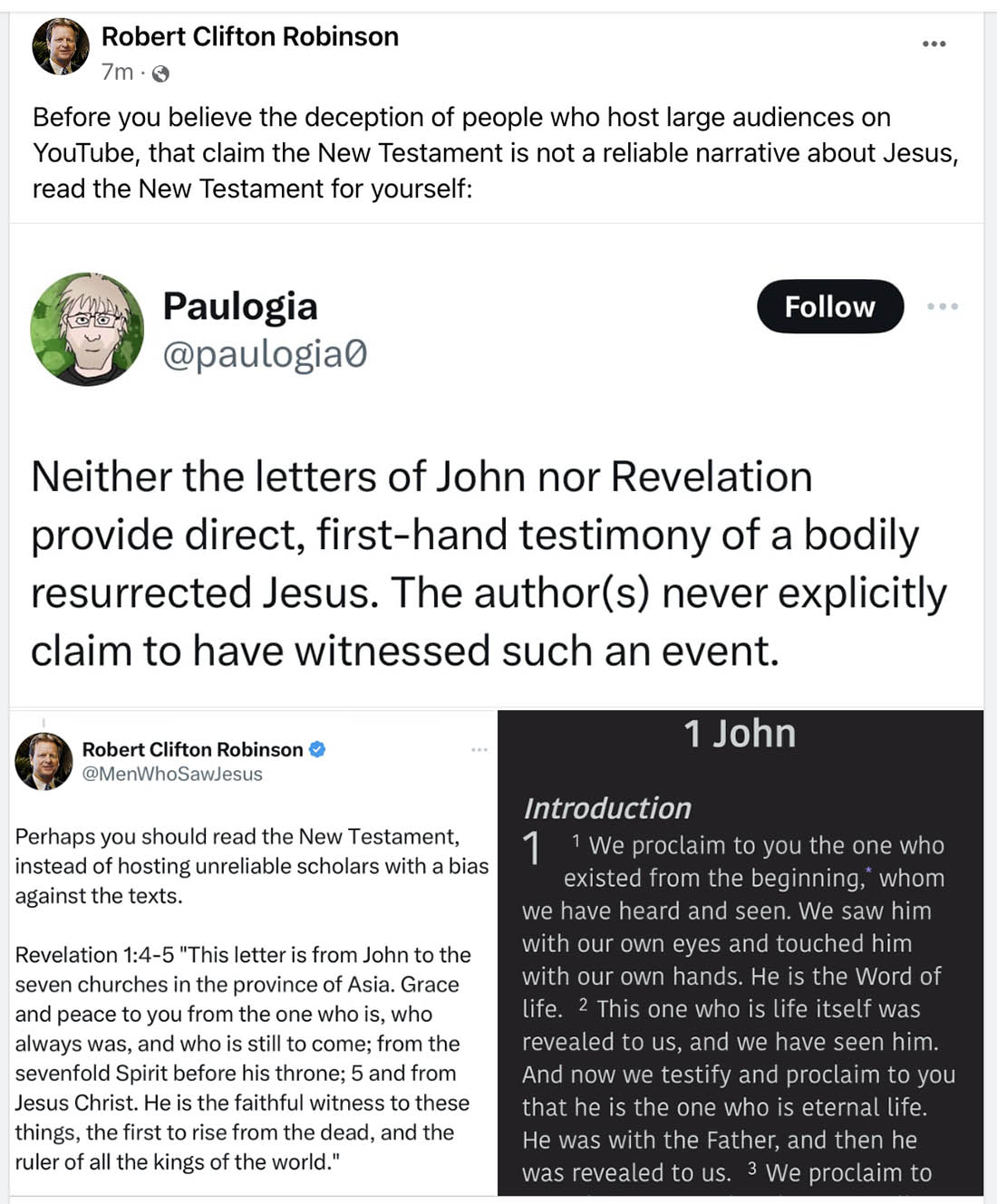
I invited Paulogia to enter into a written debate with me regarding these very issues that he states. He refused. Now we know why…
There are 21 primary arguments that atheists like Paulogia make against the New Testament narratives about Jesus. See all 21 of these false claims, and the evidence that fully impeaches them: “New Testament Apologetics,” now available at Amazon in both eBook and Paperback

Categories: Anonymity of the Four Gospels, Eyewitnesses, Historical Moses, How The NT Writers Remembered, New Testament Criticism, Paulogia, Pretend Believers, Resurrection Proven by Secular Sources, Robert Clifton Robinson, Secondary Sources, Secular sources for Jesus, The Resurrection of Jesus


I understand why Paul isn’t interested in debate, pretty big error on this first page. Oh well. In case you are unaware, John 1 is not authored by John the apostle most critical scholars believe, so Paulogia is correct, and you look silly
LikeLike
I have written and published commentary and scholarly essays on this subject, over the past 49 years.
The claim that the Apostle John is not the author of 1 John primarily arises from critical scholarship, often among those who approach the Bible from a naturalistic or historical-critical perspective. Many of these scholars are atheists or Progressives who either do not believe in divine inspiration or hold to a progressive theological view that questions traditional authorship claims.
The Evidence for Johannine Authorship of 1 John
There is strong historical, linguistic, and theological evidence supporting the claim that the Apostle John wrote 1 John:
External Evidence (Patristic Testimony)
Early church fathers consistently affirmed that John, the Apostle and author of the Gospel of John, also wrote 1 John. Notably:
* Irenaeus (c. 130–202 AD) explicitly attributes 1 John to the Apostle John and quotes from it extensively (Against Heresies 3.16.5, 3.16.8).
* Clement of Alexandria (c. 150–215 AD) acknowledges John’s authorship of the epistle.
* Tertullian (c. 155–220 AD) references it in ways that confirm traditional authorship.
* Origen (c. 185–253 AD) affirms Johannine authorship (Homilies on Luke).
* Eusebius (c. 260–339 AD) includes 1 John among the universally accepted books of Scripture, confirming that early Christians attributed it to John.
The early church was much closer to the time of authorship and preserved an unbroken tradition regarding John’s authorship.
Internal Evidence (Style, Vocabulary, and Theology)
The Stylistic Parallels to the Gospel of John
* Both books use distinct Greek expressions such as “in the beginning” (Ἐν ἀρχῇ) (John 1:1; 1 John 1:1).
* Themes such as light vs. darkness, truth vs. lies, love, knowing God, and eternal life are central in both books.
* The same simple yet profound Greek syntax, vocabulary, and rhythm appear in both.
*The phrase “that your joy may be full” (1 John 1:4, John 16:24) and other repeated expressions demonstrate a common author.
Theological Consistency
* The themes of Christ’s divinity, atonement, and love strongly align with the Gospel of John.
* 1 John emphasizes Jesus as the Son of God and His pre-existence (1 John 1:1-3), which parallels John 1:1-3.
* John is known for emphasizing “abiding in Christ” (John 15; 1 John 2:24-27), further connecting the two works.
The Author’s Eyewitness Claim
* 1 John 1:1-3 states, “That which was from the beginning, which we have heard, which we have seen with our eyes, which we have looked upon, and our hands have handled, concerning the Word of life…”
* This clearly points to an eyewitness of Christ, aligning with John’s unique perspective as an intimate disciple of Jesus.
Arguments Against Johannine Authorship and Their Weaknesses
Most of the objections come from higher critics who often presuppose that the biblical texts are unreliable. Their primary arguments include:
That Assertion That 1 John Is Written In A Differences in Style
Some critics argue that 1 John lacks the explicit personal references of 2 John and 3 John and does not mention the name “John.” However:
* Ancient epistolary styles varied. 1 John is more of a theological treatise, not a formal letter, thus explaining the lack of a traditional greeting.
* The Gospel of John also does not name its author directly, following the same pattern.
Asserted Differences in Christology
Some scholars claim that 1 John has a “higher” Christology than the Gospel of John. However, this claim is weak because:
* The Gospel of John already establishes Jesus as fully divine (John 1:1, John 10:30).
* The idea that there are “competing” theologies assumes contradictions where there are none.
The Assumption of a Late Date:
* Some scholars date 1 John to the late 1st or early 2nd century and claim that an anonymous author wrote it.
* This dating assumption often reflects a bias against traditional authorship rather than historical evidence.
* The letter’s strong polemic against early Gnostic tendencies suggests it was written while John was still alive to combat emerging heresies (late 1st century).
Who Are the Scholars Who Reject Johannine Authorship?
The majority of those who deny John’s authorship belong to the historical-critical school, which often assumes that traditional claims about authorship are unreliable unless independently confirmed by external sources. Many of these scholars do not believe in divine inspiration, including:
* Bart Ehrman (an agnostic/atheist scholar) argues against traditional authorship of many New Testament books.
* Raymond Brown (a Catholic critical scholar) acknowledges the similarities to John’s Gospel but suggests an unknown author from a “Johannine community.”
* Rudolf Bultmann (a German liberal theologian) held that 1 John was influenced by Gnostic thought rather than written by the Apostle.
Many of these scholars begin with skepticism, rejecting early church testimony as unreliable without strong independent verification, even though they would not apply the same standard to other ancient historical texts.
The Best unbiased and Scholarly Evidence Supports Johannine Authorship
The patristic testimony, linguistic similarities, theological consistency, and internal claims of 1 John overwhelmingly support the view that the Apostle John wrote the letter. The objections from skeptical scholars rely on assumptions rather than definitive evidence.
Furthermore, it is clear that those who most strongly deny John’s authorship often have a theological or philosophical bias against divine inspiration. The same scholars who deny 1 John’s authenticity are often the same ones who reject the Gospel of John and the entire New Testament as divinely inspired.
Thus, unless one is predisposed to rejecting traditional authorship, the most logical conclusion—based on historical, linguistic, and theological evidence—is that the Apostle John wrote 1 John.
So, your friend “Paulogia” is wrong. This is because he doesn’t really know the Bible, or the Historical eyewitness narratives of the New Testament.
Not someone that I would recommend following.
LikeLike
Yeah, so what you are telling me is that most non believing scholars agree with Paulogia.
The believers don’t.
So in other words, since both sides have a vested interest, I should trust either side.
Well no prob.
I gave no problem with taking everything Paulogia says with a grain of salt.
Get Outlook for Androidhttps://aka.ms/AAb9ysg
LikeLike
Dominic,
As with all things in our life, it always comes down to a choice.
The assertions of atheist and progressive scholars are predicated upon conjecture, speculation, and their opinions; the conclusions of Bible believing scholars is based upon the historical, eyewitness, testimony that is documented by extant manuscript evidence.
I was an atheist 49 years ago. It was this historical eyewitness evidence that exists in such a large body of texts, that convinced me what is written about Jesus in the New Testament is true. You can check out my evidence in my latest book that impeaches the 21 primary arguments that atheist and progressive scholars claim against the New Testament evidence.
“New Testament Apologetics” by Robert Clifton Robinson
LikeLike
Nice.
I should choose to believe in something with all my heart.
Lol.
The theists make all the same assertions.
Show some honesty, but if you truly believe otherwise, fine.
It’s your life.
LikeLike
We are simply trying to tell people the truth. God doesn’t want anyone to be lost, so He has given us time to hear the truth and make a decision.
Having been on the other side, I know the lies and deception of those who attack the truth and reliability of the Bible. There is also an enemy, satan, who doesn’t want us to know the truth, and he has worked to deceive and prevent people from being saved.
God allows all this to continue for now, because to prevent it, would rob us of our own sovereignty to learn and decide for ourselves.
It doesn’t seem to me that you have really decided. This is a good place to be. If you pursue the truth you will find it.
I wrote, “New Testament Apologetics” for people like us, who are searching. Many have turned from unbelief to belief after reading this book. I pray that you stay on this journey and that you join us who do believe. It is wonderful.
LikeLike