Evolutionary Theory Suggests That All Species Originated From One Common Ancestor. Biblical Creationism Defines Creation By God Through “Kinds,” Created As Separate And Distinct Creatures—
The concept of “kinds” (Hebrew: min, מִין) originates from the Genesis creation account, where God commands living organisms to reproduce “according to their kinds” (Genesis 1:11–12, 21, 24–25). This term is central to discussions on biblical creation and evolution, as it pertains to the nature of biological variation and the limits of change in living organisms.
The Biblical View Of “Kinds” Is Consistent With Scientific Evidence
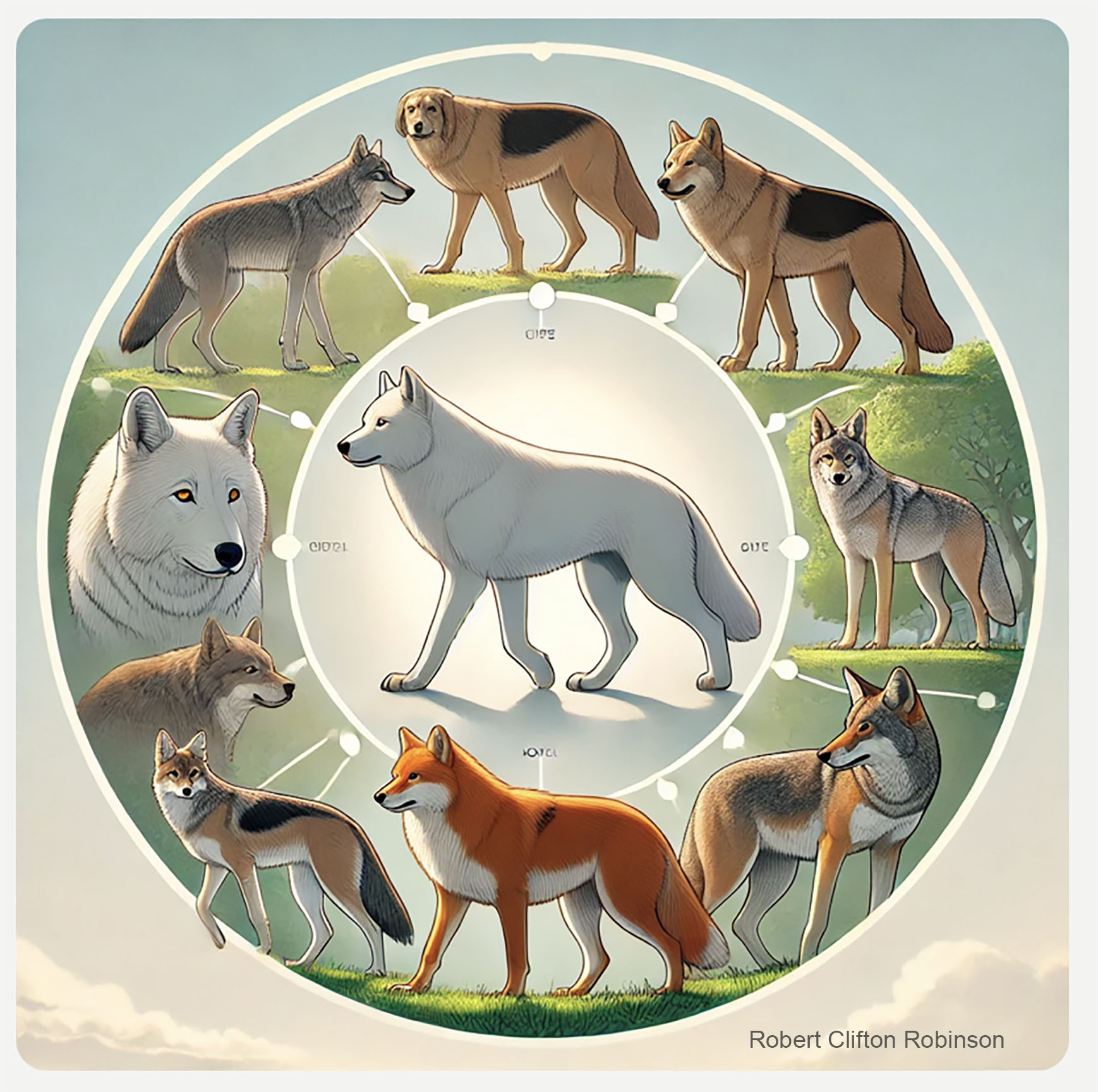
Biblical Kinds, Copyright RCR
The Biblical Definition of “Kinds”
In Genesis 1, God creates plants, sea creatures, birds, land animals, and humankind, each “according to its kind.” The phrase suggests a classification system in which organisms reproduce within defined boundaries. This biblical term does not correspond directly to modern biological taxonomy but appears to describe broad groupings of living organisms that are capable of producing offspring.
- Genesis 1:21 – “So God created the great sea creatures and every living thing that moves, with which the waters abounded, according to their kind, and every winged bird according to its kind.”
- Genesis 1:24–25 – “Then God said, ‘Let the earth bring forth the living creature according to its kind: cattle and creeping thing and beast of the earth, each according to its kind’; and it was so.”
Baraminology: The Study of Created Kinds
Modern creation scientists have developed a field called baraminology (from bara = “created” and min = “kind”), which seeks to identify the biological limits of variation within kinds. The primary hypothesis is that each created kind is a broader category than species but more specific than an entire taxonomic class or order.
Examples From Actual Living Animals:
- The canine kind may include wolves, dogs, foxes, and coyotes, all descended from an original created pair.
- The feline kind may include lions, tigers, leopards, and domestic cats.
- The equine kind may include horses, zebras, and donkeys.
This suggests that while variation and adaptation occur within kinds, one kind does not evolve into a fundamentally different kind.
“Kinds” vs. Evolutionary Theory
Evolutionary theory, as proposed by Darwin and expanded by modern biology, posits that all life evolved from a common ancestor through gradual changes over millions of years, driven by mutation, natural selection, genetic drift, and other mechanisms. This contrasts with the biblical concept of kinds, which suggests distinct, separately created groups made fully functional at their creation.
Microevolution vs. Macroevolution
Creationists generally distinguish between microevolution (small changes within a kind) and macroevolution (the large-scale transformation from one kind into another):
Microevolution (Accepted by Creationists):
- Observable variation within species due to genetic recombination, mutation, and natural selection.
- Examples: Dog breeds, finch beak variation, antibiotic resistance in bacteria.
- This does not add new genetic information but results from rearranging existing genetic material.
Macroevolution (Rejected by Creationists):
- Hypothetical large-scale changes where one kind evolves into an entirely different kind (e.g., fish to amphibians, reptiles to birds).
- Requires new genetic information and structures to develop, which has never been observed in real-time experiments.
- The fossil record lacks undisputed transitional forms demonstrating one kind evolving into another.
The Limits of Biological Change
Genetic studies support the idea that there are limits to variation:
- Dog breeding has produced numerous breeds, but all remain within the canine kind.
- Mutations generally result in a loss of function or information rather than new, complex biological structures.
- Laboratory experiments (e.g., fruit flies and bacteria) show variation, but no new kinds arise.
This supports the biblical assertion that kinds were designed with built-in genetic variability but do not evolve into entirely new forms.
Scientific Challenges to Macroevolution
Several scientific problems challenge the idea that all life evolved from a single common ancestor:
The Lack of Transitional Fossils
Darwin himself admitted that the fossil record did not contain the numerous transitional forms his theory predicted. Over 150 years later, paleontologists still debate the gaps between major groups. The abrupt appearance of fully formed organisms in the Cambrian Explosion contradicts the gradual progression expected by evolution.
Irreducible Complexity
Biochemist Michael Behe introduced the concept of irreducible complexity, where biological systems require multiple interdependent parts to function (e.g., bacterial flagellum, blood clotting system). These structures could not have evolved step-by-step, as evolution requires each step to be functionally beneficial.
Genetic Information and Mutations
- DNA contains complex coded information analogous to a computer program.
- Mutations overwhelmingly degrade genetic information rather than add new functional genes.
- No known natural process can create new functional genetic information required for macroevolution.
Biblical “Kinds” and What Can Be Proven By Scientific Observations
- The concept of created kinds provides a logical framework for understanding biological diversity within limits.
- Microevolution (variation within kinds) is supported by observable data.
- Macroevolution (one kind transforming into another) lacks conclusive evidence in genetics, fossils, and laboratory studies.
- The biblical account aligns with scientific observations of biological stability, genetic limits, and irreducible complexity.
Finally, the biblical teaching of “kinds” is consistent with scientific evidence when properly understood, challenging the naturalistic assumptions of macroevolution.
See Also:
- Arguments Against Irreducibly Complex Machines, And Counterarguments That Impeach These Arguments
- Did All Species Evolve From One Common Ancestor? The Facts Of Science That Impeach Darwinian Evolution
See Rob’s New Book: “A Universe That Proves God: The True Source of the Cosmos“
NOTES:
Biblical References:
Genesis 1:11–12, 21, 24–25 – The foundational biblical text describing the creation of organisms to reproduce “according to their kinds.”
Genesis 6:19–20 – Noah is commanded to take pairs of animals onto the ark, emphasizing kinds rather than species.
Scientific Literature Supporting Variation Within Kinds (Microevolution)
Behe, Michael J. – Darwin’s Black Box: The Biochemical Challenge to Evolution. New York: Free Press, 1996.
- Behe introduces the concept of irreducible complexity, arguing that certain biological systems could not evolve step by step.
Meyer, Stephen C. – Signature in the Cell: DNA and the Evidence for Intelligent Design. HarperOne, 2009.
- Explores the complexity of genetic information and its implications for design rather than unguided processes.
Sanford, John C. – Genetic Entropy and the Mystery of the Genome. FMS Publications, 2005.
- Demonstrates the limits of genetic variation and the degradation of genetic information over time, countering the idea of upward evolution.
Baraminology (Study of Kinds)
Wood, Todd C., and Murray, Paul A. (Eds.) – Understanding the Pattern of Life: Origins and Organization of the Species. Broadman & Holman, 2003.
- Explains the concept of created kinds and how they align with modern taxonomy.
Frair, Wayne – “Baraminology—Classification of Created Kinds.” Creation Research Society Quarterly, Vol. 29, No. 4, 1993.
- Discusses methods for identifying created kinds based on morphological and genetic data.
Wise, Kurt P. – Faith, Form, and Time: What the Bible Teaches and Science Confirms About Creation and the Age of the Earth. Broadman & Holman, 2002.
- Details the biblical concept of kinds and how it correlates with scientific observations of biodiversity.
Challenges to Macroevolution
Gould, Stephen Jay. – “Is a New and General Theory of Evolution Emerging?” Paleobiology, Vol. 6, No. 1, 1980, pp. 119–130.
- Gould discusses the lack of gradualism in the fossil record and the need for alternative explanations like punctuated equilibrium.
Coyne, Jerry A., and Orr, H. Allen. – Speciation. Sinauer Associates, 2004.
- Addresses the complexity of speciation, highlighting the difficulties in explaining large-scale evolutionary changes.
Kirk, John C. – “Mutations: The Raw Material for Evolution?” Journal of Creation, Vol. 19, No. 3, 2005.
- Critiques the assumption that mutations can create new functional genetic information, a necessary component of macroevolution.
Historical and Philosophical Context
Darwin, Charles. – On the Origin of Species. John Murray, 1859.
- The original work introducing evolutionary theory, including Darwin’s admission of gaps in the fossil record (Chapter 6).
Johnson, Phillip E. – Darwin on Trial. InterVarsity Press, 1991.
- A critical examination of the assumptions underlying evolutionary theory from a legal perspective.
Denton, Michael. – Evolution: A Theory in Crisis. Adler & Adler, 1985.
- Argues against Darwinian evolution using evidence from molecular biology, paleontology, and morphology.
Categories: Evidence: Evolution From A Common Ancestor Not True, Robert Clifton Robinson
 Robert Clifton Robinson
Pastor Rob’s new book, shown above, is a must read for anyone believing in the One True God and working in a scientific field as I do. This book has help me cement my belief in the One True God from the absolute beginning to the absolute end.
Pastor Rob’s writing, via The Holy Spirit, is constantly helping us equip ourselves against Satan and his demons. See Ephesians 6:10-18.
All praise and glory to our God.
LikeLike
Thank you, Tony, for the kind words!
You are an incredible student of the Bible…
LikeLike