Often people confuse and mingle together, New Testament Christians with all of the other man-made religions of the world. There is a profound difference between walking with Jesus in a personal relationship and adhering to the rules and traditions of a man-made religion.
This Essay Examines The Principle Differences
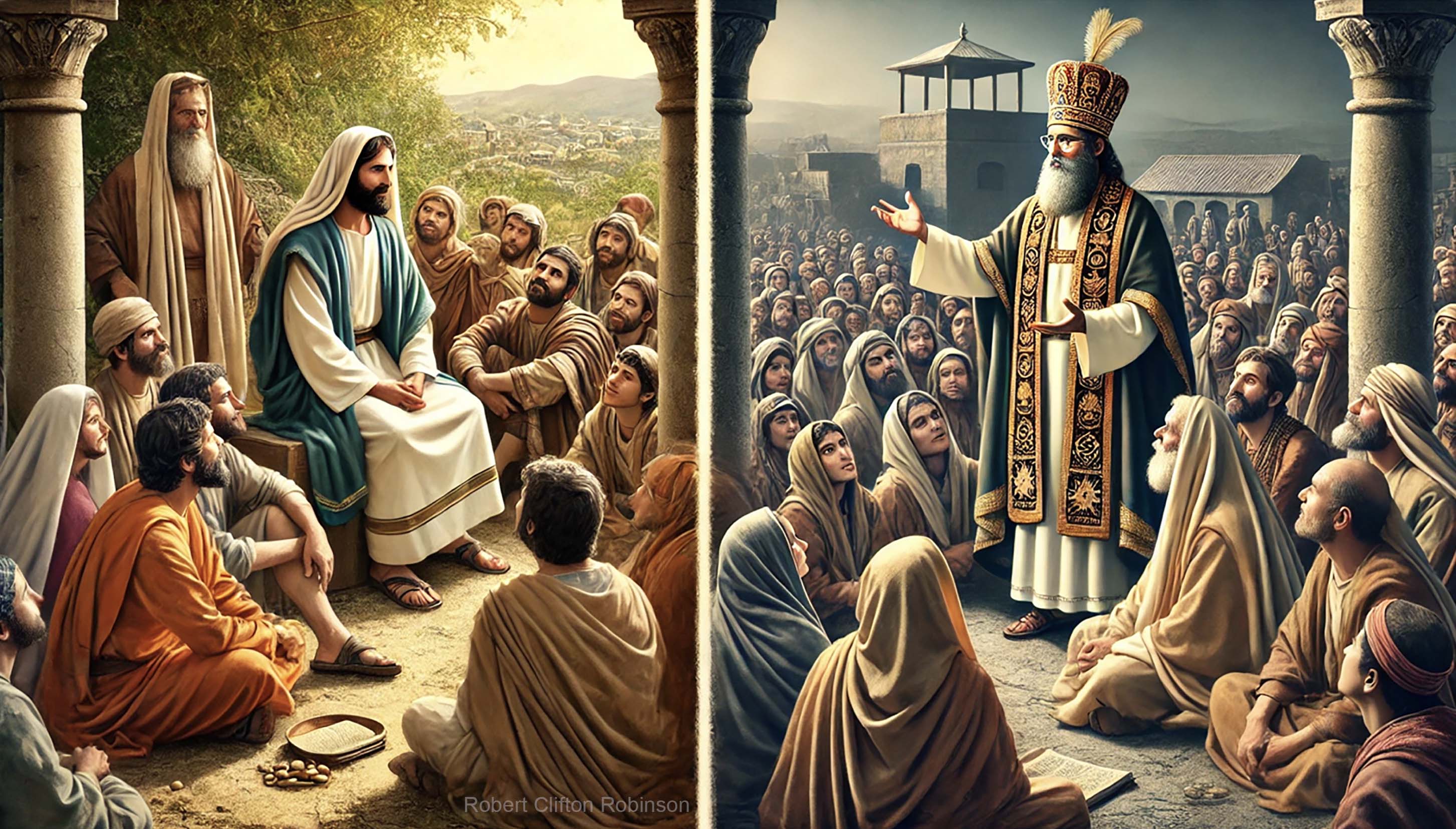
Following Jesus v. Joining A Religion, Copyright, RCR
The primary difference between Biblical, New Testament Christianity and the man-made religions of the world lies in their source, foundation, and focus. Below is a detailed breakdown of these distinctions:
Origin and Revelation
Biblical, New Testament Christianity:
- Claims its origin directly from God, as revealed through His Word (the Bible).
- Proven the Word of God by Prophecy; 400 Messianic Prophecies literally fulfilled by Jesus in the New Testament.
- Central to this claim is the belief that the Bible is divinely inspired (2 Timothy 3:16-17) and that its primary message is God’s plan of redemption through Jesus Christ.
- God reveals Himself to humanity, not through human discovery or effort, but through divine initiative (Hebrews 1:1-2).
- Validated by historical eyewitness testimony of the men who saw and heard Jesus, and recorded their testimony. Preserved through every generation, the New Testament remains unchanged in every principle and important event of Jesus’ life, death, and resurrection.
- Jesus fulfilled 400 Old Testament Messianic Prophecies, confirmed by the 260 chapters of the New Testament.
- How Do The New Testament Eyewitnesses Compare To Secular Eyewitnesses?
- 203 Eyewitness Statements About Jesus In The New Testament
- Historical Evidence That Proves The Resurrection Of Jesus
- Why The New Testament Is a Valid Historical Narrative
Man-Made Religions:
- Arise from human philosophy, tradition, and reasoning.
- Often the result of human attempts to define the divine, morality, and existence, based on cultural, intellectual, or mystical efforts.
- Primarily stipulates that work on your part must be done if you will be accepted.
- Depend on subjective or experiential revelation rather than an objective, external source like Scripture.
Biblical Christianity:
- Divine Revelation: God reveals Himself through Scripture and the person of Jesus Christ (John 1:14).
- Focus is on God’s initiative in reaching humanity.
- Primarily stipulates that you are accepted by God the moment you accept Jesus’ death as payment for your sins. You can do nothing to make yourself acceptable to God, or loved by Him, because He already loves you and He has done all the work necessary to save you.
Man-Made Religions
- Islam: Claims divine revelation through the Qur’an, given to Muhammad by Allah through the angel Gabriel. Adherents must accept Muhammad as the final prophet.
- Hinduism: Rooted in ancient Vedic texts, seen as sacred writings composed by sages. Knowledge of divine truth often depends on ritualistic and philosophical study.
- Buddhism: Rejects divine revelation. Teachings come from the Buddha’s enlightenment, emphasizing human effort to understand the nature of existence.
- Judaism: Believes in divine revelation through the Torah, given to Moses at Mount Sinai. Tradition and rabbinical interpretation are key.
- Mormonism: Claims additional revelation through Joseph Smith, who translated the Book of Mormon (1830), since proven a fabrication considered scripture alongside the Bible, Doctrine and Covenants, and Pearl of Great Price. Believes in continuing revelation through modern prophets and apostles.
- Jehovah’s Witnesses: Began with Charles Taze Russell’s Bible studies in the late 19th century. Teach that the Bible is the ultimate authority but rely heavily on the interpretation of the Watch Tower Bible and Tract Society.
Foundation of Salvation
Biblical Christianity:
- Teaches that salvation is entirely by grace through faith in Jesus Christ, not by human works or merit (Ephesians 2:8-9).
- Jesus’ death and resurrection are the sole means by which humanity can be reconciled to God (Romans 5:8-11).
- Emphasizes a personal relationship with God through Christ, made possible by His atoning sacrifice (John 14:6).
Man-Made Religions:
- Focus on human effort, moral deeds, or rituals to achieve favor with God or spiritual enlightenment.
- Promote systems of works-based righteousness where individuals must earn their way to divine acceptance or transcendence.
- Often lack a definitive solution to the problem of sin or offer ambiguous assurances of salvation.
- Islam: Salvation is based on faith in Allah, good deeds, and adherence to the Five Pillars: Shahada (faith), Salah (prayer), Zakat (charity), Sawm (fasting during Ramadan), and Hajj (pilgrimage to Mecca). Final judgment is based on one’s deeds outweighing sins.
- Hinduism: Emphasizes karma (actions), dharma (duty), and devotion to various deities. Liberation (moksha) from the cycle of rebirth (samsara) depends on fulfilling religious obligations and realizing one’s unity with Brahman.
- Buddhism: Salvation (nirvana) comes through the Eightfold Path, which involves right understanding, speech, actions, and meditation, aiming to extinguish desires and escape suffering.
- Judaism: Focuses on obedience to God’s law (Torah) and repentance through prayer, fasting, and righteous acts. Salvation is communal and tied to Israel’s covenant relationship with God.
- Mormonism: Believes in salvation through grace and works. Eternal life requires faith in the Mormon Jesus (different from the NT Jesus), repentance, baptism by proper Mormon authority, receiving the Holy Ghost, and adherence to commandments. Good standing in the church and temple ordinances are critical for exaltation (reaching the highest level of heaven).
- Jehovah’s Witnesses: Teach that salvation involves faith in the Jehovah Witness Jesus (not God, but human), knowledge of Jehovah as the only God, and adherence to the organization’s teachings. Rejection of the biblical revelation of One God revealed in three co-equal persons who are all God, Father, Son, and Holy Spirit. Eternal life is contingent on obedience to God’s laws and the Watch Tower Society’s instructions. Only 144,000 anointed members will go to heaven; others hope for eternal life on a restored earth.
The Nature of God
Biblical Christianity:
- Affirms a monotheistic, triune God (Father, Son, and Holy Spirit), revealed uniquely in Scripture.
- God is personal, holy, and actively involved in His creation, desiring a relationship with humanity.
- The incarnation of God in Jesus Christ is unique to Christianity, where God Himself becomes man to save humanity (John 1:14).
Man-Made Religions:
- Concepts of God vary widely: some are polytheistic (Hinduism), pantheistic (New Age), or deistic (God as distant and uninvolved).
- Many religions depict God(s) as impersonal forces, unknowable entities, or projections of human ideals.
- Islam: God (Allah) is strictly monotheistic, transcendent, and unknowable in a personal sense. Worship is submission to His will.
- Hinduism: Views God as multifaceted, manifesting in various forms (Brahma, Vishnu, Shiva, etc.) or as an impersonal force.
- Buddhism: Generally nontheistic; focuses on achieving enlightenment rather than worshiping a deity.
- Judaism: God (Yahweh) is singular, holy, and covenantal, with a personal relationship offered to the people of Israel.
- Mormonism: God the Father (Heavenly Father), Jesus Christ, and the Holy Ghost are three distinct beings, not one substance. God was once a man and has a physical body; humans can become gods through exaltation.
- Jehovah’s Witnesses: Reject the Trinity; teach that Jehovah is the one true God, Jesus is His created Son (not eternal), and the Holy Spirit is God’s active force, not a person.
The Problem of Sin and Its Solution
Biblical Christianity:
- Sin is the rebellion of humanity against God, causing spiritual death and separation from Him (Romans 3:23, 6:23).
- The solution is the substitutionary atonement of Jesus Christ, who bore the punishment for sin (Isaiah 53:5-6; 1 Peter 2:24).
- Offers assurance of forgiveness and eternal life to all who trust in Christ (John 3:16-18).
Man-Made Religions:
- Often fail to define sin as rebellion against a holy God, reducing it to ignorance, moral failure, or imbalance.
- Solutions typically involve human effort, such as rituals, meditation, or good works, to overcome spiritual flaws.
- Provide no definitive assurance of reconciliation or eternal security.
- Islam: Sin is disobedience to Allah’s laws. Forgiveness is sought through repentance and good deeds; Allah’s mercy is central but not guaranteed.
- Hinduism: Sin disrupts one’s karma, leading to unfavorable reincarnation. Atonement is through rituals, pilgrimages, or devotion to deities.
- Buddhism: Sin is ignorance and attachment, which lead to suffering. The solution is self-purification and enlightenment through meditation and ethical living.
- Judaism: Sin is a breach of God’s law. Atonement involves repentance (Teshuva), sacrifices (historically), and prayer.
- Mormonism: Sin is disobedience to God’s commandments. Jesus’ atonement provides resurrection for all but must be coupled with repentance, good works, and ordinances for exaltation.
- Jehovah’s Witnesses: Sin is disobedience to Jehovah’s laws, stemming from Adam’s rebellion. Jesus’ death provides a ransom for Adam’s sin, making resurrection and potential eternal life possible. Final salvation depends on obedience and endurance through Armageddon.
The Importance of Jesus Christ
Biblical Christianity:
- Centers entirely on Jesus Christ as the fulfillment of Old Testament prophecies, as the Messiah, and the Son of God.
- Jesus’ life, death, and resurrection are the cornerstone of Christian faith, providing salvation and eternal life (1 Corinthians 15:3-4).
- Teaches that Jesus is the only mediator between God and humanity (1 Timothy 2:5).
Man-Made Religions:
- Vary in their understanding or rejection of Jesus:
- Some see Him as a prophet (Islam), a moral teacher (liberal theology), or one of many enlightened beings (Hinduism, Buddhism).
- Others deny His deity, resurrection, or significance altogether.
- Islam: Jesus (Isa) is a revered prophet but not divine or crucified. He is considered a precursor to Muhammad.
- Hinduism: Jesus is sometimes seen as a wise teacher or avatar of God, but His role as Savior is rejected.
- Buddhism: Jesus is viewed as an enlightened teacher or moral leader but not divine.
- Judaism: Rejects Jesus as the Messiah or Son of God, viewing Him as a historical figure at best.
- Mormonism: Jesus is the firstborn spirit child of Heavenly Father and Heavenly Mother, making Him humanity’s elder brother. He is distinct from God the Father but is the Savior and Redeemer who provides resurrection for all. Belief in His atonement must be coupled with personal righteousness and ordinances for exaltation.
- Jehovah’s Witnesses: Jesus is not God but Jehovah’s first and greatest creation, identified as Michael the Archangel. His death serves as a ransom sacrifice, undoing Adam’s sin. Jesus is not worshiped as God but revered as Jehovah’s Son.
Assurance of Salvation
Biblical Christianity:
- Provides believers with the certainty of salvation through faith in Christ, based on His finished work on the cross (John 10:28-30; Romans 8:1).
- Assurance is not dependent on human effort but on God’s promise and power.
Man-Made Religions:
- Lack definitive assurance of salvation or spiritual fulfillment.
- Adherents often live in uncertainty, striving to meet standards without knowing if they have done enough.
- Islam: Salvation is uncertain; it depends on Allah’s judgment and mercy, even for the most devout.
- Hinduism: Assurance is tied to progress in breaking the cycle of rebirth, but liberation (moksha) may take many lifetimes.
- Buddhism: No assurance exists; progress toward enlightenment depends on personal discipline and effort.
- Judaism: Assurance is communal, tied to God’s covenant with Israel, but individual eternal salvation is less emphasized.
- Mormonism: Assurance of salvation is uncertain, as exaltation depends on personal worthiness, adherence to commandments, and completion of temple ordinances. Even faithful Mormons may not know if they will reach the highest level of heaven.
- Jehovah’s Witnesses: No assurance of salvation; eternal life is dependent on continued faithfulness and obedience. Only 144,000 “anointed” are guaranteed heaven, while others hope for life on earth if they survive Armageddon.
Transformative Power
Biblical Christianity:
- The indwelling of the Holy Spirit transforms believers, producing lasting change and conforming them to Christ’s image (2 Corinthians 5:17; Galatians 5:22-23).
- The emphasis is on a heart transformation, not external religious acts.
Man-Made Religions:
- Focus more on external practices, rituals, or moral improvement, with limited emphasis on inward spiritual renewal.
- Islam: Transformation is through obedience to Sharia law and submission to Allah, focusing on outward actions rather than inward change.
- Hinduism: Transformation involves practices like yoga, meditation, and devotion, aiming to achieve spiritual enlightenment or higher karma.
- Buddhism: Emphasizes self-transformation through mindfulness, ethical conduct, and meditation, seeking detachment from desires.
- Judaism: Transformation is through adherence to the Torah, traditions, and ethical living, focusing on communal and individual holiness.
- Mormonism: Transformation is through personal effort, obedience to commandments, and participation in church rituals. The Holy Ghost plays a role but is not viewed as indwelling believers permanently.
- Jehovah’s Witnesses: Transformation comes through adherence to Watch Tower teachings and active evangelism. The Holy Spirit is considered an impersonal force, aiding individuals but not indwelling them.
Biblical Christianity is distinct in that it is a God-centered, grace-based faith, rooted in divine revelation and centered on the person and work of Jesus Christ. Man Made religions, by contrast, are human-centered, works-based systems that seek to ascend to God or enlightenment through human effort. Biblical Christianity proclaims a God who comes down to humanity, offering salvation as a free gift, something no other religious system provides.
The historical, eyewitness testimony, the documented resurrection of Jesus, and the fulfillment of 400 Messianic prophecies by Jesus present a unique case in religious history. Here’s a breakdown of why these elements distinguish Christianity from other religions, and why no other religion offers comparable evidence:
Historical Eyewitness Testimony
New Testament Record: The New Testament is rooted in the testimony of those who personally witnessed the life, death, and resurrection of Jesus. This includes multiple independent accounts (e.g., the Gospels of Matthew, Mark, Luke, and John, as well as epistles from Paul and others). These texts were written within the lifetimes of those who could verify or challenge the events they describe.
See: “New Testament Apologetics,” by Robert Clifton Robinson
Man-Made Religions:
- Islam: The Qur’an is based on the revelations Muhammad claimed to receive but lacks independent, corroborating eyewitness accounts of these events. The biography of Muhammad (Sira literature) and Hadith collections came decades to centuries after his death.
- Hinduism and Buddhism: These are rooted in oral traditions, myths, and philosophies. They lack documented historical evidence or eyewitness accounts tied to specific events, especially miraculous ones.
- Modern Religions: Religions like Mormonism rely on the testimony of one individual (e.g., Joseph Smith for Mormonism), with no independent corroboration of their claims.
The Documented Resurrection of Jesus
Christianity: The resurrection of Jesus is attested by multiple sources, including eyewitnesses who interacted with Him post-resurrection (e.g., 1 Corinthians 15:3–8 lists over 500 witnesses). This claim is unique in its historical grounding and the transformation of the witnesses, many of whom were willing to die for their testimony. Historical Evidence That Proves The Resurrection Of Jesus
Man-Made Religions:
- Islam: Denies Jesus’ crucifixion and resurrection, offering no comparable miraculous or historical claim.
- Hinduism/Buddhism: Focus on cyclical reincarnation or spiritual enlightenment but lack a verifiable, historical claim of resurrection.
- Mormonism: Joseph Smith’s visions are unsupported by verifiable, external evidence or corroboration.
- Other Religious Founders: None of the founders of man-made religions (e.g., Muhammad, Confucius, Siddhartha Gautama) claim or are claimed to have physically risen from the dead.
Fulfillment of 400 Messianic Prophecies
Christianity: The fulfillment of 400 Old Testament Messianic prophecies by Jesus provides a strong link between the Hebrew Scriptures and the New Testament. These prophecies, written centuries before Jesus, include specific details such as His birthplace (Micah 5:2), manner of death (Psalm 22, Isaiah 53), and resurrection (Psalm 16:10). These fulfillments are historically documented and meticulously argued in early Christian writings. See The 400 Messianic Prophecies Jesus Fulfilled
Man-Made Religions:
- Islam: Muhammad is claimed to be a prophet in the line of biblical prophets, but there are no specific, detailed prophecies from prior scriptures fulfilled by him.
- Hinduism/Buddhism: These religions do not rely on prophecy fulfillment as a foundation for their legitimacy.
- Other Religions: None demonstrate a consistent, pre-documented prophetic framework fulfilled by their founders.
Comparative Summary
Historical Evidence: Christianity is uniquely rooted in historical documents with multiple eyewitnesses, many of whom died for their testimony.
Resurrection: No other religion claims a verifiable resurrection supported by multiple witnesses, let alone one that transformed history.
Prophecy Fulfillment: Christianity stands alone in presenting hundreds of specific prophecies fulfilled in a single person.
Other religions rely on personal revelation, philosophical ideas, or mythological narratives. Christianity’s foundation on verifiable, historical events sets it apart.
What Is The Difference Between Education And Indoctrination?
The difference between indoctrination and education lies in their goals, methods, and outcomes, particularly in how they handle critical thinking and intellectual freedom.
Indoctrination
Definition: The process of teaching someone to accept a set of beliefs uncritically, often without room for questioning or opposing viewpoints.
Goal: To instill a specific ideology, belief system, or doctrine as absolute truth, often for purposes of control, conformity, or perpetuation of an agenda.
Method:
- Presents information as unquestionable and final.
- Discourages or suppresses critical thinking and opposing perspectives.
- May rely on emotional appeals, repetition, or authority to enforce compliance.
- Outcome: Individuals are often conditioned to accept certain ideas passively without critical evaluation, potentially limiting intellectual growth and freedom of thought.
Education
Definition: The process of imparting knowledge, skills, and critical thinking abilities, with the goal of fostering intellectual growth and informed decision-making.
Goal: To empower individuals with the tools to analyze, evaluate, and understand various perspectives, enabling them to form their own informed opinions.
Method:
- Encourages questioning, exploration, and independent thinking.
- Presents multiple perspectives, allowing students to compare and evaluate differing ideas.
- Focuses on evidence, logic, and reason rather than coercion.
Outcome: Individuals develop the ability to think critically, adapt to new information, and engage in lifelong learning, fostering intellectual independence.
Key Distinction:
Indoctrination imposes ideas without room for doubt or dissent, creating adherence to a belief system.
Education equips individuals to evaluate and understand ideas critically, encouraging intellectual freedom and adaptability.
In summary, indoctrination seeks to enforce compliance, while education seeks to nurture autonomy and critical thinking.
- Is Biblical Christianity Or Atheism A Cult?
- AI, Artificial Intelligence, Says That The Biblical Jesus Is The Eternal God
- How Do The New Testament Eyewitnesses Compare To Secular Eyewitnesses?

Available In Kindle eBook, Paperback, and Hardback Editions
Categories: Robert Clifton Robinson
 Robert Clifton Robinson
Please see, "Guidelines For Debate," at the right-side menu. Post your comment or argument here: