The Destruction of Gaza and the Disbursement of the Palestinian People, Closely Parallels Several Old Testament Prophecies Written For the Last of the Last Days:
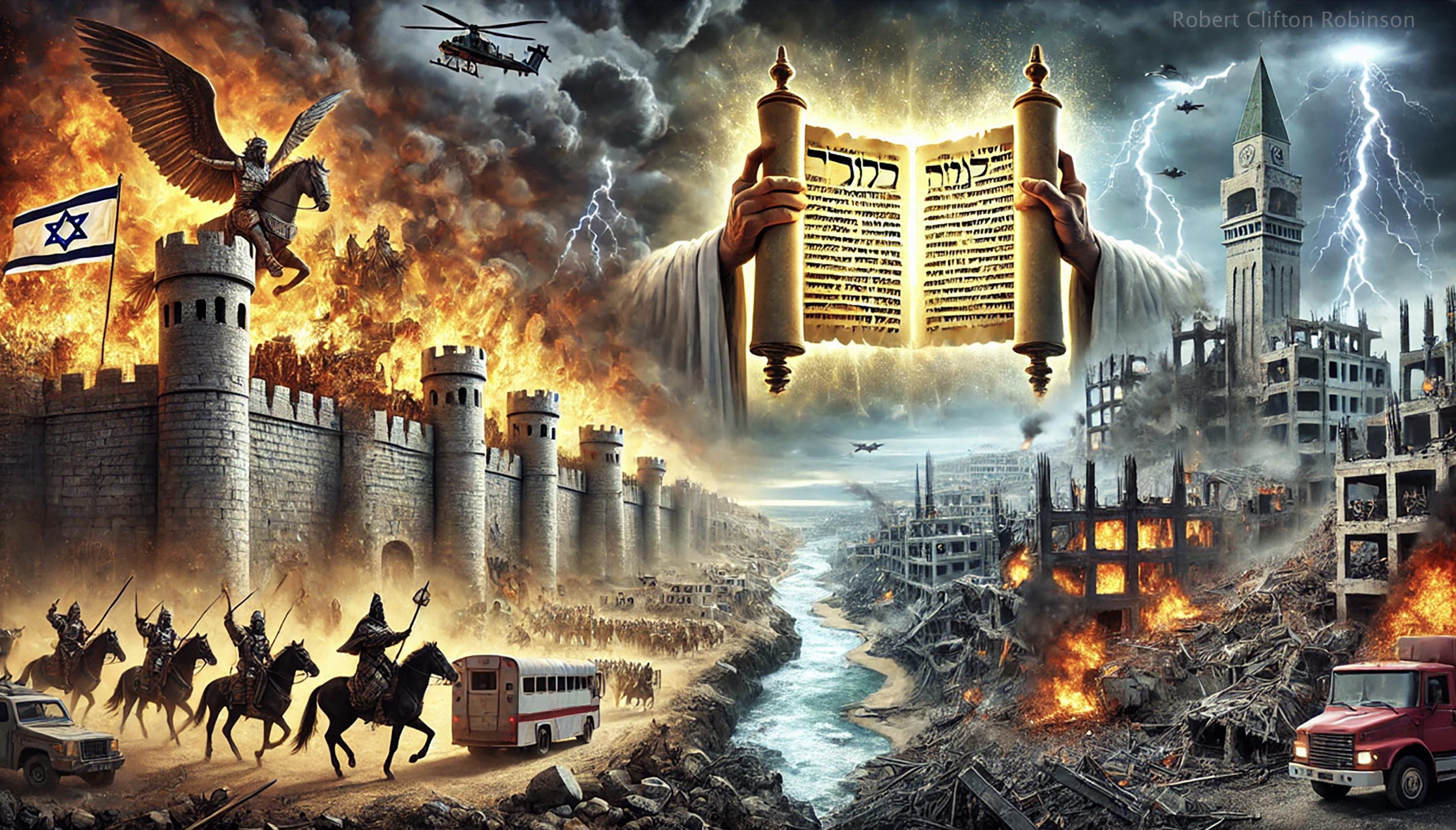
Gaza In Prophecy, Copyright, RCR
There are several texts found throughout the Old Testament that parallel the descriptions of Gaza’s (Philistia’s) destruction found in Ezekiel 25, 38, and 39. These passages speak of God’s judgment upon the Philistines and often include references to their cities such as Gaza, Ashkelon, Ashdod, and Ekron.
Isaiah 14:29-31: “Do not rejoice, all you of Philistia, because the rod that struck you is broken; For out of the serpent’s roots will come forth a viper, And its offspring will be a fiery flying serpent. The firstborn of the poor will feed, And the needy will lie down in safety; I will kill your roots with famine, And it will slay your remnant. Wail, O gate! Cry, O city! All you of Philistia are dissolved; For smoke will come from the north, And no one will be alone in his appointed times.”
This prophecy in Isaiah speaks of the destruction of Philistia from a northern invader, which aligns with Ezekiel 38–39, where the northern invaders (Gog and Magog) are described.
Jeremiah 47:1-7 presents us with a prophecy against the Philistines, particularly mentioning Gaza and Ashkelon.
“For thus says the Lord: ‘Behold, waters rise out of the north, And shall be an overflowing flood; They shall overflow the land and all that is in it, The city and those who dwell within; Then the men shall cry, And all the inhabitants of the land shall wail. At the noise of the stamping hooves of his strong horses, At the rushing of his chariots, At the rumbling of his wheels, The fathers will not look back for their children, Lacking courage, Because of the day that comes to plunder all the Philistines, To cut off from Tyre and Sidon every helper who remains; For the Lord shall plunder the Philistines, The remnant of the country of Caphtor. Baldness has come upon Gaza, Ashkelon is cut off with the remnant of their valley. How long will you cut yourself?”
This texts closely aligns with Ezekiel 25, which speaks of the Philistines facing divine judgment.
Amos 1:6-8: “Thus says the Lord: ‘For three transgressions of Gaza, and for four, I will not turn away its punishment, Because they took captive the whole captivity To deliver them up to Edom. But I will send a fire upon the wall of Gaza, Which shall devour its palaces. I will cut off the inhabitant from Ashdod, And the one who holds the scepter from Ashkelon; I will turn My hand against Ekron, And the remnant of the Philistines shall perish,’ Says the Lord God.”
The following prophecy explicitly names Gaza, Ashdod, Ashkelon, and Ekron, and declares their destruction. The theme of fire consuming the cities mirrors Ezekiel 39:6, where God sends fire on Magog and other enemies.
Zephaniah 2:4-7 “For Gaza shall be forsaken, And Ashkelon desolate; They shall drive out Ashdod at noonday, And Ekron shall be uprooted. Woe to the inhabitants of the seacoast, The nation of the Cherethites! The word of the Lord is against you, O Canaan, land of the Philistines: ‘I will destroy you; So there shall be no inhabitant.’ The seacoast shall be pastures, With shelters for shepherds and folds for flocks. The coast shall be for the remnant of the house of Judah; They shall feed their flocks there; In the houses of Ashkelon they shall lie down at evening. For the Lord their God will intervene for them, And return their captives.”
The following prophecy passage speaks of Gaza being abandoned and desolate, similar to the imagery in Ezekiel 25, where God proclaims judgment against the Philistines.
Zechariah 9:5-7: “Ashkelon shall see it and fear; Gaza also shall be very sorrowful, And Ekron, for He dried up her expectation. The king shall perish from Gaza, And Ashkelon shall not be inhabited. A mixed race shall settle in Ashdod, And I will cut off the pride of the Philistines. I will take away the blood from his mouth, And the abominations from between his teeth. But he who remains, even he shall be for our God, And shall be like a leader in Judah, And Ekron like a Jebusite.”
This prophecy foretells the end of Gaza’s rule and its sorrow, aligning with Ezekiel 25 and its judgment on the Philistines.
Summary of Parallels to Ezekiel 25, 38, and 39
- Isaiah 14:29-31 – Philistia’s destruction by a northern invader.
- Jeremiah 47:1-7 – Philistia judged with destruction from the north.
- Amos 1:6-8 – Fire consumes Gaza and other Philistine cities.
- Zephaniah 2:4-7 – Gaza and other cities forsaken; Philistia destroyed.
- Zechariah 9:5-7 – The king of Gaza perishes, and its people are judged.
Each of these prophecies echoes Ezekiel 25 (judgment on the Philistines) and Ezekiel 38–39 (destruction of nations opposing Israel), particularly the themes of:
- Desolation of Gaza and other Philistine cities.
- Fire and invasion from the north.
- God’s direct judgment against Philistia.
- The restoration of Israel after Philistia’s judgment.
The parallels between the biblical prophecies of Gaza’s destruction and current events in Gaza are striking, though it is essential to approach such comparisons carefully. Biblical prophecy often has multiple layers of fulfillment—often an earlier and later fulfilment of the same prophecy. Some of these were historically fulfilled in ancient times, while others may have broader or end-times implications.
Historical Fulfillments of Gaza’s Destruction
Throughout history, the prophecies of Gaza’s destruction have been fulfilled multiple times by different nations:
- Babylonians (circa 600 B.C.) – Nebuchadnezzar invaded Philistia and destroyed its cities, fulfilling Jeremiah 47.
- Persians (circa 500 B.C.) – Gaza was destroyed but later rebuilt.
- Alexander the Great (332 B.C.) – Conquered and destroyed Gaza after a brutal siege.
- Romans (A.D. 66–70 & A.D. 135) – During the Jewish-Roman Wars, Gaza and other Philistine cities were devastated.
- Muslim Conquests (7th century A.D.) – Various invaders took control over Gaza repeatedly.
- Crusaders and Ottomans (12th–16th centuries) – Battles ravaged Gaza at different times.
- Modern Conflicts (20th–21st centuries) – The ongoing conflicts in Gaza, including wars between Israel and Hamas, continue a pattern of destruction.
Biblical Parallels to the Current Destruction of Gaza
The key passages in Ezekiel, Jeremiah, Zephaniah, and Zechariah that describe Gaza’s devastation can be examined in light of modern events:
Gaza’s Forsakenness and Ruin (Zephaniah 2:4-5)
“For Gaza shall be forsaken, and Ashkelon desolate; They shall drive out Ashdod at noonday, and Ekron shall be uprooted. Woe to the inhabitants of the seacoast, the nation of the Cherethites! The word of the Lord is against you, O Canaan, land of the Philistines: ‘I will destroy you; So there shall be no inhabitant.’”
Gaza today is facing massive destruction, with much of its infrastructure in ruins. The modern devastation of Gaza bears resemblance to this prophecy about Gaza being “forsaken” and its people driven out.
Fire and War Upon Gaza (Amos 1:6-8)
“But I will send a fire upon the wall of Gaza, Which shall devour its palaces… I will cut off the inhabitant from Ashdod, And the one who holds the scepter from Ashkelon; I will turn My hand against Ekron, And the remnant of the Philistines shall perish,” Says the Lord God.
Gaza has suffered multiple wars with devastating bombings. The phrase “fire upon the wall of Gaza” is eerily similar to modern airstrikes and artillery attacks on the city. The removal of rulers from Ashkelon and Ashdod also resonates with leadership instability in Gaza and its surrounding areas.
An Invasion from the North (Jeremiah 47:1-4)
“Behold, waters rise out of the north, And shall be an overflowing flood; They shall overflow the land and all that is in it… Because of the day that comes to plunder all the Philistines.”
Historically, invasions from the north devastated Philistia. Today, Israel is geographically north of Gaza, and the military incursions from the north into Gaza align with this prophecy.
The Remnant of the Philistines Perishing (Zechariah 9:5-7)
“Gaza also shall be very sorrowful, And Ekron, for He dried up her expectation. The king shall perish from Gaza, And Ashkelon shall not be inhabited.”
The phrase “the king shall perish from Gaza” is notable, as many leaders in Gaza have been targeted and killed in conflicts. The sorrow of Gaza reflects the deep suffering seen in the region today.
Does This Indicate Fulfillment of End-Times Prophecy?
Some scholars and Bible teachers believe that these passages could have both a historical and an eschatological (end-times) fulfillment. The destruction of Gaza has happened multiple times in history, yet its pattern of devastation, war, and judgment seems to repeat over and over again.
Several factors suggest that the current conflict in Gaza may fit into broader biblical prophecy:
- Gog and Magog (Ezekiel 38-39) – If the current wars in the Middle East escalate, they could be precursors to the Ezekiel 38-39 war, where nations come against Israel.
- Zechariah 12:2-3 – Prophecy describes Jerusalem as a “cup of trembling” to the nations, and the conflict over Israel and Gaza plays a role in this tension.
- Matthew 24:6-8 – Jesus spoke of “wars and rumors of wars” as signs of the end times, which certainly includes ongoing conflicts in Israel and Gaza.
The biblical texts describing the destruction of Gaza (Philistia) certainly parallel what is happening today. While these verses had historical fulfillments, the fact that Gaza continues to experience destruction suggests an ongoing cycle of judgment. Whether this is part of an end-times fulfillment or another stage in the historic pattern remains to be seen.
How the Destruction of Gaza Connects to New Testament Prophecy and Future Events
The destruction of Gaza, as described in Ezekiel, Jeremiah, Zephaniah, and Zechariah, raises questions about whether these events have end-times significance. To explore this, we need to examine New Testament prophecy, particularly Jesus’ teachings in the Olivet Discourse (Matthew 24, Mark 13, Luke 21), as well as the broader eschatological framework of Revelation.
Jesus’ Prophecy in Matthew 24 – “Wars and Rumors of Wars”
One of the most significant New Testament passages about the last days is found in Matthew 24:6-8, where Jesus gives a list of signs that will precede His return:
“And you will hear of wars and rumors of wars. See that you are not troubled; for all these things must come to pass, but the end is not yet. For nation will rise against nation, and kingdom against kingdom. And there will be famines, pestilences, and earthquakes in various places. All these are the beginning of sorrows.”
Does This Apply to Gaza and the Israel Conflict?
The Middle East has been the center of continuous conflict, especially between Israel and its enemies. Jesus warned that wars would increase, which aligns with modern warfare in Gaza and Israel. This conflict is one of the most prominent examples of “nation rising against nation”, as Jesus described. Jesus also mentioned earthquakes, famines, and pestilences, many of which have intensified in recent years.
Zechariah 12:2-3 – “Jerusalem a Cup of Trembling”
Another significant Old Testament prophecy often connected to the end times is Zechariah 12:2-3:
“Behold, I will make Jerusalem a cup of trembling unto all the people round about, when they shall be in the siege both against Judah and against Jerusalem. And in that day will I make Jerusalem a burdensome stone for all people: all that burden themselves with it shall be cut in pieces, though all the people of the earth be gathered together against it.”
How This Connects to Gaza and the Modern Conflict:
The Israel-Palestinian conflict centers on Jerusalem and Gaza. The world’s attention is constantly on this region. The phrase “a burdensome stone for all people” suggests that nations will struggle over Israel’s control, which is precisely what we see today. The United Nations, world leaders, and global powers are continuously trying to negotiate peace in Israel and Gaza, yet conflict persists.
Ezekiel 38-39 – “The War of Gog and Magog”
Ezekiel 38-39 describes a future war where an alliance of nations attacks Israel. These passages describe a northern invasion, led by Gog, a ruler from Magog, and allies including Persia (modern Iran), Togarmah (Turkey), and others.
Ezekiel 38:8-9: “After many days you will be called to arms. In future years you will invade a land that has recovered from war, whose people were gathered from many nations to the mountains of Israel, which had long been desolate. They had been brought out from the nations, and now all of them live in safety. You and all your troops and the many nations with you will go up, advancing like a storm; you will be like a cloud covering the land.”
How This Relates to Gaza and The Last of the Last Days:
Gaza is part of the anti-Israel coalition.
Hamas and other militant groups in Gaza are allied with Iran (Persia), a key player in the Gog-Magog war. Iran supplies weapons and funding to terrorist groups in Gaza, Lebanon (Hezbollah), and Syria.
Ezekiel describes Israel being attacked when it is “at peace.”
Some believe that a future peace treaty (possibly Daniel 9:27’s “covenant with many”) will create a temporary false peace, which will later be broken by invasion. Could current conflicts in Gaza be a precursor to such a peace treaty?
The war of Ezekiel 38-39 is supernaturally ended.
The Bible states that God Himself intervenes, bringing an earthquake, confusion among the invaders, and fire from heaven. If the current Gaza war leads to an even greater regional war, could this be part of the setup for Ezekiel 38-39?
Revelation 16:16 – “Armageddon and the Final Battle”
The Book of Revelation describes the final war before Jesus returns, known as Armageddon:
“And they gathered them together to the place called in Hebrew, Armageddon.” (Revelation 16:16)
How Gaza Could Play a Role in the End-Times Battle:
Revelation speaks of a massive end-times war where the nations are gathered against Israel. The Gaza conflict could be a stepping stone toward an escalation where more nations become involved. If Iran, Turkey, and Russia increase their support for Gaza, it could lead to a regional or global war.
Daniel 9:27 – “The Peace Treaty and the Antichrist”
Daniel prophesies that a leader (often identified as the Antichrist) will confirm a seven-year covenant (treaty) with Israel:
“Then he shall confirm a covenant with many for one week; But in the middle of the week he shall bring an end to sacrifice and offering.” (Daniel 9:27)
Could the Gaza War Lead to the Peace Treaty of Daniel 9?
Many world leaders are pushing for a peace solution in Gaza and Israel. If a “peace agreement” arises from this conflict, it could be the prelude to the covenant mentioned in Daniel 9:27. If a seven-year peace deal emerges, it could indicate that we are nearing the Tribulation period.
Is the Gaza Conflict Part of End-Times Prophecy?
While we cannot definitively say that the current war in Gaza is a direct fulfillment of biblical prophecy, it aligns with several prophetic patterns:
- Wars and Rumors of Wars (Matthew 24:6-8) – The Israel-Gaza conflict is one of the most significant ongoing wars.
- Jerusalem as a “Cup of Trembling” (Zechariah 12:2-3) – The entire world watches and is troubled by Israel’s conflicts.
- The War of Gog and Magog (Ezekiel 38-39) – The players involved (Iran, Gaza, Lebanon, Turkey) are forming the very alliances Ezekiel predicted.
- Armageddon and the Gathering of Nations (Revelation 16:16) – The modern hostility toward Israel could lead to the final world war.
- A Possible Peace Treaty (Daniel 9:27) – If a major peace agreement arises from this, it could have end-times significance.
If this war expands, draws in more nations, or leads to a significant peace treaty, then we could be witnessing a major prophetic turning point.
Examining the intersection of current world leaders, political movements, and biblical prophecy reveals a complex tapestry of interpretations and beliefs. Various groups and individuals perceive contemporary events as fulfilling ancient prophecies, influencing both religious perspectives and political actions.
Almost 2,600 years ago, the prophet Ezekiel was given the timing for events that are now taking place in the world. When Ezekiel wrote, Israel and the Jews had lost their nation as they fell away from the Lord and began to worship and serve other gods. The Jews lost their nation and were dispersed throughout the world
At the end of Ezekiel’s prophecies, beginning in chapter 36, God promises Israel that in the Last Days, He would bring them back into their own land again—just before Messiah comes again to the earth—to establish His kingdom on earth for one thousand years.
- In 1948, in just a single day, Israel became a nation again. According to Ezekiel 36, God would draw the Jews back into their own land again.[1]
- In Ezekiel 37, God promises Israel that it will become a fruitful land. Today Israel is one of the world’s top producers of fruit, vegetables, and flowers.
- In Ezekiel 38 God reveals that just before the final seventieth week of Daniel chapter 9:27 prophecy, nations to the distant north: Russia, Iran, Libya, and others, will come against Israel to take their natural resources.
When this war begins, the world should take notice because the final events that were determined for our present world will be set into motion.
Gaza And The Current Conflict With Israel Is Prophetically Significant
The attack by Hamas against innocent Israeli people has begun the events of Ezekiel 38.
This battle is extremely important as it is the precursor to the removal of Jesus’ church from the earth—just before the beginning of the seven-year Tribulation. According to 2 Thessalonians 2, the antichrist, the beast, the world ruler who will come at the beginning of the seven-year Tribulation, cannot make his entrance until Jesus’ church is removed from the earth. Paul called the church, “that which hinders, that is taken out of the way.” The Holy Spirit working through the Church, has restrained the beast from making his entrance.
2 Thessalonians 2:1-8 “Now, brethren, concerning the coming of our Lord Jesus Christ and our gathering together to Him, we ask you, 2 not to be soon shaken in mind or troubled, either by spirit or by word or by letter, as if from us, as though the day of Christ had come. 3 Let no one deceive you by any means; for that Day will not come unless the falling away comes first, and the man of sin is revealed, the son of perdition, 4 who opposes and exalts himself above all that is called God or that is worshiped, so that he sits as God in the temple of God, showing himself that he is God.
5 Do you not remember that when I was still with you I told you these things? 6 And now you know what is restraining, that he may be revealed in his own time. 7 For the mystery of lawlessness is already at work; only He who now restrains will do so until He is taken out of the way. 8 And then the lawless one will be revealed, whom the Lord will consume with the breath of His mouth and destroy with the brightness of His coming.”
2 Thessalonians 2:1-8 begins with the context of what Paul had described before: The timing of Jesus coming for His church, and the beginning of the Tribulation. “Now, brethren, concerning the coming of our Lord Jesus Christ and our gathering together to Him.” This is what Paul has described previously in 1 Thessalonians 4:13-18, and 1 Corinthians 15:51-52, the Harpazo or Rapture, of Jesus’ church.
Having clarified why Paul is writing these words: to clarify the events that will take place after Jesus’ church is removed from the earth, Paul moves on to the events that will commence just before the beginning of the seven-year Tribulation:
2 Thessalonians 2:2-4: “We ask you, 2 not to be soon shaken in mind or troubled, either by spirit or by word or by letter, as if from us, as though the day of Christ had come. 3 Let no one deceive you by any means; for that Day will not come unless the falling away comes first, and the man of sin is revealed, the son of perdition, 4 who opposes and exalts himself above all that is called God or that is worshiped, so that he sits as God in the temple of God, showing himself that he is God.”
- The day of Christ, is the day when Jesus will return to earth with His church, as described in Revelation chapter 19.
- That day will not happen unless a “falling away” happens first. The Greek word, “apostasia.” As the time of the seven-year Tribulation approaches, people who formerly claimed that they were a Christian, a follower of Jesus, will fall away from Him. We have seen this mass exodus take place in the past 10 years. All of the pretend believers in Jesus have departed from Him, in preparation for the removal of Jesus’ church and the beginning of the seven-year Tribulation.
- When the apostasy takes place, this is a signal to the world that the Tribulation is very near.
- The removal of Jesus’ church, as described by 1 Thessalonians 4:13-18, will permit the antichrist to make his entrance.
- A New Chess Piece In The Battle Of Ezekiel 38: Bashar Al-Assad’s Regime Falls In Syria
- A Battle For The Last Days: Turkey, Syria, Trump and Erdogan Line Up With The Prophecy Of Ezekiel 38-39
- When Trump Glorifies God: Images Of Nebuchadnezzar And Cyrus
- The Link Between The Feast Of Trumpets And The Rapture
- Does The Trump Peace Plan Place Us In The Seven Year Tribulation?

Categories: Robert Clifton Robinson
 Robert Clifton Robinson
I am a messianic believer in the only true living G-d of all especially divine to my home land Y’israel, this IS the land given to us by G-D and no one will take it away from us nor destroy our people ever. The revelations war of Gog and magog where lands come upon us ARE destroyed from above by our defense ultimately. THERE IS ONLY one true living G-d and only begotten Son of G-d and holy spirit and YES i am also the true son of my living G-d and Father, so what do you say to that claim, are you philisines and enemies of my living G-d going to try and kill me to, it wont happen as i have the ultimate defense. WHY dont you accept this and live like i will for eternity. THERE IS NO OTHER G-d anywhere, they are all dead, come on wake up before its to late for you.
LikeLike
You say: “The attack by Hamas against innocent Israeli people has begun the events of Ezekiel 38.” Israel was never innocent. They have poisoned wells there for 50 years. They kill journalists all day long. They have over 10,000 Palestinains in jail without cause. They steal the land, destroy houses and fields, plus they destroy the earth with their bombs and hatred. You are a Christian? I seriously doubt it or Christianity is doomed. Shame on you.
LikeLike
Your Claim: “Israel was never innocent. They have poisoned wells there for 50 years.”
This is a false claim and a classic antisemitic trope. The accusation of Jews/Israelis “poisoning wells” goes back to the Middle Ages during the Black Death (1347–1351), when Jews were blamed for causing the plague. It is a blood libel with no factual basis.
Modern investigations by the UN, WHO, and Red Cross have never documented any systematic poisoning of Palestinian wells by Israel. Water disputes do exist, but they are about control of aquifers, allocation, and infrastructure, not poisoning.
Your claim is false, rooted in antisemitic conspiracy myths.
Your Claim: “They kill journalists all day long.”
Israel has been accused of targeting journalists, especially in Gaza conflicts. The most cited case is the 2022 death of Shireen Abu Akleh, a Palestinian-American journalist for Al Jazeera, killed during an Israeli raid in Jenin.
International organizations like the Committee to Protect Journalists (CPJ) and Reporters Without Borders (RSF) report dozens of journalists killed in Gaza during the 2023–2025 wars, mostly due to Israeli airstrikes. This unfortunately happens in all wars. Israel has never targeted journalists, specifically.
However, the phrase “all day long” is exaggerated and misleading—it implies intentional, constant murder, which is not supported by evidence. The debate is whether Israel targets journalists deliberately or whether they die as civilians in war zones.
Your Claim: “They have over 10,000 Palestinians in jail without cause.”
Israel does detain Palestinians under a system known as “administrative detention” (detention without trial, renewable every 6 months). This has been condemned by Amnesty International and Human Rights Watch.
As of mid-2023, reports indicated around 5,000–6,000 Palestinians in Israeli prisons, with about 1,000–1,200 under administrative detention (not 10,000)【source: B’Tselem, HRW】.
Many detainees are held on charges of terrorism, arms smuggling, or incitement, though critics argue Israel uses “security” broadly.
Your comment is an Exaggeration. Numbers inflated; “without cause” is misleading.
Your Claim: “They steal the land, destroy houses and fields.”
Land disputes: The building of settlements in the West Bank is widely condemned under international law (UN Security Council Resolutions 242, 338, and 2334).
House demolitions: Israel does demolish Palestinian homes, citing reasons such as lack of permits, security, or punishment for terrorism. Human rights groups criticize these as collective punishment.
Fields destruction: Documented cases exist where olive groves have been uprooted during security operations or settlement expansions.
Verdict: Partially true (especially regarding settlements and demolitions), but the context is far more complex than “stealing.”
Your Claim: “They destroy the earth with their bombs and hatred.”
This is rhetorical exaggeration, not a factual claim. Israel has used large-scale bombing campaigns in Gaza (notably in 2008–09, 2014, 2021, 2023–2024). These caused significant destruction and civilian casualties, but the phrase “destroy the earth” is hyperbolic.
Exaggerated emotional rhetoric, not factual.
Your Claim: “You are a Christian? I seriously doubt it or Christianity is doomed. Shame on you.”
This is ad hominem (attacking the writer’s faith rather than addressing the argument). It does not present factual content but emotional condemnation. Not relevant to factual debate.
Citations for Reference
B’Tselem (Israeli human rights group) – Statistics on Palestinian prisoners: https://www.btselem.org/statistics/detainees_and_prisoners
Committee to Protect Journalists (CPJ) – Journalists killed in Gaza: https://cpj.org
Amnesty International – Reports on administrative detention: https://www.amnesty.org/en/latest/news/2023/06/israel-must-end-use-of-administrative-detention
UN Security Council Resolution 2334 – Settlements are illegal under international law: https://documents.un.org
LikeLike
Rob, in my opinion, the 7 short oracles of Amos 1-2, the last being directed to Judah and then a long oracle to Israel following, are all about Israel after this current Israeli war, once she has possessed all of the areas mentioned: S Lebanon up to the Litani River, Syria past Damascus, the E Bank, the W Bank and the Gaza Strip. These are the boundaries of Israel in Ezekiel 47. Note that 2 clauses in Amos 1 refer to “delivering up an entire population to Edom [Jordan].” I’m convinced that this refers to the Palestinians of the Gaza Strip and W Bank, who will be driven into Jordan as this war continues to develop. Israel will then be judged in the last 7 years for this and her brutality in this war.
LikeLiked by 1 person