Ezekiel’s War of chapters 38 is an apocalyptic, large-scale military invasion against Israel, prophesied to occur in the “last days.” Many scholars, including those who focus on biblical prophecy and geo-political analysis, consider it distinct from the final battle at Armageddon, though some blend the two. Below is a detailed, documented analysis and a plausible modern scenario, with the nations mentioned, their modern counterparts, and how current events may align with Ezekiel’s prophecy.
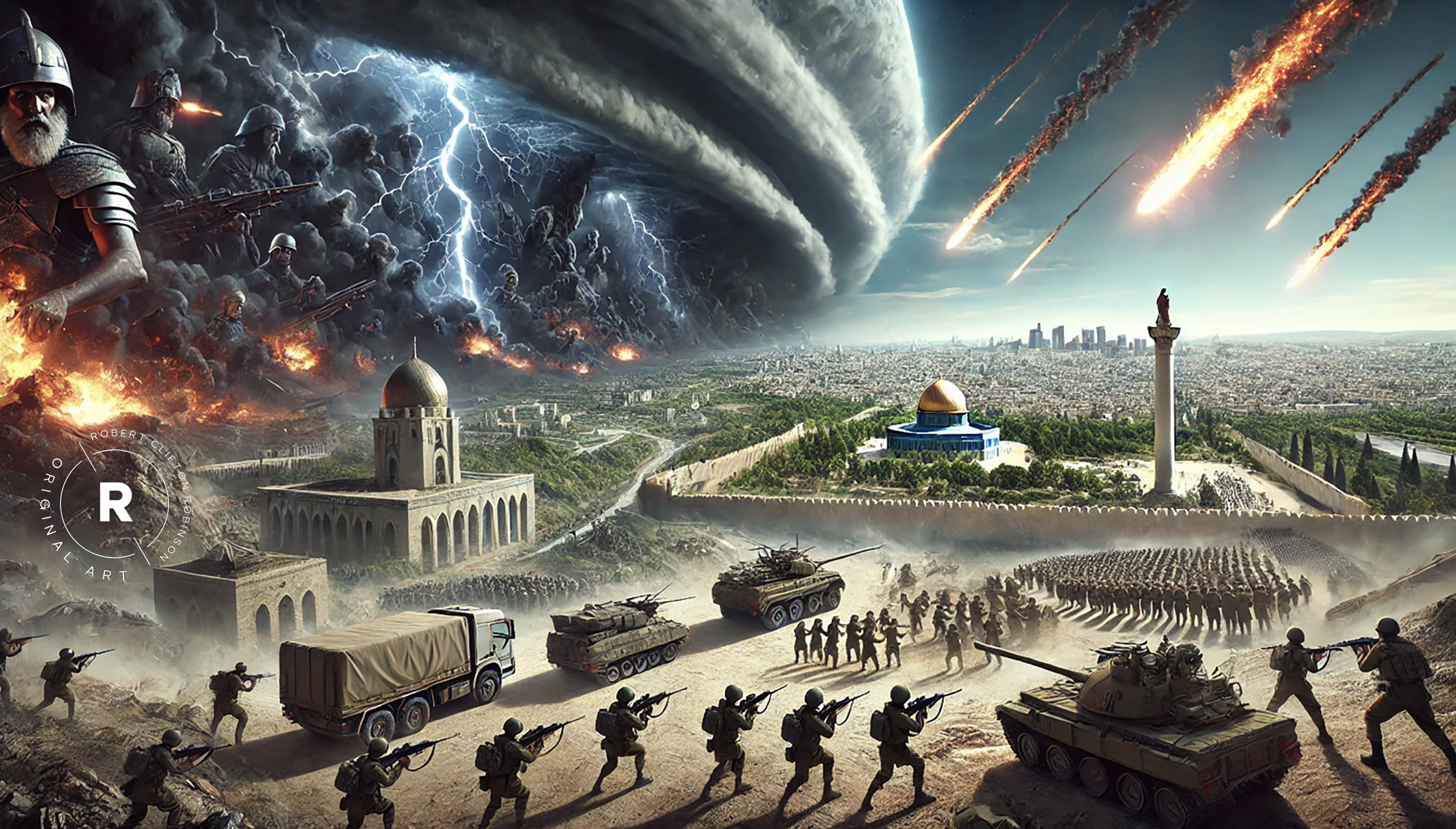
Ezekiel 38, Israel Under Attack, Copyright RCR
The Coming War of Ezekiel 38: A Prophetic Conflict on the Horizon
In the ancient words of the prophet Ezekiel resides a vision so vivid and foreboding that it seems to leap from the pages of Scripture into the headlines of modern news. Ezekiel described a day, future for his time, when a vast and ruthless military coalition would descend upon the land of Israel. This would not be a skirmish or a localized war, but a sweeping invasion involving nations from the far reaches of the earth. They would come like a storm, covering the land, motivated by greed, hatred, and a determination to erase Israel from existence. And yet, in the darkest hour, the power of God will intervene in a manner so unmistakable that the entire world will know that the God of the Bible is the Lord.
It is a scene described in Ezekiel chapters 38 and 39—a prophetic war commonly referred to as the Battle of Ezekiel 38. While the precise timing of this battle is uncertain, the likely time will be just prior or just after, the Return of Jesus for His church.
A Land Restored and Secure
Ezekiel’s prophecy presumes a time when the Jewish people have returned to their ancestral land after a long period of exile. They will be gathered from the nations and living once again in a place they now call their own. For nearly two millennia, this seemed an impossibility. Yet in 1948, after centuries of dispersion, the modern State of Israel was reborn. Jews from the four corners of the earth streamed back to their homeland, just as the prophets foretold. Against all odds, Israel not only survived the onslaught of neighboring enemies but emerged as a regional powerhouse—militarily formidable, economically prosperous, and diplomatically connected.
“After many days you will be summoned; in the latter years you will come into the land that has been restored from the sword, whose inhabitants have been gathered from many nations to the mountains of Israel which had been a continual waste; but its people were brought out from the nations, and they are living securely, all of them.” — Ezekiel 38:8
Ezekiel portrays Israel as living securely, dwelling in what he describes as “unwalled villages.”
“…and you will say, ‘I will go up against the land of unwalled villages. I will go against those who are at rest, who live securely, all of them living without walls and having no bars or gates.’” — Ezekiel 38:11
Though not entirely at peace, Israel’s confidence in its military defenses and international alliances gives it a sense of security. Moreover, the discovery of vast natural gas reserves in the Mediterranean has transformed Israel into an energy supplier—a significant geopolitical factor in the region. This wealth may serve as one of the “hooks” that draws hostile nations into war against Israel.
“I will turn you around, put hooks in your jaws, and bring you out with all your army…” — Ezekiel 38:4
Many of us who study these events have long debated whether this security refers to a time of genuine peace or simply a sense of confidence in Israel’s military capability. Today, Israel stands in just such a position. Despite facing continuous threats from Hamas, Hezbollah, and Iran’s proxies, Israel has established a relative peace within its borders. Its Iron Dome and Arrow defense systems provide a formidable shield, and its alliances with the United States and emerging partnerships with Arab nations have created a buffer of security unlike any time in its modern history.
Moreover, Israel’s discovery of vast natural gas reserves beneath the Mediterranean Sea—specifically in the Leviathan and Tamar gas fields—has transformed it into an energy supplier, threatening the monopolies of traditional energy giants like Russia and fostering envy among regional adversaries. This newfound wealth may be one of the “hooks in the jaw” that God speaks of, drawing hostile nations toward war against Israel.
The Gathering Storm: A Coalition of Nations
Ezekiel names the key players in this invasion with ancient designations, but scholars and historians have traced these names to their modern counterparts. Heading the coalition is Gog, described as the chief prince of Meshech and Tubal, ruling over the land of Magog. Most scholars agree that this points to a leader arising from modern-day Russia, a nation that lies geographically to the uttermost north of Israel, precisely as the prophecy indicates.
Today’s Russia, under the leadership of Vladimir Putin has reclaimed its role as a global power, asserting military strength and political influence across Europe and the Middle East. Russia’s strategic foothold in Syria places it directly north of Israel, with military bases and alliances that allow it to project power into the region at a moment’s notice.
But Russia does not come alone. With it are ancient Persia, which is unmistakably modern Iran, and a host of other nations: Cush, commonly understood as Sudan or Ethiopia; Put, representing Libya and parts of North Africa; Gomer and Beth Togarmah, regions encompassing modern Turkey and possibly extending into Eastern Europe and the Caucasus.
 What unites these nations is not merely geographic proximity, but an alignment of economic, religious, and military interests. Iran’s stated objective is the destruction of Israel. Its pursuit of nuclear weapons and its arming of Hezbollah and Hamas are modern expressions of this ancient enmity. Turkey, under President Erdoğan, has veered away from its secular NATO past toward an Islamist nationalism, often marked by anti-Israel rhetoric and a longing to restore Ottoman-era dominance. Libya and Sudan, though presently unstable, remain susceptible to radical ideologies and alliances that position them as enemies of Israel.
It is not difficult to imagine such an alliance coming together under the leadership of a resurgent Russia. Already, we see Russia, Iran, and Turkey cooperating in military and economic ventures, from energy pipelines to shared military operations in Syria. In this tangled web of alliances, the ancient prophecy of Ezekiel takes on chilling clarity.
The Invasion: A March Toward Israel
The coalition’s advance will be swift and massive. Ezekiel describes it as “a storm,” covering the land like a dark cloud. The invasion force is so large that Israel’s sophisticated defense systems—while formidable—are unable to repel it. The world watches, perhaps paralyzed by other global crises or unwilling to intervene. The nations traditionally friendly toward Israel—such as the United States and European allies—are either absent from the scene or offer nothing more than rhetorical protests.
Indeed, Ezekiel mentions a curious group of nations—Sheba, Dedan, and the “merchants of Tarshish”—who voice mild objections but do nothing to stop the invasion. Some scholars equate these regions with parts of the Arabian Peninsula and Western powers such as the United States, Britain and its historical colonies, but their protest is hollow. Israel stands alone.
And then, at the point where Israel’s annihilation seems certain, the God of Israel arrives in force and changes everything.
The Prophetic Response: God’s Fury Unleashed
Unlike any previous war in Israel’s modern history, this battle is not won by Israeli tanks, planes, or missiles. It is God Himself who steps into human history to defend His people. The language Ezekiel uses is dramatic and unmistakable. A massive earthquake shakes the land of Israel, so powerful that even the fish in the sea and the birds of the air are affected. Mountains crumble, walls fall to the ground.
As confusion spreads among the invading armies, they turn their weapons on one another. Chaos reigns. Ezekiel describes pestilence and bloodshed, torrential rain, hailstones, and burning sulfur raining down upon the enemies of Israel. Whether these events are wholly supernatural or involve natural disasters amplified by divine timing, the effect is devastating. The armies of Gog and his allies are annihilated on the mountains of Israel.
The slaughter is so great that it takes seven months to bury the dead. Special teams are appointed to mark and bury the bodies, a detail that some scholars believe could point to radioactive contamination or the handling of biohazards, though the text does not specify the reason for this prolonged burial process.
For seven years, Israel uses the weapons of its enemies for fuel, a curious statement that may refer to the conversion of modern military technology into usable energy, though interpretations vary.
What Comes After: Israel’s Awakening and the World’s Reckoning
In the aftermath of this divine deliverance, Israel will know beyond all doubt that their survival was not due to military prowess but the hand of God. Ezekiel records God’s own words: “So the house of Israel shall know that I am the Lord their God from that day forward” (Ezekiel 39:22).
Yet the impact of this event will not be limited to Israel. The nations of the world will witness this act of divine intervention and will be forced to reckon with the reality of God’s sovereignty. Some will fear; others will harden their hearts. But the stage will be set for the next series of prophetic events.
Many scholars believe that in the vacuum left by the destruction of the early Ezekiel 38, Gog-Magog coalition, a new world leader—the Antichrist—will rise to prominence. He will offer Israel a covenant of peace, a treaty that begins the seven-year Tribulation foretold in Daniel 9 and Revelation 6. This false peace will eventually lead to the final conflict of Armageddon and the ultimate return of Jesus Christ.
Are We On the Precipice?
The alignment of nations described by Ezekiel is already in place. Russia, Iran, and Turkey have formed an alliance of convenience that matches the biblical description. Libya and Sudan, though currently fragmented, are hotbeds of instability and radicalization. Israel stands as a prosperous, secure nation, yet increasingly isolated as global antisemitism rises and traditional allies falter.
The threats are real. Iran’s nuclear ambitions, Russia’s aggressive foreign policy, and Turkey’s regional aspirations all point toward a future confrontation. Israel’s wealth, particularly its energy resources, may soon become the spoil that draws these nations into war.
Though the exact timing of the Ezekiel 38 invasion is debated—whether before, during, or after the Tribulation—there is a growing consensus among prophecy scholars that the world is hurtling toward the moment Ezekiel saw over two thousand years ago.
Heading the coalition is Gog, of the land of Magog, prince of Rosh, Meshech, and Tubal—regions commonly identified with Russia and parts of Turkey. The prophecy describes Gog as the orchestrator of a vast alliance:
“Son of man, set your face toward Gog of the land of Magog, the chief prince of Meshech and Tubal, and prophesy against him.” — Ezekiel 38:2 (ESV)
Gog’s allies are listed with ancient names, but historical analysis has matched them to modern nations:
- Persia (modern Iran)
- Cush (modern Sudan/Ethiopia)
- Put (modern Libya/North Africa)
- Gomer and Beth Togarmah (regions in modern Turkey and possibly parts of Eastern Europe).
“Persia, Cush, and Put will be with them, all with shields and helmets; also Gomer with all its troops, and Beth Togarmah from the far north with all its troops—the many nations with you.” — Ezekiel 38:5-6
Today, this alignment is more than plausible—it is already taking shape. Russia’s military presence in Syria, its partnership with Iran, and Turkey’s geopolitical pivot from NATO ally to Islamist power all mirror Ezekiel’s description. Iran’s aggressive posture toward Israel, combined with its nuclear ambitions and proxy militias in Lebanon and Gaza, fulfills the ancient enmity implied in Persia’s involvement. Libya and Sudan remain in varying states of instability but are increasingly influenced by radical ideologies that oppose Israel.
The prophecy predicts a time when this confederation of nations will move against Israel. They come not as peacekeepers, but as invaders seeking plunder:
“You will say, ‘I will go up against the land of unwalled villages… to capture spoil and to seize plunder, to turn your hand against the waste places which are now inhabited, and against the people who are gathered from the nations… who have acquired cattle and goods, who live at the center of the world.’” — Ezekiel 38:11-12
Israel’s wealth, particularly its energy resources, may be the trigger. The invaders advance from the north, descending through Syria and Lebanon, and encircle Israel.
It is interesting that a group of nations—Sheba, Dedan, and the merchants of Tarshish—stand by and offer only verbal protest:
“Sheba and Dedan and the merchants of Tarshish with all its villages will say to you, ‘Have you come to capture spoil? Have you assembled your company to seize plunder?’” — Ezekiel 38:13
Some scholars interpret Sheba and Dedan as referring to modern Saudi Arabia and Gulf states, while Tarshish could represent Western nations, historically associated with maritime powers such as Britain. Their protests are feeble and ineffective.
Israel stands alone.
- A New Chess Piece In The Battle Of Ezekiel 38: Bashar Al-Assads Regime Falls In Syria
- A Battle For The Last Days: Turkey, Syria, Trump and Erdogan Line Up With The Prophecy Of Ezekiel 38-39
- Zechariah 9 Describes Syria, Damascus, And The Missile Defense System “Davids Sling; 2,600 Years Ago
- Timeline For The Last Days: Everything Is Centered On Israel And The Jews
The Lord’s Response: His Fury Poured Out
At the present time when Israel seems poised for destruction, God acts decisively. Ezekiel describes a divine intervention that is both terrifying and unmistakable:
“My wrath will mount up in My anger. In My zeal and blazing wrath I declare that on that day there will surely be a great earthquake in the land of Israel.” — Ezekiel 38:18-19
The earthquake shakes the entire region. Mountains collapse, cliffs crumble, and every living creature is affected. Panic grips the armies of Gog, and they turn their weapons on one another:
“I will call for a sword against him on all My mountains,’ declares the Lord God. ‘Every man’s sword will be against his brother.’” — Ezekiel 38:21
Plague, bloodshed, torrential rains, hailstones, and burning sulfur rain down upon them:
“I will execute judgment on him with plague and bloodshed; I will pour down torrents of rain, hailstones and burning sulfur on him and on his troops and on the many nations with him.” — Ezekiel 38:22
The result is catastrophic. Gog’s coalition is annihilated on the mountains of Israel. The carnage is so vast that it takes Israel seven months to bury the dead:
“For seven months the house of Israel will be burying them in order to cleanse the land.” — Ezekiel 39:12
And for seven years, they will burn the weapons of war as fuel:
“They will use them to make fires for seven years.” — Ezekiel 39:9
What Happens After: Israel’s Awakening and the World’s Reckoning
Following this unprecedented deliverance, Israel will recognize God’s hand in their salvation:
“From that day forward the house of Israel will know that I am the Lord their God. — Ezekiel 39:22
The nations, too, will understand that God’s power has been revealed:
“I will make My holy name known in the midst of My people Israel… and the nations will know that I am the Lord, the Holy One in Israel.” — Ezekiel 39:7
Many who study these events believe this victory paves the way for the rise of the Antichrist, who will offer Israel a false peace. This covenant, described in Daniel 9:27, initiates the seven-year Tribulation period, ultimately leading to the final battle of Armageddon (Revelation 16:16) and the Second Coming of Christ (Zechariah 14:1-4).
Is The Stage Set For These Prophetic Events?
The current geopolitical landscape is an uncanny reflection of Ezekiel’s prophecy:
- Russia, Iran, and Turkey have formed an alliance.
- Israel is prosperous, secure, and increasingly isolated.
- The United States and Western allies show signs of retreat from global leadership.
- China, though not explicitly mentioned in Ezekiel 38, plays a rising role in Revelation 16:12, as the “kings of the east.”
It appears that everything the prophecies of the Last Days predict, could happen at any time.
Ezekiel’s vision of the Gog-Magog war is not merely ancient history—it is a prophetic warning of events yet to come. In the midst of global uncertainty, wars, and rumors of wars (Matthew 24:6), the convergence of biblical prophecy with modern geopolitics should compel careful attention.
The God of Israel remains sovereign. He will not allow His people to be destroyed, nor His promises to fail. The day is coming when all the world will know that He is the Lord.
“I will magnify Myself, sanctify Myself, and make Myself known in the sight of many nations; and they will know that I am the Lord.” — Ezekiel 38:23 (NASB)
The convergence of current geopolitical events involving leaders like Russian President Vladimir Putin, Chinese President Xi Jinping, Iranian authorities, U.S. President Donald Trump, and the escalating conflicts involving Israel, Hamas, Hezbollah, and neighboring nations, presents a complex tapestry that some analysts view through the lens of biblical prophecy, particularly Ezekiel 38-39.
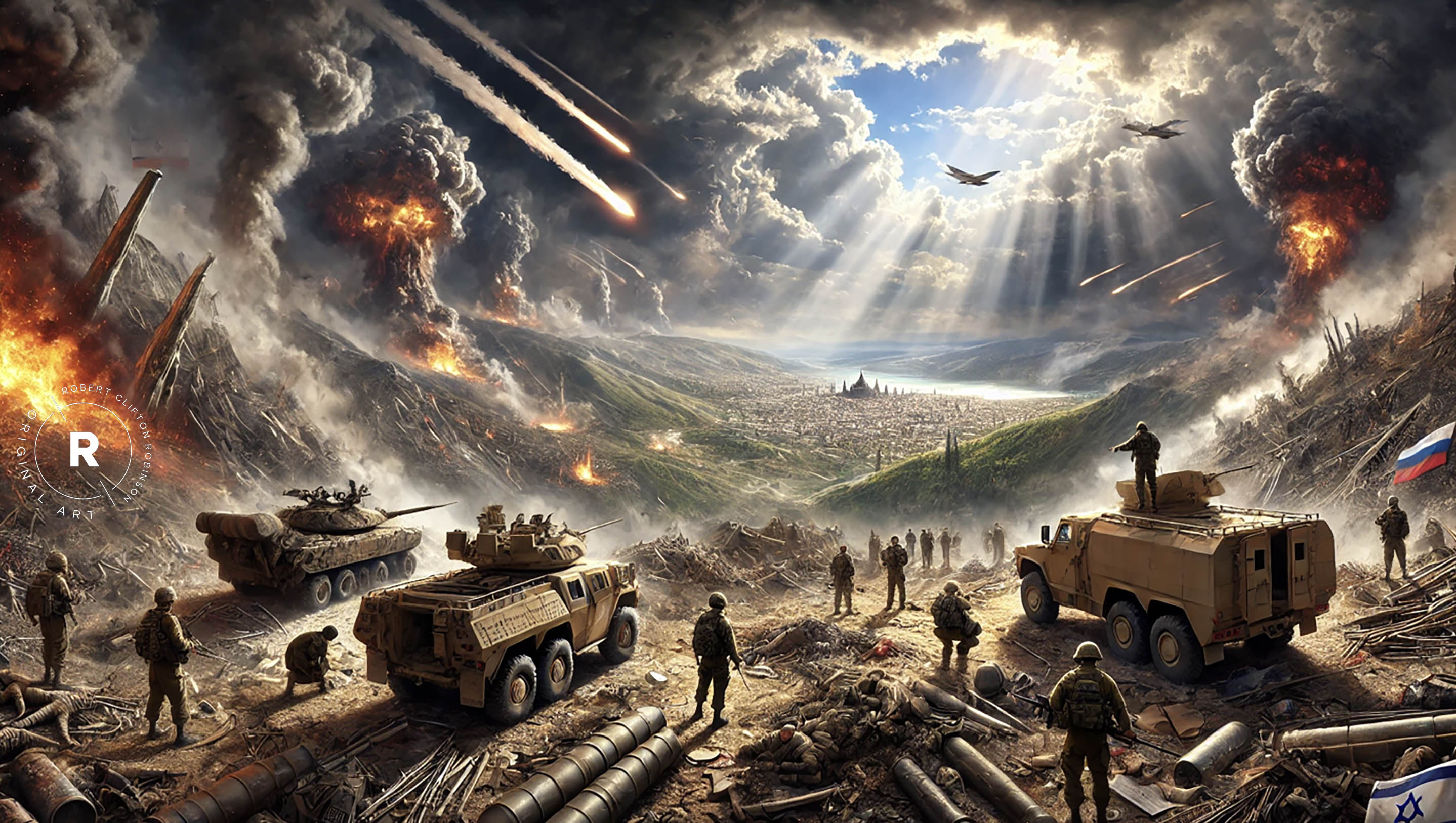
Ezekiel 38, Israel Defended By God, Copyright, RCR
Russia’s Strategic Maneuvers
Under President Putin, Russia has reasserted itself as a formidable global power, extending its influence into the Middle East. Notably, Russia has conducted joint naval drills with Iran and China in the region, signaling a strengthening alliance among these nations. This trilateral cooperation aligns with the coalition described in Ezekiel 38, where a leader from the “far north” (interpreted by some as Russia) allies with Persia (modern-day Iran) and other nations to invade Israel.
Iran’s Regional Ambitions
Iran continues to support proxy groups like Hezbollah in Lebanon and the Houthis in Yemen, aiming to expand its influence and encircle Israel. Recent escalations include Israeli airstrikes targeting Iranian-backed forces in Syria, reflecting the ongoing shadow war between Israel and Iran. Iran’s involvement with these proxies resonates with the alliances depicted in Ezekiel’s prophecy.
China’s Expanding Influence
China’s growing presence in the Middle East, marked by economic investments and military collaborations, adds another layer to the geopolitical landscape. While China is not explicitly mentioned in Ezekiel 38, its alliance with Russia and Iran could indirectly influence the dynamics of the prophesied coalition.
U.S. Policy Shifts
Under President Trump’s administration, the U.S. has taken a more aggressive stance against Iranian proxies, exemplified by recent airstrikes targeting Houthi militants in Yemen. This shift underscores a broader strategy to counter Iran’s influence in the region, aligning with the prophetic narrative of nations opposing the coalition led by Gog.
Israeli-Palestinian Tensions
The recent resurgence of violence between Israel and Hamas has led to significant casualties and international concern. Israeli Prime Minister Netanyahu’s declaration that the airstrikes are “just the beginning” indicates a potential for prolonged conflict. These hostilities contribute to the instability that could precipitate the events described in Ezekiel 38.
Regional Alignments
The involvement of neighboring countries like Jordan in mediating the conflict, alongside the broader Arab world’s reactions, reflects the complex alliances and enmities in the region. These dynamics could set the stage for the coalition of nations prophesied to come against Israel.
What’s Next?
While current events exhibit parallels to the alliances and conflicts described in Ezekiel 38-39, interpretations vary, and the exact fulfillment of these prophecies remains a subject of debate among scholars and theologians. Nonetheless, the geopolitical shifts involving Russia, Iran, China, the United States, and Middle Eastern nations contribute to a scenario that some believe aligns with Ezekiel’s vision of a future conflict centered around Israel.
If you are among the people who study and watch these vents, the current events are clear: the return of Jesus Christ draws near.
See Rob’s Books On The Last Days: “The Book of Revelation: A Verse by Verse Commentary“

Sources and Citations:
Biblical Citations: Ezekiel 38-39 and Parallel Prophetic Texts
Israel’s Restoration and Security
Ezekiel 36:24: “For I will take you from among the nations, gather you out of all countries, and bring you into your own land.”
Ezekiel 37:21-22: “Surely I will take the children of Israel from among the nations… and bring them into their own land; and I will make them one nation in the land, on the mountains of Israel.”
Ezekiel 38:8, 11: “After many days you will be summoned; in the latter years you will come into the land that has been restored… dwelling securely, all of them.”
The Invading Coalition
Ezekiel 38:2-6: Lists the nations involved in the invasion: Gog, Magog, Meshech, Tubal (commonly linked to Russia and Turkey); Persia (Iran); Cush (Sudan); Put (Libya); Gomer and Beth Togarmah (Turkey, Armenia).
The Purpose: Spoil and Plunder
Ezekiel 38:12-13: “To take plunder and to seize spoil… against the people gathered from the nations, who have acquired livestock and goods, who dwell at the center of the world.”
God’s Intervention
Ezekiel 38:18-22: Earthquake, panic, infighting, pestilence, torrential rains, hailstones, fire, and brimstone.
Ezekiel 39:4-6: “You shall fall on the mountains of Israel… I will send fire on Magog and on those who live in security in the coastlands.”
Aftermath and Israel’s Awakening
Ezekiel 39:9-16: Burning weapons for seven years, burying the dead for seven months.
Ezekiel 39:22: “So the house of Israel shall know that I am the LORD their God from that day forward.”
Parallel Prophetic Passages
Daniel 9:27: The Antichrist confirms a covenant with Israel, initiating the seven-year Tribulation.
Zechariah 12-14: Israel besieged, divine deliverance, and the Lord’s return on the Mount of Olives.
Matthew 24: Jesus describes the signs of the end of the age.
Revelation 16:12-16: The kings of the east and the battle of Armageddon.
Scholarly and Historical Sources for Nation Identification
Josephus, Antiquities of the Jews, Book 1, Chapter 6, Section 1: Josephus identifies Magog as the Scythians, an ancient people north of the Black Sea (modern Russia and Central Asia).
Gesenius’ Hebrew-Chaldee Lexicon
Rosh: Interpreted by some scholars (Gesenius included) as modern Russia.
Meshech and Tubal: Identified with regions in modern Turkey and parts of southern Russia.
Ezekiel Commentary by Charles Feinberg: Feinberg’s “The Prophecy of Ezekiel” is a foundational work for conservative evangelical interpretation of Ezekiel 38-39.
Arnold Fruchtenbaum, Footsteps of the Messiah: Detailed analysis of Ezekiel 38-39 and its timing within premillennial eschatology.
John F. Walvoord, Armageddon, Oil and the Middle East Crisis: Walvoord offers analysis of Russia’s role and the Middle East in prophecy.
Current Geopolitical Sources (As of 2025)
Russia (Magog)
- Russia’s aggressive posture under Vladimir Putin:
- War in Ukraine (2022-present).
- Military presence in Syria, directly north of Israel.
- Russia-Iran-Turkey trilateral summits (Astana Process):
Iran (Persia)
- Iran’s strategic goals:
- Nuclear program development (IAEA reports).
- Funding of Hezbollah, Hamas, Houthi rebels. Council on Foreign Relations – Iran’s Proxies
Iran-Russia-China naval exercises (2024-2025): Reuters
Turkey (Meshech, Tubal, Gomer, Togarmah)
Turkey’s shift from NATO to regional Islamist power under Erdogan: Brookings Institution Analysis
Turkey-Russia-Iran coordination: Al-Monitor
Israel’s Security and Prosperity
Discovery of Leviathan and Tamar gas fields: U.S. Energy Information Administration
Abraham Accords and normalization with Gulf nations: U.S. Department of State
United States (Sheba, Dedan, Tarshish Allies)
- U.S. involvement in Middle East policy:
- U.S. withdrawal from Afghanistan (2021) and reduced global policing.
- Current 2025 policy shifts under President Donald Trump, including renewed strikes against Iran proxies: AP News
China
China’s economic expansion through the Belt and Road Initiative: Council on Foreign Relations
China’s involvement in Iran-Saudi Arabia reconciliation: Reuters
Middle East Conflicts (2025)
- Israel-Hamas war escalations (March 2025):
- Netanyahu’s statements and airstrike campaigns: The Guardian
Hezbollah missile attacks and Israel’s northern defense: Jerusalem Post
Jordan’s recent involvement in ceasefire talks and regional security coordination: Al Jazeera
Interpretive Frameworks and Timing Debates
Pre-Tribulation View of Ezekiel 38-39
- Ezekiel’s war is before Daniel’s 70th week (Tribulation).
- Supported by Arnold Fruchtenbaum, John Walvoord, and Thomas Ice.
Mid-Tribulation/Armageddon View
- Some equate Gog-Magog with Revelation 20:7-9 (after the Millennial Kingdom).
- Amillennial and Postmillennial interpretations differ on timing and literal fulfillment.
Scholarly Sources Discussing Timing
- Randall Price, Jerusalem in Prophecy
- Mark Hitchcock, Russia Rising
- Charles Dyer and Mark Tobey, The End Times and the Secret of the Mahdi
Categories: Robert Clifton Robinson
 Robert Clifton Robinson
Thank you for your article.
A key element in understanding the prophecies in Ezekiel chapters thirty-eight and thirty-nine – more important even than the biblical identities of the nations involved – is the eschatological time frame. The Book of Revelation reveals when this East Asian confederacy occurs – Revelation 16:12; 20:7-9.
God Bless
LikeLike
A sign of the times? Check out this cartoon. Just like in ancient days … seeking a fortune teller instead of the One True God.
https://www.foxnews.com/politics/politics-cartoons-slideshow#e76a7619-cb80-51d3-8bc0-11013f0acd1c
LikeLiked by 1 person
Is this one of the hooks?
See the article below:
https://www.foxnews.com/world/warning-turkey-israel-hits-strategic-targets-syria-amid-rising-tensions
Thank Pastor Rob for your God given insight.
The Beginning is Near.
LikeLiked by 1 person
Attaching this article from Fox News which provides more evidence of Turkey’s (potential) intentions regarding Israel as explained by Pastor Rob above. Note that this essay is not the first essay where Pastor Rob has explained this.
https://www.foxnews.com/world/echoing-hamas-erdogan-reportedly-calls-israels-destruction-amid-push-rekindle-ties-trump
God Bless you Pastor Rob.
The Beginning is Near.
LikeLiked by 1 person
I’ve always been skeptical about efforts to place our era in the prophetic timeline, Robert. But I must say, you present a pretty exhaustive overview.
LikeLiked by 1 person
Revelation 21:4 states “He will wipe every tear from their eyes. Death will be no more; grief, crying, and pain will be no more, because the previous things have passed away.”
This is the HOPE of every Christian … and just not for ourselves but for everyone that has ever been conceived. We are not selfish. For we desire to share our God because He desires to be our God and Your God. And we are grateful for His unlimited grace in that He extended it to the entire world (John 3:16).
So when I became a follower of Christ, I realized that man could never achieve the promise stated above. Try as you may, to give any credit to man for the wonderful science that has been discovered and you quickly realize how astronomic the failure of man’s achievements really are. Science causes war, hunger, thirst, pain and death; but, it also extends life and heals injury. The science of man is just like man … imperfect in all it ways. There has to be a better way. That way is not with man, but, with Our Messiah Jesus Christ. He is the only one who can achieve this.
Now a cynic will arguably state When? And they would not be wrong for asking. It is something we all ask … even Christians. Consider Revelation 6:10 or Psalms 13. We Christians are waiting as well; but, the difference is, we have a heart of joyous expectation … not one of critical mocker.
No many like me, who were atheist or agnostic before, built our FAITH on the prophecy.
The article above about Ezekiel 38-39, sometimes called The Lord’s Great Victory Over the Nations, is not why I am posting this comment. Ezekiel 38-39 is followed by 8 more chapters that describe how the temple will be (re)built. When I first began studying prophecy, I considered those 8 chapters as applying to the building of the Second Temple that occurred after the Babylonian exile. And that is still prophetic for that time; however, Revelation 11 shows a picture of the rebuilt temple during the Tribulation period which confirms what is written in Daniel 9:27 which means it also applies to time in the near future as well.
Why is this important? If I can read Ezekiel 38-48 contiguously as 1 prophecy instead of two, I could draw the conclusion that once this war is complete, as stated above by Pastor Rob, the Israelites will begin to rebuild their (third) temple which will take three years. This rebuilding will occur in the Tribulation Period which will allow for new sacrifices to God for 6 months before the Great Tribulation begins.
Now as part of the sanctification process a Red Heifer will be slaughtered, by law, and it blood used for sanctifying the temple (as I currently understand it). I quickly admit that I am no Levitical Legal Scholar but I understand clearly their significance to the End of this Era.
See the links below concerning the Red Heifers which are extremely rare:
https://cbn.com/news/israel/first-time-after-2000-years-israels-biblical-red-heifers-attract-world-attention
https://www.messianicbible.com/feature/the-red-heifer-and-the-third-temple-in-end-time-prophecy/
So the prophesy from multiple perspectives are now coming into view.
So for the atheist, non-believer or those that are uncertain what to belief, watch for these signs as well. I personally believe in the Pre-Tribulation Rapture. If that expectation is true and event know as the Rapture (the removal of ~billion people from Earth by Christ) will occur shortly after this war ends, and, most likely before the construction of the template starts. I say most likely because there are two other ways to look at the Rapture (a story for another time).
So it is an exciting time for Christians because we cannot wait, a figure of speech, to meet Out Lord. Hurry Lord … let Your Kingdom Come … Amen.
May God bless anyone who read this essay and this comment for the Beginning is Near.
LikeLike