Bart Ehrman Is Known As A New Testament Scholar. The Problem Is That Ehrman Does Not Believe The Extant Historical Eyewitness Manuscript Evidence Of The New Testament
The following debate took place on Bart Ehrman’s Facebook Page. The subject is whether Paul wrote the texts of Ephesians. Ehrman writes that Paul could not have written this letter because the opening statement of the chapter contains one long sentence.

I opened this debate with my observations in Ehrman’s failure to prove that Paul did not write Ephesians:
Robert Clifton Robinson
Writing style differences are common among all writers of antiquity. The actual words that Paul uses, with his immense knowledge of the Hebrew texts of the Old Testament, prove that only Paul could write these letters.”
In Koine Greek, long sentences with embedded clauses (known as periodic sentences) were quite normal, especially in elevated, doxological, or liturgical prose.
Praising God (Eulogetos), as in Eph. 1:3, often began Jewish and Christian liturgical and prayer expressions with extended exaltation.
Greek authors (both secular and religious) routinely wrote in long, flowing sentences when expressing grandeur or theological richness.”
Examples from Paul and contemporaries:
- Romans 5:12-21 → complex sentence structure with long clauses.
- 2 Corinthians 1:3-7 → another extended doxology.
- Colossians 1:9-20 → long sentence extolling Christ.
“Thus, Ephesians 1:3-14 is not an anomaly, but follows the known pattern of exalted Greek and Jewish prose.”
Pam Boyington Holmes
Robert Clifton Robinson
The first rule in achieving an unbiased outcome in the forensic examination of historical texts is the assumption that all documents that come from known sources and were used by those who held the documents in their custody for long periods of history—believing them to be true—are entitled to the presumption of truthfulness.
A fundamental basis in determining reliability for all ancient documents that assert eyewitness testimony is that every document should be assumed trustworthy unless it can be shown unreliable through the burden of proof.
Unless we assume a general presumption of truth in every testimony, we will never be capable of determining whether anything is true. The only effective method that allows a professional examiner to determine truthful testimony is the presumption of truth at the onset.
Ehrman has never proven that any part of the New Testament is not true by evidence. I own most of his books. You will find his opinion as a biased atheist, but no scholarly evidence that proves that his opinions as an atheist are true.”
Pam Boyington Holmes
Let’s examine the serious flaws in your thinking here.
You want to start with the presumption that God exists. Yet there is no evidence for such a presumption. As a matter of fact, there is zero evidence of the existence of a supernatural realm, supernatural entities, or supernatural events. When you approach a subject with a false premise, it will lead you to false conclusions.
You say, “We must also begin our examination of the New Testament with the presumption that what is written is true.” Why on earth “must we do that? Can you think of any other ancient text that we afford such privilege? What I have already pointed out automatically makes all supernatural claims suspect. The Bible does not get special treatment just because it’s your sacred text.
We cannot judge ancient writings by the same standards we apply to modern historical documents. The Gospels, for example, were written with a religious purpose in mind. The Jewish authors were not concerned with recording accurate history but in expressing their religious faith. They did not view themselves as liars. It was later Gentile church leaders who began to view these texts as literal biographies. The Greek worldview that pervaded the culture at the time was very different from the Jewish one.
Then you make this remarkable statement: “The only effective method that allows a professional examiner to determine truthful testimony is the presumption of truth at the outset.” If I wasn’t already retired from teaching, I would save this sentence as a perfect example of circular reasoning. Thank goodness our modern courts aren’t based on such a methodology!
True scholarship is not based on presumptions and credulity. These are the very approaches that result in bias. Ehrman has accepted the burden of proof and provides ample evidence for every conclusion he makes. Moreover, most modern scholars agree with most of his conclusions. He is actually very mainstream in his thinking.”
Robert Clifton Robinson
“You are a good student of Bart Ehrman. He has taught you well to trust him because he is known as a New Testament scholar. You have learned from Ehrman that you don’t need any evidence to impeach the New Testament, all you need is an opinion.
In the world of New Testament scholarship we must be able to prove that what we assert is provable by evidence. Ehrman cannot prove that Paul did not write Ephesians, he resorts to conjecture and speculation. When we examine his conclusions we find that they are in opposition to what we do know about koine greek documents of history. I gave you this evidence, you ignore it, choosing to trust Ehrman because, like you, he is an atheist and he tells you what you want to hear.
The New Testament is a historical, eyewitness narrative that proves God exists. Jesus claimed to be Yahweh, the God of the Old Testament, on numerous occasions. He performed tens of thousands of miracles, healing “everyone who was brought to Him.” He spoke to the physical laws of the universe and commanded them to obey Him, and they did, on 9 separate occasions.
Ehrman wrote in his books that other than in John’s Gospel, Jesus never claimed to be God, yet the texts that Jesus asserted a proof that He is God, are in all of the Gospels. How is it that a New Testament scholar doesn’t know these things?
I have published numerous impeachments of Ehrmans false assertions in my 37 books and 3,400 essays.
If you choose to believe someone simply because they tell you what you want to hear, rather than proving what he says by evidence, you do so at your own peril.”
Pam Boyington Holmes
The New Testament is NOT a historical eyewitness narrative. Jesus DOES claim to actually be God only in the Gospel of John. There is absolutely no evidence to support supernatural claims such as “miracles.”
Robert Clifton Robinson
“Pam Boyington Holmes It doesn’t appear that you have studied the New Testament.
If we conduct a personal investigation concerning the Canonical Gospels of the New Testament, we quickly discern that we are reading testimony from men who were present when Jesus said and did the things recorded in these texts. These men state repeatedly that they saw and heard Jesus and there is no ambiguity in what they meant:
- Paul: 1 Corinthians 9:1: “Am I not an apostle? Haven’t I seen Jesus our Lord with my own eyes?
- Peter: 1 Peter 1:16: “We saw his majestic splendor with our own eyes.”
- John: 1 John 1:1:”We saw him with our own eyes and touched him with our own hands.”
- James, Paul, all the Apostles: 1 Corinthians 15:7: “Then Jesus was seen alive by James and later by all the apostles. Last of all, as though I had been born at the wrong time, I also saw him.”
- Mary Magdalene: John 20:18: “Mary Magdalene found the disciples and told them, “I have seen the Lord!”
- Peter: Acts 5:29-32: “But Peter and the apostles replied… We are witnesses of these things…”
- John: 1 John 1:2-3: “This one who is life itself was revealed to us, and we have seen him. And now we testify and proclaim to you that he is the one who is eternal life. He was with the Father, and then he was revealed to us. We proclaim to you what we ourselves have actually seen and heard so that you may have fellowship with us.
Pam Boyington Holmes
Robert Clifton Robinson
- The kingdom of heaven and the kingdom of God (Mt. 13:11; Mk. 4:11; Lk. 8:10)
- Israel’s blindness (Rom. 11:25)
- Salvation in Christ (Rom. 16:25)
- The wisdom of God (1Cor. 2:7)
- The doctrines of God (1Cor. 4:1; Col. 2:2; 1Tim. 3:16)
- The gospel (Eph. 6:19)
- Gift of knowledge (1Cor. 13:2)
- Speaking in tongues (1Cor. 14:2)
- The rapture of the church (1Cor. 15:23,51-58 Jn. 14:1-3 1Th. 4:13-16)
- God’s will (Eph. 1:9)
- The church (Eph. 3:1-9; 5:32)
- Christ in people (Col. 1:26-27)
- Doctrines of Christ (Col. 4:3)
- Spirit of lawlessness (2Th. 2:7)
- Faith of the gospel (1Tim. 3:9)
- Seven candlesticks (Rev. 1:20)
- God’s delay in casting out of Satan (Rev. 10:7; 12:7-17)
- Mystery Babylon (Rev. 17:5,7)
The idea that Paul never knew Jesus is a fabrication of atheist scholars.
Pam Boyington Holmes
Robert Clifton Robinson
- Paul’s statement: 1 Corinthians 9:1 On the road to Damascus: Acts 9:3-6 “I saw Jesus with my own eyes.”
- Ananias said that Paul saw Jesus: Acts 9:17
- Barnabas said that Paul saw Jesus: Acts 9:27
- At Corinth: 1 Corinthians 15:8
- At Corinth: Acts 18:9-10
- At Jerusalem: Acts 22:6-10
- While praying at the Temple: Acts 22:12-21
- At the Roman barracks: Acts 23:11
- Before King Agrippa: Acts 26:12-18
- The personal visitation Paul had with Jesus in Acts 9, he later recounts in Acts 26:12-18 (above) as a part of his legal defense before King Agrippa.
Pam Boyington Holmes
Robert Clifton Robinson
15 “‘Who are you, lord?’ I asked.
“And the Lord replied, ‘I am Jesus, the one you are persecuting. 16 Now get to your feet! For I have appeared to you to appoint you as my servant and witness. Tell people that you have seen me, and tell them what I will show you in the future. 17 And I will rescue you from both your own people and the Gentiles. Yes, I am sending you to the Gentiles 18 to open their eyes, so they may turn from darkness to light and from the power of Satan to God. Then they will receive forgiveness for their sins and be given a place among God’s people, who are set apart by faith in me.’
- Paul said that Jesus told him that He personally appeared before him to appoint Paul as a witness that he had seen Him after He had risen from the dead.
- Jesus tells Paul to “tell people that you have seen me…”
I don’t know how you can deny this specific texts, that demonstrates in Paul’s own words that he saw the risen Jesus as he previously stated in chapter 9 of Acts.
Perhaps you should cease from the teaching of Ehrman who denies that Paul saw the risen Jesus, and believe what the historical texts of Acts have preserved for us.
Jesus also told Paul that He would give him more knowledge in the future and a continuing revelation. Paul knew more about Jesus than any of the other Apostles. There are 18 mysteries Jesus gave to Paul that are described as previously hidden from the foundation of the world.
This story makes no sense unless Paul had seen Jesus with his own eyes.
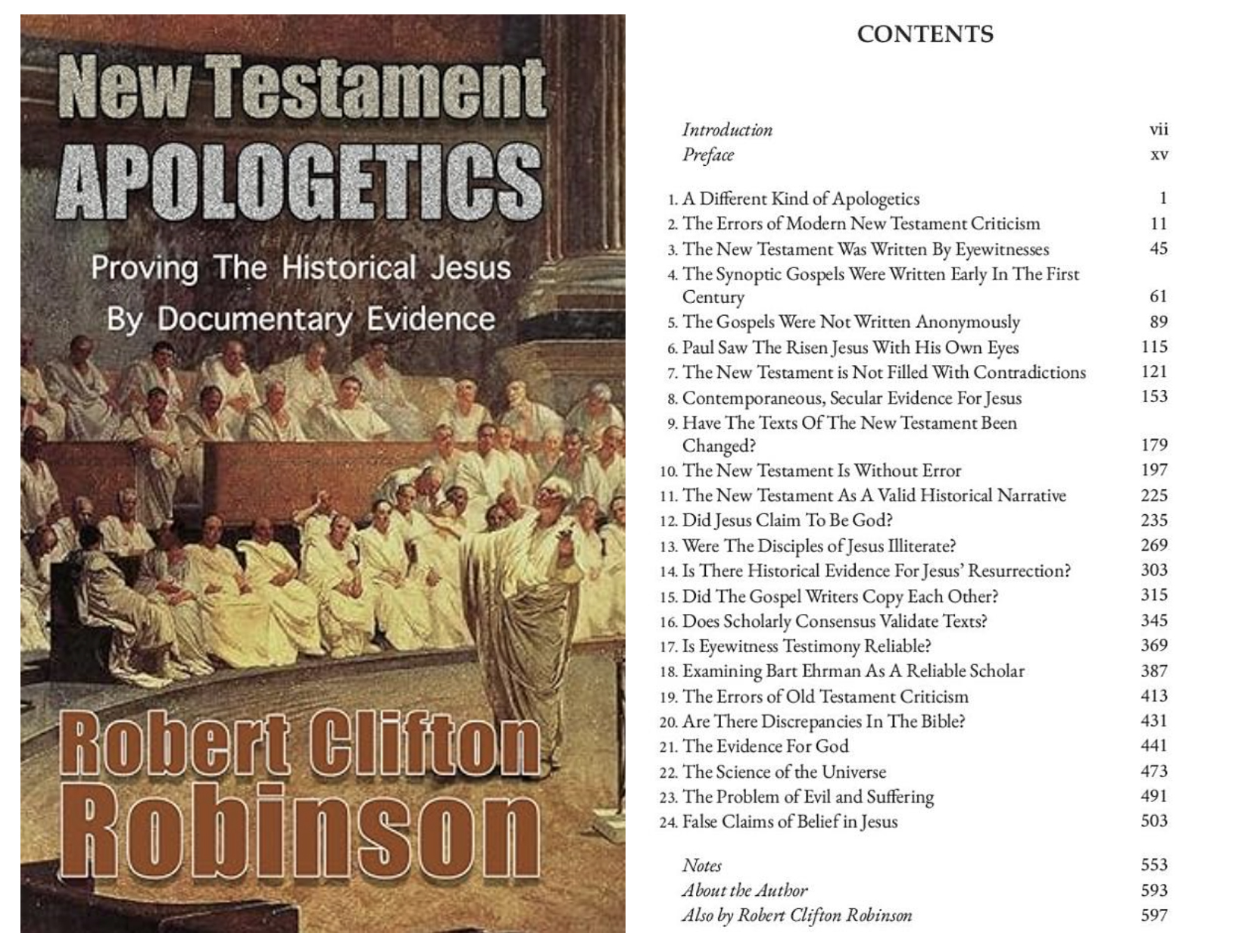
See The 21 Primary Arguments That Atheists and Progressive Scholars Make Against The Historical Eyewitness Testimony of the New Testament
Categories: Robert Clifton Robinson
 Robert Clifton Robinson
Do we have fingerprints and DNA of Caesar? How about a video showing his greatness? Prove he existed without the use of that which was written. You cannot but yet we believe.
The arguments made by Pam Boyington Holmes reminds me of the arguments the Israelites, that went off into destruction in Egypt after the fall of Jerusalem in 586BC, were making believing, wrongly, that they were being put to the sword by the Queen of the Heavens (presumably Baal’s wife) – Jeremiah 44:17 – presumably for what Josiah did years earlier.
God does not need His existence proven for Jesus, the Bible and Universe itself is His calling card to existence. And it is His desire that all mankind be saved (Ezekiel 33:11).
No man can judge you Pam; but, belief is the smallest part of faith. Belief is the mustard seed of Jesus’ parable. Faith is what comes from it. Here’s a small story of what I mean by this statement.
A little boy has grown up and moved away from his parents. He runs into difficulty, use your imagination here, and he calls his dad asking for money so that he can pay his rent. His father says no problem for the money will be there in 3 days. So 3 days later the boy pays his rent.
Faith is not believing the father in the story would deposit the money for that is belief. Faith is just paying your rent 3 days later without checking your account.
I tell this story because the boy is Jesus and He knew the Father would deliver Him without question or proof. This is faith. Now I am not saying faith is blind for faith is trust that a thing will happen without the need of proof. Cornelius comes to mind.
I have faith that bible is the historical record of the Promise of Salvation through Jesus Christ. This is what I believe. I will remind the reader of Matthew 11:25 and Romans 12:3. For Christ taught salvation, which was His mission, and that is all that is important because 1 Corinthians 15:28 – MY HOPE! Please look that one up for yourselves.
May all have a Blessed Day that the Lord Our God has created for us.
The Beginning is Near!
LikeLiked by 1 person