Since World War II, There Have Been Nine Incidents Where U.S. Presidents Have Issued Orders For Military Actions Without A Congressional Declaration Of War (Democrat and Republican)
Iran’s Supreme Leader, Khamenei, Is Dead!
“Days of Wrath: The Final Sign” The Final Events Of The Last Days
In 1863, The Supreme Court Ruled that President Lincoln’s naval blockade of Confederate ports—without a Congressional declaration—was constitutional.
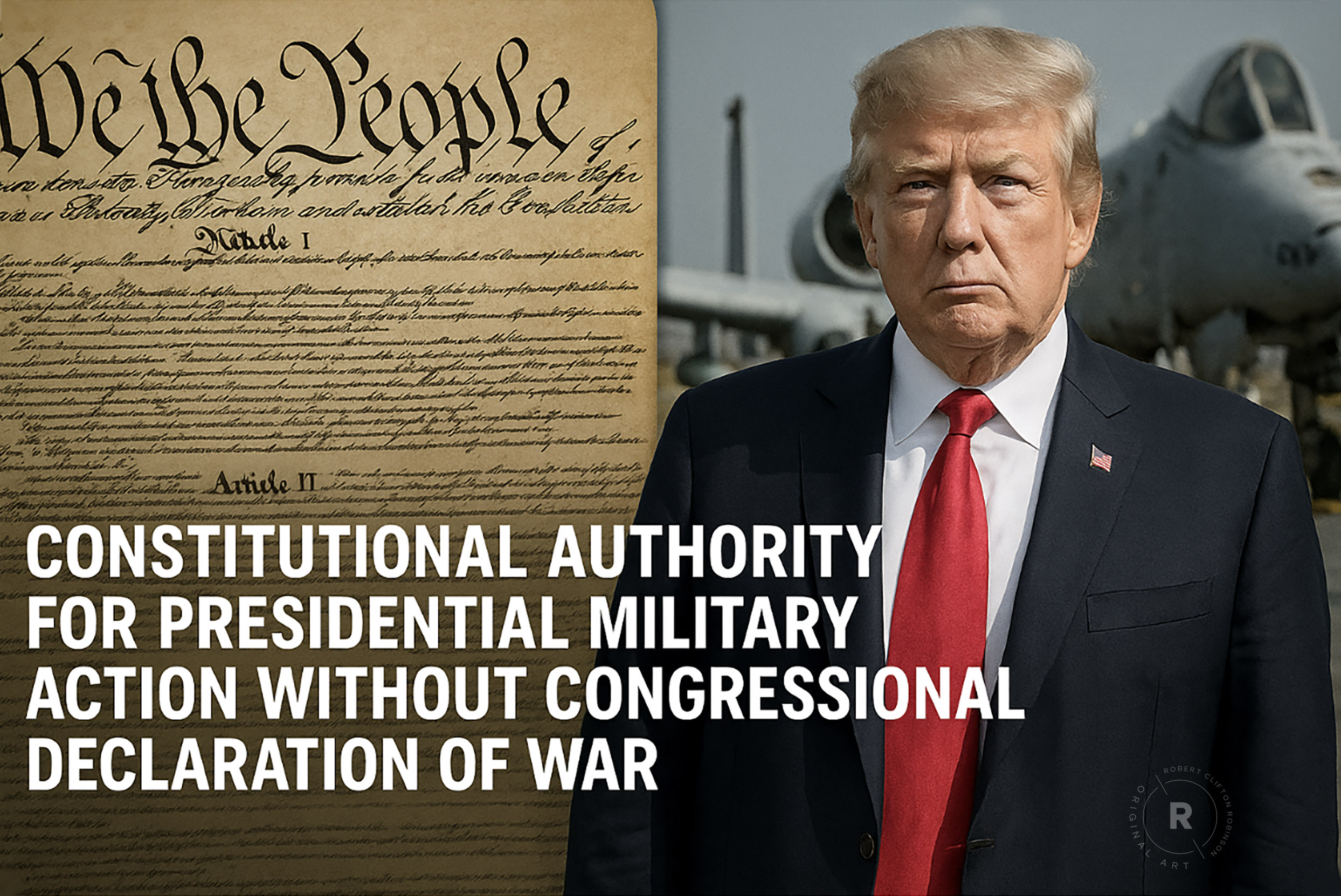
Presidents Can Justify These Actions Under The Following:
- War Powers Resolution (1973): mandates 48‑hour reporting and limits hostilities to 60 days without congressional approval .
- AUMFs: such as the 2001 AUMF used by Bush and Obama to justify operations in the “War on Terror” .
- Presidential self‑defense authority or other legal interpretations supporting limited strikes abroad.
Enforcement Of Immigration Law, And The Right Of Federal Agents To Defend Themselves
The Following Chart Illustrates 9 Incidents Where Presidents Ordered Military Actions Without The Approval of Congress.
Click on the Chart to enlarge:

There Are Over 200 Deployments of U.S. Military Forces Overseas, 1798-April 2023
The War Powers Resolution has not prevented these actions, only regulated their reporting and legal contours
- Presidents Reagan, Bush, Trump (and others) have launched unilateral strikes across different regions and regimes.
- These operations range from targeted raids and no‑fly zone enforcement to full-scale bombing campaigns—all executed without congressional authorization, albeit often under post-hoc reporting obligations.
- All actions were taken without a formal declaration of war by Congress.
- Most actions were justified under presidential authority for self-defense, protection of U.S. interests, or via the War Powers Resolution of 1973.
- Some operations (e.g., Just Cause or Urgent Fury) involved significant troop deployment, while others (e.g., Shayrat, Infinite Reach) were precision strikes.
- Recent actions, such as the 2025 Iran strikes, have raised fresh debates over executive war powers and Congress’s role. Trump will be found to have operated under the powers given to Him by the Constitution.
The War Powers Act: What Presidents Can Do, What They Cannot Do
There is legal precedent and constitutional interpretation that provides a basis for the use of military force by the President without a formal declaration of war by Congress.
Concerning The Recent (2025) Order of President Trump To Attack Nuclear Sites In Iran:
While the Constitution divides war powers between Congress and the President, the historical precedent and legal opinions do support that President Trump acted within the scope of presidential authority, as understood in U.S. constitutional law—particularly when acting to protect national interests, prevent imminent threats, or respond to attacks.
Constitutional Framework:
The U.S. Constitution: Article I & II
- Article I, Section 8: Grants Congress the power to declare war, raise armies, and regulate the military.
- Article II, Section 2: Declares the President is the Commander in Chief of the Armed Forces.
This creates a shared responsibility:
- Congress authorizes long-term war and funding,
- The President has power for military command and urgent defense action.
Historical & Legal Precedent for Presidential Action Without Congressional Declaration
The Supreme Court and Congress have generally upheld limited presidential military action without formal declarations of war. Key precedents:
The Prize Cases (1863) – Supreme Court
- Ruled that President Lincoln’s naval blockade of Confederate ports—without a Congressional declaration—was constitutional.
- Rationale: The President may repel attacks and suppress insurrections without prior Congressional approval in emergency situations.
“Whether the President in fulfilling his duties…had met with such a condition of affairs as required him to act without waiting for Congress, was a question to be decided by him.” — The Prize Cases, 67 U.S. (2 Black) 635 (1863)
United States Military Actions Since WWII
The U.S. has not declared war since WWII, yet presidents from both parties have ordered over 200 military actions under:
- Inherent executive authority under Article II
- Authorizations for Use of Military Force (AUMFs)
- War Powers Resolution of 1973
Examples:
- Reagan (Grenada 1983, Libya 1986)
- Bush Sr. (Panama 1989)
- Clinton (Kosovo, Sudan, Afghanistan)
- Obama (Libya 2011, Syria drone strikes)
- Trump (Syria 2017/2018, Iran 2020, 2025 nuclear site strikes)
Instances Where Democratic President, Bill Clinton Acted Without A Vote From Congress in 1999:
- Bosnia. On January 19, 1999, President Clinton reported to Congress that he was continuing to authorize the use of combat-equipped U.S. Armed Forces in Bosnia and other states in the region as participants in and supporters of the NATO-led Stabilization Force (SFOR). He noted that the U.S.
- Hungary, Croatia, Italy: SFOR military personnel totaled about 6,900, with about 2,300 U.S. military personnel deployed to Hungary, Croatia, Italy, and other regional states. Also, some 350 U.S. military personnel remain deployed in the Former Yugoslav Republic of Macedonia (FYROM) as part of UNPREDEP.
- Kenya. On February 25, 1999, President Clinton reported to Congress that he was continuing to deploy U.S. military personnel in that country to assist in providing security for the U.S. embassy and American citizens in Nairobi, pending completion of renovations of the U.S. embassy facility in Nairobi, subject of a terrorist bombing in August 1998.
- Yugoslavia. On March 26, 1999, President Clinton reported to Congress that, on March 24, 1999, U.S. military forces, at his direction, and in coalition with NATO allies, had commenced air strikes against Yugoslavia in response to the Yugoslav government’s campaign of violence and repression against the ethnic Albanian population in Kosovo.
- Yugoslavia/Albania. On April 7, 1999, President Clinton reported to Congress that he had ordered additional U.S. military forces to Albania, including rotary wing aircraft, artillery, and tactical missiles systems to enhance NATO’s ability to conduct effective air operations in Yugoslavia. About 2,500 soldiers and aviators are to be deployed as part of this task force. The President also reported the deployment of U.S. military forces to Albania and FYROM to support humanitarian disaster relief operations for Kosovar refugees.
- Yugoslavia/Albania. On May 25, 1999, President Clinton reported to Congress, “consistent with the war Powers Resolution,” that he had directed “deployment of additional aircraft and forces to support NATO’s ongoing efforts [against Yugoslavia], including several thousand additional U.S. Armed Forces personnel to Albania in support of the deep strike force located there.” He also directed that additional U.S. forces be deployed to the region to assist in “humanitarian operations.”
- Yugoslavia/Kosovo. On June 12, 1999, President Clinton reported to Congress, “consistent with the War Powers Resolution,” that he had directed the deployment of about “7,000 U.S. military personnel as the U.S. contribution to the approximately 50,000-member, NATO-led security force (KFOR)” currently being assembled in Kosovo. He also noted that about “1,500 U.S. military
There are 29 additional instances where President Bill Clinton acted without Congressional approval, in the years 1995-1999
The War Powers Resolution (1973)
This resolution was passed in response to Vietnam, it limits presidential power by: Requiring notification within 48 hours of deploying armed forces; Permitting use for up to 60 days without Congressional approval, with a 30-day withdrawal window
Presidents have often complied in part but rejected it as unconstitutional. Courts have not definitively ruled on its full enforceability, but Congress has not effectively challenged presidential action through this law.
Trump’s Legal Justifications for Strikes (Examples)
2017 Shayrat Missile Strike (Syria) was Justified under: Presidential authority to respond to chemical weapons use, and National interest in enforcing international norms
No congressional authorization or War Powers invocation; however, Trump notified Congress
2020 Soleimani Strike (Iraq)
- Justified as self-defense under Article II powers
- Trump administration argued Qasem Soleimani posed an “imminent threat” to U.S. personnel
2025 Iran Nuclear Site Strikes Based on:
- Imminent threat to Israel and U.S. regional interests
- Executive’s inherent power to preempt hostile acts and preserve national security
- Historical precedent for strategic strikes without congressional approval
Possible Congressional Response and Constraints
Congress has passed non-binding resolutions expressing concern (e.g., over Soleimani strike), but no binding law has prevented presidential strikes. Congress can cut funding (rarely used effectively) or pass binding resolutions under the War Powers Act (often vetoed)
The Posse Comitatus Act and Related Matters: The Use of the Military to Execute Civilian Law
Did Trump Act Constitutionally In Ordering The 2025 Iran Nuclear Site Attack?
 Under current precedent and interpretation, President Trump’s military strikes—such as in Syria, Iraq, and Iran—fall within the established use of Article II commander-in-chief powers as understood over the past 75 years.
Trump’s actions are not unique—both parties have exercised this power since 1945. Courts have upheld such actions when justified by national interest or imminent threat. Congress has not enforced constraints through legislation or the War Powers Act in a way that limits this presidential authority effectively.
How do you write a book about the Last Days, when you believe that there is great evidence we may be just months away from the subjects of your book?
Like many people who study the Prophecies of the Bible that describe the Last Days, I have devoted my entire life, the past 50 years, to this endeavor. Recently, I began to notice a pattern that was developing in world affairs and the government of the United States.
Iran’s Supreme Leader, Khamenei, Is Dead!
See The Current Events Taking Place In Their Full Context Of Biblical Prophecy: “Days of Wrath”
See The 45 Books of Robert Clifton Robinson

See All 45 of Rob’s Books
Sources and Citations:
U.S. Constitution: U.S. Constitution, Article I, Section 8
Grants Congress the power: “To declare War, grant Letters of Marque and Reprisal, and make Rules concerning Captures on Land and Water…” – Constitution of the United States
U.S. Constitution, Article II, Section 2: “The President shall be Commander in Chief of the Army and Navy of the United States…” – Constitution of the United States
Judicial Precedent: The Prize Cases
67 U.S. (2 Black) 635 (1863)
The Supreme Court upheld Lincoln’s blockade of Confederate ports without a declaration of war. Chief Justice Taney wrote: “The President does not initiate war but is bound to meet hostile actions with force if necessary.”
See The Full Text of The Prize Cases (Legal Information Institute)
War Powers Resolution (1973)
50 U.S.C. §§ 1541–1548: Passed over President Nixon’s veto to limit executive war-making powers.
Requires a 48-hour notification of troop deployment, 60-day engagement limit without authorization, 30-day withdrawal period
U.S. Code, War Powers Resolution (GovInfo.gov)
Historical Precedent: Presidential Use of Military Force: Congressional Research Service (CRS)
“Instances of Use of United States Armed Forces Abroad, 1798–2023”
Author: Barbara Salazar Torreon: Details over 300 uses of U.S. military force without declarations of war.
Examples:
- Reagan (Libya, Grenada)
- Bush (Panama, Somalia)
- Clinton (Bosnia, Sudan, Kosovo)
- Obama (Libya, Syria)
- Trump (Syria, Iraq, Iran)
CRS Report R42738 (Updated 2023)
Specific to President Trump: April 2017 – Shayrat Airbase Strike (Syria)
- 59 Tomahawk missiles launched in response to Assad’s use of chemical weapons.
- Legal justification: Protecting U.S. national interests and enforcing international norms.
Sources:
January 2020 – Soleimani Drone Strike (Iraq)
- Targeted Qasem Soleimani, commander of Iran’s Quds Force.
- Legal rationale: Imminent threat to U.S. forces; inherent Article II power.
Sources:
June 2025 – Iran Nuclear Facility Strikes
- Targeted underground nuclear facilities at Fordow, Natanz, Esfahan.
- Justified on grounds of national defense and preemptive security threats.
Sources:
- Associated Press – “Trump’s Path to Yes on Bombing Iran” (June 2025)
- The Times UK – “Will Britain Join the War?” (June 2025)
Academic Opinions
Yoo, John (Professor of Law, UC Berkeley)
- Argues that Article II provides the president broad authority to conduct military operations without congressional approval in cases of immediate threat or national interest.
- Book: The Powers of War and Peace (2005)
Goldsmith, Jack (Harvard Law School)
- Emphasizes limits of the War Powers Resolution and the rise of “Presidential War Power Norms.”
- Book: Power and Constraint (2012)
Categories: Robert Clifton Robinson
 Robert Clifton Robinson
Not shocked at all that you left out Clinton, Obama and Biden from your “list”. Yellow hack journalism at its worst. Shame on you.
LikeLike
I did not leave them out. Read the essay
Click to access deployments-of-u.s.-military-forces-overseas-1798-april-2023.pdf
LikeLike
Why were Obama’s drone strikes left out of the chart? He killed lots of people without Congressional approval. Including two Americans, one of whom was only 16 years old.
LikeLike
As the worldly person of my being trembles and shacks in fear and sin, the spiritual person of my being is calm, relaxed and knows exactly who is in control. And thus, the Spirit says to me, “Do not be afraid“. So. I stand upon my feet to watch and persevere until the coming of The Lord. See to it that you have plenty of oil for your lamps and let no one be caught napping.
Thank you Brother Rob. May God bless and keep you.
The Beginning is Near.
LikeLiked by 1 person