The following is an exegetical essay on the theological and philosophical proposition, which is drawn from Romans 1:20 and rooted in classical theistic reasoning:
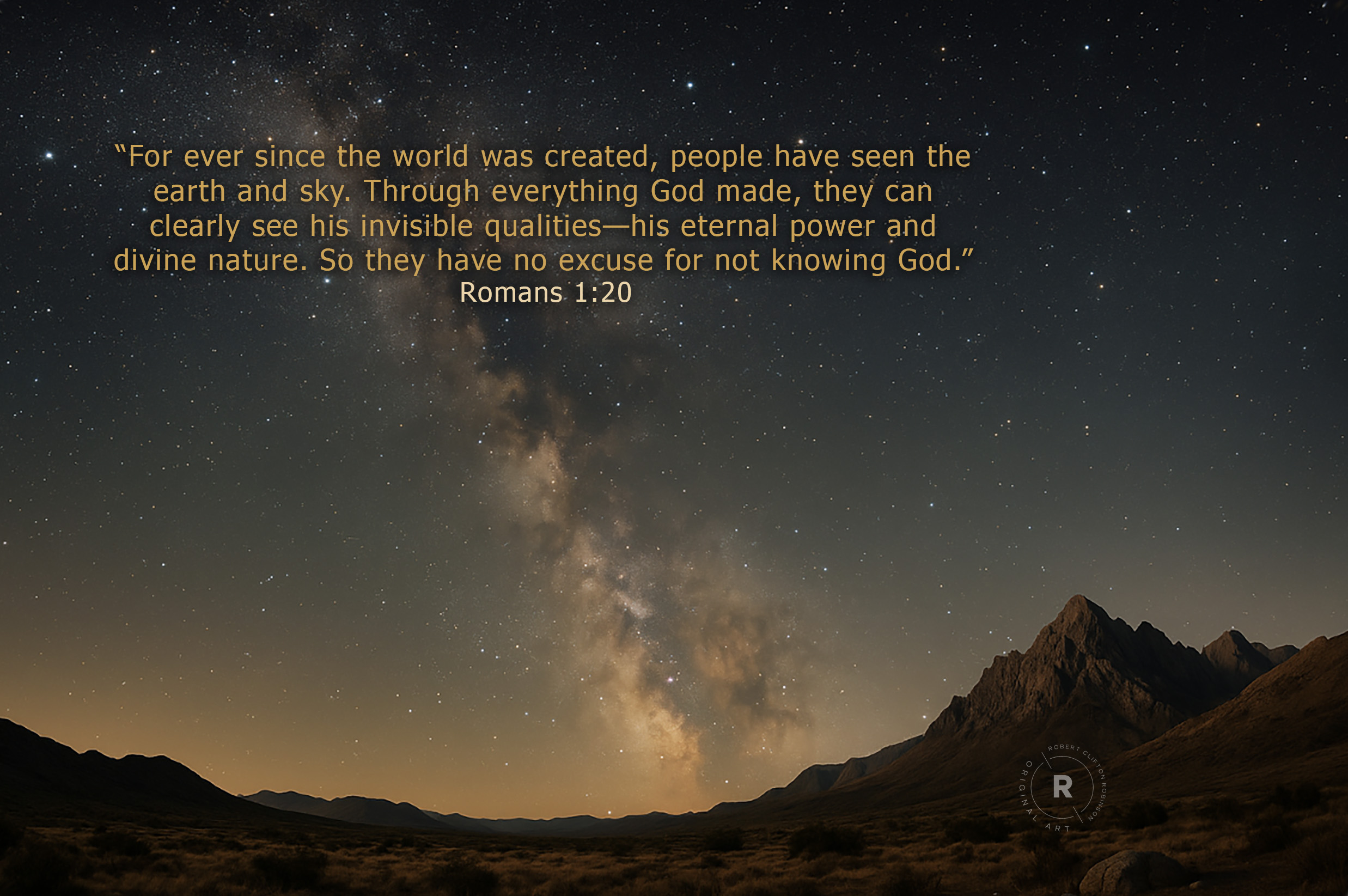
Exegesis Essay: The Eternal Power and Godhead Revealed Through Creation
Textual Focus: Romans 1:20
Thesis: God’s eternal power and divine nature are clearly revealed through the material creation, and through the law of cause and effect, mankind is held accountable for recognizing and worshiping the Creator.
Romans 1:19 Wuest Word Studies in the Greek New Testament:
“Man, reasoning upon the basis of the law of cause and effect, which law requires an adequate cause for every effect, is forced to the conclusion that such a tremendous effect as the universe, demands a Being of eternal power and of divine attributes. That Being must be the Deity who should be worshipped.”
Introduction
The statement under consideration draws from Paul’s declaration in Romans 1:20:
“For ever since the world was created, people have seen the earth and sky. Through everything God made, they can clearly see his invisible qualities—his eternal power and divine nature. So they have no excuse for not knowing God.”
This verse encapsulates a foundational Christian argument for the existence and knowability of God through what is known as natural revelation—the knowledge of God that is accessible through observation and rational reflection upon the created order. Paul argues that God’s “eternal power and Godhead” are not hidden, but manifest through the things that have been made. This essay will examine the theological, philosophical, and apologetic implications of this truth.
Exegetical and Linguistic Analysis
The Greek Text of Romans 1:20
“τὰ γὰρ ἀόρατα αὐτοῦ ἀπὸ κτίσεως κόσμου τοῖς ποιήμασιν νοούμενα καθορᾶται, ἥ τε ἀΐδιος αὐτοῦ δύναμις καὶ θειότης, εἰς τὸ εἶναι αὐτοὺς ἀναπολογήτους.”
Key Koine Greek Terms:
- ἀόρατα (aorata) – “invisible things”
- ἀπὸ κτίσεως κόσμου (apo ktiseōs kosmou) – “since the creation of the world”
- νοούμενα καθορᾶται (nooumena kathoratai) – “clearly perceived, being understood”
- ἀΐδιος δύναμις (aidios dynamis) – “eternal power”
- θειότης (theiotēs) – “divine nature” or “Godhead”
- ἀναπολόγητος (anapologētos) – “without excuse”
Paul asserts that God’s invisible qualities—specifically His eternal power and divine nature—are clearly seen by means of creation, and are discerned through the faculty of human reason (νοούμενα, “being understood”). This perception leaves mankind without excuse for unbelief or idolatry.
Theological Implication: Natural Revelation and Human Accountability
Creation as the Revelation of God
Paul’s argument is not merely rhetorical but theological and ontological. The created universe is itself a testimony to the Creator. This corresponds with Psalm 19:1–4:
“The heavens proclaim the glory of God. The skies display his craftsmanship… They speak without a sound or word… Yet their message has gone throughout the earth, and their words to all the world.”
This is the doctrine of general revelation: all men, regardless of culture, language, or historical era, are exposed to the witness of God’s power and divinity through nature. The order, beauty, complexity, and grandeur of the cosmos point unmistakably to a Creator.
The Law of Cause and Effect: Philosophical Reasoning
The statement provided refers to the law of cause and effect, which is a bedrock principle of both classical philosophy and modern science. It asserts that:
- Every effect must have a cause.
- The cause must be adequate to produce the effect.
Applied to the universe, this principle demands an uncreated First Cause—a Being of sufficient magnitude to cause the existence of space, time, matter, and life. This echoes the classical cosmological argument, especially as formulated by Thomas Aquinas:
“It is necessary to arrive at a first mover, put in motion by no other; and this everyone understands to be God.” (Summa Theologica, I, Q.2, Art.3)
Modern iterations include the Kalam Cosmological Argument:
- Whatever begins to exist has a cause.
- The universe began to exist.
- Therefore, the universe has a cause.
- This cause must be uncaused, timeless, immaterial, powerful, and personal.
Thus, the “tremendous effect” of the universe demands a Being of eternal power and divine attributes, just as Paul wrote. This Being, as revealed, is not a force but a Deity, deserving of worship.
The Moral Consequence: Worship Owed to the Creator
Paul does not merely make an argument for God’s existence—he indicts humanity for its moral failure in light of that knowledge. As Romans 1:21 continues:
“Yes, they knew God, but they wouldn’t worship him as God or even give him thanks.”
Here, natural revelation is not salvific, but condemning. It renders humanity “without excuse” (ἀναπολόγητος). Though the evidence for God’s existence and attributes is plain, mankind suppresses the truth (Romans 1:18), turning instead to idolatry.
Hence, the theological progression is:
- Creation reveals God.
- Human reason can apprehend this.
- Failure to worship the Creator is moral rebellion.
- This rebellion warrants divine judgment.
Apologetic Application: From General to Special Revelation
Hebrew Scholar, Paul, establishes a firm apologetic foundation in Romans 1. While the existence of God is accessible through the natural world, this knowledge alone cannot save. It points to God, but not to Christ. For salvation, mankind needs special revelation—the revealed Word of God and the Incarnation of Jesus Christ.
Nevertheless, Romans 1 provides a bridge between natural reason and gospel proclamation. The external witness of creation leads to the internal awareness of God’s existence and moral law, ultimately exposing humanity’s need for redemption through Christ.
Paul’s words in Romans 1:20, echoed in the statement under examination, provide a profound affirmation of the revelation of God through the created order. The logical necessity of a first uncaused cause, combined with the beauty and order of the cosmos, compels the reasonable mind to acknowledge a Creator of eternal power and divine nature. The result is that all mankind is accountable to God. To ignore or reject this truth is to engage in willful suppression. To acknowledge it is the first step toward reverence, worship, and the discovery of the One who is not only Creator—but also Redeemer.
Counterargument: The Universe Exists By Naturalistic, Random Events
The argument for a naturalistic, random universe fails on multiple levels—philosophical, scientific, logical, and theological—when measured against the reality of the universe as we experience it and as Paul describes in Romans 1:20. The following is a detailed defense noting why the notion of a random, purposeless cosmos is untenable, and why the universe demands a transcendent, eternal Creator of divine attributes.
The Law of Cause and Effect Disqualifies a Random Universe
At the heart of the naturalistic worldview is the assertion that the universe either caused itself or arose from nothing without cause, governed by impersonal, blind processes. However, this contradicts the fundamental metaphysical principle of cause and effect:
- Every effect must have an adequate cause.
- The cause must be equal to or greater than the effect.
The Universe Is an Effect
The universe is not eternal. Modern cosmology confirms a definite beginning to the universe in the finite past (e.g., Big Bang, second law of thermodynamics, cosmic background radiation). For this reason, the universe is a caused effect, not a self-existing entity.
A Random Process Cannot Be an Adequate Cause
Randomness is not a cause; it is the absence of intention, design, or purpose. To say the universe came from “random chance” is to attribute causality to non-being—which is philosophically incoherent. Non-being has no properties and cannot produce anything.
Self-Causation Is Impossible
For something to cause itself, it must exist before it exists, which is logically contradictory. The cause of the universe must be external to and greater than the universe: timeless, spaceless, immaterial, powerful, and personal—i.e., God.
The Impossibility of Information Arising by Random Chance
The Universe presents us with Information
Modern science reveals that the universe, from the cosmic scale down to DNA, is rich in encoded, functional information:
- Laws of physics: finely tuned and consistent across space and time.
- Genetic code: DNA contains a language-based instruction set for building and maintaining life.
- Mathematical structure: the cosmos is describable by elegant, discoverable mathematical laws.
No natural process is capable of these three attributes. Only an eternal unlimited mind could achieve these knowable clues to the source for our universe. The Creator designed the universe to be understood by the thinking beings He created,
Information Requires Intelligence
According to information theory (developed by Claude Shannon and others):
- Information does not arise from disorder.
- Meaningful, functional sequences (like those in DNA or software) require an intelligent source.
- No observation in history confirms the rise of functional information by chance alone without a directing intelligence.
To assert that random processes created the DNA code, or the laws of physics, is to deny everything we know about the origin and nature of information.
The Fine-Tuning of the Universe Refutes Randomness
Constants and Quantities Are Precisely Set
The universe is finely tuned in such a way that even minor alterations in the fundamental constants would make life impossible:
- Strength of gravity
- Cosmological constant
- Strong and weak nuclear forces
- Initial conditions of entropy
- Mass of subatomic particles
Evidence For Fine-Tuning Of The Universe: 209 Physical Constants That Make Life On Earth Possible
Physicist Paul Davies, though not a biblical theist, admits: “The impression of design is overwhelming.” —Paul Davies, The Cosmic Blueprint
Click On Image To Look Inside
Randomness Cannot Account for Fine-Tuning
- Random chance has no mechanism to produce fine-tuning.
- The probability of life-permitting constants arising by chance is so minuscule that it is functionally zero.
- For example, Roger Penrose calculated the odds of our low-entropy universe at 1 in 10^10^123.
Roger Penrose: The Multiverse v. Intelligent Creator: Examining The Cosmological Evidence
This precision requires purposeful calibration, not randomness.
The Moral and Existential Reality Denies a Random Universe
Humans Are Moral, Rational, and Purpose-Driven
- We possess consciousness, moral awareness, love, reason, and aesthetic judgment.
- If the universe is a random accident, these properties are illusory and ungrounded.
In retrospect of these things all human civilization operates on the assumption that:
- Truth exists
- Right and wrong exist
- Life has meaning
- Human beings have dignity and worth
A random, purposeless universe cannot produce or justify these realities. They only make sense if we were created by a personal, moral, purposeful Creator, as Romans 1 presupposes.
The Self-Defeating Nature of Naturalism
Naturalism, which asserts that only physical processes exist, undermines its own foundation:
Reason Becomes Impossible
If human thoughts are the result of random, unguided chemical reactions, then our beliefs are not based on truth, but on biology. Naturalism cannot justify rationality, yet it relies on rational argumentation to defend itself.
C.S. Lewis summarized this: “If the solar system was brought about by an accidental collision, then the appearance of organic life on this planet was also an accident… If so, then all our thought processes are mere accidents… But if their thoughts (i.e., of Naturalists) are mere accidents—why should we believe them to be true?” —C.S. Lewis, The Case for Christianity
Biblical Theology: Natural Revelation vs. Naturalistic Denial
Romans 1:20 Condemns the Denial of the Creator
Paul’s assertion that God’s eternal power and Godhead are clearly seen in the material world directly challenges naturalism:
- The evidence is not hidden.
- It is not that people cannot believe—but that they refuse to believe.
- The rejection of God is not intellectual; it is moral (Romans 1:18: “they suppress the truth in unrighteousness”).
Naturalism Is an Idolatrous Exchange
“Claiming to be wise, they became fools and exchanged the glory of the immortal God for images…” (Romans 1:22–23)
Naturalism replaces the Creator with the creation itself: atoms, energy, or chance.
But the created universe cannot explain itself, sustain itself, or provide its own purpose. The Bible is clear: creation demands a Creator, and to ignore this is to reject both truth and responsibility.
The Universe Demands God, Not Chance
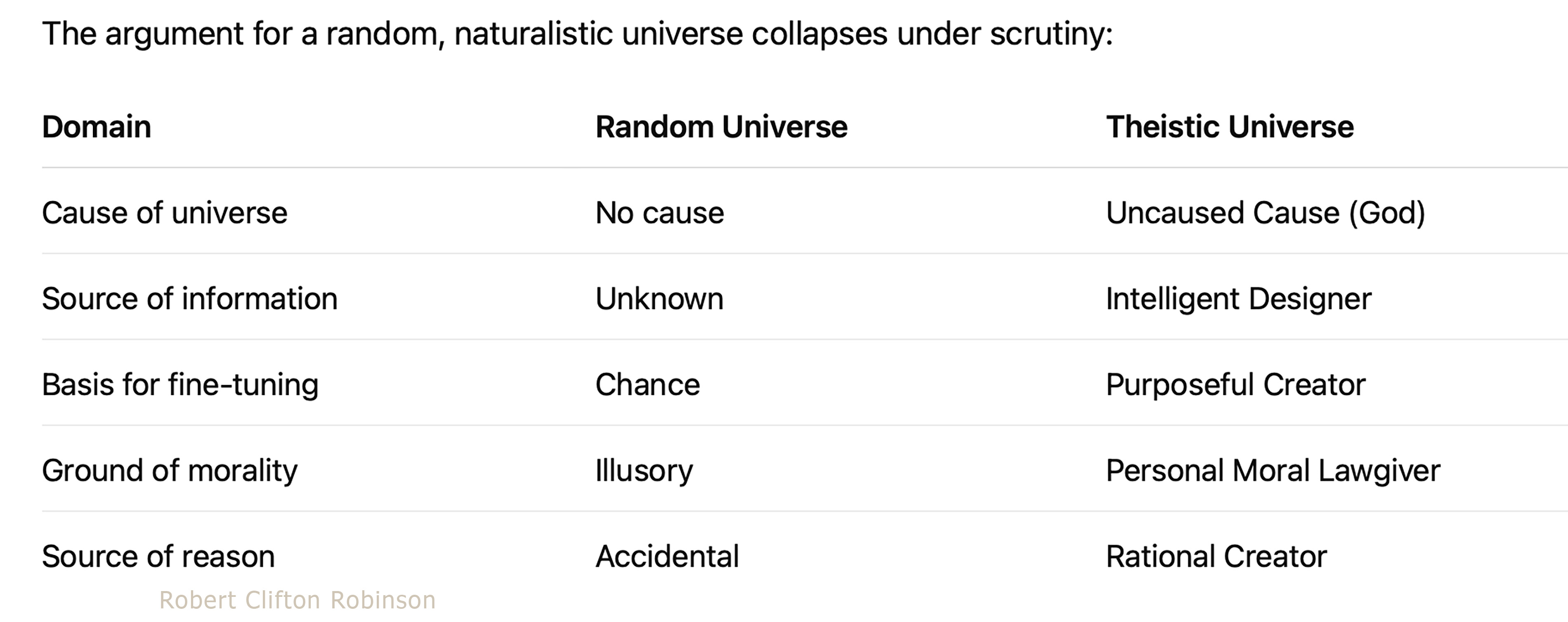
The argument for a random, naturalistic universe fails because:
- It violates the law of cause and effect.
- It cannot account for the origin of information or life.
- It collapses under the weight of fine-tuning.
- It renders reason, morality, and truth meaningless.
- It is morally accountable for rejecting the clearly revealed God.
In contrast, the biblical view affirms that the material universe is the clear, intelligible, and intentional handiwork of an eternal Creator, whose divine nature and power are on display. Man’s reason, aligned with observation, points unmistakably to God—not randomness.
“In the beginning, God created the heavens and the earth.” (Genesis 1:1)
That single sentence remains the most coherent, rational, and true explanation for everything that exists.
Sources and Citations:
The Law of Cause and Effect Disqualifies a Random Universe
The Universe Is an Effect
The principle of causality—that every effect must have a cause—is a foundational axiom in philosophy and science.
- Aristotle taught that nothing moves or exists without a prior cause (Metaphysics, Book XII).
- Thomas Aquinas argued in his “Five Ways” that the universe must be caused by an Unmoved Mover or First Cause (Aquinas, Summa Theologica, I. Q2. Art.3).
- The Second Law of Thermodynamics indicates that the universe is running down (increasing entropy), implying it had a beginning (Craig, Reasonable Faith, p. 111).
“Whatever begins to exist has a cause; the universe began to exist; therefore, the universe has a cause.” — William Lane Craig, The Kalam Cosmological Argument, Wipf & Stock, 2000.
The Impossibility of Information Arising by Random Chance
The Universe Contains Functional Information
DNA is not merely chemical material—it stores symbolic, language-based code for life processes.
“DNA is like a computer program but far, far more advanced than any software ever created.” — Bill Gates, quoted in Stephen C. Meyer, Signature in the Cell (HarperOne, 2009), p. 4.
The information theory formulated by Claude Shannon in the 1940s established that information cannot arise from random noise without an intelligent source (Shannon, A Mathematical Theory of Communication, 1948).
Meyer: “All our experience affirms that information-rich systems arise from intelligent causes, not chance or physical necessity.” — Meyer, Signature in the Cell, p. 347.
The Fine-Tuning of the Universe Refutes Randomness
The Precision of Physical Constants
Numerous physicists and cosmologists recognize the precise values of universal constants necessary for life:
- Gravitational constant (G)
- Cosmological constant (Λ)
- Mass of protons, electrons, and quarks
- Ratio of fundamental forces
“A common sense interpretation of the facts suggests that a superintellect has monkeyed with physics… and that there are no blind forces worth speaking about in nature.” — Fred Hoyle, The Universe: Past and Present Reflections, Engineering & Science, November 1981.
Probability of Random Fine-Tuning
Roger Penrose calculated the odds of our universe’s low entropy condition at the Big Bang as
1 in 10^10^123—a number so inconceivable that it effectively rules out chance.
— Roger Penrose, The Road to Reality (Vintage Books, 2007), p. 762.
“The fine-tuning of the universe is too remarkable to be due to chance.” — Paul Davies, The Cosmic Blueprint (Simon & Schuster, 1988), p. 203.
The Moral and Existential Reality Denies a Random Universe
Human Nature Defies Naturalism
If humans are the result of random evolution, then morality, purpose, and rationality are illusions. Yet we live as though:
- Truth matters
- Evil is real
- Life has meaning
These three cannot be grounded in blind materialism.
“The first and most obvious flaw in materialism is that it can provide no account of rationality.” — J.P. Moreland & William Lane Craig, Philosophical Foundations for a Christian Worldview (IVP Academic, 2003), p. 91.
“If my mental processes are determined wholly by the motions of atoms in my brain… how can I trust my own thinking?” — C.S. Lewis, The Case for Christianity (HarperOne, 2001), p. 32.
The Self-Defeating Nature of Naturalism
Naturalism destroys the very tools it uses to argue:
- If our brains are the products of unguided evolution, shaped solely for survival, not truth, then rational thought is undermined.
- This is the central critique of Alvin Plantinga’s “Evolutionary Argument Against Naturalism” (EAAN).
“If you take evolution and naturalism together, you have a defeater for trusting your own cognitive faculties.” — Alvin Plantinga, Where the Conflict Really Lies: Science, Religion, and Naturalism (Oxford University Press, 2011), pp. 307–310.
Biblical Theology: Natural Revelation vs. Naturalistic Denial
Romans 1:18–20 – The Inescapable Knowledge of God
“For since the creation of the world God’s invisible attributes… have been clearly perceived… so that they are without excuse.” — Romans 1:20
Paul cites:
- Creation testifies of God.
- This knowledge is sufficient to hold people morally accountable.
- To deny this is to suppress the truth (Romans 1:18).
This is consistent with Psalm 19:1: “The heavens declare the glory of God; the skies proclaim the work of His hands.” — Psalm 19:1
Suppression of Truth is Moral, Not Intellectual
“Although they knew God, they did not honor Him as God or give thanks.” — Romans 1:21
“Claiming to be wise, they became fools.” — Romans 1:22
R.C. Sproul: “The Bible never debates the existence of God. It simply declares that the knowledge of God is innate and inescapable—and that atheism is sin, not merely an intellectual mistake.” — R.C. Sproul, If There’s a God, Why Are There Atheists? (Tyndale, 1988), p. 27.
The biblical worldview, as seen in Romans 1:20, not only explains the existence, design, purpose, and moral structure of the universe—it demands a response. The eternal power and divine nature of God are not hidden but clearly perceived. Therefore, all mankind is without excuse.
“In the beginning God created the heavens and the earth.” — Genesis 1:1
This sentence remains the most philosophically sound and scientifically consistent explanation for everything that exists.
Bibliography and Sources
- Aquinas, Thomas. Summa Theologica, I, Q2. Art.3.
- Craig, William Lane. Reasonable Faith, 3rd ed. Crossway, 2008.
- Craig, William Lane. The Kalam Cosmological Argument. Wipf & Stock, 2000.
- Davies, Paul. The Cosmic Blueprint. Simon & Schuster, 1988.
- Gates, Bill (quoted in Meyer). Signature in the Cell. HarperOne, 2009.
- Hoyle, Fred. “The Universe: Past and Present Reflections.” Engineering & Science, Nov. 1981.
- Lewis, C.S. The Case for Christianity. HarperOne, 2001.
- Meyer, Stephen C. Signature in the Cell. HarperOne, 2009.
- Moreland, J.P., and Craig, William Lane. Philosophical Foundations for a Christian Worldview. IVP Academic, 2003.
- Penrose, Roger. The Road to Reality. Vintage Books, 2007.
- Plantinga, Alvin. Where the Conflict Really Lies: Science, Religion, and Naturalism. Oxford University Press, 2011.
- Shannon, Claude E. “A Mathematical Theory of Communication.” Bell System Technical Journal, 1948.
- Sproul, R.C. If There’s a God, Why Are There Atheists? Tyndale, 1988.
- The Holy Bible, New Living Translation (NLT), English Standard Version (ESV).
Categories: Robert Clifton Robinson


So at the moment of conception, the DNA inherited from both parents determines the fundamental aspects of who a person will be, including their sex and genetic makeup. Now. It is said that DNA is an adaptation in that mutations, or errors, that may occur causes a thing to evolve.
So how badly have we evolved when we protect the weakest amongst us? Why do we waste critical resources on the weak if survival of fittest is actually real? Why do we allow weaker human beings to reproduce? I could go on for days with this line of thinking. It appears to me that we did not evolve; but, were created, because we are doing that which is opposite of Evolution’s Nature – Survival of the Fittest.
So for those that believe in the non-sense of evolution, you will be shown exactly what survival of the fittest means during the Great Tribulation. Survival of the fittest will be on full display during that period of human history; so much so, that the Bible states the following in Matthew 24:22:
So for those that believe in Survival of the Fittest, God has foretold a future for you where Survival of the Fittest will be on full display during The Great Tribulation; and, NOTHING will be able to stand against it – Zephaniah 1. So if Evolution is your belief, then you shall die by it. How fitting … right?
Find Christ now and survive … for He is the Fittest (Most Holy) of All – John 3:16.
Thank you Pastor Rob for helping us keep our eyes on the prize; that we run a great race.
The Beginning is Near.
LikeLiked by 1 person
Original sin is responsible for mankind’s predicaments, for EVERY evil in this world
LikeLiked by 1 person
I could not agree more with your statement. It is sad that many refuse to see it and will instead invent new ways of doing evil – Romans 1:30. This is exactly what evolution is – a invention of doing evil. Peace be with John.
Tony
LikeLike