The Recent Deaths In Kerrville, Texas, Have Raised Many Important Questions Regarding The Love of God and Why He Doesn’t Stop These Events From Happening

The question—why does God allow people to die in natural disasters—is one of the most profound and challenging theological and pastoral issues in the Bible. The question touches on God’s sovereignty, His Love, human responsibility, the problem of evil, and the fallen state of creation.
The following is a thorough and detailed biblical exposition addressing this question, organized under biblical principles:
The Biblical Principles of Creation and Natural Order
God Created a “Very Good” World (Perfect)
Genesis 1:31: “Then God looked over all he had made, and he saw that it was very good!”
The original creation was orderly, harmonious, and free of death, disaster, or destruction. Natural disasters (hurricanes, floods, earthquakes) were not part of God’s original design for creation.
The Entrance of Sin and the Curse on the Earth
The Fall of Adam Introduced Decay and Death
Romans 5:12: “When Adam sinned, sin entered the world. Adam’s sin brought death, so death spread to everyone, for everyone sinned.”
Genesis 3:17-19: “The ground is cursed because of you… It will grow thorns and thistles for you… Until you return to the ground from which you were made.”
The introduction of sin into the perfect world that God created, brought both moral evil (sin) and natural evil (death, suffering, disaster). The curse on creation brought disorder into the natural world. Nature became unstable and at times dangerous.
The Current Fallen Creation Groans for Redemption
Creation Is in Bondage to Decay
Romans 8:20-22: “Against its will, all creation was subjected to God’s curse… But with eager hope, the creation looks forward to the day when it will join God’s children in glorious freedom from death and decay.”
Hebrew Scholar, Paul, describes all of creation groaning under the weight of sin’s consequences. Earthquakes, floods, and storms are symptoms of a broken creation, not acts of arbitrary divine judgment.
God’s Sovereignty and Human Responsibility
God Gave the Earth to Humanity to Steward
Genesis 1:28: “Fill the earth and govern it. Reign over the fish in the sea, the birds in the sky, and all the animals…”
The dominion directive that God gave Adam implies responsibility, not domination. We are caretakers of creation. This dominion includes using God’s wisdom and discernment to prevent risks (e.g., building codes, early warning systems, environmental care).
Hosea 4:1-3: “The Lord brings a charge… There is no faithfulness, no kindness, no knowledge of God… That is why your land is in mourning, and everyone is wasting away—even the wild animals, the birds of the sky, and the fish of the sea are disappearing.”
Human sin and neglect can amplify the consequences of natural disasters. Failure to act wisely may be part of why tragedy strikes (e.g., ignoring flood warnings, poor infrastructure).
Why God Allows Suffering and Death in a Fallen World
God Permits, But Does Not Take Pleasure in Death
Ezekiel 18:32: “I don’t want you to die, says the Sovereign Lord. Turn back and live!”
God does not delight in suffering or death. But He permits it under the broader umbrella of human freedom and the fallen state of the world. The Lord views the death of those who love Him as a blessing to these persons and to God. We should see these early deaths from God’s perspective that He has spared them from all of the evil, suffering, and pain that these persons would have experienced If they had not gone home to be with the Lord.
Isaiah 57:1-2: Good people pass away; the godly often die before their time. But no one seems to care or wonder why. No one seems to understand that God is protecting them from the evil to come. For those who follow godly paths will rest in peace when they die.
Ecclesiastes 3:1-2: “For everything there is a season… A time to be born and a time to die.”
Hebrews 9:27: “Each person is destined to die once and after that comes judgment.”
Death is part of the human condition after-the-Fall, and natural disasters—though tragic—are part of the general groaning of a broken world.
Tragedy as a Call to Reflection and Mercy
Jesus Rejected the Idea That All Suffering Is Direct Judgment
Luke 13:1–5: “Do you think those Galileans were worse sinners than all the other people from Galilee? Not at all!… And what about the eighteen people who died when the tower in Siloam fell on them? Were they the worst sinners in Jerusalem? No…”
Jesus disconnected natural disasters from specific sin but warned that such events are reminders of the brevity of life and the need for repentance. In the same context Jesus warned us all that “If all of you do not repent, you will all be lost” (Luke 13:3).
For the saved death is a blessing as they exit this world of suffering and pain, and enter the perfect world that God has prepared for all who love Him. For the unsaved and those who reject Jesus’ offer to pay for our sins and make us ready for heaven, death is the end of our opportunity to be saved. It is appointed for all of us to die just once, and after this, comes God’s judgement (Hebrews 9:27)
The Role of Human Compassion and Responsibility
We Are Commanded to Love and Care for One Another
Galatians 6:2: “Share each other’s burdens, and in this way obey the law of Christ.”
James 2:15-16: “Suppose you see a brother or sister… and you say, ‘Goodbye and have a good day; stay warm and eat well’—but then you don’t give that person any food or clothing. What good does that do?”
When tragedy and loss of life happens, the failure to act—by governments, communities, or individuals—can result in preventable death. As believers in Jesus we must come to these persons and offer them some comfort and assurance that God is able to take what is terrible and hopeless, and turn it into something good.
Romans 8:28: And we know that God causes everything to work together for the good of those who love God and are called according to his purpose for them.
We must remember that there is often no good advice or help we can offer to people who have lost a child, a parent, or dear friend.
It is sometimes better during the first moments of loss, to not quote scripture, or offer hope in the deepest moments of a persons suffering and loss. It is better to sit quietly and embrace these persons, rather than to speak. People value highly those who don’t lecture them when they are in such pain, but stand by silently to be with them.
For those who want to know why God didn’t intervene to stop the tragedy and loss of life, we must remember that it is most often not God’s failure, but human error, that leads to the magnitude of suffering.
God knowing that these things will happen does not mean that He made it happen or approves of it happening.
THE ARGUMENT: God’s Foreknowledge Equals Responsibility
The Assertion:
If God is omniscient (knows all things), omnipotent (can stop all things), and omnibenevolent (is perfectly good), then He should not allow evil or suffering. Since He knew evil would happen and still created the world, He is morally responsible for every evil that takes place.
This is sometimes summarized as: “If God knew what would happen, then He caused it by creating the world where it would happen.”
THE BIBLICAL RESPONSE: Distinguishing Foreknowledge from Causation
Foreknowledge Does Not Imply Causation
Acts 2:23: “But God knew what would happen, and His prearranged plan was carried out when Jesus was betrayed. With the help of lawless Gentiles, you nailed him to a cross and killed him.”
God foreknew Jesus would be crucified, and ordained the redemptive outcome, but men were still responsible for the evil act. Knowing something will happen ≠ causing it to happen. In logic, this is a category error—confusing knowledge of an action with agency in causing it.
Romans 8:29: “For God knew his people in advance, and he chose them to become like his Son…”
God’s foreknowledge informs His redemptive plan, but doesn’t force human decisions.
THE PROBLEM OF MORAL AGENCY AND LOVE
God Created Humans with Free Will
Deuteronomy 30:19: “Today I have given you the choice between life and death… Oh, that you would choose life!”
The Bible is clear: human beings have agency. God commands, pleads, warns, and holds people responsible. Love requires freedom. A world where humans are robots would be devoid of love, moral growth, or meaningful relationship.
C.S. Lewis said: “Try to exclude the possibility of suffering… and you find that you have excluded life itself.” (C.S. Lewis, The Problem of Pain)
God knew sin and suffering would happen, but also knew that only in such a world could true love, redemption, and salvation occur.
GOD’S SOVEREIGNTY IN A FALLEN WORLD
God Permits Evil for a Greater Purpose
Genesis 50:20: “You intended to harm me, but God intended it all for good. He brought me to this position so I could save the lives of many people.”
Evil is never good, but God can redeem it and bring greater good from it. The cross of Jesus is the ultimate example: the worst evil (murder of God’s Son) becomes the greatest good (salvation of the world).
Romans 8:28: “And we know that God causes everything to work together for the good of those who love God and are called according to his purpose…”
This doesn’t mean God approves of evil—but He is not paralyzed by it. He works through it without being the author of it.
THE DIFFERENCE BETWEEN PERMISSION AND MORAL GUILT
God Allows Evil, But Is Not the Author of Evil
James 1:13: “And remember, when you are being tempted, do not say, ‘God is tempting me.’ God is never tempted to do wrong, and He never tempts anyone else.”
1 John 1:5: “God is light, and there is no darkness in him at all.”
God permits evil actions (to preserve free will) but is not their source. The moral guilt lies with those who choose evil, not the God who gave freedom.
Philosopher Alvin Plantinga explains this with the Free Will Defense: “A world containing creatures who are significantly free is more valuable… even though it allows for the possibility of moral evil.”
GOD’S FOREKNOWLEDGE IS PART OF HIS JUSTICE
Knowing All Outcomes Makes God a Perfect Judge
Hebrews 4:13: “Nothing in all creation is hidden from God. Everything is naked and exposed before his eyes, and he is the one to whom we are accountable.”
Because God knows all choices, He can perfectly judge each person. No one will be able to say on the Day of Judgment: “God didn’t understand.”
Hebrews 5:8: “Even though Jesus was God’s Son, he learned obedience from the things he suffered.
God’s Mercy in the Midst of Tragedy
God Comforts, Redeems, and Restores
Psalm 34:18: “The Lord is close to the brokenhearted; he rescues those whose spirits are crushed.”
2 Corinthians 1:3–4: “God is our merciful Father and the source of all comfort. He comforts us in all our troubles so that we can comfort others.”
Revelation 21:4: “He will wipe every tear from their eyes, and there will be no more death or sorrow or crying or pain. All these things are gone forever.”
The hope of people who love Jesus and trust Him lies not in escaping all earthly tragedies, but in the promise of restoration and eternal life in Christ. Even in disaster and terrible loss, God works through His people to bring comfort, rescue, and salvation.
God allows death in natural disasters not because He is indifferent, but because He honors the conditions of a world that has rejected His order and is now under a curse. He has provided both a spiritual remedy (salvation through Christ) and a moral framework (love and stewardship) through which human beings are to act in the face of suffering.
In the case of modern disasters, like the recent flooding in Texas, it is likely a combination of fallen nature and human error, not divine punishment. Yet in every case, God is near to the brokenhearted, works through His people, and ultimately promises a world where there will be no more disasters, death, or tears.
Micah 6:8: “O people, the Lord has told you what is good, and this is what he requires of you: to do what is right, to love mercy, and to walk humbly with your God.”
God’s Foreknowledge Magnifies His Love and Justice

We Might Take A Similar View Of God’s Silence In Jesus’ Silence As He Stands Before Pilate:
Mark 15:4-5: “Then Pilate asked Him again, saying, “Do You answer nothing? See how many things they testify against You!” But Jesus still answered nothing, so that Pilate marveled.”
When Pilate scolds and threatens Jesus for not answering him, Jesus speaks up and informs this Roman ruler that the only reason He is standing before Pilate at all is because his authority to do so was given to him by God.
John 19:10-11: “Then Pilate said to Him, “Are You not speaking to me? Do You not know that I have power to crucify You, and power to release You?” 11 Jesus answered, “You could have no power at all against Me unless it had been given you from above.”
While in His suffering for our sins, Jesus was fully in control of all the circumstances of His life, death, and resurrection. No man really had the ability to take authority over Jesus because He remained the King of the Universe, even as He was assuming the position of a servant to die for the sins of the world.”
The mouths of the most powerful men in Judea were shut by Jesus, as He demonstrates that He has power over all the events of history. This remains for us today, a demonstration of the practical applications for how God is sovereign over all the affairs of the earth.
Controlling His Death
Jesus made it clear that no one could take His life; He was freely giving it—in fulfillment of what had been written of the Messiah. The Old Testament is replete with hundreds of scriptures which require the Messiah’s death—in order to remove the sins of the world. Jesus was carefully and methodically completing each of these requirements, precisely as they were required. In order to accomplish this great feat, He would need to be in control of absolutely ever minute detail.
John 10:17-18:“Therefore My Father loves Me, because I lay down My life that I may take it again. No one takes it from Me, but I lay it down of Myself. I have power to lay it down, and I have power to take it again. This command I have received from My Father.”
Jesus was in control of every tiny detail of the final night and day of His life. As we study the words which David had written in the Psalms, words that he intended as prophetic descriptions of the coming Messiah; we see thatPsalm 31 contains four predictions that Jesus carefully fulfilled. It would be a mistake to assume that Jesus arrest, trial, scourging, and crucifixion were actions dictated solely by the Jewish leadership and the Roman government. Although these men are personally responsible for their actions, the Lord is also moving these events into alignment so that every prophecy spoken for the Messiah is fulfilled by Jesus actions and words.
“Into Your hand I commit my spirit…” ~Psalms 31:5
Luke Describes These Precise Words As Jesus Died
Luke 23:46: “And when Jesus had cried out with a loud voice, He said, “Father, ‘into Your hands I commit My spirit.’ Having said this, He breathed His last.”
Jesus was fully in control of when and where He would make His sacrifice for our sins—both in His death by crucifixion and by His resurrection three days later. Jesus boldly declared before He was crucified that no one had the power to take His life from Him.
Control Over Those Who Were In Control
As the soldiers come to arrest Jesus in the Garden of Gethsemane, He asks these men, Whom are you seeking? When Jesus speaks the words, “I am He,” the soldiers fall backwards onto the ground (John 18:6).
In the original text of this verse, the word “He” does not appear. The translators added this word because they felt that it clarified the verse for the reader. In reality, when Jesus answers the guards, He said “I am.” This is the eternal name for God, found in Exodus 3:14, where He instructed Moses to call Him by this name. Jesus was telling those who came to arrest Him that He is the eternal God. Jesus confirmed this fact when He spoke to the Pharisees in John, chapter 8.
John 8:58: “Jesus said to them, “Most assuredly, I say to you, before Abraham was, I AM.”
David, in writing Psalms 40:14 about the Messiah, prophecies that: Those Who seek to destroy my life; Let them be driven backward. These are the exact words of John’s testimony which occurred when Jesus said, “I am He.”
When the soldiers come to arrest Jesus at the garden of Gethsemane, He made it clear to those who came to take Him by force that they were not orchestrating His arrest; He was allowing these soldiers to arrest Him. As the soldiers approach Jesus, He assumes a place of authority by questioning them: Whom are you seeking? When the soldiers answer “Jesus of Nazareth,” Jesus answers; “I AM.” The translators later added “He,” but this word was not in the original Greek manuscript of this encounter. By answering “I AM,” Jesus was using the eternal name for God—signifying that it was He who was orchestrating these events that would lead to His death and resurrection.
As Jesus speaks the words, “I AM,” the power of the eternal God bursts forth, causing the soldiers to fall backwards.
Jesus was making a very important statement to demonstrate that He was allowing these soldiers to arrest Him. No one at any time had authority over Jesus. It was He who was surrendering His life, and allowing the soldiers to take Him in order to fulfill the prophecies of the Old Testament—so that all those who would believe in Him could be saved.
John 18:3-6: “Then Judas, having received a detachment of troops, and officers from the chief priests and Pharisees, came there with lanterns, torches, and weapons. Jesus therefore, knowing all things that would come upon Him, went forward and said to them, “Whom are you seeking?” They answered Him, “Jesus of Nazareth.” Jesus said to them, “I am He.” And Judas, who betrayed Him, also stood with them. Now when He said to them, “I am He,” they drew back and fell to the ground.”
Jesus Controlled Every Situation
Although Jesus was laying down His life for us as a servant, He was still Lord of the universe and in control over absolutely every event that we read in the four Gospels.
- The foal of a donkey submits to His authority (Matthew 21:7).
- The wind and the waves submit to His authority (Mark 4:39).
- The dead submit to His authority (John 11:43).
- Death submits to His authority (John 11:25).
- Sickness and disease, submit to His authority (Luke 18:42).
- The demons submit to His authority (Luke 4:35).
- The devil submits to His authority (Matthew 4:10).
- All History submits to His authority (Matthew 26:56).
- All the kingdoms of this world will submit to His authority (Matthew 19:28).
One day, every knee will bow to Jesus; every tongue will confess that He is the Lord.
Philippians 2:9-11: “Therefore God also has highly exalted Him and given Him the name which is above every name, that at the name of Jesus every knee should bow, of those in heaven, and of those on earth, and of those under the earth, and that every tongue should confess that Jesus Christ is Lord, to the glory of God the Father.”
We have the choice today; to willingly submit our lives to Jesus and be saved, or to have His judgment fall on us later and be crushed. Jesus claimed that every person has a choice: we can come to Jesus willingly, admitting that He is worthy of our devotion and thank Him for all He has done; or we can remain stubborn and refuse. On the day that Jesus appears on the earth again and the people who are alive at that time, realize that He is God, they will submit to His authority. Today, we all live in a great time of grace when God has freely offered us a pardon for all our sin. This time of God’s favor will not last forever. There is an appointed time when Jesus will come again in judgement and then it will be too late. As with all great offers, they have an expiration date.
Luke 20:17-18: “Then Jesus looked at them and said, “What then is this that is written: ‘The stone (Jesus) which the builders rejected Has become the chief cornerstone’? Whoever falls on that stone will be broken; but on whomever it falls, it will grind him to powder.”
The Sovereignty of God remains an absolute necessity, for it is by His power that the entire universe is held together at this very moment.
Colossians 1:17: “JESUS existed before everything else began, and he holds all creation together. “
We can trust Him because all that He does, all that He wants for us who love Him, is always Good.
Sources and Citations:
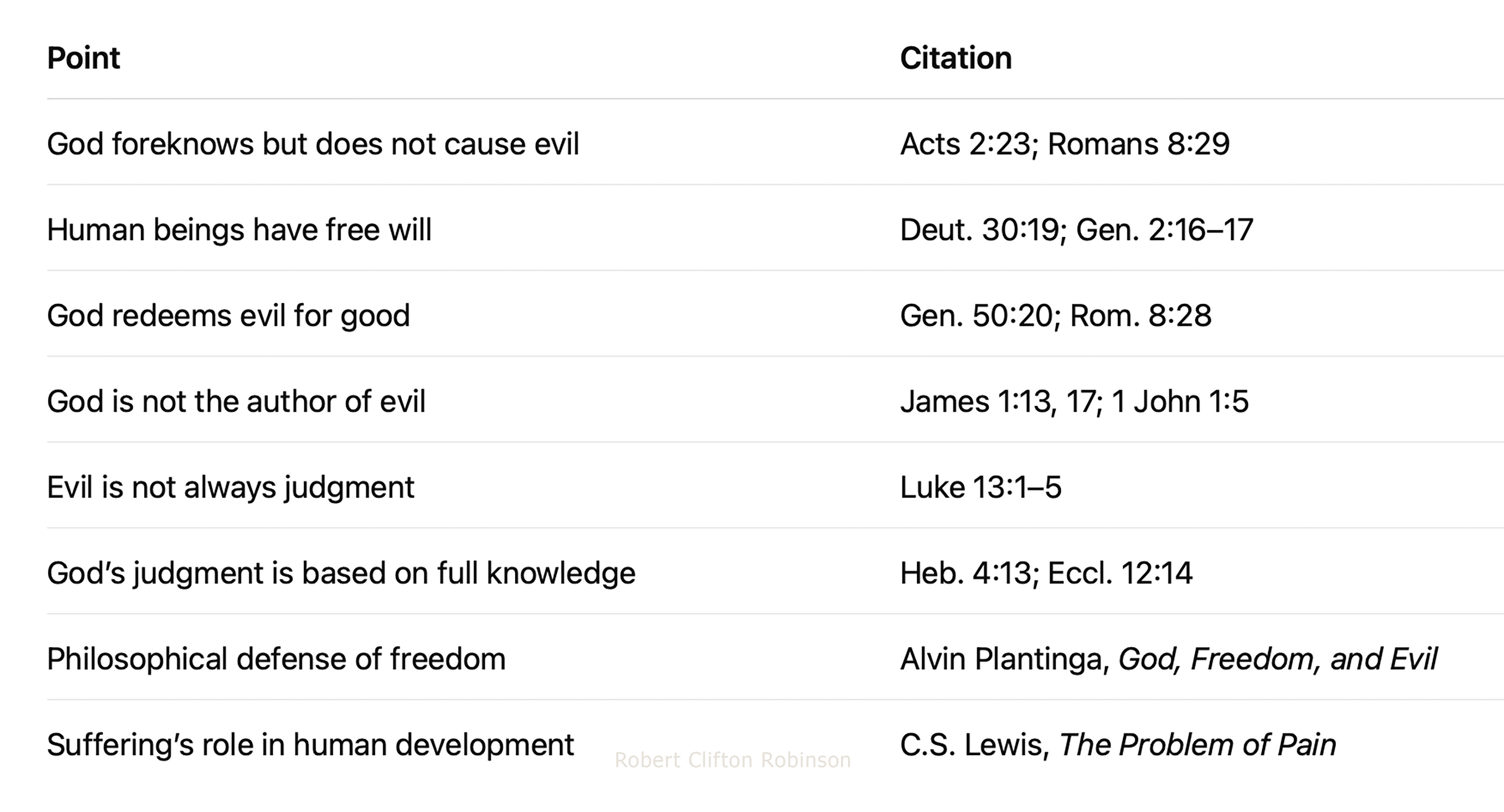
God’s Foreknowledge Does Not Equal Causation
Biblical Evidence:
Acts 2:23: “But God knew what would happen, and His prearranged plan was carried out when Jesus was betrayed. With the help of lawless Gentiles, you nailed him to a cross and killed him.”
This text distinguishes between God’s foreknowledge and human moral responsibility. God knew the crucifixion would happen, and even used it for redemptive purposes, but still held the actors accountable.
Romans 8:29 “For God knew His people in advance, and He chose them to become like His Son…”
God’s foreknowledge (Greek: proginosko) precedes His predestination, but does not equate to coercion.
Free Will and Moral Agency
Deuteronomy 30:19: “Today I have given you the choice between life and death… Oh, that you would choose life…”
God grants humans the moral capacity to choose, reinforcing moral responsibility.
Genesis 2:16–17: “You may freely eat the fruit of every tree in the garden—except the tree of the knowledge of good and evil.”
From the beginning, human beings were granted volitional freedom.
God Permits Evil but Redeems It
Genesis 50:20 “You intended to harm me, but God intended it all for good…”
In Genesis 50;20, Joseph acknowledges human evil but affirms God’s sovereign plan of redemption.
Romans 8:28 “God causes everything to work together for the good of those who love God…”
God sovereignly repurposes evil for His ultimate good, without originating it.
God Is Not the Author of Evil
James 1:13, 17 “God is never tempted to do wrong, and He never tempts anyone else… Whatever is good and perfect is a gift coming down to us from God our Father…”
God is morally perfect and never the instigator of evil.
1 John 1:5 “God is light, and there is no darkness in Him at all.”
God’s nature is completely pure. He cannot author moral evil.
Disasters and Evil Are Not Always Divine Judgment
Luke 13:1–5 “Do you think those Galileans were worse sinners…? Not at all!… And what about the eighteen people who died when the tower in Siloam fell on them? Were they the worst sinners in Jerusalem? No…”
Jesus rejects the idea that all suffering is the result of specific divine punishment.
Philosophical Support – Free Will Defense
Alvin Plantinga, God, Freedom, and Evil (Eerdmans, 1974): “A world containing creatures who are significantly free… is more valuable… even though it allows for the possibility of moral evil.”
Plantinga defends the idea that moral freedom is a greater good, even with the risk of evil.
C.S. Lewis, The Problem of Pain (1940): “Try to exclude the possibility of suffering… and you find that you have excluded life itself.”
Lewis argues that love and growth require the risk of pain.
God’s Judgment Is Perfect Because His Knowledge Is Perfect
Hebrews 4:13 “Nothing in all creation is hidden from God… He is the one to whom we are accountable.”
God’s omniscience ensures perfect judgment of every person and deed.
Ecclesiastes 12:14 “God will judge us for everything we do, including every secret thing, whether good or bad.”
Categories: Robert Clifton Robinson
 Robert Clifton Robinson
I’m so blessed every time I receive your message. You truly have a wonderful gift from God. You write so beautifully and explain everything so well. God has led me to you.
I ordered and am reading your book, Days of Wrath 2025-2029 The Final Days. I am going to give my daughter-in-law a gift of your book and I told her. She wrote back to me and was so thrilled and she shared with me that she and her husband went to your church for 10 years.
She currently has endometrial cancer. I have been praying for her and I am sure she would appreciate it if you would also keep her in your prayers. Her name is Toby Robledo. My daughter also has rectal cancer. God has been answering my prayers throughout this time.
My daughter also, Suzanne Peterson, is a believer; however, she wasn’t relying on God. I prayed and told God that I had done everything that I knew to do and I asked Him to please help her to walk closer. My daughter shortly after told me that she finally realized that she wasn’t relying on God to help her and so she started walking closer with Him. She now has a daily routine that includes taking with Him and praying for His guidance.
Her bloodwork shows considerable improvement. I myself have a long history of issues since I was a young child and I couldn’t have gotten through my life without my heavenly Father. I am so thankful for Him. I don’t want to take up anymore of your time but I do want to let you know how much your messages help me every day. Yours in Christ, Jan Cohea
LikeLiked by 1 person
Thank you for your kind words, and the update on your family. I will be praying for all that you mentioned, and ask the Lord to use these trials to show your loved-ones His incredible love and power to do all things.
I am happy that you are enjoying “Days of Wrath.” In all of my 50 years in studying the prophecies of the Last Days, this year had been the only one that everything necessary for Jesus to come for His church, has been happening all at the same time.
I don’t know if this will be the year that the Lord comes for us, but world events certainly point to this real possibility.
I wait with you and hope that our families turn to Jesus before He arrives.
Blessings,
Rob
LikeLike
I too was lead to Pastor Rob by the Holy Spirit. I have read many of his books. I now have and understanding of salvation that I did not have before. Prayers and blessings for your family always.
The Beginning is near.
LikeLiked by 1 person