This Essay Is An Analysis of The Phrase “No man knows the day or the hour” As A Jewish idiom Directly Linked to the Feast of Trumpets (Yom Teruah)
Today many Christians are unaware of the ancient use of “no man knows the day or the hour,” that originated as a title for the Feast of Trumpets. The cultural and linguistic context of Jesus’ words in Matthew 24:36 (and parallels in Mark 13:32) gives this statement a layer of meaning rooted in the Jewish calendar and its prophetic significance.

“No Man Knows the Day or the Hour” as a Feast of Trumpets Idiom
In First Century Judaism, the Feast of Trumpets (Yom Teruah) was unique among the seven Feasts of the LORD (Leviticus 23). Unlike the other feasts, which were tethered to clear calendar dates (Passover on Nisan 14, Day of Atonement on Tishrei 10, etc.), the Feast of Trumpets began at the sighting of the new moon in Tishrei (the seventh month).
See The Essay: Why The Rapture Is Called: “No Man Knows The Day or the Hour”;
Since the appearance of the new moon could not be calculated precisely (due to possible cloud cover or other atmospheric factors), the exact “day or hour” could not be known in advance. The Sanhedrin required two reliable witnesses to observe and testify of the new moon’s sighting before the feast could officially begin. Thus, the Feast was sometimes colloquially referred to by Rabbis and scholars as “the feast where no man knows the day or the hour.”
Documentation from Rabbinic Sources:
Talmud Bavli, Rosh Hashanah 25a describes the process of two witnesses reporting to the Sanhedrin to confirm the new moon sighting. The Mishnah, Rosh Hashanah 2:7 records that if the moon was not seen, the festival was delayed a day.
Because of this uncertainty, Yom Teruah was celebrated over two days (Yom Arichta — “one long day”), though it was considered a single day extended into two, to accommodate for the unknown start. This led to the popular idiomatic expression that no one could know the exact day or hour of its commencement.
Jesus’ Use of the Phrase in Matthew 24:36
When Jesus said: “But of that day and hour no one knows, not even the angels of heaven, but My Father only.” (Matthew 24:36)
He was not merely stating that the timing of His coming is unknowable, but invoking a well-known Jewish idiom referring to the Feast of Trumpets. His Jewish audience would have understood this layered meaning, much as they understood other Messianic idioms like “the Bridegroom coming for His Bride.”
Thus, this statement subtly points to the Rapture’s association with the Feast of Trumpets.
Paul’s Rapture Descriptions (1 Thessalonians 4:13-18 & 1 Corinthians 15:51-52) and the Feast of Trumpets
Both of Paul’s primary “Rapture” texts contain language and imagery that are deeply rooted in the Feast of Trumpets:
1 Thessalonians 4:16-17: “For the Lord himself will come down from heaven with a commanding shout, with the voice of the archangel, and with the trumpet call of God. First, the Christians who have died will rise from their graves. Then, together with them, we who are still alive and remain on the earth will be caught up (harpazo) in the clouds to meet the Lord in the air.”
1 Corinthians 15:51-52: “But let me reveal to you a wonderful secret. We will not all die, but we will all be transformed! It will happen in a moment, in the blink of an eye, when the last trumpet is blown. For when the trumpet sounds, those who have died will be raised to live forever.”
Connections to the Feast of Trumpets:
- “Trumpet call of God” (1 Thess. 4:16) — The Feast of Trumpets is the only feast characterized by the blowing of trumpets (shofar blasts) as its central theme (Leviticus 23:23-25).
- “Last Trumpet” (1 Cor. 15:52) — Among the 100 trumpet blasts sounded on Yom Teruah, the final, long blast is called the Tekiah Gedolah (the “Great Trump”).
- Resurrection imagery — The resurrection of the dead (Daniel 12:2) was a key eschatological theme associated with the Feast of Trumpets in Jewish thought.
- “Caught up in the clouds” — The wedding motif of the Jewish bridegroom lifting up his bride, combined with the “clouds of glory” imagery, matches perfectly with the Rapture’s description.

The Prophetic Pattern of the Feasts and the Rapture’s Timing
As I have Published in my books and essays, Jesus fulfilled the first four feasts (Passover, Unleavened Bread, First Fruits, Pentecost) literally and precisely. It is reasonable, then, to expect that He will fulfill the last three (Trumpets, Atonement, Tabernacles) with the same precision.
In 2025 The Feast of Trumpets Takes Place During September 22-24
This means that the Feast of Trumpets is likely the intended time (Mo’ed) that Jesus meant for the Rapture:
- Trumpets (Yom Teruah) — Rapture of the Church
- Atonement (Yom Kippur) — Israel’s National Repentance (Zechariah 12:10)
- Tabernacles (Sukkot) — Messiah’s Kingdom on Earth (Millennial Reign)
The Jewish Wedding Idiom in Context
It’s also significant that the Jewish bridegroom would not know the exact day or hour he would return for his bride, because it was the Father who determined the timing. This perfectly parallels Jesus’ statement “but My Father only” — reinforcing the idea that His coming for His bride (the Church) mirrors the Jewish wedding custom.
The phrase “No man knows the day or the hour” is not an idiom of general ignorance, but a direct pointer to the Feast of Trumpets. Jesus’ Jewish listeners would have recognized this, understanding the cultural, calendrical, and prophetic implications.
When Paul speaks of the trumpet of God, the last trumpet, and the resurrection/rapture of believers, he is anchoring these eschatological events within the context of the Feast of Trumpets.
The conclusion that the Rapture is intricately linked to the Feast of Trumpets is not only plausible—it is theologically sound, culturally consistent, and prophetically aligned with the biblical feasts’ fulfillment pattern.
- Matthew 24:36: “However, no one knows the day or hour when these things will happen, not even the angels in heaven or the Son himself. Only the Father knows.” Jesus’ statement referencing the unknown timing of the Feast of Trumpets, idiomatic to Jewish culture.
- Leviticus 23:23-25: T”he LORD said to Moses, ‘Give the following instructions to the people of Israel. On the first day of the appointed month in early autumn, you are to observe a day of complete rest. It will be an official day for holy assembly, a day commemorated with loud blasts of a trumpet.'”
- 1 Thessalonians 4:16-17: “For the Lord himself will come down from heaven with a commanding shout, with the voice of the archangel, and with the trumpet call of God.” Paul’s description of the Rapture correlating with the trumpet call of God, tied to the Feast of Trumpets. Jesus’ removal of His church from Earth is preceded by a voice and a Trumpet call of God.
- 1 Corinthians 15:51-52: “But let me reveal to you a wonderful secret. We will not all die, but we will all be transformed! It will happen in a moment, in the blink of an eye, when the last trumpet is blown.” Paul’s reference to the ‘last trumpet,’ which is characteristic of the Feast of Trumpets’ final blast (Tekiah Gedolah).
- Talmud Bavli, Rosh Hashanah 25a: Describes the procedure for the Sanhedrin to receive testimony of the new moon sighting by two witnesses. Illustrates why the Feast of Trumpets was called ‘the day and hour no man knows.’
- Mishnah, Rosh Hashanah 2:7: If witnesses failed to report the new moon, the festival would be postponed by a day. Explains the uncertainty in determining the exact start of Yom Teruah.
- Zechariah 12:10: “Then I will pour out a spirit of grace and prayer on the family of David and on the people of Jerusalem. They will look on me whom they have pierced and mourn for him as for an only son.” Atonement (Yom Kippur) typology following the Rapture (Trumpets), Israel’s national repentance.
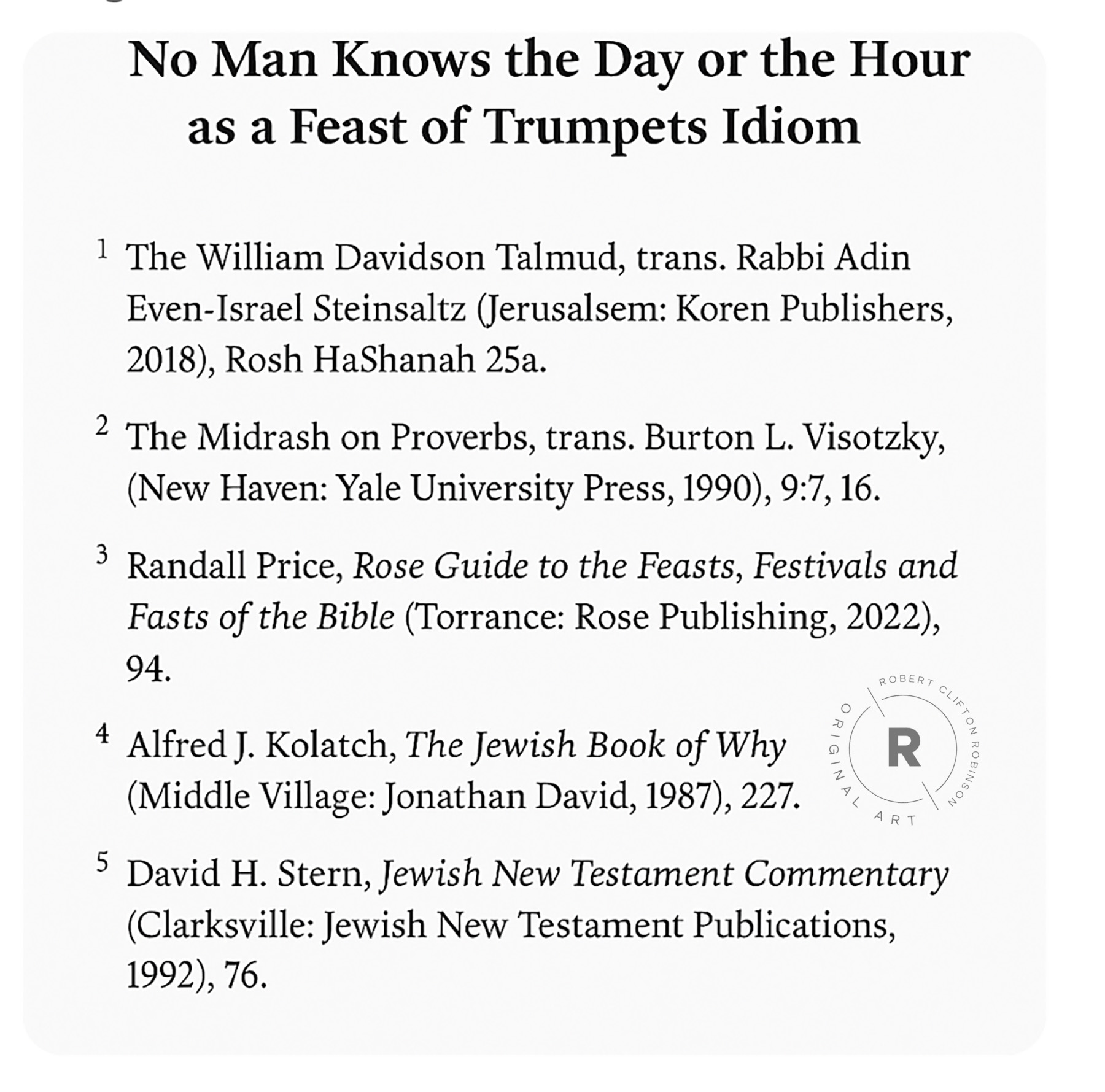
Citations and Sources:
Categories: Robert Clifton Robinson
 Robert Clifton Robinson
Thus, the Feast was sometimes colloquially referred to by Rabbis and scholars as “the feast where no man knows the day or the hour.”
Hi there, do you have a historical quote to prove this? I can’t find any in my internet search, only Christians claiming it referred to yom teruah.
LikeLike