Mark 13:34 Presents A Statement By Jesus that He Will Arrive During The Night Hours (Jerusalem-Time) During The Feast Of Trumpets:
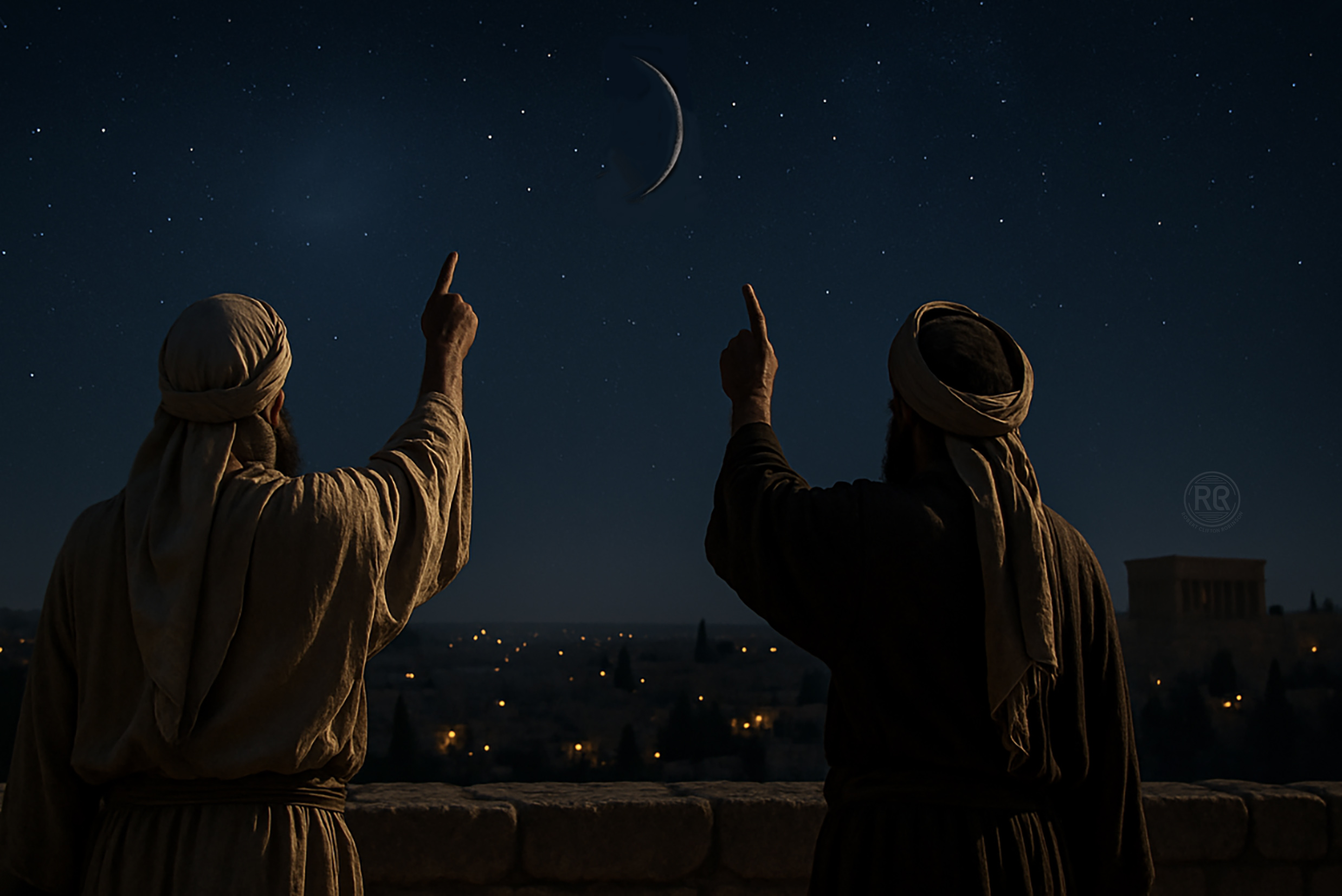
The Two Witnesses of Rosh Chodesh
It is interesting in Mark’s Gospel (Peters testimony) that he recorded the words of Jesus in a very specific manner concerning the timing of Jesus’ return for His church:
Mark 13:34-37 “The coming of the Son of Man (Messiah) can be illustrated by the story of a man going on a long trip. When he left home, he gave each of his slaves instructions about the work they were to do, and he told the gatekeeper to watch for his return. 35 You, too, must keep watch! For you don’t know when the master of the household will return—in the evening, at midnight, before dawn, or at daybreak. 36 Don’t let him find you sleeping when he arrives without warning. 37 I say to you what I say to everyone: Watch for him!”
Notice that Jesus is instructing those who are waiting and watching for His return that He will come during the night hours (Jerusalem-Time). This language indicates that Jesus was referencing a well known Jewish event that only took place during the night watch hours when the Feast of Trumpets arrived. Jews of the first century called the Feast of Trumpets: “no man knows the day or the hour,” because it could happen, “in the evening, at midnight, before dawn, or at daybreak,” during a two day period.
Jerusalem-Time is where the record keeping for all Feasts are set. Wherever we live on earth, we must adjust our time to Jerusalem-time, to know the precise moment when the Feast of Trumpets begins.
The Feast of Trumpets is the fifth Feast of the Lord. Jesus fulfilled the first four Feasts, on the exact day and in the precise way, these Feasts must be fulfilled. Passover, Unleavened Bread, Firstfruits, and Pentecost.
Two witnesses are watching in Israel during this two-day Feast, for the moment when they see the beginning of the thin silver horns of the moon that begins the Feast of Trumpets. This can only happen, “At evening, at midnight, before dawn, or a daybreak.” Jesus intentionally referenced this Feast and the occurrence of the silver horns of the moon, in Mark chapter 13.
This Year The Feast of Trumpets occurs when the Waxing Crescent takes place on September 24, 2025.
According to the instructions of the Sanhedrin, two witnesses must watch in the evening for the horns of the moon to appear before declaring, “Rosh Chodesh, the moment when the Feast of Trumpets arrives.
I find it interesting that Jesus’ instructions in Mark 13:34, only includes “evening, at midnight, before dawn, or at daybreak,” not morning or during the daylight hours. It seems that Jesus is giving us a specific clue for the time when He will come for His church, (1 Thessalonians 4:13-18. Jesus tells us that His arrival is tied to the evening when the two witnesses are watching for the precise moment when the Moon is at its waxing crescent.
The Context of Mark 13:34–37
In this text, Jesus frames His return with a parable of a master who has gone on a long journey and tells his servants to stay awake and alert. The watch times Jesus mentions are:
- Evening (6–9 pm)
- Midnight (9 pm–12 am)
- Before dawn (12–3 am)
- Daybreak (3–6 am)
Notice that Jesus does not mention daytime hours. This raises the question: Why would He restrict His illustration to the night watches?
Jewish Timekeeping and the Watches
By the first century, Jews in Judea often used the Roman division of four watches of the night rather than the older Jewish three-watch system. Jesus clearly references these four:
- Evening (ὀψὲ) – ~6–9 pm
- Midnight (μεσονύκτιον) – ~9 pm–12 am
- Cockcrow / Before Dawn (ἀλεκτοροφωνίας) – ~12–3 am
- Daybreak (πρωΐ) – ~3–6 am
The Feast of Trumpets Is The Only Feast That Has a Night Watch
The Feast of Trumpets is the only feast that begins on the first day of the month (Tishri 1).
In the biblical and early rabbinic system, months began only when two witnesses confirmed the sighting of the waxing crescent moon. Because the crescent could appear on one of two nights (depending on visibility and conditions), the exact day of Trumpets could not be predicted in advance.
For this reason, watching through the night was necessary for the Feast of Trumpets— and why Jesus’ “evening, midnight, cockcrow, or morning” warning in Mark 13:35 resonates so closely with it.
The Other Feasts of the Lord
- Passover (Nisan 14) — fixed date once the month began; no need for night watch.
- Unleavened Bread (Nisan 15–21) — follows Passover automatically.
- Firstfruits (the day after the Sabbath following Passover) — determined by the weekly cycle, not moon-watching.
- Pentecost (Shavuot) — counted seven weeks from Firstfruits.
- The Day (Feast) of Atonement (Tishri 10) — fixed date, already known once Tishri 1 was set.
- The Feast of Tabernacles (Tishri 15–22) — likewise fixed date.
None of these other Feasts of the Lord required night watching for their start date; they were known in advance after the month’s beginning was sanctified. In Mark 13:34, Jesus makes a deliberate statement that emphasizes night watching. This seems to indicate for us that the time He will return for His church is during the Feast of Trumpets, the only Feast that requires a “Night Watch.”
These events described by Jesus in Mark 13:34 will happen according to Jerusalem-Time. We have to adjust our own time, wherever we live on Earth, to the time events take place in Jerusalem.
To “watch” is not a literal staying awake all night to wait for Jesus during the two nights of Trumpets. Jesus is saying that we who love Him should not be sleeping as the world is (unaware), but awake, understanding the signs and times of His arrival.
Wherever we are on Earth when Jesus comes for us, we will all meet Him in the air (1 Thessalonians 4:13-18).
- Why The Rapture Is Called: “No Man Knows The Day or the Hour”
- Is The Term: “No Man Knows The Day Or The Hour”; A Hint By Jesus For The Time When He Will Return For His Church?
- The Seven Feasts and the Rapture
The Feast of Trumpets Connection
The Feast of Trumpets (Yom Teruah/Rosh Hashanah) is unique among the feasts in that:
- It begins at the sighting of the new moon (Rosh Chodesh).
- Two witnesses of the Sanhedrin were required to testify that they had seen the first sliver of the waxing crescent.
- Since the new moon is faint and may appear at different times depending on weather and sky clarity, watching through the night hours was necessary.
- The ancient Jews called the Feast of Trumpets, “No man knows the day or the hour,” because the beginning of the Feast of Trumpets could happen anytime during the two day Feast.
This required vigilant night watches—precisely the hours Jesus names in Mark 13:35.
The Prophetic Hint
By saying His return could be at evening, midnight, before dawn, or daybreak, Jesus may be aligning His return for HIs church (the Rapture, 1 Thess. 4:13–18; 1 Cor. 15:51–52) with the Feast of Trumpets, the only feast tied to the sighting of the moon, during the night hours of Israel time.
This would reinforce the Jewish idiom for this feast: “No one knows the day or the hour” (since the exact moment of the new moon could not be predicted).
This becomes subtle clue to His disciples, who were already aware of the name for the Feast of Trumpets.
The 2025 Importance:
- The next Feast of Trumpets takes place in 2025 on September 22–24, 2025.
- The waxing crescent (visible horns of the moon) is expected on September 24, 2025.
- This aligns with Jesus’ words about night watches and the two witnesses declaring the beginning of the feast.
It is interesting that in Mark’s record (Peter’s testimony) of Jesus words, He seems to preserve this detail not only as a call to watch but also as a prophetic marker for the time when the Rapture will happen.
Jesus could be deliberately narrowing the illustration to the night watches to align His hearers with the practice of watching for the new moon. Since the Feast of Trumpets is the feast of the “unknown day and hour” and is tied to the very concept of watching at night for the crescent moon, His words carry a hidden prophetic clue. For this reason, Mark 13:34–37 may not just be a general call to stay awake spiritually, but a subtle alignment with the Feast of Trumpets as the appointed time of His return for the church.
Mark 13:34–37, the Night Watches, and the Feast of Trumpets (Yom Teruah):
Mark’s four “night-watch” markers (evening, midnight, cock-crow, morning) are the Roman divisions of the night and function first as a call to continual vigilance. This watch-illustration also follows the historical procedure that the new crescent moon appears that begins the Feast of Trumpets.
How the Feast of Trumpets actually began in the second Temple and Early Rabbinic Tradition
Observational beginning: In the pre-fixed calendar era, months began when witnesses reported sighting the first visible (waxing) crescent after sunset; the court interrogated them and then sanctified the new month by proclamation (“mekudash, mekudash”).
Once the two witnesses had been thoroughly evaluated for their truthful account of the new moon, the President of the Sanhedrin would announce the beginning of the “Rosh Chodesh” (new month), with the words: “Sanctified.” This would happen even on Shabbat for Tishri/Nisan. Following the President’s declaration that the horns of the moon had been seen, all the people would answer: Sanctified.”
 This process was uncertain because the horns of the moon could occur anytime during the two days of the Feast of Trumpets. Because the arrival of the witness could be delayed, authorities sometimes had to treat two days as holy to cover any uncertainty. In one case the testimony of the two witnesses was received after the afternoon sacrifice, resulting in both that day and the next day that were observed as Trumpets (Rosh Hashanah.)[A]
This legal history of Israel explains why the Feast of Trumpets is observed for two days instead of just the moment when the moon reaches the correct phase of waxing crescent (as in the image).[1]
This means that during the time that Jesus said: “no man knows the day or the hour,” people did not know ahead of the event, which evening the court would sanctify as the start of Trumpets. This uncertainty explains why Jesus said: “no one knows…”[2] but in Mark’s Gospel, Jesus gives us four night watch times to specify the event He is speaking of is the Feast of Trumpets for His return for His church.[3]
Some biblical expositors today say that Matthew 24:36/Mark 13:32 is an abiding idiom for Rosh Hashanah. In New-Testament eschatology the writers repeatedly relate the Lord’s appearing with a trumpet: Paul’s “last trumpet” (1 Cor 15:52) and “the trumpet of God” (1 Thess 4:16), and Jesus’ “great trumpet” gathering the elect (Matt 24:31). These events relate to the Jewish Yom Teruah (“day of blasting”). This thematic overlap is real, though the texts stop short of pinning the Parousia to that calendar date.[4]
Noting the Night-Watch Nuance in Mark’s Narrative
There is a fact that we should pay attention to in Mark’s four watches in 13:35 that also pictures the crucifixion events as they unfold “in the evening” (14:17ff), “at midnight” (Gethsemane, 14:32ff), “at cockcrow” (Peter’s denial, 14:72), and “in the morning” (trial before Pilate, 15:1). On this reading, the exhortation is describing the approaching suffering of Jesus and the need to stay awake with Jesus.[5]
Trumpets in 2025
The Astronomical new moon on Sunday, Sep 21, 2025 ~19:54 UTC (≈ 22:54 Israel time), will be visibility in the Eastern part of the Mediterranean on the evenings of Sep 22–23 (depends on local conditions). In the fixed (rabbinic) calendar, Rosh Hashanah 5786 begins at sundown Monday, Sep 22, 2025; day 2 continues through Wednesday, Sep 24. (Local observance begins at local sunset.)[6]
Note: the visible crescent is an after-sunset phenomenon; we cannot not see a new crescent at midnight or before dawn (it sets shortly after the sun). Thus Mark’s four watches are best read as comprehensive-night vigilance, not four separate crescent-viewing windows.
The Strong Historical Precedence : Mark’s “night watches” descriptions aligns with real-world uncertainty surrounding the observational start of Tishri 1; and the trumpet motif in Jesus/Paul clearly resonates with Yom Teruah..[7]
The observation that Jesus mentions four nighttime events in context with His arrival for His church during the Feast of Trumpets is textually relevant and historically supported: Mark’s night-watch language fits both the Roman accounts and the historical uncertainty around the Feast of Trumpets beginning in the observational calendar. This idea supports (without proving) a trumpet-feast resonance for Jesus’ return. This view does not set a date while allowing for the historical and scriptural reality that exists.
The following are Rabbinic sources, Sanhedrin testimony requirements, and the Early church writings) that support this connection between Mark 13:35-37 and the Feast of Trumpets
The New Testament Texts (Greek and English)
Mark 13:35 (Greek)
γρηγορεῖτε οὖν· οὐκ οἴδατε γὰρ πότε ὁ κύριος τῆς οἰκίας ἔρχεται, ὀψὲ ἢ μεσονύκτιον ἢ ἀλεκτοροφωνίας ἢ πρωΐ.
New Testament English Translation:
“So you, too, must keep watch! For you don’t know when the master of the household will return—in the evening, at midnight, before dawn, or at daybreak.”
These four Greek terms correspond to the Roman four night-watches:
- ὀψὲ (opse, “evening,” ~6–9 pm)
- μεσονύκτιον (mesonyktion, “midnight,” ~9 pm–12 am)
- ἀλεκτοροφωνίας (alektorophōnias, “cockcrow,” ~12–3 am)
- πρωΐ (prōi, “early morning/daybreak,” ~3–6 am)
Jewish Night-Watches
Mishnah Berakhot 1:1
“From when may they recite the Shema in the evening? From the time the priests enter to eat their terumah until the end of the first watch. These are the words of Rabbi Eliezer. But the Sages say: Until midnight…”
This proves that the older Jewish three-watch system (evening, midnight, morning) changed in the first century, under Roman influence, became, four watches were also used (cf. Mark 13:35).
Witnesses for the New Moon
Mishnah Rosh Hashanah 2:5
“If the court itself and all Israel saw [the new moon], and the witnesses were examined, and the court had sanctified it, then if night fell before they could say: ‘Sanctified,’ the month is intercalated.”
Mishnah Rosh Hashanah 3:1
“On two occasions witnesses may desecrate the Sabbath: For the appearance of the new moon of Nisan and the new moon of Tishri, because on these two months messengers are sent out to Syria, and in them the appointed times are fixed.”
The Sanhedrin required two witnesses to testify they had seen the crescent. Even Sabbath laws were suspended for this testimony in Nisan and Tishri, showing the importance of declaring Rosh Chodesh for the Feast of Trumpets.
Rabbinic Codification
Maimonides (Rambam), Mishneh Torah, Kiddush HaChodesh 2:1
“By Torah law, the new month is sanctified only by the Great Court in Eretz Yisrael. How do they sanctify it? When witnesses come before them who have seen the new moon, they question them and, if their words are consistent, they sanctify the month and proclaim: ‘Sanctified! Sanctified!’”
The Uncertainty of the Day
Mishnah Rosh Hashanah 4:4
“Originally they would accept testimony [about the new moon] all day. Once the witnesses tarried and did not arrive, and they confused the Levites in their song. From then on they decreed that they would only accept testimony until the time of the afternoon sacrifice. If witnesses came after that time, both that day and the following day were sanctified.”
This is the origin of the two-day observance of Rosh Hashanah, even in Israel: because one could not know in advance which day the Feast would fall upon.
Exegetical Implication
Jesus’ night-watch imagery (Mark 13:35) matches the Roman four-watch system, but the limitation to night hours resonates with the actual nighttime uncertainty of sighting the new moon.
“No one knows the day or hour” (Mark 13:32; Matt 24:36) fits the lived reality of Rosh Hashanah, when people literally did not know which evening would be sanctified.
Paul’s “last trumpet” (1 Cor. 15:52) and “trumpet of God” (1 Thess. 4:16) further tie the resurrection and rapture imagery to the Feast of Trumpets (Yom Teruah).
In Mark 13:35, Jesus Emphasizes: “Therefore, stay awake—for you do not know when the master of the house will come, in the evening, or at midnight, or at the cockcrow, or in the morning.”[8]
The four divisions reflect the Roman four-watch system rather than the older Jewish three-watch division.[9] Jesus’ restriction to night hours is striking, for it echoes the practical reality of watching for the crescent moon that initiated the Feast of Trumpets (Yom Teruah).
The Mishnah states that two witnesses had to testify before the Sanhedrin that they had sighted the new crescent moon of Tishri, even suspending Sabbath laws for this testimony.[10] Rambam later codified this practice, noting the court proclaimed “Sanctified! Sanctified!” once their words were found consistent.[12]
Because witnesses sometimes arrived late, the Mishnah records that both that day and the next could be sanctified—the origin of the two-day observance of Rosh Hashanah.[13] Thus, in the first century, “no one knew the day or hour” of the feast’s arrival until the court declared it.
The New Testament further ties the return of Jesus for His church to the Feast of Trumpets: Paul writes that the resurrection and rapture will occur “at the last trumpet” (1 Cor. 15:52) when “the trumpet of God” sounds (1 Thess. 4:16).6 This strengthens the case for a typological link between Jesus’ return and the Feast of Trumpets.[14]
Sources and Citations
[1] Roman four watches / “cockcrow” as a watch term: Mark 13:35 uses alektorophōnia; standard lexica and notes identify it as a Roman-watch marker; see Blue Letter Bible (lexical entry G219) and classic dictionary discussions.
[2] Jewish three watches: Mishnah Berakhot 1:1; b. Berakhot 3a discuss three watches.
[3] Witness-based sanctification & “mekudash”: Rambam, Kiddush ha-Ḥodesh (esp. chs. 2–3, 6, 18); overviews in OU Press and Chabad.
[4] Two-day Rosh Hashanah from late testimony: Mishnah Rosh Hashanah 4:4 (with modern summaries).
[5] Trumpet texts: 1 Thess 4:16; 1 Cor 15:52; Matt 24:31.
[6] Literary linkage of Mark’s watches to the Passion: representative treatment at WorkingPreacher.
[7] 2025 timing: timeanddate (new moon Sep 21, 2025 ~19:54 UTC) and Hebcal (RH 5786: Sep 22 at sundown → Sep 24).
[8] Mark 13:35, author’s translation; Greek: “γρηγορεῖτε οὖν· οὐκ οἴδατε γὰρ πότε ὁ κύριος τῆς οἰκίας ἔρχεται, ὀψὲ ἢ μεσονύκτιον ἢ ἀλεκτοροφωνίας ἢ πρωΐ.”
[9] Mishnah Berakhot 1:1; cf. Babylonian Talmud, Berakhot 3a. For the Roman four-watch system, see C. S. Keener, The IVP Bible Background Commentary: New Testament (Downers Grove, IL: InterVarsity, 1993), 166.
[10] Mishnah Rosh Hashanah 3:1; cf. Rosh Hashanah 2:5. See also Herbert Danby, The Mishnah (Oxford: Clarendon, 1933), 190–93.
[11] Maimonides (Rambam), Mishneh Torah, Kiddush ha-Chodesh 2:1. English in Moses Maimonides, Mishneh Torah: Book of Seasons, trans. Solomon Gandz, ed. Julian Obermann and Harry Blumberg (New Haven: Yale University Press, 1961), 1:5–6.
[12] Mishnah Rosh Hashanah 4:4. Translation in Danby, Mishnah, 194.
[13] 1 Corinthians 15:52; 1 Thessalonians 4:16; cf. Matthew 24:31.
[14] For discussion, see Michael L. Brown, Answering Jewish Objections to Jesus, vol. 3 (Grand Rapids: Baker, 2003), 136–39; note Brown’s caution that while the concept of uncertainty matches Trumpets, the idiom “no one knows the day or the hour” as a technical phrase is not documented in rabbinic literature.
Bibliography
- Brown, Michael L. Answering Jewish Objections to Jesus. Vol. 3. Grand Rapids: Baker, 2003.
- Danby, Herbert, trans. The Mishnah. Oxford: Clarendon Press, 1933.
- Keener, Craig S. The IVP Bible Background Commentary: New Testament. Downers Grove, IL: InterVarsity Press, 1993.
- Maimonides, Moses. Mishneh Torah: Book of Seasons. Translated by Solomon Gandz. Edited by Julian Obermann and Harry Blumberg. New Haven: Yale University Press, 1961.
- The Babylonian Talmud. Berakhot 3a. Standard Vilna Edition.
- The Mishnah. Berakhot 1:1; Rosh Hashanah 2:5; 3:1; 4:4.
Categories: Robert Clifton Robinson


In the following article, https://apnews.com/article/france-israel-gaza-palestinians-macron-5fc1f17fbeb0f5c7a7bdf21f987ccced
This means many countries will recognize a Palestinian state on September 23.
LikeLike
Does this mean we need to actually stay awake during the Feast of Trumpets this year, and not sleep on those nights so we can watch for Jesus return since we don’t know the exact time or day?
LikeLiked by 1 person
No, these events will happen according to Jerusalem-Time. We have to adjust our own time, wherever we live on Earth, to the time events take place in Jerusalem.
To “watch” is not a literal staying awake all night to wait for Jesus during the two nights of Trumpets. Jesus is saying that we who love Him should not be sleeping as the world is (unaware), but awake, understanding the signs and times of His arrival.
Wherever we are on Earth when Jesus comes for us, we will all meet Him in the air (1 Thessalonians 4:13-18).
Maranatha!
LikeLiked by 1 person