When The Disciples of Jesus Asked Him About The Time When He Will Return, He Said, “Do Not Be Deceived.”
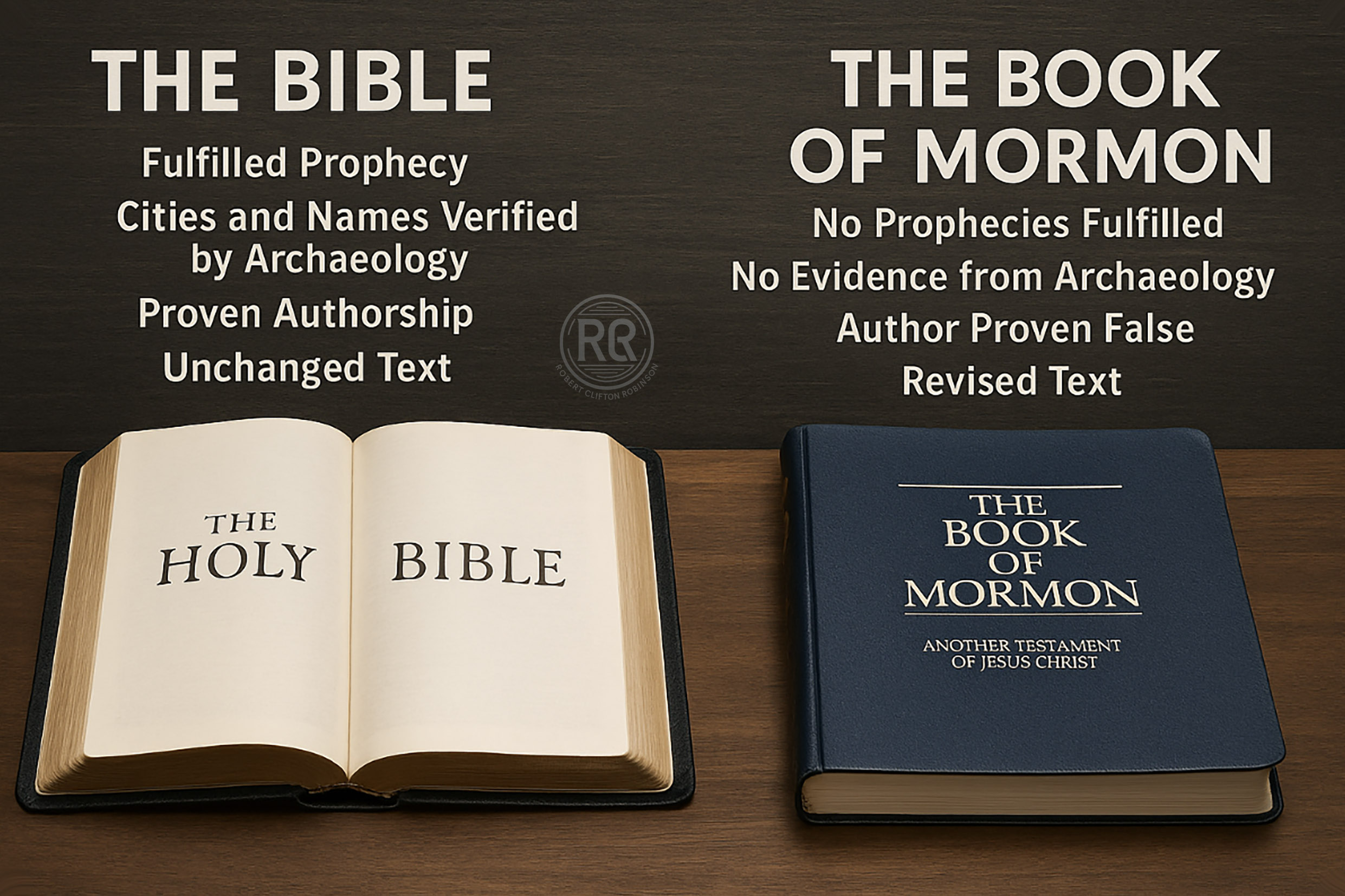
The primary principle that every person seeking the truth of God should remember is that satan is a very religious being. There is no possibility that he can convince the world that Jesus did not exist, or that He died on a Roman cross for all sins. It’s not possible to prove that Jesus did not rise from the dead, and that all sins are paid for by Jesus’ death for all sins.
What is possible, and history proves this is true, is the fact that false religious systems are constantly being created for the purpose of deception.
There is no religion that bears greater evidence of deception than the LDS or Mormon religion. When we conduct a scholarly examination of the History, Archeology, Literary, and Practical attributes of Mormon Theology, it is quite easy to impeach this religion as one that Jesus described as a work of deception.
This Essay Documents Just Five of the Key Indictments Against The Book of Mormon
- “Not one prophecy fulfilled”;
- “Not one ancient city ever discovered”;
- “The author lied about his ability to translate the plates”;
- “The plates were fabricated to prove Joseph Smith did not understand the language he claims the BoM was translated from”;
- “The book has been revised numerous times to cover for serious errors.”
The following is a detailed evaluation of each claim, often stated by many biblical scholars.. For each one I present: (a) the critique; (b) what LDS apologists or scholars say in response; (c) an assessment (including strengths and weaknesses).
“Not one prophecy fulfilled”
(a) The critique
Critics assert that no prophecy in the BoM can be clearly verified as historically fulfilled outside the text, or that prophecies are too vague or conditional to count as fulfilled. For example, some say the prophetic material in the BoM is either internal (prophecy → fulfillment later in the BoM text) or not sufficiently specific or verifiable by independent means.
One writer argues: “There exists no credible archaeological evidence … the BoM is not a record of highly literate ancient American people of Hebrew descent.”
Another states that certain BoM prophecies are “ambiguous” and not convincingly fulfilled.
Source: https://puritanboard.com/threads/mormon-prophecies.73519/?utm_source=chatgpt.com
(b) LDS response
LDS-friendly sources assert that the BoM does contain numerous fulfilled prophecies—for instance, “internally-fulfilled” within the book, and also some they believe correspond to external realities. For example, one article says: “The Book of Mormon records the fulfillment of more than 100 prophecies.”
On archaeology LDS advocates state that lack of discovery of a specific city does not mean prophecy hadn’t been fulfilled—some prophecies are conditional, and some events may yet be located.
(c) Assessment
Strengths of the LDS response:
Many of the prophecies in the BoM are indeed internal (i.e., one part of the BoM predicts something later in the BoM) rather than independently documented historical events.
From mainstream archaeology and historical scholarship, there is no widely accepted identification of major BoM cities with known ancient American ruins. For example: “There have been no spectacular finds… no Zarahemla discovered, no gold plates brought to light, no horses uncovered…”
Some prophecies or claims (e.g., “horses” in the Americas or “steel swords” etc) are contested on anachronism grounds.
Source: https://en.wikipedia.org/wiki/Archaeology_and_the_Book_of_Mormon?utm_source=chatgpt.com
Weaknesses of the LDS response:
If the criterion is internal textual fulfillment (prophecy in BoM, later BoM event), then the LDS side has merit. That does not necessarily meet the stronger criterion of external verification.
If Christians used this same standard (internal prophecies) for concluding that the Bible is the Word of God, it would have been discarded and ignored centuries ago. What makes the Bible truthful, accurate and reliable, are the thousands of predicted and historically fulfilled prophecies (externally) that have accumulated over the period of human history.
See The 400 Old Testament Prophecies of the Messiah Jesus Fulfilled in the New Testament
Some of these archaeological or historical findings (e.g., ancient roads, burial sites) are argued by LDS apologists to correlate with BoM content (though these are debated). The confirmation for these citations in the Book of Mormon, are only cited in this book, but cannot be validated by archeological discovery.
The idea that prophecy may include conditional or contingent language—that is, “if you do x, then y will happen” (see LDS apologetic note on false prophecy possibility). When God speaks through the Old Testament prophets, these prophecies have both an earlier and later fulfillment of the same prophecy.
If an Old Testament prophet predicted an earlier event that must take place during the life of that prophet, and this prophecy did not happen as the prophet wrote, this prophet would have been stoned to death and all of his words stricken from the Bible.
The fact that we find both the Old Testament prophets, their earlier and later predictions still in the Bible, means that the earlier prophecies did happen as the prophets wrote.
We do not find these attributes in the Book of Mormon. We find speculative internal citations with no prophetic fulfillment recorded anywhere, at any time.
End Result:
If by “fulfilled prophecy” LDS advocates mean documented, independently verifiable historical prophecy from the BoM that came true exactly as stated, then the critique has merit only because these alleged prophecies are written, not because there is a historical record they were fulfilled outside the Book of Mormon.
This is in contrast to Jesus’ prophecy in Matthew 24 where He stated that Jerusalem and the Temple would be completely destroyed within one generation, and secular history records this event by the Roman Army General in 70 AD. The fulfillment of this prophecy by Jesus, is not recorded in the New Testament.
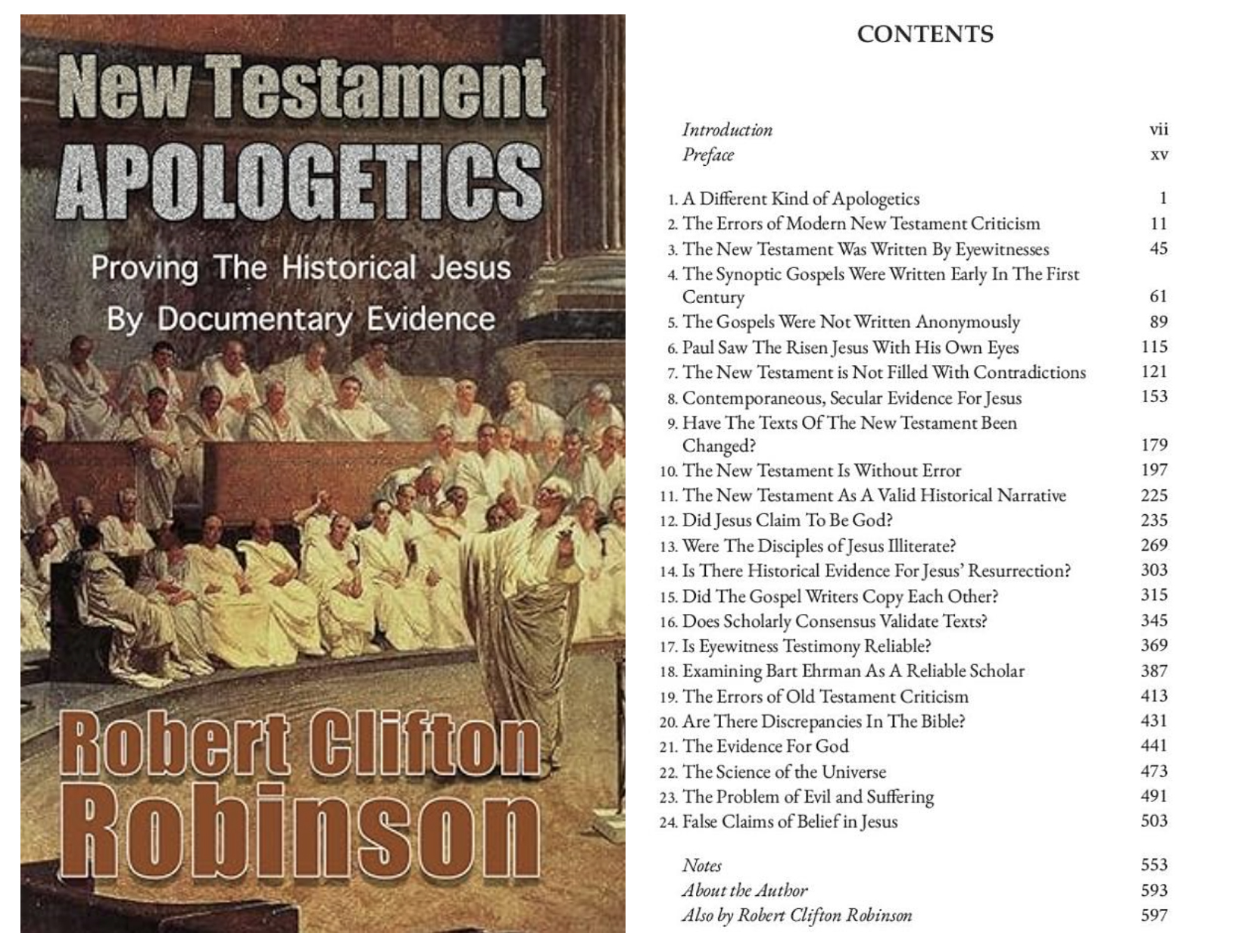
See: “New Testament Apologetics,” by the same author
This proves that what is written in the Synoptic Gospels was written before the events of 70 AD, very early in the first century. Second, that we can confirm bible prophecy by secular historical documentation. This is not true of any LDS, Book of Mormon prophecy.
: the evidence is not broadly accepted outside LDS circles. If LDS advocates use a broader definition (including internal fulfillments), then the LDS claim has some footing.
As a biblical scholar, While the Book of Mormon claims many prophecies, the major academic consensus is that the strongest externally verified fulfillments remain unproved, and are therefore, untenable.
“Not one ancient city ever discovered”
(a) The Issue
The claim is that the Book of Mormon mentions numerous large cities (e.g., Zarahemla, Nephi, etc.) inhabited by tens or hundreds of thousands, yet none of these have been definitively identified by mainstream archaeology as corresponding to ancient American sites, is a serious omission.
For example, one (non-Mormon) critique says: “As far as I know there is not one professionally trained archaeologist, who is not a Mormon, who sees any scientific justification for believing the historicity of the Book of Mormon.”
Source: https://en.wikipedia.org/wiki/Archaeology_and_the_Book_of_Mormon?utm_source=chatgpt.com
Another says “We still don’t know where the cities mentioned in the Book of Mormon are located.”
(b) LDS response
LDS apologists often respond:
Archaeology is ongoing and absence of proof is not proof of absence.
Some possible correlates or consistent patterns have been found: e.g., ancient highways, burial sites, place-names like “Nahom” in Arabia (for Lehi’s journey) which they argue correspond to BoM geography. 
Source: https://www.ldsliving.com/tag/archaeology?utm_source=chatgpt.com
It should also be noted that many of the statements in the Book of Mormon, these details are consistent with what is known of ancient American civilization (according to LDS scholars).
(c) Assessment
The Strengths of the argument:
It is correct that mainstream archaeology has not accepted a specific city as “Zarahemla” or “Nephi” with universal consensus.
Concerning the validation of the New Testament, in past history, because many of the cities, people, and events described by the Book of Acts, were not found in archeology, the New Testament was defined as a work of fiction.
Today a majority of the cities, persons, and events described by the Book of Acts, have been validated by archeology.
If we apply these same historical standards of archeological verification to the Book of Mormon, we cannot validate anything in these texts as historical proven true.
Many of the described features (e.g., large populations, certain animals, technologies) are disproven by non-LDS archaeology.
The weaknesses of the LDS response:
The LDS position that “search continues” is intellectually modest (though whether it gains traction depends on the evidence quality). The possibility of limited-geography models or reinterpretation of BoM setting complicates the “none discovered” statement (if locations may not match earlier models).
The statement “not one ancient city described in the Book of Mormon has ever been discovered” is correct under the standards used to validate the Bible and other important works of history.
“The author, Joseph Smith, lied about his ability to translate the plates”
(a) The critique
The implication is that Joseph Smith claimed he translated the gold plates (or other ancient records) by divine means, and the critique alleges this claim is false (i.e., he “lied” or misrepresented). Critics point to the fact that the “Reformed Egyptian” language Smith mentioned is unknown outside LDS tradition, or that his translation mechanisms (seer stones, Urim & Thummim) are not validated externally. One overview says that Joseph Smith’s claimed translation of the Bible (via the JST) shows heavy dependence on existing commentaries—implying that his claimed translation skill was suspect. 
(b) LDS response
LDS sources argue that Smith’s translation ability was a gift of revelation, not conventional linguistic ability. They note that Joseph Smith stated he did not know Hebrew or Greek prior to translation, and that the translation was accomplished “by the gift and power of God.” For example: “His knowledge of Hebrew or Greek or his acquaintance with ancient documents was no more essential … than a previous knowledge of Reformed Egyptian.”
Of course, this argument makes the assertion impossible to validate. “I was given the ability to translate, as I wrote.” The problem is that Smith claimed the language he was writing was an ancient form of Egyptian. Professional Linguists have confirmed that what Smith wrote is not ancient Egyptian, but an unintelligible compilation of words and phrases that counterfeits Egyptian. When we examine the texts for the Book of Mormon, we can easily distinguish that it is a fabrication based upon the texts of the Bible as it’s source, not ancient Egyptian or any other unknown texts.
(c) Assessment
Strengths of the argument:
The term “lying” is certainly true in that independent verification of his claimed translation language (“Reformed Egyptian”) is not true. The lack of primary evidence (gold plates no longer available for inspection, no extensive corpus of “Reformed Egyptian” outside Smith’s claims) makes the claim vulnerable under conventional historical methodology.
Weaknesses / strengths of LDS response:
Even if we accepted the premise of revelatory translation, then traditional standards of linguistic proof may not apply. But from a scholarly/historic apologetic standpoint, that moves the claim into the realm of faith rather than empirically testable claims. The LDS response is internally coherent (translation by gift/power), but it does not produce a corpus of independently verifiable “Reformed Egyptian” texts.
This makes the entire body of texts for the Book of Mormon, a fabrication by the author, not an ancient work of facts, proven by historical literary evidence.
It is reasonable to state: “Joseph Smith claimed to translate ancient plates from a language he said was ‘Reformed Egyptian’. Independent linguistic verification is lacking, and mainstream scholarship does not accept his claimed translation process as historically validated.”
“The plates were fabricated to prove Joseph Smith did not understand the language he claims the Book of Mormon was translated from.”
(a) The critique
This is a specific assertion that the plates were a test to disprove Joseph Smith, and that he failed. Critics on non-LDS sites point to the “Kinderhook plates” hoax. Also, they cite the fact that there is no extant corpus of plates or “Reformed Egyptian” with external provenance. Some claim Smith’s translation method (using seer stones) shows he did not truly understand the language. For example: an article says “Joseph Smith failed as a translator … he couldn’t recognize a hoax from ancient text.”
(b) LDS response
LDS sources state that the church historically cite the plates as real, translated by Smith, then returned to an angelic messenger, and that translation was by revelation. Mainstream LDS writing rarely presents the notion that the plates were intentionally fabricated to “test” Smith.
(c) Assessment
Strengths of the claim
The claim draws attention to unresolved questions: we do not have the physical Book of Mormon plates available for inspection; the language “Reformed Egyptian” lacks extant comparative examples; the method of translation (seer stone, etc.) is unconventional from standard philology.
From a critical standpoint, the argument offers a plausible alternative hypothesis (fabrication) consistent with the available evidences (or lack thereof).
The Weaknesses / LDS response:
This critique seems to attribute a motive (fabrication to test Smith) which is speculative—there is no known primary source in LDS records stating that motive. LDS faithful would argue their historical claim is the converse: the plates were authentic ancient records.
This criticism can be reframed more neutrally: “Some critics propose that the plates were fabricated and that Joseph Smith’s claimed translation was therefore discredited.
“The book of Mormon has been revised numerous times to cover for serious errors.”
(a) The critique
Critics point out that the Book of Mormon has undergone multiple editions and assert that these indicate attempts to cover for “serious errors” (anachronisms, internal contradictions, etc.). One historian writes: “While many critics disagree about Joseph Smith’s character, there is almost universal agreement that he had an unusually creative … imagination.”
Another critics cites manuscripts and translations that imply Smith did not follow a literal letter-by-letter method but had more “tight control”
(b) LDS response
LDS scholars and the Church accept that the BoM has had multiple editions and minor corrections. For example, early editions (1830) had printing errors; later editions included clarifications, punctuation changes, standardized chapter headings, cross references, and occasionally doctrinal clarifications. They argue that textual development is natural in any religious text, especially as new printings standardize language; that does not necessarily mean the original text was “seriously in error.”
(c) Assessment
Strengths of the examination: It is historically correct: the BoM has been revised. Scholars note changes in punctuation, grammar, chapter headings, footnotes, and occasionally wording.
• The critique that these revisions may reflect a response to earlier problems (anachronisms, internal inconsistency) is plausible.
Weaknesses / LDS response: Revision does not automatically equal “covering for serious errors.” Many religious texts (including the Bible, Qur’an translations, etc.) have undergone revisions in printing, spelling, punctuation, and formatting. The critique must distinguish between minor editorial revisions vs. substantive doctrinal changes or corrections of major historical claims. If the changes are mostly minor (spelling, punctuation), the weight of “serious errors” may be exaggerated.
It is fair to say: “The Book of Mormon has been revised in many editions, including grammar, punctuation, chapter/verse structuring, and wording adjustments; critics interpret this as evidence of “serious” underlying problems, though defenders regard such revisions as normal for a text in active use.” For your work you might want to collect an appendix listing major textual variants and their editions for transparency
A Critical Comparative Study of Asserted Mormon Scholarship
When we examine the fulfilled prophecy, archaeological correlation, authorship/translation integrity, textual authenticity, and revision history for the Book of Mormon, we find numerous errors and omissions.
Fulfilled Prophecy of the Bible
The Criterion: “Not one Mormon prophecy fulfilled” — compared to the fulfilled prophecy of the Bible, verified by history:
Evidence of Fulfillment: The Bible contains hundreds of prophecies verified by later historical events. Among the most well-documented examples:

See: “New Testament Apologetics: Proving The Historical Jesus By Documentary Evidence”
Scholarly confirmation:
- Gleason Archer, Encyclopedia of Bible Difficulties (Zondervan, 1982), pp. 75–78.
- Josh McDowell, Evidence That Demands a Verdict (Thomas Nelson, 2017), Vol. 1, pp. 281–315.
- Peter Stoner, Science Speaks (Chicago Moody Press, 1963) — calculates mathematical probability of messianic prophecy fulfillment.
The Result of Bible Prophecy Examination
Fulfilled prophecy in the Bible is historically and textually verified—many predictions demonstrably preceded the events (verified by Dead Sea Scroll dating). The Book of Mormon has no external prophetic fulfillments verifiable by independent history.
The Bible: Hundreds fulfilled, historically dated.
The Book of Mormon: None externally corroborated.
Archaeological Examination
The Criterion Concerning Mormon Texts: “Not one ancient city ever discovered.”
The Archaeological Verification for the Bible
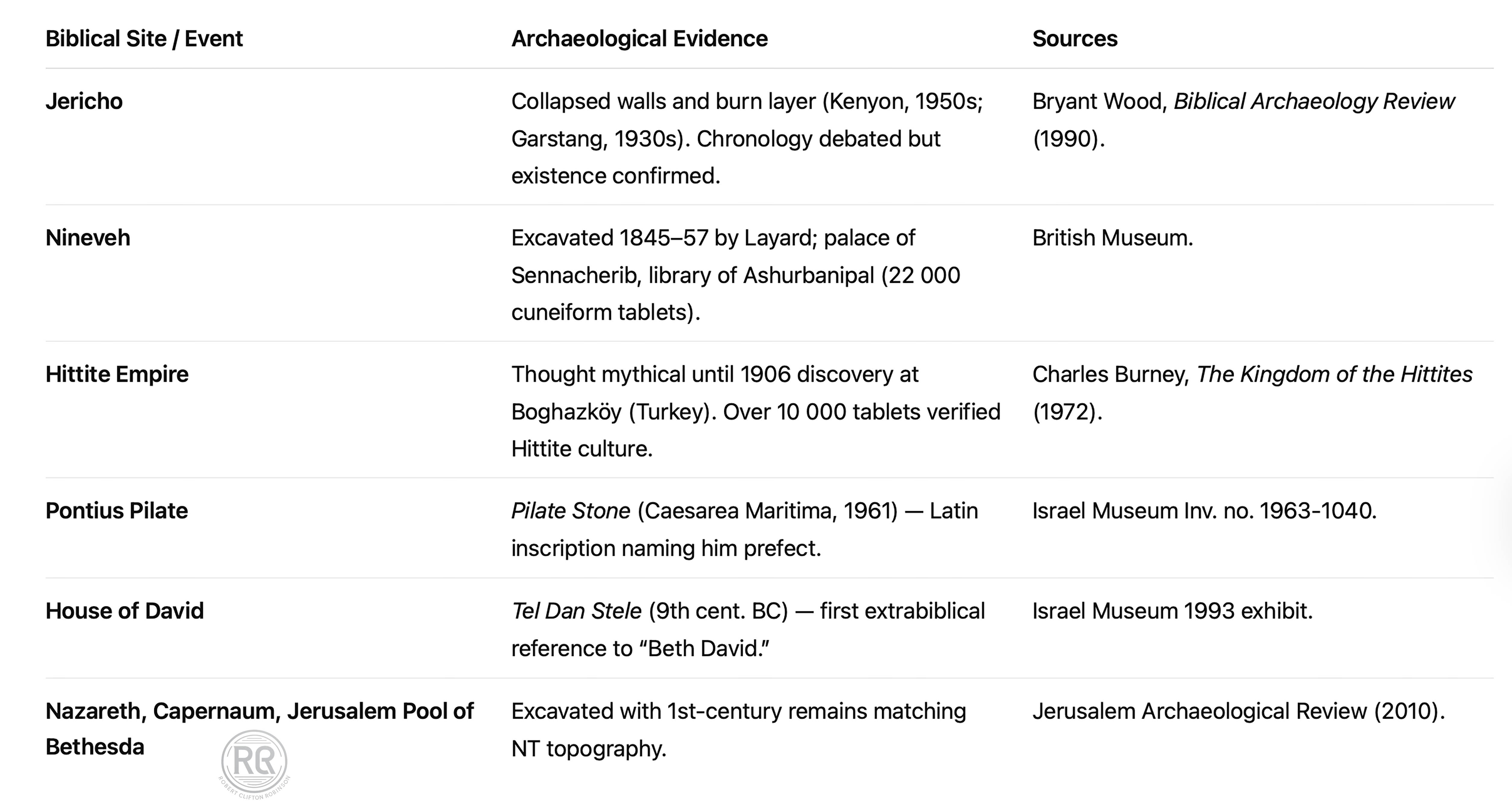
The Bible is unique among ancient religious texts in its extensive archaeological corroboration.
Scholarly Consensus:
Archaeology consistently confirms cultural, linguistic, and geopolitical details of the biblical world. No other ancient scripture enjoys equivalent verification.
The Bible: Hundreds of archaeological validations.
The Book of Mormon: No confirmed sites corresponding to its geography.
Authorship and Translation Integrity
The Criterion of the Mormon Bible: “The author lied about his ability to translate the plates.”
The Bible’s Translation Record:
- Old Testament: written primarily in Hebrew, some Aramaic, by about 40 authors (1500 – 400 BC).
- New Testament: written in Koine Greek (45 – 95 AD) by eyewitnesses or their direct associates.
- Each translation—from Septuagint (LXX, 3rd cent. BC) to modern versions—is linguistically traceable to extant manuscripts in known languages.
- No claim of “mystical translation” by divine stones or lost languages. The process is transparent philology.
Documented translators:
- The Septuagint (Greek translation of the Hebrew Tanakh) — still extant.
- Jerome’s Vulgate (Latin) — AD 405, known source.
- Modern English versions (KJV, NASB, NLT) based on critical Hebrew/Greek texts (Nestle-Aland, Biblia Hebraica Stuttgartensia).
The Bible: Transparent, linguistically traceable translation process across millennia.
The Book of Mormon: Translation claimed from unknown “Reformed Egyptian,” no surviving source texts.
Authenticity of the Original “Plates” or Manuscripts
The Book of Mormon Criterion: “The plates were fabricated…”
The Biblical Manuscripts: The Bible’s manuscripts are extant, tangible, and verifiable.

Verification: The Manuscripts for the Bible are physically accessible in museums (British Library, Vatican, Chester Beatty Library, etc.).
The Book of Mormon: No physical Book of Mormon plates exist for examination; their disappearance is an article of faith, not textual criticism.
The Bible: Extant manuscripts verifiable by scientific analysis.
The Book of Mormon: No extant source; alleged plates unavailable.
Revisions, Textual Stability, and Transmission
The Book of Mormon Criterion: “The book has been revised numerous times to cover for serious errors.”
The Bible’s Textual History
- Scribal Transmission: Thousands of copies survive → allows textual criticism to reconstruct original readings.
- Revisions are not doctrinal coverups but text-critical refinements documented publicly in apparatuses.
- Modern critical editions (e.g., Biblia Hebraica Stuttgartensia and Nestle-Aland 28) note every variant—complete transparency.
Quantitative data
- ~5 800 Greek NT manuscripts; ~10 000 Latin; ~9 300 in other languages → over 25 000 total.
- Variant rate < 1 % affecting meaning; none alter core doctrine. (Bruce Metzger, The Text of the New Testament, 4th ed., 1992, pp. 289-290.)
Dead Sea Scroll confirmation: Isaiah Scroll (1QIsa) matches Masoretic Text in > 95 % of words after ~1 000 years of transmission.
The Bible: Revisions documented scientifically; no hidden alterations; core text stable for millennia.
The Book of Mormon: Revisions are not publicly noted in critical apparatuses; made to smooth errors and grammar; some affect doctrinal wording (e.g., “white and delightsome” → “pure and delightsome”).
Summary Comparison

Empirical Reliability of the Bible vs. the Book of Mormon
The Bible
- Verified through fulfilled prophecy, archaeology, manuscripts, and textual transparency.
- Proven transmission across three millennia with minimal variation and complete documentary chain.
- Consistent internal coherence supported by independent historical corroboration (Babylon, Persia, Rome, Pilate, Herod, Caiaphas, etc.).
The Book of Mormon
- Lacks fulfilled prophecies confirmed by history.
- Lacks archaeological or linguistic corroboration for its geography or civilizations.
- Lacks extant source documents or identifiable translation language.
- Revised repeatedly to correct grammatical and doctrinal inconsistencies.
When we use the same evaluative criteria that are applied equally, the Bible stands uniquely validated, whereas the Book of Mormon fails empirical authentication.
Sources and Citations:
Comparative Evaluation of the Bible and the Book of Mormon
Fulfilled Prophecy
- Archer, Gleason L. Encyclopedia of Bible Difficulties. Grand Rapids: Zondervan, 1982.
– Comprehensive documentation of prophetic fulfillment, especially Messianic and historical prophecies. - McDowell, Josh, and Sean McDowell. Evidence That Demands a Verdict, Vol. 1. Nashville: Thomas Nelson, 2017. –Statistical treatment of fulfilled prophecy, including Daniel, Isaiah, Micah, and Zechariah.
- Stoner, Peter W. Science Speaks: Scientific Proof of the Accuracy of Prophecy and the Bible. Chicago: Moody Press, 1963. Classic probability study demonstrating mathematical improbability of accidental fulfillment.
- Kaiser, Walter C. The Messiah in the Old Testament. Grand Rapids: Zondervan, 1995. Scholarly analysis of 65 Messianic prophecies historically verified in Christ.
- Finegan, Jack. Handbook of Biblical Chronology. Peabody, MA: Hendrickson, 1998. Correlates historical dates of Babylonian, Persian, Greek, and Roman empires with biblical predictions.
- The Dead Sea Scrolls (1QIsaᵃ): Hebrew University, Jerusalem. Carbon-dated to c. 125 BC; demonstrates pre-Christian authorship of Messianic passages (Isaiah 53, 61).
Archaeological Corroboration
- Wood, Bryant G. “Did the Israelites Conquer Jericho? A New Look at the Archaeological Evidence.” Biblical Archaeology Review 16, no. 2 (1990): 44–58.
- Burney, Charles. The Kingdom of the Hittites. Oxford: Clarendon Press, 1972.
– Confirmation of Hittite Empire once deemed mythical. - Millard, A. R. Discoveries from the Time of the Bible. Peabody, MA: Hendrickson, 1997.
– Illustrated documentation of Nineveh, Babylon, and other biblical sites. - Herodotus. Histories 1.191. Describes Cyrus’ conquest of Babylon as foreseen in Isaiah 13 and 45.
- Avigad, Nahman, and Yigael Yadin. A Temple Scroll from the Dead Sea Caves. Jerusalem: Israel Exploration Society, 1965.
- Barkay, Gabriel. “The Silver Amulets from Ketef Hinnom.” Biblical Archaeology Review 18, no. 6 (1992): 26–32. Earliest extant text of Numbers 6:24–26, confirming pre-exilic Mosaic text.
- Israel Antiquities Authority. Pilate Stone Inscription. Caesarea Maritima, 1961. Latin text naming Pontius Pilate as praefectus Iudaeae.
- Biran, Avraham, and Joseph Naveh. “An Aramaic Stele Fragment from Tel Dan.” Israel Exploration Journal 43 (1993): 81–98. First extrabiblical mention of “House of David.”
Authorship and Translation Integrity
- Biblia Hebraica Stuttgartensia. Edited by Karl Elliger and Wilhelm Rudolph. Stuttgart: Deutsche Bibelgesellschaft, 1997.
- Nestle–Aland Novum Testamentum Graece, 28th ed. Stuttgart: Deutsche Bibelgesellschaft, 2012.
- Metzger, Bruce M., and Bart D. Ehrman. The Text of the New Testament: Its Transmission, Corruption, and Restoration. 4th ed. New York: Oxford University Press, 2005.
- Pritchard, James B., ed. Ancient Near Eastern Texts Relating to the Old Testament. Princeton: Princeton University Press, 1969.
- Tov, Emanuel. Textual Criticism of the Hebrew Bible. 3rd ed. Minneapolis: Fortress Press, 2012.
- Wallace, Daniel B. “The Reliability of the New Testament Manuscripts.” Journal of the Evangelical Theological Society 43, no. 1 (2000): 1–36.
Extant Manuscripts and Early Witnesses
- Chester Beatty Papyri (P45, P46, P47): Chester Beatty Library, Dublin. Dated AD 200–250.
- Rylands Library Papyrus P52 (John 18:31–33). University of Manchester. Dated AD 125.
- Codex Sinaiticus (London: British Library, Add. 43725, ca. AD 325).
- Codex Vaticanus (Vatican Library, B 1209, ca. AD 340).
- Dead Sea Scrolls: full corpus, Qumran Caves 1–11, 1947–1956; curated at Israel Museum, Jerusalem.
Textual Revisions and Transmission
- Aland, Kurt, and Barbara Aland. The Text of the New Testament: An Introduction to the Critical Editions and to the Theory and Practice of Modern Textual Criticism. 2nd ed. Grand Rapids: Eerdmans, 1989.
- Wegner, Paul D. A Student’s Guide to Textual Criticism of the Bible: Its History, Methods, and Results. Downers Grove: IVP Academic, 2006.
- Comfort, Philip W. Encountering the Manuscripts: An Introduction to New Testament Paleography and Textual Criticism. Nashville: Broadman & Holman, 2005.
- Bruce, F. F. The New Testament Documents: Are They Reliable? 6th ed. Downers Grove: IVP, 1981.
- Geisler, Norman L., and William Nix. A General Introduction to the Bible. Rev. and exp. ed. Chicago: Moody Press, 1986.
Comparative References for the Book of Mormon
- The Book of Mormon, 1830 ed., Palmyra NY: E. B. Grandin.
- The Book of Mormon, current LDS ed. (Salt Lake City: Church of Jesus Christ of Latter-day Saints, 2013).
- Metcalfe, Brent L., ed. New Approaches to the Book of Mormon. Salt Lake City: Signature Books, 1993.
- Larson, Stan L. “Changes in the Book of Mormon.” Dialogue: A Journal of Mormon Thought 10 (1977): 8–37.
- Sorenson, John L. An Ancient American Setting for the Book of Mormon. Provo UT: FARMS, 1985.
- Tanner, Jerald and Sandra. 3,913 Changes in the Book of Mormon. Salt Lake City: Utah Lighthouse Ministry, 1996.
- FAIR LDS. “Textual Changes in the Book of Mormon.” https://www.fairlatterdaysaints.org.
When evaluated by identical empirical criteria—fulfilled prophecy, archaeological verification, authentic manuscript evidence, linguistic transparency, and documented textual transmission—the Bible demonstrates historical reliability unmatched by any other ancient religious text. The Book of Mormon, in contrast, lacks verifiable prophecy, archaeology, linguistic source evidence, or manuscript lineage.
These findings are affirmed across archaeology (Jericho, Nineveh, Hittites), epigraphy (Tel Dan Stele, Pilate Stone), and manuscript science (Dead Sea Scrolls, Codex Sinaiticus). Conversely, no external archaeological or linguistic corroboration exists for the Book of Mormon’s claimed civilizations or languages.
Robert Clifton Robinson, “New Testament Apologetics”
Categories: Robert Clifton Robinson
 Robert Clifton Robinson
Please see, "Guidelines For Debate," at the right-side menu. Post your comment or argument here: