Claims that dozens of early Latter-day Saint leaders saw or heard the resurrected Jesus Christ in Kirtland, Ohio, have become increasingly common in contemporary LDS apologetics.

These claims are frequently supported by devotional reconstructions rather than contemporaneous historical documentation. A careful examination of the primary LDS sources demonstrates that these assertions substantially exceed what the evidence can prove. When evaluated according to accepted historical standards—multiple attestation, contemporaneity, firsthand testimony, and independent corroboration—the Kirtland vision claims reduce to a single, narrowly attested event: the reported appearance of Jesus Christ to Joseph Smith and Oliver Cowdery on April 3, 1836.¹
¹ Joseph Smith and Oliver Cowdery’s April 3, 1836 account in the Kirtland Temple remains the only canonical, first-person claim of an appearance of Jesus Christ in Kirtland. The account explicitly names only Smith and Cowdery as witnesses and contains no reference to any additional individuals seeing Christ. Doctrine and Covenants 110:1–4.
The only canonical, first-person account of an appearance of Jesus Christ in Kirtland is recorded in Doctrine and Covenants 110. The narrative explicitly identifies Joseph Smith and Oliver Cowdery as the sole recipients of the experience and contains no reference to additional participants seeing or hearing Christ. The language of the account underscores its exclusivity: “The veil was taken from our minds, and the eyes of our understanding were opened.” The plural pronouns consistently refer only to Smith and Cowdery, and no contemporaneous LDS source expands the circle of witnesses beyond these two individuals.²
² No contemporaneous LDS journal, minute book, or independent third-party document records any other person seeing the resurrected Jesus in the Kirtland Temple. This absence is acknowledged even within LDS historiography. See Richard L. Bushman, Joseph Smith: Rough Stone Rolling (New York: Knopf, 2005), 306–309.
This absence is not an argument from silence; it is an impeached conclusion acknowledged within LDS historiography itself. Richard L. Bushman affirms that the Kirtland Temple appearance rests solely on the testimony of Smith and Cowdery and offers no suggestion of corroborating eyewitnesses. The event is treated as a private visionary encounter rather than a corporate manifestation comparable to group resurrection appearances in the New Testament.³
³ Claims frequently cited as additional “Kirtland witnesses” originate largely from visionary or impressionistic experiences rather than sensory, corporeal encounters. LDS sources themselves distinguish between “visions,” “spiritual manifestations,” and physical appearances. See Steven C. Harper, Making Sense of the Doctrine and Covenants (Salt Lake City: Deseret Book, 2008), 268–272.
Much of the numerical exaggeration surrounding Kirtland vision claims comes from the combining of distinct events, locations, and experiential categories (deception). A primary example is the February 16, 1832, vision later canonized as Doctrine and Covenants 76. This experience occurred in Hiram, Ohio—not Kirtland—and involved only Joseph Smith and Sidney Rigdon. The text explicitly frames the event as visionary rather than corporeal, and no additional individuals are recorded as seeing Jesus during the experience.⁴ LDS apologists dishonestly combine these events.
⁴ The February 16, 1832, vision recorded as Doctrine and Covenants 76 occurred in Hiram, Ohio, not Kirtland, and involved only Joseph Smith and Sidney Rigdon. No additional participants are recorded as seeing Jesus, and the experience is explicitly visionary in nature. Doctrine and Covenants 76; see also Bushman, Rough Stone Rolling, 183–185.
Sidney Rigdon later clarified (the deception) that others present during the 1832 vision did not share the experience, reinforcing its limited and non-corporate character and confirming that the event cannot be counted as a group appearance of Christ.⁵
⁵ Sidney Rigdon later clarified that others present during the 1832 vision did not share the experience, underscoring its limited, non-corporate character. Sidney Rigdon, statement in Millennial Star 14 (1852): 154.
Further confusion arises from the treatment of subjective religious experiences—such as intense emotion, auditory impressions, or feelings of divine presence—as though they constituted sensory encounters with the resurrected Christ. These exaggerated emotional descriptions are a frequent part of the LDS church. LDS-faithful scholarship itself distinguishes between visions, spiritual manifestations, angelic appearances, and physical encounters, cautioning against collapsing these categories into a single evidentiary class.⁶
⁶ Karl R. Anderson does not claim that 23 individuals saw Jesus Christ in Kirtland. Rather, he compiles late reminiscences and secondary reports describing spiritual impressions, feelings, or auditory experiences, many of which do not name Jesus and some of which refer to angelic manifestations. Karl R. Anderson, The Savior in Kirtland (Salt Lake City: Deseret Book, 2017), esp. 1–12, 203–245.
Contemporary appeals to Karl R. Anderson’s The Savior in Kirtland illustrate this methodological error. Anderson assembles late reminiscences and secondary accounts describing spiritual impressions, many recorded decades after the events in question. In these, we understand that the distortion of facts was intentional. These accounts frequently lack firsthand specificity, often do not identify Jesus explicitly, and in several cases refer to angelic beings or generalized divine presence rather than to Christ Himself. Anderson repeatedly acknowledges the fragmentary, devotional, and retrospective nature of his sources and does not present them as eyewitness testimony of the physical appearance of Jesus.⁷
⁷ Anderson repeatedly acknowledges the fragmentary and retrospective nature of these accounts and does not present them as firsthand eyewitness testimony comparable to the canonical Kirtland vision. The book offers devotional synthesis rather than historical proof of multiple appearances. Anderson, The Savior in Kirtland, 4–6, 231–233.
Nevertheless, some LDS apologists exaggerate numerical claims by combining all reported religious experiences associated with the Kirtland period, regardless of content, timing, or character. These exaggerations are a frequent article of all LDS claims. This approach assumes the existence of lost records to justify higher totals and treats devotional impressions as historical evidence—an approach explicitly cautioned against within LDS historical scholarship itself.⁸
⁸ Assertions that “20–30” or “50–100” individuals saw or heard Jesus in Kirtland rely on speculative aggregation, assumed lost records, and the conflation of subjective religious experience with eyewitness testimony. Such methodology fails standard historical criteria of multiple attestation, contemporaneity, and independent corroboration. See Mark Ashurst-McGee, “Joseph Smith’s Early Visions,” in Opening the Heavens, ed. John W. Welch (Provo, UT: BYU Press, 2005), 299–302.
Even among LDS-faithful historians, there is no support for the assertion that twenty to thirty leaders—or still less fifty to one hundred—saw or heard the resurrected Christ in Kirtland. Bushman, Harper, and Ashurst-McGee converge on the conclusion that the Kirtland Temple appearance rests solely on the testimony of Joseph Smith and Oliver Cowdery, without independent corroboration.⁹
⁹ Even LDS-faithful historians consistently affirm that the Kirtland Temple appearance of Jesus rests solely on the testimony of Joseph Smith and Oliver Cowdery, without corroborating eyewitness support. See Bushman, Rough Stone Rolling, 307; Harper, Making Sense of the Doctrine and Covenants, 271.
Accordingly, claims that “surviving records document at least 23 Church leaders who saw or heard the Savior in Kirtland” materially overstate the historical evidence. Such assertions misrepresent the primary sources, conflate disparate experiences, and attribute to Anderson conclusions he does not make. A historically responsible assessment must affirm only what the evidence supports: a single claimed appearance, reported by two individuals, without corroboration.¹⁰
¹⁰ For these reasons, claims that surviving records document “at least 23 Church leaders” who saw or heard the Savior in Kirtland materially overstate the historical evidence and misrepresent both the primary sources and Anderson’s own conclusions.
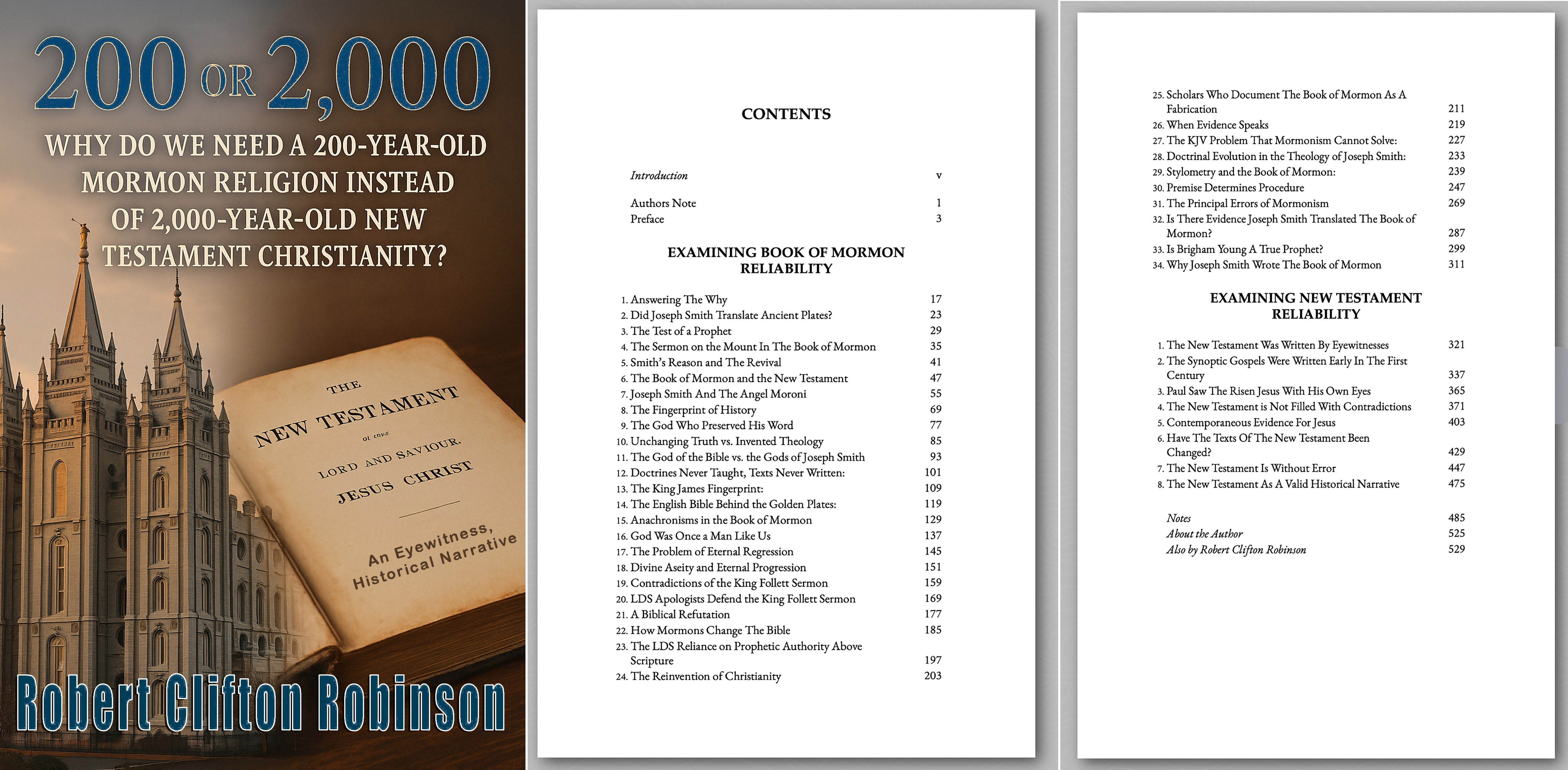
See The Truth About The False and Deceptive Statements of the LDS Church and How Joseph Smith Fabricated the Book of Mormon:
Categories: Robert Clifton Robinson
 Robert Clifton Robinson
Thank you for this article. It’s very helpful.
LikeLiked by 1 person
I will use this quote from the article to illustrate my point:
There is no way Joseph, or anyone else for that matter, could have saw or heard Jesus; because of what Jesus actually said when He was on the Earth the first time – See Matthew 24:22-24.
So it appears that Mormons prefer that I listen to Joseph Smith and not Jesus Himself? Really?
The deception of this religion will fall upon those who adhere to its lie. We know this because of 2 Thessalonians 2:9-12.
Thank you Brother Rob for exposing this deception. Hopefully it will bring many to the truth about Our Lord and Savior.
We need to continuously pray for them.
LikeLike