Redefining what evidence is effectively builds atheism into the methodology, ensuring that no non-physical explanation can ever be considered, regardless of the data.
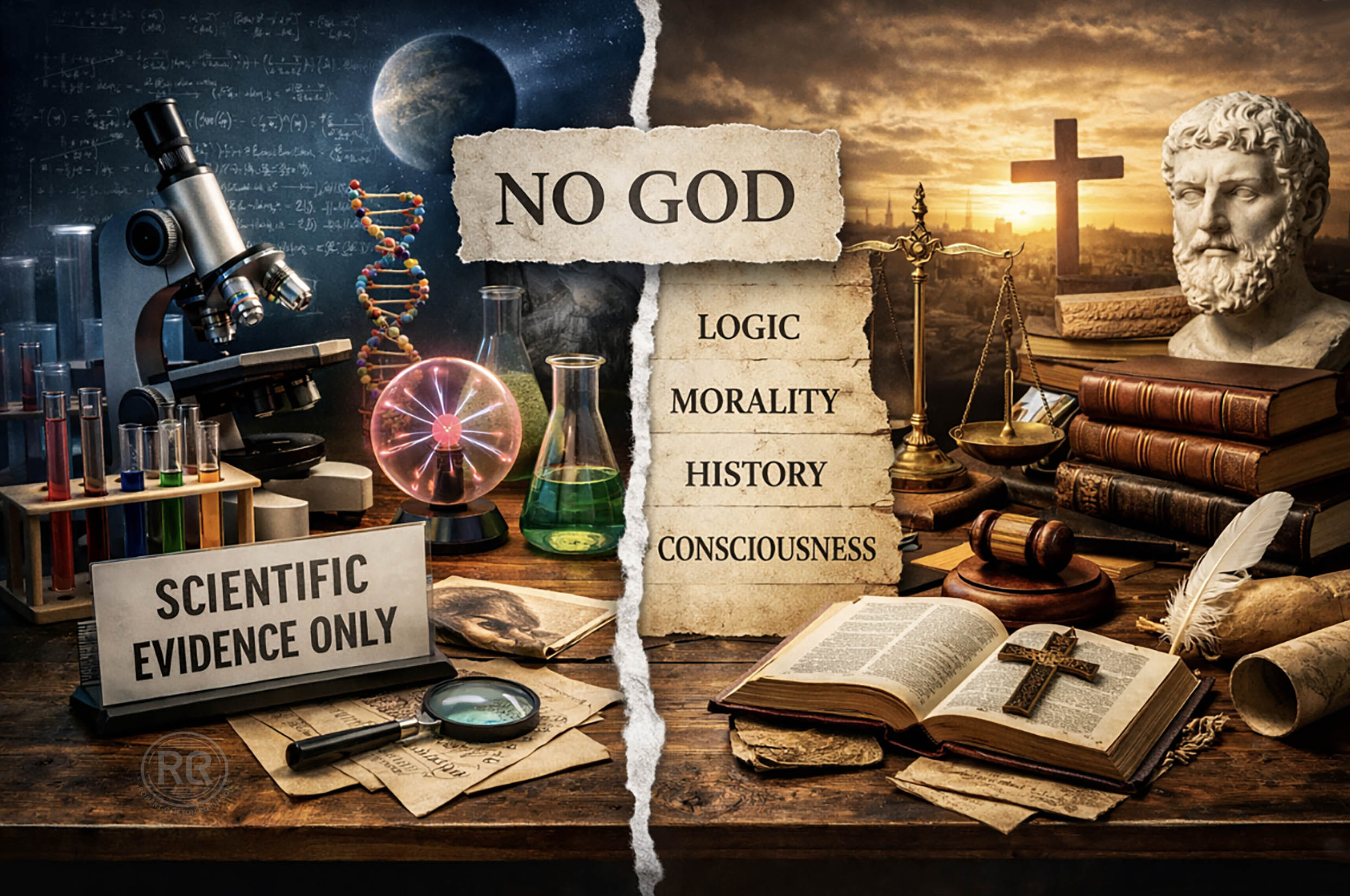
One of the most common claims made by atheists today is the assertion that “there is no evidence that any god exists.” At first glance, this appears to be a straightforward empirical judgment. When we look at this claim by closer inspection, the assertion originates not from an absence of evidence, but from a redefinition of what counts as evidence, one that is philosophically loaded and methodologically restrictive. This redefinition, when examined carefully, reveals a category error, an unwarranted narrowing of epistemology (the theory of knowledge), and a defensive tactic that moves toward non-physical explanations of reality.
First, the atheist demand for scientific evidence only completely redefines the term “evidence” in a way that excludes God by the atheist’s definition rather than by discovery. When pressed to clarify what they mean by evidence, most atheists specify that they will only accept evidence that is scientific, repeatable, and empirically observable. This requirement mirrors the methods of the natural sciences, which are designed to investigate physical phenomena operating within space, time, and material causation. However, this demand assumes—without argument—that scientific methodology is the only legitimate avenue to truth. That assumption is not itself a scientific conclusion; it is a philosophical one.¹
Science does not claim universal jurisdiction over all aspects of reality. By definition, it investigates the regular behavior of matter and energy under natural laws. If God exists as traditionally defined—non-material, transcendent, personal, and the cause of the physical universe—then He is not the kind of entity that could be detected by scientific instruments. To insist on scientific evidence for a non-physical cause is to commit a category error, similar to demanding a microscope image of justice or a chemical analysis of a mathematical theorem.² The absence of scientific detectability does not imply non-existence; it merely reflects the limitations of the method being demanded by the atheist. This demand is disingenuous since it does not seek truth but confirmation of an already established bias that God does not exist.
This redefinition of evidence effectively builds atheism into the methodology, ensuring that no non-physical explanation can ever be considered, regardless of the data. As philosopher Alvin Plantinga has stated, this approach does not originate from science itself but from a prior commitment to philosophical naturalism, which is then imposed upon the evidential standards atheists demand.³ The argument then becomes circular: only physical causes are allowed, therefore no non-physical cause exists.
Second, evidence as a concept is far broader than science, and always has been. In ordinary life, in courts of law, in historical investigation, and in philosophical reasoning, evidence is understood as anything that reasonably supports the truth of a proposition. Scientific evidence is one subset within a much larger epistemological framework. Historical events such as the assassination of Julius Caesar, the reign of Augustus, or the life of Socrates are accepted on the basis of documentary testimony, corroboration, and inference—not repeatable experiments.⁴ Legal judgments regularly hinge on eyewitness testimony, motive, and circumstantial reasoning, none of which are scientifically repeatable in the laboratory sense.
More importantly, many of the most basic elements of human knowledge are non-scientific yet indispensable. Logical laws, mathematical truths, moral obligations, and the reliability of human reason itself cannot be established through empirical experimentation without circularity. Science presupposes these realities; it does not prove them.⁵ The law of non-contradiction, for example, is not discovered through measurement, yet without it, no scientific reasoning is possible. Similarly, moral judgments—such as the conviction that torturing children for pleasure is objectively wrong—are widely regarded as true regardless of cultural preference, yet they cannot be weighed or quantified.⁶
To reject all non-scientific evidence is therefore self-defeating. This method demanded by atheists undermines not only theism but also the foundations of rational inquiry itself. As philosopher C.S. Lewis argued, if rational thought is nothing more than the byproduct of irrational physical causes, then there is no reason to trust any belief—including atheism.⁷ The intelligibility of the universe, the applicability of mathematics to nature, and the reliability of human cognition all point beyond blind material processes to a rational source.
Third, the persistent refusal to accept broader categories of evidence is not primarily evidential but defensive. When atheists narrow the definition of evidence to exclude philosophy, morality, history, and experience, they are not merely expressing skepticism; they are protecting their guarded worldview of “no god” from challenge. Accepting broader evidential categories would immediately reopen several powerful arguments for God’s existence. Philosophical causation raises the question of why anything exists at all rather than nothing. Moral realism suggests a moral lawgiver. The rational intelligibility of the universe points to a prior mind. Historical testimony forces engagement with claims about Jesus of Nazareth and the resurrection. Experiential evidence challenges the claim that God is wholly absent from human experience.⁸
Because these lines of evidence are cumulative and mutually reinforcing, excluding them simplifies the debate at the cost of intellectual honesty. The oft-repeated claim “there is no evidence” functions rhetorically rather than analytically. It shifts the burden away from engaging the actual arguments and onto a methodological gatekeeping maneuver that prevents those arguments from being heard in the first place. As philosopher Richard Swinburne has noted, if we applied such restrictive standards consistently, we would have to discard much of what we claim to know about history, other minds, and even the external world.⁹
The demand for evidence that fits the atheist worldview is not about evidence per se but about which worldview gets to define reality. The atheist insistence on scientific evidence alone reflects an implicit commitment to naturalism, not a neutral assessment of the data. Once this is exposed, the conversation can move from slogans to substance—from “there is no evidence” to the far more honest question of whether non-physical explanations are permitted at all. Only then can the God question be addressed on rational and fair terms.
Sources and Citations:
- Karl Popper, The Logic of Scientific Discovery (London: Routledge, 1959).
- John Lennox, God’s Undertaker: Has Science Buried God? (Oxford: Lion, 2007).
- Alvin Plantinga, Where the Conflict Really Lies: Science, Religion, and Naturalism (Oxford: Oxford University Press, 2011).
- F.F. Bruce, The New Testament Documents: Are They Reliable? (Grand Rapids: Eerdmans, 1981).
- Michael Polanyi, Personal Knowledge (Chicago: University of Chicago Press, 1958).
- Robert Adams, Finite and Infinite Goods (Oxford: Oxford University Press, 1999).
- C.S. Lewis, Miracles (New York: Macmillan, 1947).
- William Lane Craig, Reasonable Faith (Wheaton: Crossway, 2008).
- Richard Swinburne, The Existence of God (Oxford: Oxford University Press, 2004).
See Two Critical Pieces of Evidence That Address The Above Issues, Published by Robert Clifton Robinson: “A Universe That Proves God: The True Source of the Cosmos,” and “New Testament Apologetics: Proving The Historical Jesus By Documentary Evidence.”

Categories: Robert Clifton Robinson


Wonder article thank Brother Rob.
LikeLike