If we understand that the Bible is a transcendent book written by God from outside time, space, and matter, it’s constriction and format bring new insight to the texts that describe the arrival of Jesus and the prophecies of the Last Days.
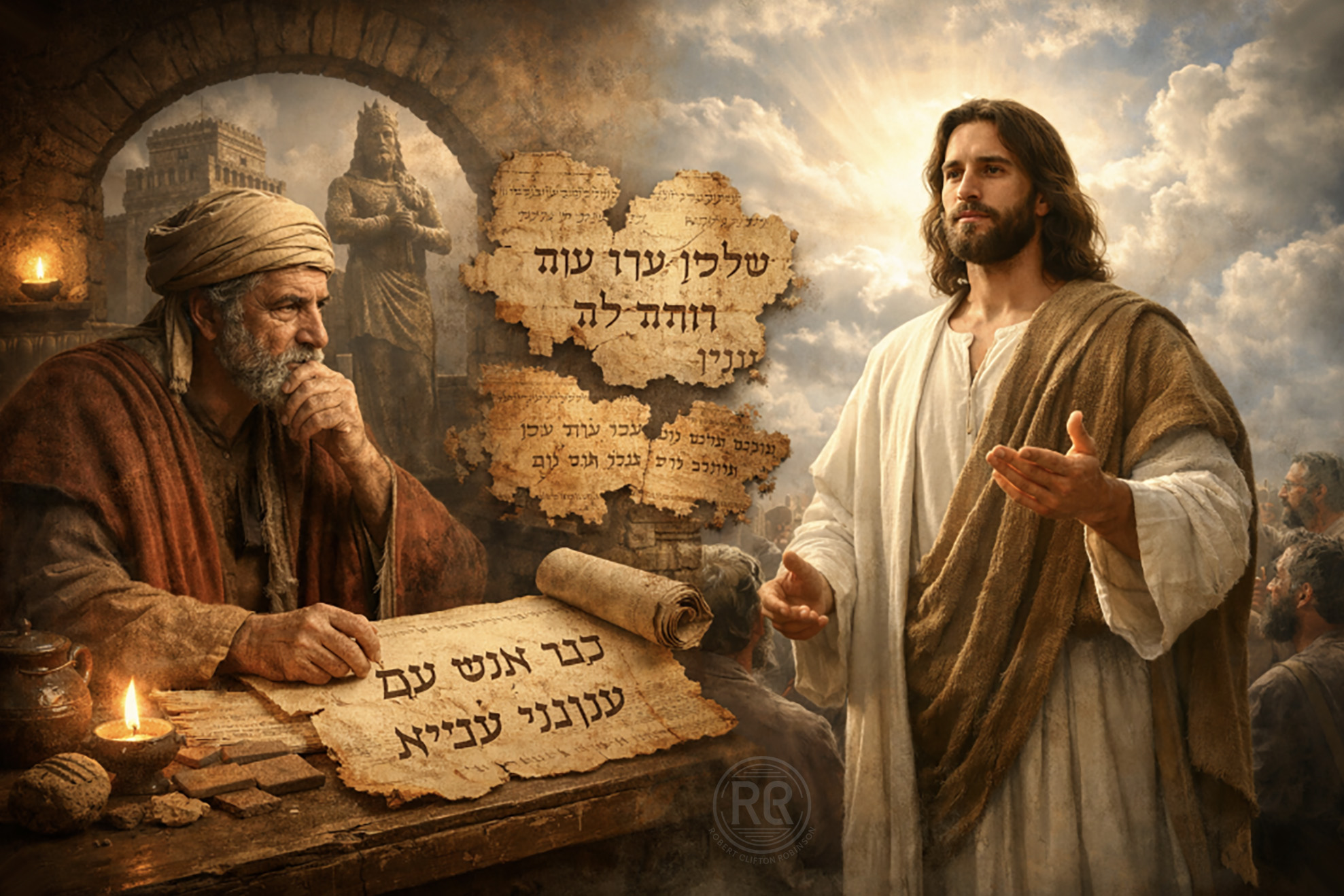
No other person in the history of the world has fulfilled the 400 Messianic Prophecies Jesus fulfilled in the pages of the New Testament.
These prophecies were written from 400 to 1,450 years before Jesus arrived.
Among these stunning Messianic Prophecies, those written by the Prophet Daniel are among the most extraordinary. Prophecies that predict the exact day the Messiah will arrive at Jerusalem, fulfilled by Jesus.
Prophecies that describe the specific days we now live in, when a world ruler will emerge who will subdue the Earth by peace. Sound familiar?
Daniel wrote chapters 2-7 in Aramaic, a language that is specific only to the 5th and 6th Century BC, not the 1st century that critics claim the Prophecies of Daniel were written. See The 400 Messianic Prophecies Jesus Fulfilled.
The Precise Aramaic Texts in Daniel
The Book of Daniel is written in two languages, Hebrew and Imperial (Biblical) Aramaic. The Aramaic sections have eternal fixed boundaries and determined defining texts.
| Chapter | Verses | Language |
|---|---|---|
| Daniel 1 | 1:1–21 | Hebrew |
| Daniel 2 | 2:1–4a | Hebrew |
| Daniel 2 | 2:4b–49 | Aramaic |
| Daniel 3 | 3:1–30 | Aramaic |
| Daniel 4 | 4:1–37 | Aramaic |
| Daniel 5 | 5:1–31 | Aramaic |
| Daniel 6 | 6:1–28 | Aramaic |
| Daniel 7 | 7:1–28 | Aramaic |
| Daniel 8–12 | 8:1–12:13 | Hebrew |
Daniel 2:4b begins with a specific language marker: “Then the Chaldeans spoke to the king in Aramaic…” From that point onward, the text continues in Aramaic uninterrupted through the end of chapter 7.
See The 400 Messianic Prophecies Jesus Fulfilled
Manuscript Confirmation
The Aramaic sections of Daniel 2-7 are identical in the subjects they reveal in several manuscript sources. This demonstrates the date-writing integrity of the entire Book of Daniel as a genuine sixth-century writing by Daniel himself.
- The Masoretic Text
- The Dead Sea Scrolls (Manuscripts 4QDanᵃ, 4QDanᵇ, 4QDanᶜ)
- The Septuagint Vorlage
- Theodotion
- The Peshitta
- The Vulgate
There is no manuscript tradition—Jewish or Christian—that places additional material in Aramaic or removes any portion of 2:4b–7:28.
Why These Chapters Written in Aramaic Are Not Accidental
The Aramaic section forms a deliberate literary and theological component, centered on Gentile kingdoms and global sovereignty.
The Aramaic Structure
| Section | Theme |
|---|---|
| Daniel 2 | Four Gentile kingdoms |
| Daniel 3 | God delivers faithful Jews |
| Daniel 4 | God humbles a Gentile king |
| Daniel 5 | God judges a Gentile king |
| Daniel 6 | God delivers faithful Jews |
| Daniel 7 | Four Gentile kingdoms (expanded, prophetic) |
Daniel 2 and 7 mirror each other
Daniel 3 and 6 mirror each other
Daniel 4 and 5 form the theological center
This is a supernatural structure that only works if the text is Aramaic, because the diplomatic language of the empires is being described.
The Linguistic Classification
The Aramaic in Daniel is Imperial / Official Aramaic, consistent with 6th–5th century BC inscriptions, Elephantine papyri, and Achaemenid administrative documents. These texts are not late Palestinian Aramaic, undermining claims of a late-written Maccabean-era composition. This historical, literary evidence proves the latter; non-Daniel authorship is wrong.
The Aramaic of Daniel 7 and the Son-of-Man Claims of Jesus
One of the most important yet frequently underappreciated pieces of evidence for Jesus’ self-understanding of Himself as the Messiah, all the Prophets wrote about is the linguistic continuity between the Aramaic of Daniel 7 and Jesus’ Son-of-Man sayings. This connection is not speculative, conjectural, or merely a theory. It is rooted in specific Aramaic vocabulary, preserved textual structures, and a shared theological structure that spans six centuries—from the Babylonian exile to the Roman occupation of Judea.
The prophetic vision of Daniel 7, recorded in Imperial Aramaic, introduces a figure described as כְּבַר אֱנָשׁ (kĕbar ʾĕnāš), “one like a son of man,” literally in Aramaic “God in human flesh,” who approaches the Ancient of Days and receives everlasting dominion, glory, and a kingdom over all peoples, nations, and languages.[1] This passage is universally recognized as the origin point for the latter New Testament Son-of-Man citation as well as Jewish eschatology. More importantly, these texts are not written in Hebrew, the covenantal language of Israel, but in Aramaic—the international language of Gentile power and administration. This linguistic choice signals that the vision concerns world empires, universal authority, and global judgment, rather than internal Jewish covenantal affairs.[2]
The Aramaic phrase bar ʾĕnāš does not function as a generic reference to humanity. It speaks of a Messiah who will also be Yahweh. Within Daniel 7 this Aramaic phrase stands in deliberate contrast to the four beasts, which represent successive Gentile kingdoms. The “son of man” figure is human in form yet transcendent in authority as the Son God, receiving from God the Father what no mere human king ever receives: everlasting dominion and universal service.[3] The Aramaic verb used for this service—פְּלַח (pelach)—is of particular significance, as it is used in other places in Daniel strategically for Messianic works attributed to Yahweh.[4] This defines this text as presenting a person who is distinguished from beasts (inhuman empires), elevated above all kings, and given worship reserved only for God.
When Jesus repeatedly refers to Himself as “the Son of Man” in the Gospels (77 times), He is using a Greek expression (ὁ υἱὸς τοῦ ἀνθρώπου) that is recognized as a clear translation of an underlying Aramaic idiom, more importantly, בַּר נָשָׁא (bar nāšāʾ).[5] This is not a natural Greek title, nor does it function well within Greek idiom. This term is an awkward usage that is best explained by the fact that the Gospel writers preserved Jesus’ spoken Aramaic self-definition as the Messiah, translating His words as literally as possible rather than substituting a more idiomatic Greek expression.[6] This lends great integrity and reliability to the authenticity of the New Testament Gospels as absolutely true and authentic, not fabricated or contrived as some critics assert.
The significance of these texts becomes unmistakable when Jesus combines the Son-of-Man title with distinctive Aramaic language found in Daniel’s prophecies of the coming Messiah. In His trial before the high priest, Jesus declares, “You will see the Son of Man seated at the right hand of Power and coming on the clouds of heaven.”[7] This statement combines Daniel 7:13 with Psalm 110:1, and by Jesus’ usage of this term and attributing it to Himself, there is no mistake that He was claiming to be not only Yahweh from the Old Testament, but also the Messiah predicted by all the prophets.
In the Hebrew Scriptures, the Messiah “coming with the clouds” is a clear, unmistakable reference to Yahweh as the Messiah coming to earth to rule over the kingdom promised to David.[8] By applying this term to Himself, Jesus is not claiming to be a merely exalted human; He is identifying Himself as God in human flesh, fulfilling the Messianic prophecies given to David as “The Son of Man” who comes to earth with the authority of God.
The reaction of the high priest to Jesus’ statement that He will return to earth “on the clouds” confirms that Jesus was claiming to be the Eternal God, Yahweh, the Messiah. Critics who claim that Jesus never claimed to be God are ignorant of Aramaic Idioms like “coming with the clouds” as a declaration that Jesus is God.
When the High Priest tore his garments after Jesus said these words with the charge of blasphemy, this defines what Jesus said as understood by the High Priest of Israel as a claim to be Yahweh and Messiah. In the view of the leaders of Israel, Jesus was merely a man who was committing blasphemy by claiming to be God, making Jesus worthy of death. When critics say that Jesus didn’t say He is God, they ignore the fact that His claim to be God was the very reason He was crucified.
Jesus’ words, as those recorded in the Aramaic texts of Daniel, were understood by the Jews of the first century as a claim to be Yahweh. This was not a vague claim.[9] Had Jesus intended His words, “son of man,” as merely a human, the son of a man, we would not find the serious abhorrence the High Priest and other leaders expressed when they called for Jesus’ death. Jesus was citing the text of Daniel 7 in Aramaic, which He claimed was written only for Him, and only He could fulfill these texts of prophecy.
Additional confirmation is seen in Jesus’ repeated references to authority being “given” to Him (by God the Father). Daniel 7:14 states that dominion (שָׁלְטָן, šolṭān) was “given” (יְהִיב, yĕhîb) to the Son of Man by the Ancient of Days. Jesus echoes this structure precisely when He declares after the resurrection, “All authority in heaven and on earth has been given to Me.”[10] The passive construction of Jesus words mirrors Daniel’s Aramaic grammar and assumes the same Messianic, divine authority Jesus spoke of as the Son of Man sent to Earth to complete God’s redemptive plan for all people who will believe.
Jesus also based His authority to judge everyone on Earth on this final event of Eschatology, His return as the Messiah who will establish the kingdom promised to David on earth. In John 5:27, Jesus states that the Father has given Him authority to execute judgment “because He is the Son of Man.”[11] This explanation is impossible to understand without Daniel 7, where judgment by the Messiah comes before He is seated as the Son of Man and ruler of the Earth. At that time, the transfer of dominion from the kingdom of the beast who ruled for seven years will be overtaken and destroyed by God’s righteous ruler, the Messiah whom God promised. Jesus is not merely borrowing a title; He is asserting His mission, authority, and destiny within Daniel’s Aramaic prophecies of the Last Days.
For these reasons, the similarities between Daniel chapter 7 and the words that Jesus used to describe Himself are striking. Jesus claimed that He was the object of Daniel’s prophecies of the Messiah, who would return to Earth on a cloud, the symbol of God’s singular power and authority. If Jesus never claimed to be God, as many critics claim, why does He intentionally use the language intended by Daniel in chapter 7 for God coming to Earth in the Last Days, as the Messiah?
When Jesus is found in the Old Testament, He is called Yahweh, the LORD. He is the instrument of judgment in Noah’s Flood. He is the LORD if Genesis 19:24 who brings fire from heaven and executes all the men of Sodom for their Sodomy. He is the singular source who leads the Israelites out of Egypt, then later kills in judgment all those who complained against His generosity, provision, power, and love for them. Not one of those who first left Egypt, over 20 years of age, ever made it to the land God promised.
See The 400 Messianic Prophecies Jesus Fulfilled
Jude describes the judgment of Jesus as Yahweh in his letter:
Jude 1:5-7 “So I want to remind you, though you already know these things, that Jesus first rescued the nation of Israel from Egypt, but later he destroyed those who did not remain faithful. And I remind you of the angels who did not stay within the limits of authority God gave them but left the place where they belonged. God has kept them securely chained in prisons of darkness, waiting for the great day of judgment. And don’t forget Sodom and Gomorrah and their neighboring towns, which were filled with immorality and every kind of sexual perversion. Those cities were destroyed by fire and serve as a warning of the eternal fire of God’s judgment.
Remember that Jesus is the older half-brother of Jude. Most people think of Jesus as one who did not come to judge anyone, but came in love from heaven to save the world. Many don’t realize that in the Old Testament, Jesus is known as a “Warrior,” and he has a book recorded in heaven called “The Book of the Wars of the Lord.”
After Jesus return to Earth at the end of the seven-year Tribulation, Revelation chapter 19 describes Him in terms that would shock those who see Him as a humble, gentle, loving Savior who would harm no one:
Revelation 19:11-17 Then I saw heaven opened, and a white horse was standing there. Its rider was named Faithful and True, for he judges fairly and wages a righteous war. His eyes were like flames of fire, and on his head were many crowns. A name was written on him that no one understood except himself. He wore a robe dipped in blood, and his title was the Word of God. The armies of heaven, dressed in the finest of pure white linen, followed him on white horses. From his mouth came a sharp sword to strike down the nations. He will rule them with an iron rod. He will release the fierce wrath of God, the Almighty, like juice flowing from a winepress. On his robe at his thigh was written this title: King of all kings and Lord of all lords.”
“He judges fairly and wages a righteous war. His eyes were like flames of fire,”
“He judges fairly and wages a righteous war.”
“His eyes were like flames of fire.”
“He wore a robe dipped in blood.”
“From his mouth came a sharp sword to strike down the nations.”
“He will release the fierce wrath of God.”
When Jesus tells the leaders of Israel that they will see Him return to Earth “coming with the clouds,” He is using Daniel’s description of the Messiah, which John uses to describe Jesus (above), from Revelation 19. We make a serious error if we fail to understand who Jesus is, who He was before He came to earth as a man to die for the sins of the world, and who He will be when He returns as a Warrior at the end of the seven-year Tribulation to bring a “sharp sword to strike the nations, and release the fierce wrath of God.”
Although Daniel writes about Jesus nearly 700 years before He was born, these preserved texts of Daniel exist in the Aramaic language before any Christian manuscripts were created. The only period of history in which Aramaic was used to write Hebrew Bible text was the 5-6th centuries BC. Aramaic was not in wide usage in the first century before Jesus arrived in 100 BC, rendering the assertion that Daniel was written 167–164 BC, during the reign of Antiochus IV Epiphanes, as impossible.
Wrong Language, Wrong Time
The Aramaic in Daniel closely resembles Imperial Aramaic, the diplomatic language of the Neo-Babylonian and Achaemenid Persian administrations (6th–5th century BC). It fits closely with the Elephantine Papyri, the Aramaic papyri from Elephantine, and the Official Persian-era correspondence. It does not reflect the later Palestinian Aramaic dialects that developed by the 2nd century BC.
The Aramaic language in which Daniel was written establishes the time and language of that period of history firmly within the period of Gentile dominion, it describes in the 5th and 6th centuries. It’s no coincidence that when Jesus entered the world and began speaking to Gentiles, His usage of Aramaic was purposeful to fulfill the texts of Daniel written in Aramaic for the Gentiles of that period. Jesus’ Aramaic speech places Him historically within that same “times of the Gentiles,” and His Son-of-Man claims (Messiah), which asserts that the decisive turning point of history has arrived.[13] The same language that once announced the rise and fall of empires is now spoken by the One who claims to inherit the kingdom that will replace them all.
The Aramaic of Daniel 7 and the Aramaic speech of Jesus form a single, coherent Last Days Prophetic Message for the world. By the first century, Aramaic had become the common spoken language of Judea and Galilee. Jesus of Nazareth, though fully fluent with Hebrew Scripture and capable of reading it publicly (Luke 4:16–21), spoke primarily in Aramaic in daily life. This is preserved for us in the surviving manuscript texts of the Gospels: Jesus used key Aramaic terms:
- Talitha qumi (Mark 5:41)
- Ephphatha (Mark 7:34)
- Abba (Mark 14:36)
- Eloi, Eloi, lama sabachthani (Mark 15:34)
These are not later inventions; they are exact Aramaic words that Jesus used because they were known by the people to whom He spoke them. Just as Daniel’s Aramaic addresses Gentile power, Jesus’ Aramaic addresses common people living under Gentile power.
Daniel’s Aramaic reveals the coming King of God’s kingdom; Jesus’ Aramaic reveals that the King has arrived.
Daniel 7—written in Aramaic—introduces the Messiah: “One like a Son of Man… given dominion, glory, and a kingdom, that all peoples, nations, and languages should serve Him.”
When Jesus repeatedly calls Himself “the Son of Man”, He is purposely using Daniel’s Aramaic vision, but now doing so in spoken Aramaic, in front of witnesses. This was not a coincidence. Jesus was intentionally fulfilling the Messianic Prophecies of the Old Testament (See: “Prophecies of the Messiah,” by Robert Clifton Robinson)
Daniel (Aramaic): God reveals His authority to the world from exile. Jesus (Aramaic): God reveals His grace to the world in incarnation. Aramaic is the language of accessibility—not priestly Hebrew, not elite Greek, but the language people actually spoke. God did not reveal the “Son of Man” in Daniel in a sacred, inaccessible tongue. God did not reveal the Messiah in Jesus in a scholarly dialect.
Daniel’s Aramaic and Jesus’ Aramaic also bracket the “Times of the Gentiles”: Daniel defines their structure and duration. Jesus enters history during that period and announces the fulfillment. (Luke 21:24)
The following is an examination of specific Aramaic vocabulary in Daniel 7 that Jesus used when He arrived to fulfill what Daniel recorded. Daniel 7 (Aramaic Original)
Book of Daniel 7:13–14 is written entirely in Imperial Aramaic. This is the fountainhead of the “Son of Man” title.
Daniel 7:13–14 (key Aramaic clauses, transliterated)
כְּבַר אֱנָשׁ
kĕbar ʾĕnāš
“one like a son of man”
עִם־עֲנָנֵי שְׁמַיָּא
ʿim ʿănānê šmayyāʾ
“with the clouds of heaven.”
וְלֵהּ יְהִיב שָׁלְטָן
wĕlēh yĕhîb šolṭān
“To him was given dominion.”
וְכֹל עַמְמַיָּא אֻמַּיָּא וְלִשָּׁנַיָּא
wĕḵōl ʿammayyāʾ ʾummayyāʾ wĕliššānayyāʾ
“all peoples, nations, and languages”
Every major Son-of-Man saying of Jesus draws from the above texts
“Son of Man,”
Aramaic: bar ʾĕnāš / bar nāšāʾ, Daniel 7
כְּבַר אֱנָשׁ (kĕbar ʾĕnāš) Means: a human one, but distinct from beasts (kingdoms)
Jesus’ Greek phrase ὁ υἱὸς τοῦ ἀνθρώπου (ho huios tou anthrōpou) is a forced literalism—clearly translating an Aramaic idiom, not inventing a Greek title.
What Jesus almost certainly said aloud: בַּר נָשָׁא (bar nāšāʾ). This phrase is not a normal statement that Jesus would have made about himself. It is not a generic “human.” Is uniquely marked by Daniel 7 as a heavenly, royal figure. Every time Jesus says “the Son of Man,” He is invoking Daniel 7’s Aramaic identity, not Psalm 8 or Ezekiel.
Coming With The Clouds
Aramaic: ʿănānê šmayyāʾ (“clouds of heaven”). Daniel 7. Clouds are never associated with human beings in the Hebrew Bible. Cloud-riding is a YHWH-exclusive attribute (cf. Psalm 104:3; Isaiah 19:1). In using this term, Jesus is saying
“You will see the Son of Man coming on the clouds of heaven…” (Matthew 26:64)
This is a direct citation of Daniel’s Messianic Prophecy. The high priest’s reaction (tearing his robes) proves the point: He understood this as a claim to divine authority, not poetic language.
Given Authority / Dominion
Aramaic: šolṭān (שָׁלְטָן). Daniel 7. šolṭān = sovereign authority. Used repeatedly of imperial power. Here: bestowed by the Ancient of Days. When Jesus used this term for himself, he is defining Himself as Yahweh-God.
“All authority has been given to Me in heaven and on earth.” (Matthew 28:18)
The passive “has been given” mirrors Daniel’s Aramaic יְהִיב (yĕhîb).
Jesus Accepts Worship
Aramaic: pelach (פְּלַח). Daniel 7:14: pelach = cultic service/worship. In another place in Daniel, it is ascribed only to God. It is the use of false gods in Daniel 3 that is forbidden. Yet Jesus receives worship of Himself. In (Matthew 14:33; 28:9, 17), Jesus is worshipped as Yahweh-God. He never corrects the worship of people to Himself; He never denies that He is God and refuses worship as God.
See The Seven Volume Print Edition and Single Volume eBook Edition of “The Prophecies of the Messiah, at Rob’s Amazon Authors Website:
See The 400 Messianic Prophecies Jesus Fulfilled
Sources and Citations:
- Daniel 7:13–14 (Aramaic text); see standard critical editions of the Masoretic Text.
- John J. Collins, Daniel: A Commentary on the Book of Daniel (Hermeneia; Minneapolis: Fortress, 1993), 279–281.
- Gerhard F. Hasel, “The Identity of the Son of Man in Daniel 7,” Andrews University Seminary Studies 19 (1981): 147–148.
- Daniel 3:12, 14, 17–18, 28; 6:16, 20; note the exclusive cultic usage of pelach.
- Maurice Casey, The Son of Man: The Interpretation and Influence of Daniel 7 (London: SPCK, 1979), 21–23.
- R. T. France, Jesus and the Old Testament (London: Tyndale, 1971), 144–146.
- Matthew 26:64; Mark 14:62.
- Psalm 104:3; Isaiah 19:1; see also Richard Bauckham, Jesus and the God of Israel (Grand Rapids: Eerdmans, 2008), 178–180.
- Mishnah Sanhedrin 7.5; cf. N. T. Wright, Jesus and the Victory of God (Minneapolis: Fortress, 1996), 526–528.
- Matthew 28:18; Daniel 7:14.
- John 5:27.
- Matthew 14:33; 28:9, 17; cf. Larry Hurtado, Lord Jesus Christ (Grand Rapids: Eerdmans, 2003), 305–307.
- Luke 21:24; Daniel 2; Daniel 7.
Categories: Robert Clifton Robinson
 Robert Clifton Robinson
Thank you Rob for these past few write-ups about our coming Messiah. I
appreciate your way of explaining things and going into detail. You are
man with much wisdom and much discernment.
Now we wait and watch for His return. Soon!
May God richly bless you for your ministry!
Debbi Reeves in Oregon
LikeLiked by 2 people
Thank you, Debbi, for the kind words. I eagerly watch with you in great anticipation of Jesus arrival. We live in exciting times.
Rob
LikeLike
I am currently reading these powerful books. I am early in the First Volume and so far it has been eye opening as to why I follow Christ. I must say this here and I will state the book titles as I call them and why they are important at least to me.
Revelation – what can I expect the world to look like if I am not part of the Rapture
Trumpets – why the Rapture is for the Gentiles and what must I do to be a part of it
Universe – this book is truly amazing and gave me a broad understanding of how to defend my faith in God as the Creator of the universe from a scientific perspective
Funny how I now call them the Trinity Of (Pastor Rob’s) Books. I have purchased them myself to give to my dear friends.
Now this volume really sinks it down for me.
I thank the Lord for the books and for my brother Rob for being kind enough to share with me that which Holy Spirit has shown him.
If you believe there is truly a God and your armor to defend that notion needs polishing these are three that did it for me.
Thank you Brother Rob for everything.
LikeLiked by 1 person