The Historical and Textual Problems in the Formation of the Qur’an: A Critical Examination of Muhammad’s Role
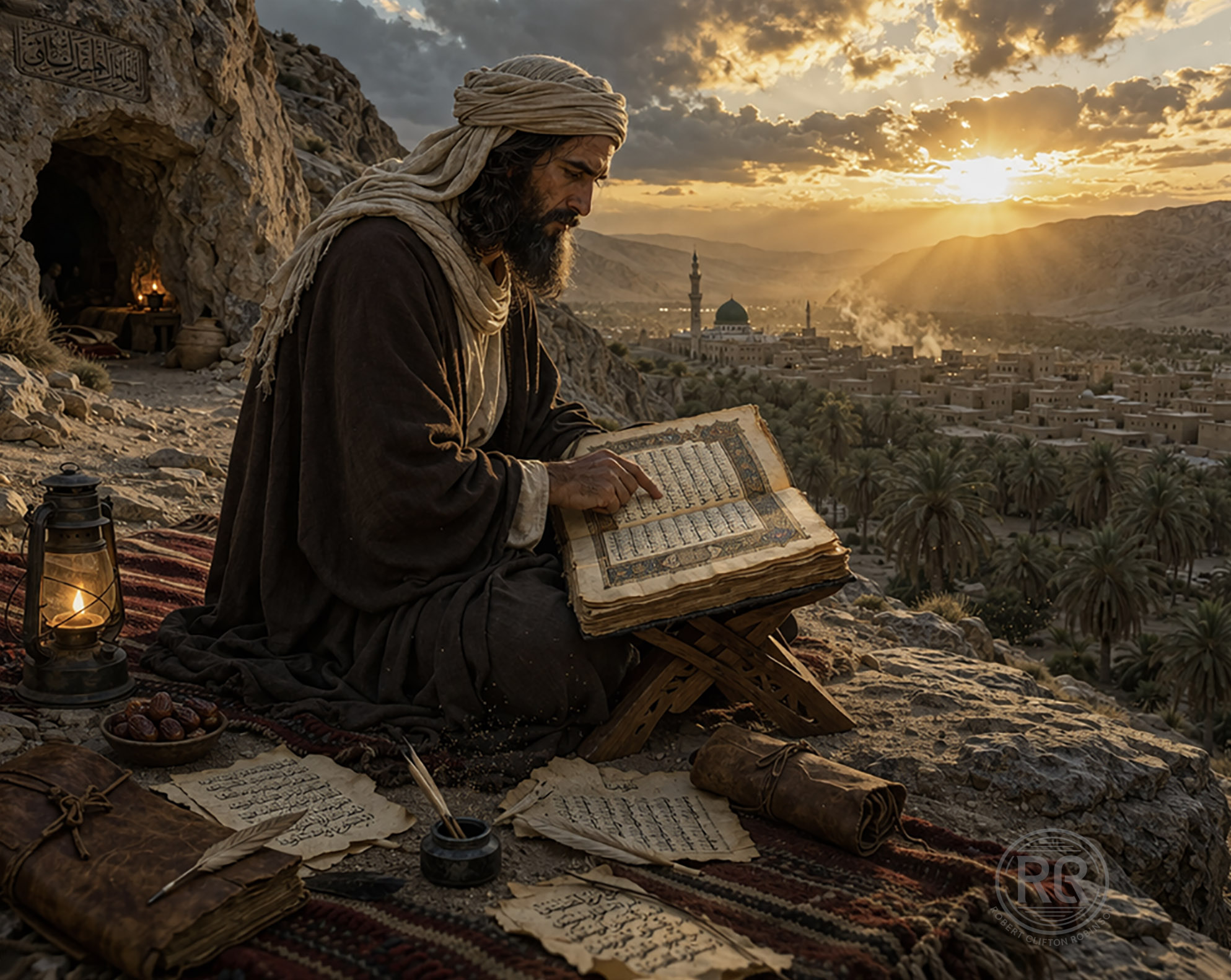
The origins of the Qur’an and the role of Muhammad in its formation present a complex historical problem that has been examined by both Islamic scholars and critical historians for centuries. At the center of this discussion is the claim that the Qur’an is the direct, verbatim word of God, revealed to Muhammad through the angel Gabriel over a period of approximately twenty-three years. While this claim is foundational to Islamic faith, the historical method requires that such assertions be evaluated on the basis of evidence, transmission, and corroboration. When examined through this lens, several significant issues emerge regarding the nature of Muhammad’s revelations, the compilation of the Qur’an, its textual history, and its relationship to earlier religious traditions.
The first and most fundamental issue concerns the private nature of Muhammad’s revelation experiences. According to the earliest Islamic sources, the revelations that constitute the Qur’an were received by Muhammad in isolation, often during periods of retreat or contemplation. These experiences were not witnessed by others but were later recited by Muhammad to his followers, who memorized and recorded them. As a result, the foundational claim of divine revelation rests almost entirely upon the testimony of a single individual. From the standpoint of historical inquiry, this presents an immediate challenge, as events that lack independent eyewitness corroboration are inherently more difficult to verify. In contrast to public events recorded by multiple observers, Muhammad’s encounters with Gabriel remain inaccessible to external confirmation, requiring acceptance on the basis of trust in his personal reliability rather than empirical validation.¹
Closely related to this issue is the fact that the Qur’an was not compiled into a single written text during Muhammad’s lifetime. Instead, the revelations existed in a combination of oral recitation and fragmentary written materials, like parchments, bones, and leaves that were preserved by his followers. Following Muhammad’s death in 632 AD, the first caliph, Abu Bakr, initiated a process to collect these materials, motivated in part by the deaths of many who had memorized the text. This effort was later expanded under the third caliph, Uthman ibn Affan, who produced a standardized version of the Qur’an and ordered the destruction of variant copies.² The necessity of such standardization raises important questions regarding the existence of textual variations prior to this effort. If the Qur’an had been perfectly preserved from the moment of revelation, the need to eliminate differing versions would seem unnecessary. The historical record, however, suggests that multiple forms of the text were in circulation, necessitating editorial intervention to achieve uniformity.³
The issue of textual variation is further illuminated by the study of early Qur’anic manuscripts. Among the most significant discoveries is the Sana’a manuscript, which contains both an upper text and a lower, erased text that differs in various respects from the standard Qur’anic version.⁴ This palimpsest provides real evidence that the text underwent a process of revision or correction during its early writing. While some scholars argue that these differences are minor and fall within acceptable recitational variants, others contend that they indicate a more fluid textual tradition than is often acknowledged. Additional manuscripts, such as the Topkapi and Samarkand codices, also reveal variations in the spelling system and arrangement, which complicates claims of perfect textual uniformity from the outset.⁵
Another significant area of concern involves the relationship between the Qur’an and earlier Jewish and Christian traditions. The Qur’an contains numerous narratives that parallel accounts found in the Hebrew Scriptures and the New Testament, including stories of Adam, Noah, Abraham, Moses, and Jesus. However, these narratives often appear in forms that more closely resemble later Jewish midrashic expansions or Christian apocryphal writings than the canonical biblical texts themselves.⁶ For example, certain details about Abraham’s confrontation with idol worship or descriptions of Jesus’ early life bear striking similarities to non-canonical sources circulating in the Near East during late antiquity. This has led some scholars to propose that the Qur’an reflects a process of cultural and religious interaction, in which existing traditions were adapted and reinterpreted within a new theological structure.⁷ While Islamic theology maintains that the Qur’an corrects distortions in earlier scriptures, the historical evidence suggests a more complex pattern of literary dependence and transformation.
The doctrine of abrogation (abolishing, naskh) introduces another layer of difficulty. Within the Qur’an itself, certain verses are understood as taking the place of or even replacing earlier revelations, demonstrating a change in Muhammad’s message over time.⁸ Early Meccan passages often emphasize themes of tolerance and patience, while later Medinan verses introduce more detailed legal prescriptions and, in some cases, directives related to conflict. This is evidence, not of faithful reproduction of the texts as with the New Testament manuscripts, but replacements and corrections in the text, signs of fabrication. The existence of removing texts raises important theological and historical questions. If the Qur’an is the unchanging word of God, why would later revelations modify or nullify earlier ones? Muslim scholars typically explain this as a form of progressive revelation, tailored to the evolving circumstances of the early Muslim community. However, critics argue that this pattern is more consistent with a message shaped by historical context rather than one that is timeless and immutable.⁹
Further complicating the picture are instances in which Qur’anic revelations appear to address specific situations in Muhammad’s personal life. Certain passages provide guidance or permissions that apply uniquely to him, including matters related to marriage and domestic arrangements.¹⁰ While these verses are understood within Islamic tradition as examples of divine guidance in practical affairs, they have been interpreted by some scholars as evidence that the content of the revelations was influenced by Muhammad’s immediate circumstances. This raises the broader question of whether the Qur’an reflects purely divine communication or a combination of divine and situational elements.
In addition to these internal considerations, the external historical record provides limited contemporary corroboration for the events surrounding Muhammad’s revelations. Unlike some figures of antiquity whose lives link with independent historical sources, the primary accounts of Muhammad’s life and the formation of the Qur’an are found in Islamic traditions compiled generations after his death, such as the Hadith collections and early biographies.¹¹ While these sources are invaluable for understanding Islamic history, their chronological distance from the events they describe introduces the possibility of retrospective development and embellishment. The absence of extensive contemporary external documentation leaves historians largely dependent on these later accounts, which must be evaluated with careful critical scrutiny.
The Qur’an’s claim to linguistic perfection and inimitability has been both a cornerstone of Islamic belief and a subject of debate. Muslim scholars have long argued that the Qur’an’s Arabic style is unparalleled and constitutes a miracle in itself. Critics, however, note that literary excellence is inherently subjective and difficult to measure by objective standards.¹² While the Qur’an is undoubtedly a work of profound rhetorical power, the assertion that it is beyond imitation cannot be empirically demonstrated in the same way as historical or textual claims.
Taken together, these issues form a cumulative case that challenges the traditional Islamic view of the Qur’an as a perfectly preserved, verbatim revelation delivered without historical development.
The private nature of Muhammad’s experiences, the later compilation of the text, the existence of early manuscript variations, the parallels with pre-existing religious traditions, the doctrine of replacement, the influence of personal circumstances, and the limited external corroboration all point toward a process that bears the marks of historical formation. This does not, in itself, disprove the possibility of divine inspiration, but it does suggest that the origins of the Qur’an are more complex than a straightforward model of direct and unmediated revelation would imply.
In the final testing of the document, the question of the Qur’an’s origin is not merely a matter of theological assertion but one that must be considered in light of historical evidence. The same standards applied to other ancient texts—standards that examine sources, transmission, and corroboration—must also be applied here. When this is done, the formation of the Qur’an appears to reflect a dynamic interaction between religious experience, community memory, and historical context, rather than a process entirely removed from human influence.¹³
Sources and Citations
¹ F. E. Peters, Muhammad and the Origins of Islam (Albany: SUNY Press, 1994), 252–255.
² Ṣaḥīḥ al-Bukhārī, Book 61, Hadith 509; also see Ibn Abi Dawud, Kitab al-Masahif.
³ John Burton, The Collection of the Qur’an (Cambridge: Cambridge University Press, 1977), 105–110.
⁴ Behnam Sadeghi and Mohsen Goudarzi, “Ṣan‘ā’ 1 and the Origins of the Qur’an,” Der Islam 87 (2012): 1–129.
⁵ Keith Small, Textual Criticism and Qur’an Manuscripts (Lanham: Lexington Books, 2011), 45–60.
⁶ Gabriel Said Reynolds, The Qur’an and Its Biblical Subtext (London: Routledge, 2010), 12–30.
⁷ Sidney H. Griffith, The Bible in Arabic (Princeton: Princeton University Press, 2013), 85–102.
⁸ Qur’an 2:106; see also Abdullah Saeed, Interpreting the Qur’an (London: Routledge, 2006), 87–92.
⁹ David S. Powers, Muhammad Is Not the Father of Any of Your Men (Philadelphia: University of Pennsylvania Press, 2009), 56–70.
¹⁰ Qur’an 33:50–53; see also W. Montgomery Watt, Muhammad at Medina (Oxford: Oxford University Press, 1956), 277–280.
¹¹ Fred Donner, Muhammad and the Believers (Cambridge: Harvard University Press, 2010), 60–75.
¹² Neal Robinson, Discovering the Qur’an (Washington, DC: Georgetown University Press, 2003), 260–275.
¹³ Angelika Neuwirth, The Qur’an and Late Antiquity (Oxford: Oxford University Press, 2019), 140–165.
Categories: Robert Clifton Robinson


Sharing this youtube short video as a good example of the Qur’anic Dilemma or Islamic Dilemma.
Consider.
LikeLike
The Qur’anic Dilemma should be understood by every Christian.
But even as I say this I am reminded of Deuteronomy 12:29-31.
Peace be to all who read this.
Thank you Brother Rob.
LikeLike