
Paul, Irenaeus, Tertullian, and Jesus Discuss Why He Is Yahweh-God (Copyright)
When we read the entirety of Paul’s letters in the New Testament, he repeatedly states that Jesus is God. Considering who Paul is and his education as a preeminent Pharisee of Israel, this is a stunning revelation. What is the chance that Paul, who was a chief advocate for the elimination of all teaching about Jesus as the Messiah, before his Damascus Road meeting with Jesus, could have ever accepted that Jesus is not only the Messiah, but the Eternal Living God, Yahweh?
1 Corinthians 9:1 “Am I not as free as anyone else? Am I not an apostle? Haven’t I seen Jesus our Lord with my own eyes?
Based on the literal koine Greek text of Romans 9:5:
“Abraham, Isaac, and Jacob are their ancestors, and Christ himself was an Israelite as far as his human nature is concerned. And he is God, the one who rules over everything and is worthy of eternal praise! Amen,”
How does this statement by Paul confirm that he intended that we understand that Jesus is God (Yahweh)?
Romans 9:5 stands as one of the most focused Christological statements in all of Paul’s writings, and its force is best seen when we look carefully at the actual Koine Greek structure, not merely an English rendering.
The Greek Text and Its Structure
The critical portion of Romans 9:5 reads:
ὧν οἱ πατέρες, καὶ ἐξ ὧν ὁ Χριστός τὸ κατὰ σάρκα·
ὁ ὢν ἐπὶ πάντων θεὸς εὐλογητὸς εἰς τοὺς αἰῶνας, ἀμήν.
Transliterated:
hōn hoi pateres, kai ex hōn ho Christos to kata sarka;
ho ōn epi pantōn theos eulogētos eis tous aiōnas, amēn.
The literal reading:
“From whom are the fathers, and from whom is the Christ according to the flesh, who is over all, God, blessed forever. Amen.”
The Key Grammatical Point
The defining statement is:
ὁ ὢν ἐπὶ πάντων θεός
“the one being over all, God”
There are several important grammatical observations:
The Participle “ὁ ὢν” (“the one who is”)
This is a present participle with the article, functioning as a continuing description of the nearest antecedent. The nearest antecedent is ὁ Χριστός (the Christ).
Therefore, grammatically, the phrase naturally reads: “Christ … who is over all, God”
No Grammatical Break Exists
There is no verb, conjunction, or structural marker that would indicate Paul suddenly shifts from Christ to a separate doxology about the Father. If Paul intended a doxology to God the Father, we would expect something like:
“Blessed be God…” (as in Romans 1:25)
Instead, the sentence flows continuously from Jesus to God:
Romans 9:5: “Christ himself was an Israelite as far as his human nature is concerned. And he is God, the one who rules over everything and is worthy of eternal praise! Amen,”
Word Order Emphasizes Identity
Greek word order is flexible, but here: θεὸς (God) is placed directly in apposition to the participial phrase describing Christ. This is not incidental; it is identificational, not merely descriptive.
Why This Is Not a Separate Doxology
Some critical scholars have attempted to read the final clause as: “God, who is over all, be blessed forever.” The problem is that this reading fails on several grounds:
Greek doxologies follow a known pattern
For example, Romans 1:25:
“ὁ κτίσας… ὅς ἐστιν εὐλογητὸς…”
“the Creator… who is blessed forever”
Notice here that the subject (“God”) is clearly identified first. Then followed by the blessing. In Romans 9:5, the structure is reversed: The subject is already Christ
Then comes the description: “who is over all, God”
The Consistency of Paul’s Argument
Romans 9:1–5 is a lament over Israel’s privileges: their adoption, glory, covenants, law, promises, patriarchs, and finishing with: “from whom is the Christ according to the flesh”
This final statement of Paul elevates Christ beyond mere ancestry:
- He is not only from Israel according to the flesh
- He is also over all, God forever
This is clearly a deliberate and theological intent.
Paul’s Broader Theology Confirms This Statement
Romans 9:5 is not isolated—it aligns perfectly with Paul’s consistent teaching:
Philippians 2:6: “Jesus existed in the form of God.”
Colossians 2:9: “In Jesus all the fullness of God dwells in human form.”
Titus 2:13: “our great God and Savior, Jesus Christ.”
These texts demonstrate that Paul had no hesitation in identifying Jesus as the Eternal God.
The Yahweh Connection
The significance goes even further. In the Old Testament, “God over all” is a title reserved for Yahweh alone. Notice that Paul used this Old Testament phrase for Yahweh, as a description of Jesus as Yahweh: Romans 9:5, “Christ … who is over all, God.”
The Old Testament Presents Sovereignty Over All Creation as a Unique Right that only Yahweh has
Deuteronomy 10:17 — “God of gods and Lord of lords.”
Psalm 97:9 — “You are exalted far above all gods.””
When Paul says, “Christ… who is over all, God,” he is not assigning a vague divine status—he is placing Jesus within the exclusive identity of Yahweh.
The Two-Nature Contrast (Critical Insight)
Paul deliberately places side-by-side: “κατὰ σάρκα,” Jesus “according to the flesh” (human nature) “θεὸς ἐπὶ πάντων,” with Jesus as “God over all” (divine nature)
This provides us with the clearest and earliest declaration of Paul in his view of Jesus true identity as:
Fully human (from Israel)
Fully God (God over all)
The First Century Early Christian Understanding
First century Greek-speaking Christians who read this text as local inhabitants of Israel, consistently understood what Paul wrote as affirming Jesus’ as Yahweh-God.
Early Church Fathers, Irenaeus, and Tertullian cite texts like Romans 9:5 in defense of Jesus as Yahweh-God
Irenaeus (c. 130–202 AD)
Direct Citation of Romans 9:5 Applied to Christ as God. Source: Against Heresies
Book III, Chapter 16, Section 3:
“Paul also says: ‘Whose are the fathers, and from whom is Christ according to the flesh, who is over all, God blessed for ever.’”
This is crucial for several reasons: Irenaeus quotes Romans 9:5 verbatim. He explicitly applies the phrase “God over all” to Christ. He uses this passage as proof of Christ’s full deity, not as a separate doxology.
He introduces the citation in a section devoted to demonstrating that Jesus Christ is truly God, not a lesser being or emanation of God.
Additional Supporting Statement (Same Work). In the same broader context (Book III), Irenaeus writes:
“Christ Himself, therefore, together with the Father, is the God of the living…” (Against Heresies, III.6.1)
This shows that his use of Romans 9:5 is not isolated, but part of a consistent theological argument.
Tertullian (c. 155–220 AD)
His Explicit Use of Romans 9:5 to Affirm Jesus as God. Source: Against Praxeas, Chapter 13:
“Of whom are the fathers, and of whom as concerning the flesh Christ came, who is over all, God blessed for ever.”
Tertullian is writing against modalism (Praxeas), defending the distinction of Persons, the full deity of Christ. He uses Romans 9:5 as a proof text that Christ is called God directly.
An Additional Confirming Statement: In the same treatise, Tertullian states:
“The Apostle (Paul) also calls Him God… saying… ‘Christ… who is over all, God blessed for ever.’”
This is extremely important because Tertullian explicitly says Paul is calling Christ “God.” He does not interpret the verse as referring to the Father.
This Provides Historical Evidence of Early Understanding in Jesus’ Church That He is Yahweh-God
The Chronological Proximity
Irenaeus: ~100 years after Paul
Tertullian: ~150 years after Paul
These men were fluent in Greek (Irenaeus) or trained in its tradition, and lived much closer to the apostolic interpretive tradition. Neither has any awareness of an alternative reading. Neither Irenaeus nor Tertullian suggests this verse is ambiguous, separates the “God” clause from Jesus, or treats it as a doxology to the Father. This proves that the earliest Christian understanding of Romans 9:5 directly calls Jesus “God over all.”
Early Christians Used This Text Polemically Against Heresy
Both Irenaeus and Tertullian used this Romans 5 verse to impeach Gnostic subordinationism (Irenaeus), and Modalism, the denial of proper distinctions (Tertullian). This means Romans 9:5 was understood as a decisive, authoritative statement that Jesus was understood by Hebrew Scholar, Paul, as God-Yahweh.
“Both Irenaeus (Against Heresies III.16.3) and Tertullian (Against Praxeas 13) clearly cite Romans 9:5 as proof that Christ is ‘God over all, blessed forever,’ demonstrating that the earliest post-apostolic interpreters uniformly understood Paul to identify Jesus as fully divine.”
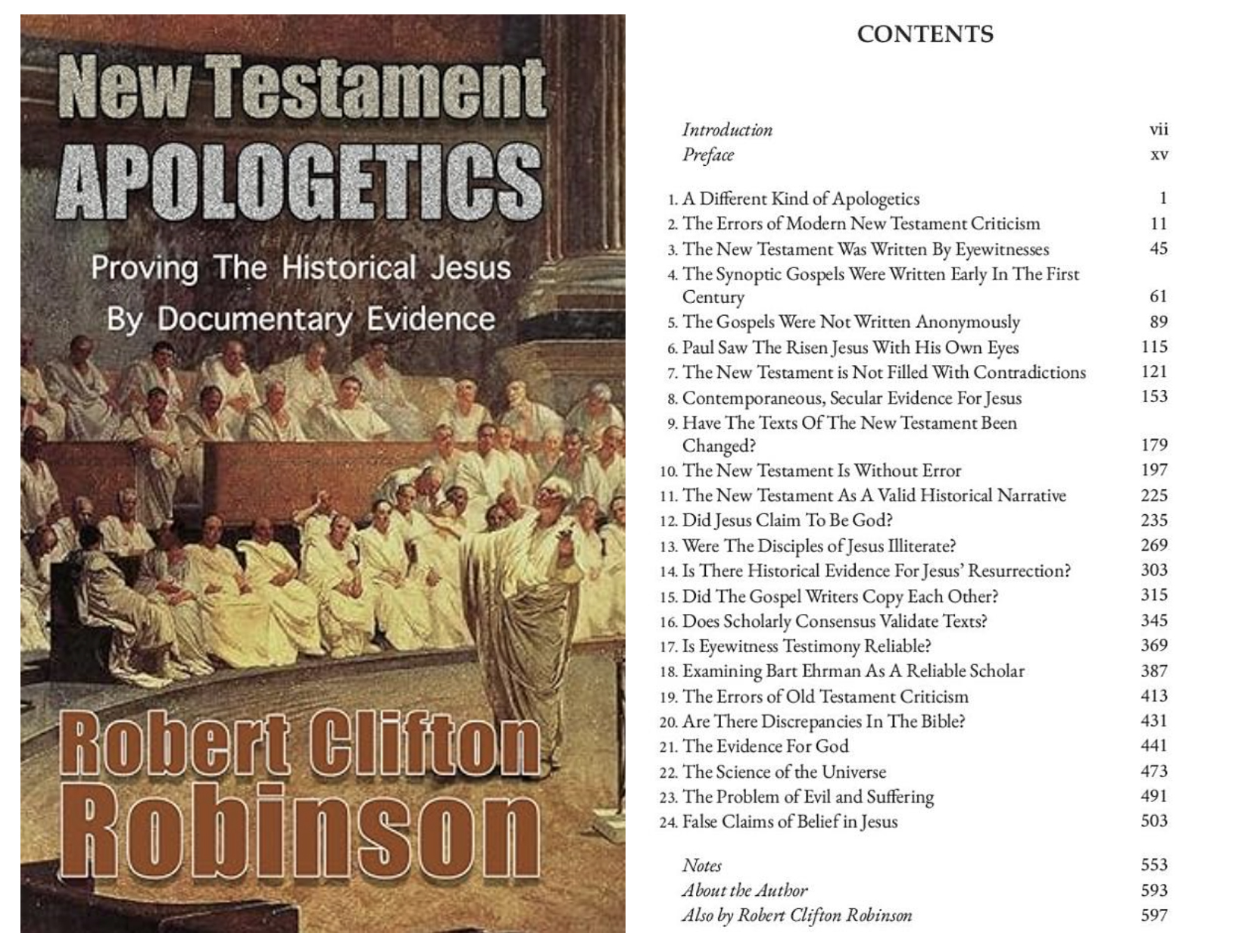
See Rob’s Treatise on the Reliability of the New Testament Documents as Genuine Historical Eyewitness Accounts: “New Testament Apologetics“
Categories: Robert Clifton Robinson
 Robert Clifton Robinson
Many thanks. Yahweh can be considered phonetically as Yah meaning ‘Yes’ and weh meaning ‘way’, the whole becoming ‘Yesway’. Jesus is the ‘Yesway’ and as it is written “For all the promises of God are ‘Yes’ in Christ.”
LikeLiked by 1 person
And tomorrow April 5, 2026 we shall celebrate the Feast of First Fruits as it was fulfilled nearly two millennium ago with the resurrection of Jesus Christ – 1 Corinthians 15:20-23.
Thank you for these wonderful essays.
Tony
LikeLiked by 1 person