The claim that a human being in the womb can be morally dismissed because it is called a “fetus” rests on a misunderstanding of both language and human development. The issue is not merely semantic; it touches biology, philosophy, and ethics. When examined carefully, the justification proves inadequate for several reasons.
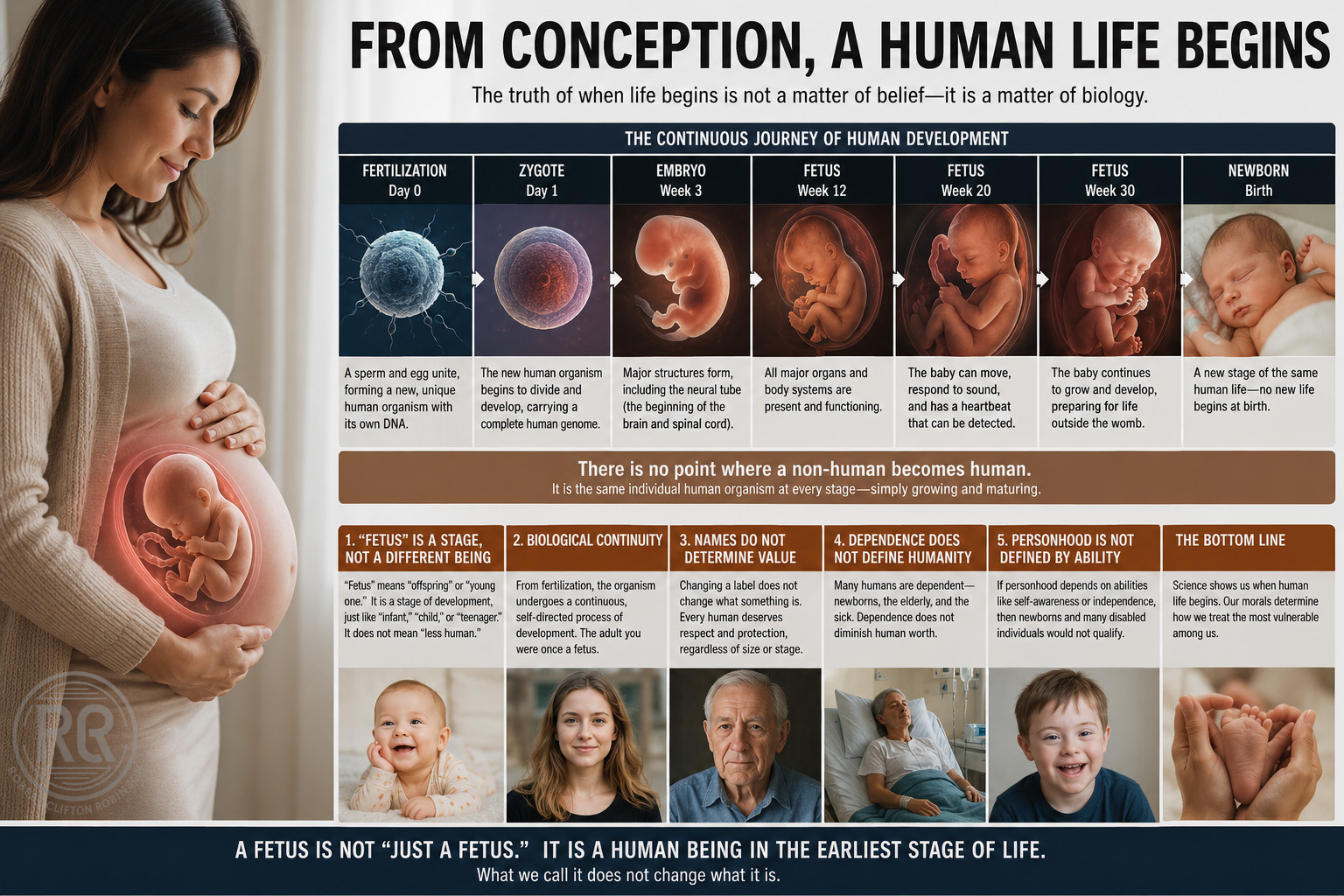
“Fetus” is a stage of development, not a different kind of being
The word fetus comes from Latin and simply means “offspring” or “young one.” In modern biology, it refers to a specific stage of human development, typically from about eight weeks after fertilization until birth. It does not describe a different species, it is still human; fetus merely describes a phase in the life of the human inside the mother.
In the same way that terms like “infant,” “child,” “adolescent,” and “adult” refer to stages of human life, “embryo” and “fetus” describe earlier stages of a human being. No one would argue that an infant is less human because it is not yet an adult. The label identifies development, not identity.
So the question becomes: Does changing the name of a stage change the nature of the being? Biologically, it does not.
Biological continuity from conception
From the moment of fertilization, a new, genetically distinct human organism exists. This is not a philosophical claim but a well-established biological observation: the zygote possesses a complete human genome and begins a continuous, self-directed process of development.
There is no later point, when heartbeat, brain activity, or viability that decides something non-human suddenly becomes human. Instead, development is gradual and uninterrupted. The growing being in the womb is the same individual at every stage, it is always human, maturing over time.
If we stipulate that the adult human is the same individual who once existed as an embryo and fetus, then the distinction between “fetus” and “person” becomes difficult to maintain as a dividing line based on biology alone.
Naming does not determine moral value
Calling something by a different term does not alter its intrinsic nature or value. History provides many examples where language has been used to distance moral responsibility, referring to groups as “subhuman,” “property,” or other depersonalizing labels. These terms did not change what those individuals were; they only influenced how others chose to regard them.
The central ethical question is therefore not: What do we call it? But rather: What is it? If the being in the womb is a developing human organism, then its moral status must be considered on that basis, not on terminology. Since it is a human species, it is entitled to human rights, particularly in its most vulnerable state in the womb of the mother.
The distinction between dependence and identity
Some argue that because a fetus is dependent on the mother, it does not have the same moral standing. However, dependence does not determine whether a being is human. Newborn infants are completely dependent; so are many elderly or medically fragile individuals. Can we kill an infant simply because it is completely dependant of its mother? Why then do we kill the same children in the womb who are simply at an earlier stage of development? Dependence may raise important ethical questions about care and responsibility, but it does not redefine the nature of the individual and allow their life to be taken.
The philosophical question of personhood
At the heart of the issue is the concept of personhood. Some define personhood by characteristics such as self-awareness, rationality, or independence. But these criteria, if applied consistently, would exclude not only fetuses but also newborns and some disabled individuals.
An alternative view holds that human beings possess inherent value by virtue of what they are, not by what they can presently do. Under this view, the developmental stage does not determine worth. If we use this standard, then the disabled must be considered for execution. Do we really believe that this is true? Of course not. Why then do we use this irrational standard for babies in utero?
The fundamental logical problem
The reasoning “it is only a fetus” functions as a category shift: It assumes that being a “fetus” is morally different from being a “human being.” But biologically, a fetus is a human being at a particular stage of development. Thus, the argument risks becoming circular: it justifies the act by redefining the subject rather than addressing its actual nature.
The assertion that it is acceptable to end the life of a human in the womb because it is a “fetus” fails on both biological and logical grounds. “Fetus” does not denote a lesser kind of being; it denotes a younger human being. The ethical question cannot be resolved by terminology alone. It requires a deeper examination of what it means to be human and whether human value is grounded in development, capability, or intrinsic nature.
If the being in the womb is recognized as a developing human organism—as biology consistently indicates—then the moral discussion must proceed from that reality rather than from a label.
Categories: Robert Clifton Robinson


Thank you so much here is what i write a articles and am a pastor in india mostly difficult place to share the gospel now days please keep in praying for me and my family and churches under our leadershiip God bless you .
LikeLike
At the moment of conception if the baby dies one minute old, will that baby live again during the millinneum? Thank you for all you do. bobwheeler54@gmail.com
LikeLike
A thirteen year old (adolescent) isn’t less human than a twenty-three year old (adult), etc., because of its stage of physiological and cognitive development. Mothers often share ultrasound images with their children to introduce them to a new sibling. If a child asks their mother whether the “baby” is their new brother or sister, they’d be perplexed if she answered, “No, it’s a fetus.”
LikeLiked by 2 people
Great points, thanks for sharing these important truths. Everyone deserves a chance to live.
Blessings!
LikeLike
I thank my father and mother for giving me a chance.
LikeLike