What Jesus Said About The True Believer In John Chapter 17
Jesus said in His prayer to the Father in John 17:6 that “I have revealed you to the ones you gave me from this world. They were always yours.”
John 17:6 “Father, I have revealed you to the ones you gave me from this world. They were always yours.”
Since those born again by the Spirit of God, as Jesus described in John 3:3, were “always His,” there can never be a time when they were not His.
Before God created the universe and placed man on earth, He knew who would believe in Jesus and continue to believe for all of their life. He knew these persons before they were created. God chose people for eternal life based on this eternal knowledge of who would believe and continue to believe. God’s Sovereignty in choosing whomever He will save originates in His knowledge of all things from eternity.
These are the persons that Jesus is speaking of to the Father in John 17:6: “They were always yours.”
Based on this truth, who are the people Paul described in Hebrews chapter 6?
Hebrews 6:4-6: “For it is impossible to bring back to repentance those who were once enlightened—those who have experienced the good things of heaven and shared in the Holy Spirit, 5 who have tasted the goodness of the word of God and the power of the age to come—6 and who then turn away from God. It is impossible to bring such people back to repentance; by rejecting the Son of God, they themselves are nailing him to the cross once again and holding him up to public shame.”
The people described in Hebrews 6 had knowledge of who Jesus is. They “experienced the good things of heaven and shared in the Holy Spirit, tasted the goodness of the word of God and the power of the age to come, but then turn away from God.”
God knew those who would believe in Jesus and always believe in Him, before He created the universe; therefore, these persons who are “always his,” there can never be a time when they are not His.
This defines those in Hebrews 6 as close to salvation but not saved. The reason: if they were truly saved, they will always be saved (“always yours”).
In 1 John The Apostle defines people who claimed to belong to Jesus, but later leaving Him and the church, as never a part of Jesus.
1 John 2:19 “These people left our churches, but they never really belonged with us; otherwise they would have stayed with us. When they left, it proved that they did not belong with us.”
The argument could be made that these persons left the church but not Jesus. This is not possible in the context in which John writes these words, because the church is the Body of Christ. People can leave a church but not leave Jesus, but people cannot leave the Body of Christ and still belong to Christ.
Romans 12:4-5 “Just as our bodies have many parts and each part has a special function, 5 so it is with Christ’s body. We are many parts of one body, and we all belong to each other.”
1 Corinthians 12:12 “The human body has many parts, but the many parts make up one whole body. So it is with the body of Christ.”
1 Corinthians 12:27 “All of you together are Christ’s body, and each of you is a part of it.”
In John 17:6 Jesus describes the people who are genuinely saved as never leaving Jesus (“they were always yours”) and John 3:3 (new birth) to the doctrine of God’s eternal foreknowledge of His elect (cf. Romans 8:29–30), concluding that Hebrews 6 cannot be describing truly regenerated believers, because true regeneration is an irreversible act in God’s eternal plan.
This view is a historically recognized interpretation of these texts:
The “Always Yours” Principle — John 17:6
Jesus says of the disciples: “They were always yours. You gave them to me.”
This is an eternal reality: those the Father has given the Son have always belonged to Him in God’s eternal decree (Ephesians 1:4 — “chosen in Him before the foundation of the world”).
If someone has truly been born again by the Spirit, that regeneration is a work of God’s will (John 1:13), not man’s, and is irreversible (Philippians 1:6 — “He who began a good work in you will carry it on to completion”).
The Implication: If a person could lose salvation, then they were never part of that eternal “always yours” group in the first place.
1 John 2:19 — John’s Test
John describes people who left the fellowship: “They went out from us, but they were not really of us; for if they had been of us, they would have remained with us…”
The proof of true regeneration is perseverance in faith to the end. Apostasy, in this view, shows not a loss of salvation, but that salvation was never possessed in the first place.
Reading Hebrews 6 in Light of This
Hebrews 6:4–6 describing people who:
- Have been deeply involved in the life of the church.
- Have experienced the Spirit’s power (perhaps in gifts, fellowship, or miracles).
- Have been intellectually convinced of the truth.
- But have never been inwardly regenerated — they have not crossed from death to life (John 5:24).
An example of this is seen in Judas Iscariot. None of the other Apostles of Jesus knew that Judas had not been born again by the Holy Spirit. Jesus knew this, and he allowed Judas to continue with Him till the very end. This illustrates for us the fact that Jesus will never give up on us, even though He knows we are not saved, until the very end of our lives.
The danger in Hebrews 6 is not that a true believer loses salvation, but that a person gets as close as possible without truly believing — and then decisively rejects Christ.
This rejection produces a hardness beyond remedy, like Pharaoh in Exodus.
The Key Word: “Shared in the Holy Spirit”
If we understand the term in Hebrews 6: “partakers of the Holy Spirit” (metochous genēthentas pneumatos hagiou) as association rather than indwelling, we can understand how close someone can come to genuine salvation, without actually being born again.
The Spirit can work in and through people without regenerating them (e.g., Saul in 1 Samuel 10:10–11; Judas Iscariot, who preached and healed but was never saved, John 6:70).
Why This Fits with the “Always His” View
People truly given by the Father to the Son (John 6:37, 39; John 17:6) will never be lost.
Hebrews 6 serves as a warning to the nearly converted — that proximity to salvation without faith is spiritually dangerous. The “impossible to renew” language reflects that once someone has had full exposure to the truth, rejected it, and hardened themselves, there’s nothing more God can reveal to bring them to repentance.
Experiencing the Spirit does not equal salvation. People can be immersed in the Spirit’s work without being born again. Perseverance is the proof of salvation. True believers are “always His” and will be kept by His power (1 Peter 1:5).
Hebrews 6 is not describing people who were truly “born again” and lost salvation. It describes people who had every possible advantage, yet never truly surrendered to Christ. Their final rejection of Christ is the clearest evidence that they never belonged to Him in the eternal sense.
What Did Jesus Mean By: “I Never Knew You?
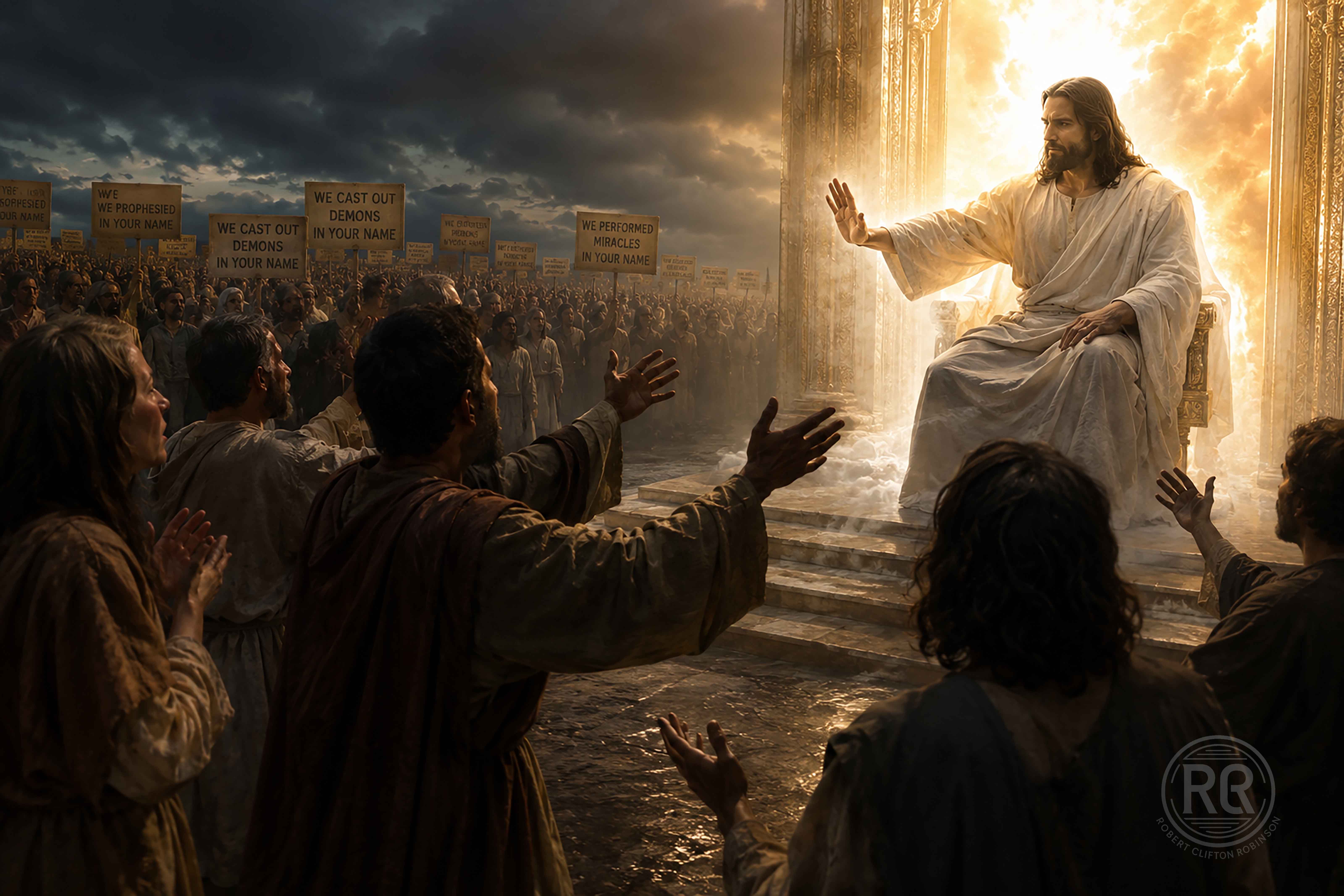
Jesus said: “On judgment day many will say to me, ‘Lord! Lord! We prophesied in your name and cast out demons in your name and performed many miracles in your name.’ 23 But I will reply, ‘I never knew you. Get away from me, you who break God’s laws.’” (Matthew 7:22-23)
Atheists Who Claim To Be Former Christians
There are people today who claim they once believed in Jesus but now no longer do. They write critical comments about Christianity, Jesus, and the Bible, as though they are authorities. Because these individuals once claimed to be Christians, they believe they are qualified to tell others the truth about the realities of Christianity.
Nearly two thousand years ago, Jesus wrote extensively about people who claimed to be one of His believers but were not. In the Parable of the Wheat and the Tares, Jesus described a reality that some who claim they are Christians are not. In this Parable Jesus explains why this is true.
Matthew 13:24-25: “Another parable Jesus put forth to them, saying: ‘The kingdom of heaven is like a man who sowed good seed in his field; but while men slept, his enemy came and sowed tares among the wheat and went his way.”
Matthew 13:37-39: “Jesus answered and said to them: ‘He who sows the wheat, the good seed, is the Son of Man. The field is the world, the good seeds are the sons of the kingdom, but the tares are the sons of the wicked one. The enemy who sowed them is the devil.”
The wheat is the true believer, those who are genuinely saved. The tares are the people who claim to be true believers but are pretending. According to this Parable, Jesus tells us that the pretend believer cannot always be detected in Jesus’ church. These people often look and sound just like a real believer. Jesus said in this parable that satan, the enemy of Jesus’ church, has planted these pretend believers in the church.
Jesus describes the pretend believer as self-deceived. They think they are a true Christian, but the reality is that they were never born again by the Spirit of God. The reason? Verse 23 tells us why: “And then I will declare to them, ‘I never knew you; depart from Me, you who practice lawlessness!’
Before Jesus grants the forgiveness of sins, a person must be willing to turn from their sins. It is necessary that those who will be saved by Jesus feel genuine sorrow for their sins. They come to Jesus because of this sorrow and a desire to turn away from their sins and follow Jesus for the rest of their life. In John chapter 3, Jesus tells us that when genuine repentance takes place, these persons are “born again” by the Spirit of God.
These persons whom Jesus says He never knew are people He never had a close and personal relationship with. When a person is not truly sorry for their sins, and they don’t feel a need to end their former sins, there can be no salvation and no true relationship with Jesus.
Jesus is the friend of sinners, and He came to die for sinners, but a person must feel sincere sorrow over their sins before He will save them. Jesus didn’t leave heaven and die on the cross for all sins—only to have people continue in their sins.
A person can join a church and begin to say and do all the same things that true Christians do—while never being born again by the Spirit of God.
2 Peter 1:10-11: “So, dear brothers and sisters, work hard to prove that you really are among those God has called and chosen. Do these things, and you will never fall away. Then God will give you a grand entrance into the eternal Kingdom of our Lord and Savior Jesus Christ.”
We don’t work hard to obtain our salvation, but we do work hard after we are saved to prove we really are saved. A person who claims to trust in Jesus—yet continues in their sins—never was saved.
1 Corinthians 15:1-2: “Let me now remind you, dear brothers and sisters, of the Good News I preached to you before. You welcomed it then, and you still stand firm in it. It is this Good News that saves you if you continue to believe the message I told you—unless, of course, you never really believed it was true in the first place.”
When a person will not end their former lifestyle of sin, it means they are not truly sorry for their sins. This is a pretense that prohibits a person from obtaining eternal life. To these persons at the judgment, Jesus tells them: “Depart from Me, you who practice lawlessness.”
Matthew 7:21-23: “Not everyone who says to Me, Lord, Lord,’ shall enter the kingdom of heaven, but he who does the will of My Father in heaven. Many will say to Me in that day, ‘Lord, Lord, have we not prophesied in Your name, cast out demons in Your name, and done many wonders in Your name?’ And then I will declare to them, ‘I never knew you; depart from Me, you who practice lawlessness!’”
Jesus describes the true believer as one whom He knows intimately, by their repentance from sin, and full commitment to Him as Lord and Savior. The pretend believer, the tare, Jesus describes as someone who has not felt sincere sorrow for their sin, has not taken action to end their sins, and therefore, their relationship with Jesus is not possible.
Jesus began His ministry with a call for all people to repent and believe the good news that He came to save sinners.
Matthew 4:17: “From that time Jesus began to preach and to say, ‘Repent, for the kingdom of heaven is at hand.”
Luke 13:5 Jesus said: “I tell you, no; but unless you all repent you will all likewise perish.”
The entire New Testament is filled with the exhortation to anyone who wants to be saved that we must repent of our sins:
Paul: Acts 26:17-20. Jesus tells Paul that He is sending him to the Gentiles so that they will turn from darkness to light. Then they will receive the forgiveness of their sins:
Jesus tells Saul: “Yes, I am sending you to the Gentiles to open their eyes, so they may turn from darkness to light and from the power of satan to God. Then they will receive forgiveness for their sins and be given a place among God’s people, who are set apart by faith in me.’
Paul carries this message of repentance of sins to everyone he meets:
“And so, King Agrippa, I obeyed that vision from heaven. I preached first to those in Damascus, then in Jerusalem and throughout all Judea, and also to the Gentiles, that all must repent of their sins and turn to God, and prove they have changed by the good things they do.”
Peter: In 2 Peter 3:9
“The Lord isn’t really being slow about his promise, as some people think. No, he is being patient for your sake. He does not want anyone to be destroyed, but wants everyone to repent.”
In the modern doctrine of Progressive Christianity, repentance is not a prerequisite to salvation. This defect in the message has precipitated the acceptance of people remaining in their sins, and Jesus not granting salvation.
Jesus said that in the final judgment, there would be many people who called Him “Lord” who were never saved.
These unrepentant persons who claim they are Christians are described by Jesus as tares. A tare is a weed that grows alongside the wheat, looking just like the wheat. Jesus is saying that in His church satan plants pretend believers who look and sound just like true Christians. They speak like real Christians, and do the same kinds of good works that genuine Christians do—while living a lifestyle of sin, without repentance.
See Part 2: “Who Are The Truly Saved, People Who Do Belong To Jesus?”
See Answers To The 21 Primary Arguments Made By Atheists And Critics Of God: “New Testament Apologetics: Proving The Historical Jesus By Documentary Evidence“
See All of Rob’s 51 Books at Amazon

See All 51 of Rob’s Books
Categories: Robert Clifton Robinson


I truly wish the rapture would take place with Jesus coming before the great tribulation, as everyone seems to preach. But, Matthew was not wrong for chapter 24 verse 29 it says immediately after the tribulation we will see the son of man coming on the clouds for the first resurrection. But there is a place of safety during the great tribulation as stated in revelation 12:14 and Daniel 11:41. I have my passport ready for next year. I love you and all that you do. God bless you Rob.
LikeLiked by 1 person
This is the second coming, not the Rapture. The people saved who come out of the Tribulation, are a part of the first resurrection that began at the Rapture, before the Tribulation.
LikeLike
Thank you for this Rob! This is a topic we have been discussing on a Christian Forum and your words added to the discussion. The Lord never ceases to amaze me with His love and His timing.
Blessings to you brother! 🙂
LikeLike
Thank you Brother Rob for everything you do for us while we wait for the arrival of our Lord.
When I sin, I immediately feel the shame of it. And when I confess my sin by asking for forgiveness the shame of that sin is just wiped away.
I sin … many, many times everyday. And satan wishes for me to surrender to my sin by sin-shaming me into believing that my sin is so shameful that Jesus could never forgive it; but, I cannot surrender to it for the sick feeling that comes over me causes me to repent, confess and ask for forgiveness. I am grateful for that feeling – a rebuke from the Holy Spirit. It is truly appreciated.
There is always doubt. But that feeling erases those doubts fairly quickly.
Because of Grace and the Cross … I have the hope of Salvation because it is truly all I need for the Lord has everything else covered.
Prayers and blessings always. The Beginning is Truly Near!
LikeLike