Following Jesus is About Freedom. Knowing Jesus is About Peace
Romans 8:1 So now there is no condemnation for those who are in Christ Jesus. 2 And because you belong to him, the power of the life-giving Spirit has freed you from the power of sin that leads to death. 3 The law of Moses was unable to save us because of the weakness of our sinful nature. So God did what the law could not do. He sent his own Son in a body like the bodies we sinners have. And in that body God declared an end to sin’s control over us by giving his Son as a sacrifice for our sins. 4 He did this so that the just requirement of the law would be fully satisfied for us, who no longer follow our sinful nature but instead follow the Spirit.”
In the final scriptures from Romans 7, Paul said: 24 “Oh, what a miserable person I am! Who will free me from this life that is dominated by sin and death? 25 Thank God! The answer is in Jesus Christ our Lord. So you see how it is: In my mind I really want to obey God’s law, but because of my sinful nature I am a slave to sin.”
We are creatures made in the image of God, but in our fallen nature that still exists alongside the new nature directed by the Spirit, we struggle every day with doing what is right. I thought that when I gave my life to Jesus and made Him the Lord of my life, everything was going to be great. The next day, when I failed, I realized this journey with Jesus was going to be difficult.
Paul finished Romans 7 with: “In my mind I really want to obey God’s law, but because of my sinful nature I am a slave to sin.”
Every person who loves Jesus and has been born again by the Spirit of God continues to struggle with sin. So that you might have assurance in these difficulties, Romans 8 begins with: “So now there is no condemnation for those who belong to Christ Jesus.”
There is a good reason that Paul begins this chapter with words that give us peace. In our struggle against sin, we are very good at condemning ourselves. Most honest persons, whether they are saved or not, understand that they are a sinner. God created us with a conscience that tells us when we are right and when we are wrong in our behavior.
Adam and Eve did not need a conscience to produce feelings of guilt before the Fall because they had never sinned, but they still possessed moral awareness and the ability to understand God’s command. But notice what happened after they disobeyed God—seeking to know what evil was like:
Genesis 3:7-8: “At that moment their eyes were opened (Adam and Eve), and they suddenly felt shame at their nakedness. So they sewed fig leaves together to cover themselves. 8 When the cool evening breezes were blowing, the man and his wife heard the LORD God walking about in the garden. So they hid from the LORD God among the trees.”
We cannot escape two fundamental truths about ourselves, because God created us with these attributes inside us: We know that God exists, and we know when we have sinned. These two facts are resident inside every person, whether we admit it or not.
A change takes place for people who turn from their sins and fully trust in Jesus for the rest of their lives: there is NOW no more condemnation from God. This doesn’t mean we won’t condemn ourselves. We are experts at feeling shame. The Good News is that we don’t have to live like this any longer.
Romans 8:1-2 “So now there is no condemnation for those who are in Christ Jesus. And because you belong to him, the power of the life-giving Spirit has freed you from the power of sin that leads to death.”
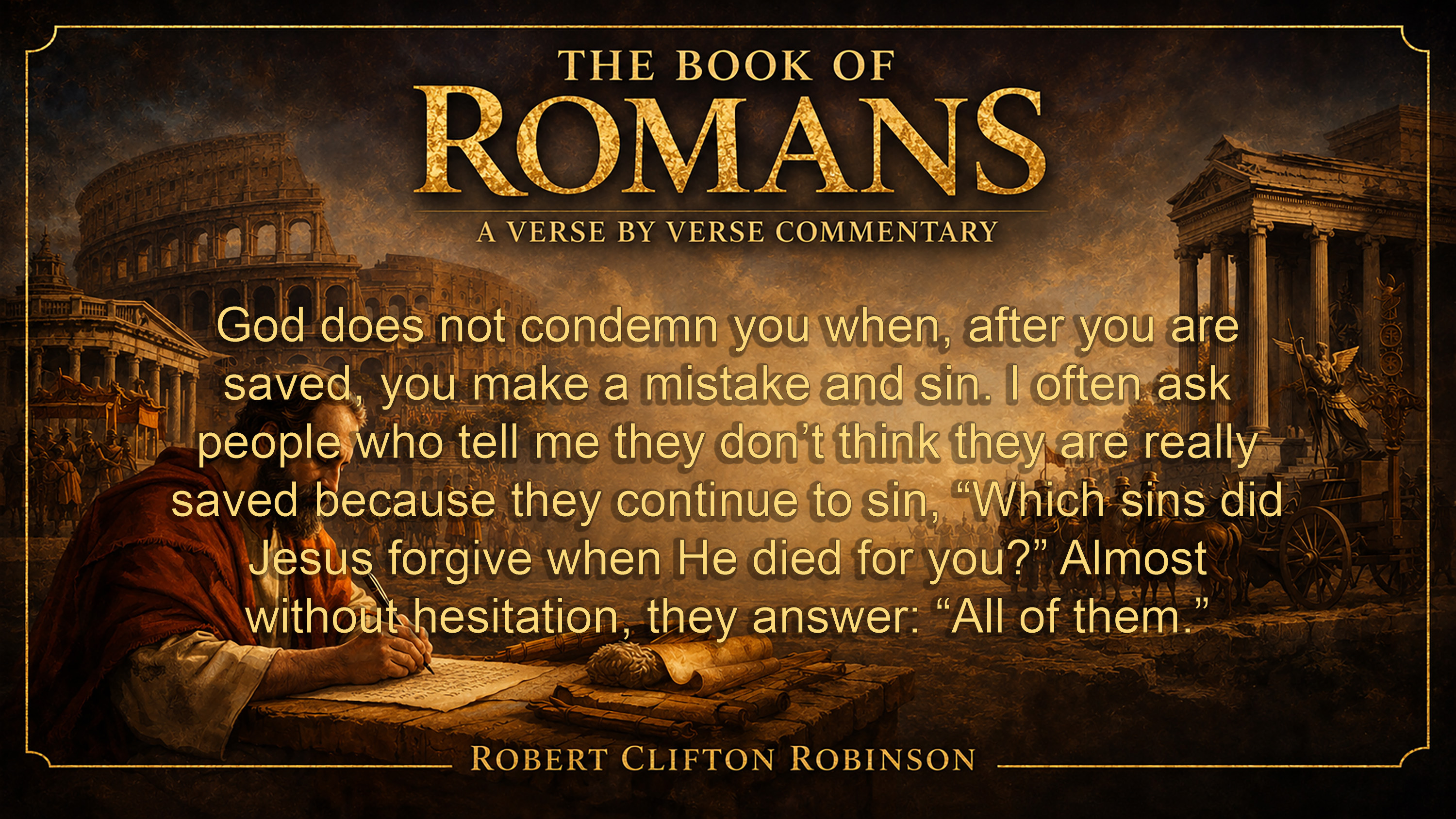
God does not condemn you when, after you are saved, you make a mistake and sin. I often ask people who tell me they don’t think they are really saved because they continue to sin, “Which sins did Jesus forgive when He died for you?” Almost without hesitation, they answer: “All of them.”
Sometimes we need a reminder that Jesus died for all of our sins. The sins we committed before we asked Him to forgive us, the sins we have committed today, and the sins we will commit for the rest of our lives. This doesn’t mean that we can just go on sinning as we please, but that we no longer live in a lifestyle of sin, and when we do sin, God will not condemn us. Instead, we have an open-door relationship with the Lord where we can walk into His office and talk to Him.
John said that if we confess our sins, He is faithful and just to forgive us and cleanse us of all unrighteousness (1 John 1:9). The hardest part is to knock on the door of His office. Romans 8 is written so that you will be encouraged to knock, open the door, and talk to the Lord whenever you are struggling with any issue.
“For He Himself is our peace, who has broken down the middle wall of separation… So let us come boldly to the throne of our gracious God. There we will receive his mercy, and we will find grace to help us when we need it most.” (Ephesians 2:14-16, Hebrews 4:16)
At the end of Romans chapter 8, verse 29, Paul writes that “…nothing in all creation will ever be able to separate us from the love of God that is revealed in Christ Jesus our Lord.”
Remember these words the next time you fail and fall. You have a gracious and kind Savior who will always welcome you into His presence when you come to Him.
The Preceding Is From Rob’s New Verse by Verse Useful Commentary on the Book of Romans
Available in digital Kindle edition and Print edition
Categories: Robert Clifton Robinson
 Robert Clifton Robinson
The first word of the Bible Bereshit is usually translated as In the beginning. But as I have recently learnt it can also be translated as by the first or as it is commonly read by the Rabbis on account of the messiah. What does this actually mean? The significance of this translation goes far beyond the cross and salvation.
Consider. I have always read Genesis 1:1 as In the beginning God created the Heavens and the Earth. This is how we have always read this. But what if we start reading it this way – On account of the Messiah God created the Heavens and the Earth. Consider how the meaning of the Bible’s very first word tells a deeper truth and a story that predates creation.
In one word a decision was made. A decision that not only laid the framework for our salvation but for the existence of ALL things. It is said amongst the Jewish Rabbis that God The Father approached God the Son and said `I will create this if you agree to die to redeem it`. And the Son agreed to do this. We know this to be true because Jesus was described as the Lamb slain before the foundation of the World – Revelation 13:8.
Now here is the deep part. If Jesus had decided differently nothing would have been created … not one thing. God would not have created a single thing had He not had the cure for Sin beforehand which was provided by the Son’s death and resurrection which occurred in Eternity long before anything was created.
So the very first word of the Bible tells you everything that is important. Creation was redeemed by a decision which led to the cross after the FACT. Understanding this means that Messiah saved everything in creation … everything! This is what is behind 1 Corinthians 15:28 where the Son subjects all things back to Father and the Father becomes all in all (or all things to all things).
All of this from the FIRST WORD. The FISRT WORD … the MESSIAH … of ALL THINGS!
Thank you brother Rob for everything. Prayers and blessings always.
LikeLiked by 1 person