Critics often cite Leviticus 19 when describing the inconsistency or selective application of Scripture by Christians
Comments that critics make are generally like the following: “The Bible commands believers to welcome the stranger, therefore Christians should support unrestricted immigration.” “Leviticus 19:33–34 says to treat the foreigner as the native-born, so support for border enforcement or immigration laws contradicts biblical teaching.” “Christians who advocate immigration restrictions are ignoring God’s command to love the stranger.” “Jesus was a refugee, therefore Christians should oppose immigration controls.”
The problem with these critics is that persons who say these things have a great lack of knowledge in what the Bible actually says, and how God intends that people who love Him, should apply His laws to their lives.
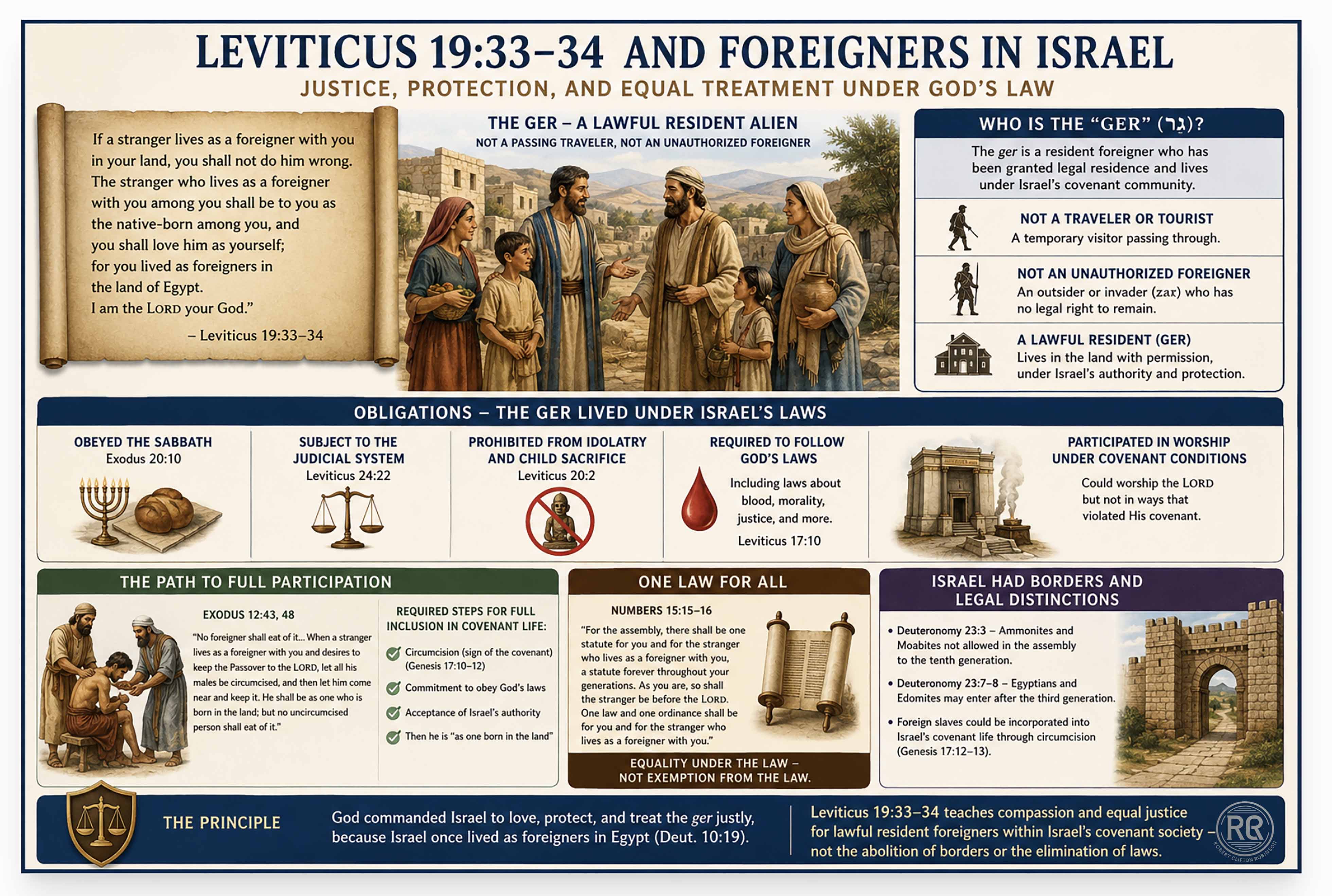
Leviticus 19:33–34 is not speaking of unrestricted migration or automatic citizenship. The Hebrew text distinguishes between several categories of non-Israelites living among Israel, and the rights and obligations attached to those categories.
“If a stranger lives as a foreigner with you in your land, you shall not do him wrong. The stranger who lives as a foreigner with you among you shall be to you as the native-born among you, and you shall love him as yourself; for you lived as foreigners in the land of Egypt. I am Yahweh your God.”
The Hebrew word translated “stranger” or “foreigner” here is ger (גֵּר). A ger was not merely a traveler crossing through Israel or a foreign invader entering the land without permission. The ger was an alien who had been granted legal residence within Israel’s covenant society, upon completion of the process required by Hebrew Law. The Old Testament distinguishes the ger from the nokri (נָכְרִי), a foreigner from another nation who remained outside Israel’s community, and from the zar (זָר), an outsider or unauthorized person. A zar is an individual entering the country without legal authorization, similar to illegal aliens who enter the United States without permission.
Israel recognized distinctions between citizens, resident foreigners, temporary foreigners, and unauthorized outsiders. Israel extended legal protection and humane treatment to lawful resident foreigners (gerim). Israel expected all persons residing within the land to obey the laws of the nation. Unauthorized persons who were in the country illegally could not participate in privileges or covenant functions, and they were often removed from the country.
The ger lived under Israel’s laws and accepted Israel’s civil authority. Numerous passages demonstrate this clearly:
- The ger was required to obey the Sabbath laws (Exodus 20:10).
- The ger was subject to Israel’s judicial system (Leviticus 24:22).
- The ger was prohibited from idolatry and child sacrifice (Leviticus 20:2).
- The ger was required to observe laws regarding blood consumption (Leviticus 17:10).
The ger could participate in religious observances only under specified covenant conditions.
One of the clearest examples concerns Passover:
“No foreigner shall eat of it… When a stranger lives as a foreigner with you and desires to keep the Passover to Yahweh, let all his males be circumcised, and then let him come near and keep it. He shall be as one who is born in the land; but no uncircumcised person shall eat of it.” (Exodus 12:43, 48)
This indicates a process of covenant identification and submission to Israel’s laws before enjoying the full privileges of membership within the community.
Also, Numbers 15:15-16 states:
“For the assembly, there shall be one statute for you and for the stranger who lives as a foreigner with you, a statute forever throughout your generations. As you are, so shall the stranger be before Yahweh. One law and one ordinance shall be for you and for the stranger who lives as a foreigner with you.”
The principle was equality under the law, not exemption from the law.
Israel also possessed border controls and legal distinctions regarding foreigners. Certain nations faced restrictions on entering the assembly of Israel: Deuteronomy 23:3 restricted Ammonites and Moabites from entering the assembly to the tenth generation. Egyptians and Edomites could enter after the third generation (Deuteronomy 23:7-8).
Foreign servants purchased by Israelites were not mistreated, but could be incorporated into Israel’s covenant life through circumcision (Genesis 17:12-13). These regulations demonstrate that entry into Israel’s covenant community involved legal and religious conditions rather than automatic admission.
- “Did foreigners have to obey Israel’s laws to reside in Israel?” The biblical answer is clearly yes.
- “Did foreigners become citizens merely by entering Israel?” The answer is no.
The ger was a lawful resident alien living under Israel’s authority and protections if they met the terms of immigration. Israel was commanded to love, protect, and treat such people justly because Israel herself had once been a vulnerable foreign population in Egypt. But the same Scriptures that command compassion toward the foreigner also assume that the foreigner lives under the same law and authority as everyone else in the land.
Leviticus 19:33–34 teaches equal justice and humane treatment for lawful resident foreigners within Israel’s covenant society, not the abolition of national borders or the elimination of legal distinctions regarding membership in the nation.
So, when critics say that foreigners in Israel were different than foreigners in the United States, they are wrong.
See All of Rob’s 52 Books and 3,400 Essays at This Site and Amazon
 See All 52 of Rob’s Books
Categories: Robert Clifton Robinson


Please see, "Guidelines For Debate," at the right-side menu. Post your comment or argument here: