Is There Scriptural Evidence That the Holy Spirit Still Speaks to Those Who Have Been Born Again?
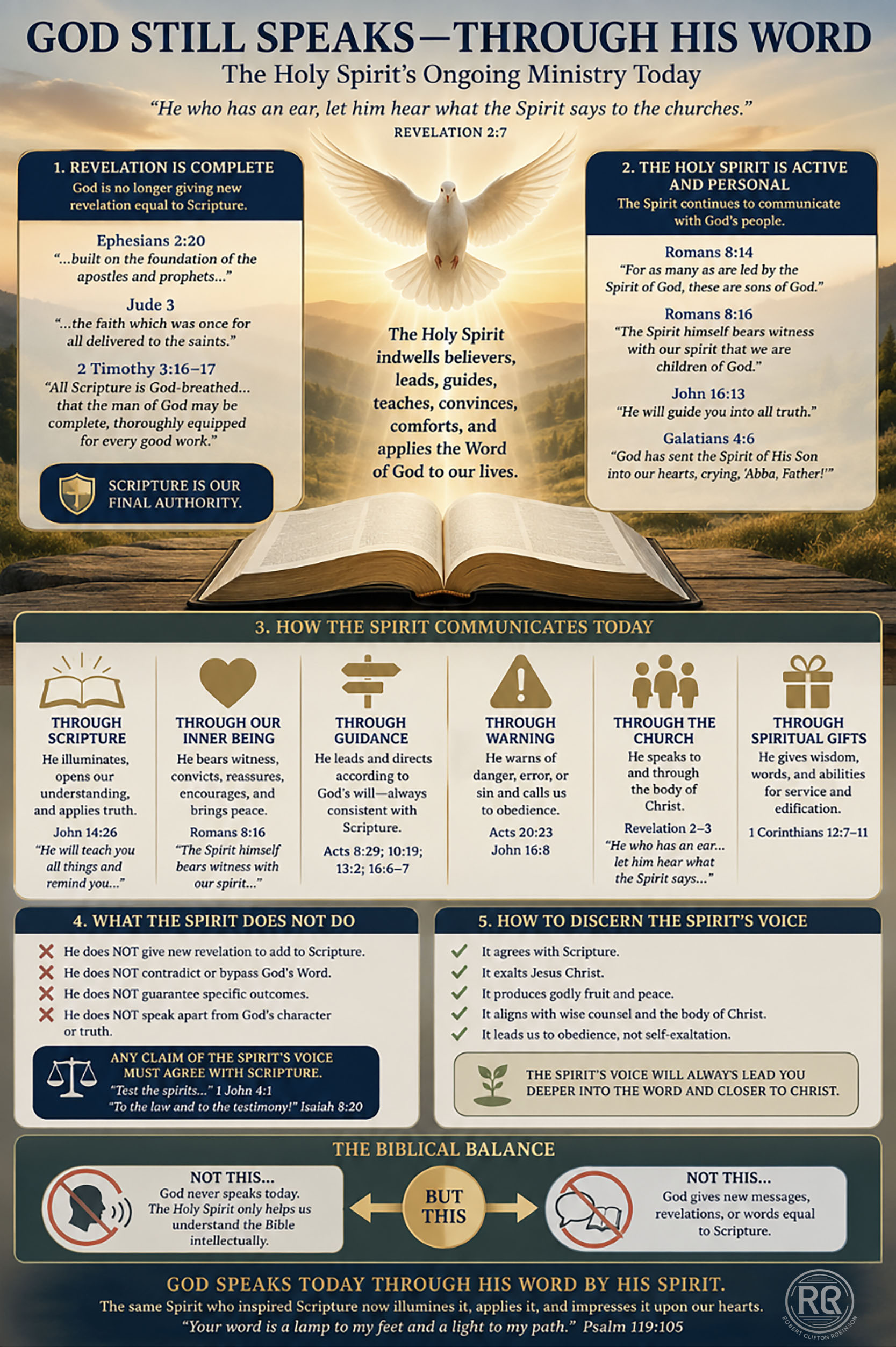
The New Testament repeatedly describes the Holy Spirit as personally communicating with believers. The key question is not whether the Spirit speaks, but how He speaks and whether His communication is equivalent to new Scripture. The biblical evidence demonstrates that the Holy Spirit continues to guide, convict, warn, encourage, and direct God’s people, while never adding to or contradicting the completed revelation of Scripture.

Copyright RCR
The Holy Spirit Speaks
Jesus promised that after His ascension, the Holy Spirit would continue His ministry among believers.
In John 14:16–1, Jesus said: “I will pray to the Father, and he will give you another Counselor, that he may be with you forever—the Spirit of truth.”
The word translated “another” (ἄλλον, allon) means another of the same kind. Jesus was promising that the Holy Spirit would continue His own ministry of teaching and guiding His disciples.
Later Jesus added: “But the Counselor, the Holy Spirit, whom the Father will send in my name, he will teach you all things, and will remind you of all that I said to you.” (John 14:26) While this promise had a unique application to the apostles, the Spirit’s ministry of teaching believers has continued throughout the entire Church age.
Jesus also said: “However when he, the Spirit of truth, has come, he will guide you into all truth.” (John 16:13)
Notice the verbs: teach, remind, guide. These describe ongoing personal ministry.
The Holy Spirit Speaks to Our Spirit
The clearest statement in the Bible that the Holy Spirit continues to speak to believers today is found in Romans 8:14: “For as many as are led by God’s Spirit, these are God’s children.”
The verb “are led” (ἄγονται) is present tense, indicating continual leading.
Paul also writes in Romans 8:16 “The Spirit himself testifies with our spirit, that we are children of God.”
The Greek verb συμμαρτυρεῖ (symmartyrei) literally means “bears witness together with.”
The Spirit communicates with our human spirit
This is not just communicating with us by reading Scripture; Paul describes an inward testimony of the Spirit.
The Spirit Speaks Directly
- Acts 8:29: “The Spirit said to Philip, ‘Go near, and join yourself to this chariot.'”
- Acts 10:19–20: “While Peter thought about the vision, the Spirit said to him, ‘Behold, three men seek you. But arise, get down, and go with them, doubting nothing; for I have sent them.'”
- Acts 13:2: “As they served the Lord and fasted, the Holy Spirit said, ‘Separate Barnabas and Saul for me for the work to which I have called them.'”
- Acts 16:6–7 Paul and his companions “were forbidden by the Holy Spirit to speak the word in Asia…”
Later, Paul writes that “the Spirit of Jesus didn’t allow them.”
The Spirit is described as making decisions and directing ministry.
The Spirit Warns
In Acts 20:23, Paul says: “except that the Holy Spirit testifies in every city, saying that bonds and afflictions wait for me.”
Again, this is an ongoing communication.
The Spirit Speaks to Churches
This principle of the Bible is repeated seven times in Revelation 2–3: “He who has an ear, let him hear what the Spirit says to the assemblies.”
The present tense (“says”) emphasizes the Spirit’s ongoing message to Christ’s churches.
The Spirit Gives Wisdom
James 1:5 promises that God will give wisdom generously. James 1:5 “If you need wisdom, ask our generous God, and he will give it to you.”
Paul confirms James: 1 Corinthians 2:10–12 “…God revealed them through the Spirit…. We received…the Spirit who is from God, that we might know the things that were freely given to us by God.”
The Spirit illumines the believer’s understanding.
The Spirit Gives Peace or Restraint
Colossians 3:15 says “Let the peace of Christ rule in your hearts…”
The verb translated “rule” (βραβευέτω) means “to act as an umpire.” Believers throughout church history have recognized that the Spirit often guides through inward conviction, restraint, or peace consistent with Scripture.
The Spirit Convicts
John 16:8: “When he has come, he will convict the world concerning sin, righteousness, and judgment.”
If the Spirit still convicts today, and Christians of every generation confirm that He does, then the Holy Spirit is still actively communicating truth to human hearts today.
The Spirit Distributes Gifts
1 Corinthians 12:11: “But the one and the same Spirit produces all of these, distributing to each one separately as he desires.”
This requires ongoing direction and interaction with believers.
Copyright RCR
Distinguishing the Spirit’s Voice from Scripture
The Bible does not teach that the Spirit ceased communicating after the apostolic age. What ceased was the giving of new, inspired revelation of scripture that would become part of the biblical canon. Scripture is complete (2 Timothy 3:16–17; Jude 3). The Spirit does not add new doctrine or reveal truths that compete with Scripture.
Instead, the Spirit’s ministry includes: Illuminating Scripture. Applying Scripture personally. Convicting of sin. Giving wisdom. Leading in obedience. Directing ministry. Warning of danger. Comforting believers. Confirming our adoption as God’s children.
Any claimed guidance by the Spirit must be tested against God’s written Word. It cannot be in opposition to what has already been written in the Bible. The Spirit does not contradict Himself.
John instructs believers: “Beloved, don’t believe every spirit, but test the spirits, whether they are of God…” (1 John 4:1)
Isaiah also wrote: “To the law and to the testimony! If they don’t speak according to this word, surely there is no morning for them.” (Isaiah 8:20)
These texts assume that believers may receive impressions or claims of spiritual guidance, but those impressions must be evaluated by the objective standard of Scripture.
The New Testament presents the Holy Spirit as a living person who is god, a person who actively communicates with God’s people. He teaches (John 14:26), guides (John 16:13), bears witness with our spirit (Romans 8:16), leads believers (Romans 8:14), speaks to individuals (Acts 8:29; 10:19–20), directs the Church (Acts 13:2), restrains and redirects ministry (Acts 16:6–7), warns of future events (Acts 20:23), convicts the world (John 16:8), and continually addresses Christ’s churches (Revelation 2–3).
This communication should not be confused with a new revelation of scripture. It is the continuing ministry Jesus promised when He said He would send “another Counselor” who would remain with believers forever (John 14:16). The Spirit’s voice always glorifies Christ (John 16:14), always agrees with Scripture, and always leads God’s people into greater obedience to the written Word rather than beyond it.
What About Books That State That The Holy Spirit Does Not Speak To Believers Today?
The book “Is That You, Lord? Hearing the Voice of the Lord: A Biblical Perspective,” by Gary E. Gilley, originally published by Evangelical Press in 2007 and republished by G3 Press. It is a relatively brief work (about 100–120 pages, depending on the edition).
Gilley writes from a cessationist perspective and argues that God’s normative communication to believers today is through the completed Scriptures. He states that modern claims that believers regularly receive personal messages, impressions, or words from God are not taught in the New Testament. The following is Gilley’s own words from his book:
“Is That You, Lord? offers a clear and compelling exploration of how Christians can discern the voice of God in their lives. Dr. Gary E. Gilley challenges the modern trends of seeking extra-biblical revelation and emphasizes the sufficiency of Scripture as the authoritative guide for believers. Through a careful examination of historical and biblical perspectives, Gilley uncovers the dangers of subjective experiences and urges readers to place their confidence in the Word of God. This book is a vital resource for anyone struggling with understanding God’s will and longing for assurance in their spiritual walk.”
Many popular evangelical books on “hearing God’s voice” blur the distinction between the authority of Scripture and subjective impressions. Christians should seek God’s will primarily through the wisdom of Scripture, first, prayer, sanctification, and the application of Scripture rather than expecting direct revelations.
Gilley’s Concern is primarily a reaction to authors and movements such as Henry Blackaby (Experiencing God), Dallas Willard (Hearing God), the Vineyard movement, and various charismatic and contemplative spirituality writers. Gilley contends that these approaches encourage believers to interpret inner impressions as divine speech without sufficient biblical warrant.
I agree with Gilley on several foundational points:
- Scripture is the only infallible and sufficient revelation for doctrine.
- No one today receives a new revelation that is equal to Scripture.
- Any claimed communication from God must be tested by Scripture (1 John 4:1; Isaiah 8:20).
However, I also disagree with Gilley on an important point.
In one of my essays, I described how, during my devotional reading of Habakkuk 3:2, I believed the Holy Spirit impressed that passage upon my heart for that particular day. I grounded this conviction not in a new doctrine, but in Romans 8:14–16, where Paul says believers are led by the Spirit and that “the Spirit himself bears witness with our spirit.” That view affirms the sufficiency of Scripture while also maintaining that the Holy Spirit personally applies Scripture to believers’ lives.
This view and usage of scripture is widely supported by hundreds of expositional Bible teachers and is a correct application of scripture concerning the Holy Spirit. This agreement is that new revelation (which ceased with the apostolic foundation of the New Testament and the completion of the biblical canon), and the Spirit’s ongoing illumination, conviction, guidance, and personal application of Scripture, which continues today.
This distinction allows us to confirm both the sufficiency of Scripture and the continuing personal ministry of the Holy Spirit without equating present guidance with inspired revelation.
The strongest part of Gilley’s argument is his insistence that God is no longer giving inspired revelation equal to Scripture. I believe this is unquestionably correct. The Bible teaches that the apostolic revelation forms the once-for-all foundation of the Church.
Ephesians 2:20: “…being built on the foundation of the apostles and prophets, Christ Jesus himself being the chief cornerstone.”
A foundation is laid once. Jude writes: “…contend earnestly for the faith which was once for all delivered to the saints.” (Jude 3)
The Greek word ἅπαξ (hapax) means “once for all time.”
Scripture is complete.
Paul said: “All Scripture is God-breathed…that the man of God may be complete.” (2 Timothy 3:16–17)
If Scripture completely equips God’s people, then no further doctrinal revelation is necessary. On this point, Gilley is standing on solid biblical ground.
Where I Think Gilley’s Argument Goes Too Far
I believe Gilley overextends his case by concluding that because new revelation has ceased, God no longer personally speaks to believers at all.
These are not identical propositions. The Bible never says: “When the canon is complete, the Holy Spirit will cease communicating with believers.”
There is no scripture in the Bible that states this. Instead, we find numerous passages describing an ongoing ministry of personal communication. Romans 8 is the strongest evidence. Paul writes: “For as many as are led by the Spirit of God, these are sons of God.” (Romans 8:14)
Notice Paul does not say: “They were led.” Nor does he limit this to apostles. Every child of God is led by God’s Spirit.
Then in Romans 816, notice what Paul says: “The Spirit himself bears witness with our spirit that we are children of God.”
The verb is in the present tense. The Spirit is actively testifying. This is not simply reading Scripture. Paul distinguishes God’s Spirit, from our spirit. The Holy Spirit communicates with those who have been Born Again by the Spirit of God.
If Gilley argues this merely refers to Scripture, Paul never says that.
Acts Describes The Spirit Speaking To Believers
Throughout Acts, ordinary believers, not merely apostles, were directed by the Spirit.
Philip: “The Spirit said…” (Acts 8:29)
Peter: “The Spirit said…” (Acts 10:19)
The church at Antioch: “The Holy Spirit said…” (Acts 13:2)
Paul: “Forbidden by the Holy Spirit…” (Acts 16:6)
None of these texts suggest the Spirit’s ministry would end with the first century believers
The Spirit Is a Person
Jesus consistently described the Spirit personally. John 16:13″When He, the Spirit of truth, comes…” Notice Jesus repeatedly uses personal pronouns. He does not describe the Spirit as merely preserving an ancient book.
The Spirit: teaches, reminds, guides, glorifies Christ, convicts, and speaks. These are present ministries.
Jesus, In The Book of Revelation, States Seven Times: “He who has an ear, let him hear what the Spirit says to the churches.”
Notice: “The Spirit says.” This is in the present tense.
The Spirit remains active in Jesus’ church.
What Does “Speak” Mean?
Many Christians, unfortunately, use expressions such as: “God told me…” when what they really mean is “I believe the Lord impressed this upon my heart.” Those are very different statements. Scripture itself distinguishes between: Inspired Revelation from the Holy Spirit, and Personal Spiritual Guidance.
Inspired Revelation from the Holy Spirit is premised by “Thus says the Lord.” It is Infallible, Binding, Universal, and Authoritative.
Personal Spiritual Guidance is subject to testing by comparison to what the Bible has already said. It is never equal to Scripture. It is never adding doctrine. It is never infallible.
The New Testament repeatedly commands believers to test impressions. 1 John 4:1: “Test the spirits.”
We might ask why we would test these spiritual guidings from the Lord if the Spirit isn’t communicating with us. This text alone demonstrates that the Holy Spirit is still speaking to the followers of Jesus today.
In the same way, the text from 1 Thessalonians 5:19–21: “Don’t quench the Spirit. Don’t despise prophecies. Test all things; hold firmly that which is good,” also confirms that the Holy Spirit is speaking to believers to the present time.
Regardless of our personal view of the continuation of prophecy, Paul’s principle is clear: claims of spiritual communication are to be evaluated, not accepted uncritically or dismissed automatically.
Illumination Is More Than Intellectual Understanding
Sometimes cessationists reduce illumination to simply understanding the Bible correctly, but Scripture describes something deeper. Jesus promised: “He will guide you into all truth.”
Paul writes: “God has sent the Spirit of his Son into your hearts, crying, ‘Abba, Father!'” (Galatians 4:6)
Notice that the Spirit Himself cries within believers. This is experiential language.
On the morning of Saturday, July 18, 2026, during my daily devotional, the text of Habakkuk was presented to me. Habakkuk writes concerning Judah: “I have heard all about you, LORD. I am filled with awe by your amazing works. In this time of our deep need, help us again as you did in years gone by. And in your anger, remember your mercy.”
In a prophetic sense, Habakkuk was talking about two events of God’s wrath that will take place. An earlier event when He destroys Israel and Judah, and a later event in the Last Days when He destroys the world during the seven-year Tribulation.
The Holy Spirit impressed upon my heart that this passage was especially for that day, and He connected it with Romans 8:14: “For all who are led by the Spirit of God are children of God.”
In doing this, I violated NO PRINCIPLE OF SCRIPTURAL INTERPRETATION.
Nothing new was revealed. No doctrine was added. No prophecy was given. Instead, God took His already-inspired Word and applied it personally. That is entirely different from claiming to receive new Scripture. This kind of experience is consistent with the biblical ministry of the Holy Spirit, provided it remains subordinate to Scripture and is evaluated in light of Scripture.
Historical Theology
It is also worth noting that many of the greatest evangelical theologians did not deny the Spirit’s personal leading.
- John Calvin frequently spoke of the testimonium Spiritus Sancti internum (the internal testimony of the Holy Spirit), by which believers gain assurance of the truth of Scripture.
- Jonathan Edwards wrote extensively about the Spirit’s inward work in producing holy affections and assurance.
- Charles Spurgeon often spoke of the Spirit impressing biblical truths upon his heart in a powerful and timely way, while strongly rejecting any notion of adding to Scripture.
- Martyn Lloyd-Jones distinguished between the Spirit’s illumination and the reception of new revelation, emphasizing the Spirit’s ongoing experiential work in the believer.
These men were vigorous defenders of the authority and sufficiency of Scripture, yet they did not reduce the Spirit’s ministry to a merely intellectual process.
I believe Gilley is entirely correct in rejecting the idea that God is giving new canonical revelation, authoritative messages equal to Scripture, or doctrinal additions through modern visions, prophecies, or impressions.
Where I believe he overstates his case is in treating every form of personal guidance or inward testimony as though it were a claim to new revelation. The New Testament consistently presents the Holy Spirit as a living, personal divine agent who indwells believers, bears witness with their spirit, leads them, convicts them, grants wisdom, applies the Scriptures to their lives, and directs them in ways that are always consistent with the written Word.
The biblical balance is therefore neither “God still gives Scripture” nor “God never personally communicates.” Rather, it is that God no longer gives inspired revelation to expand the canon, but the Holy Spirit continues to actively minister to believers by illuminating, applying, impressing, convicting, comforting, warning, and leading through the Scriptures He inspired. This preserves both the sufficiency of Scripture and the personal ministry of the Holy Spirit without confusing the two.
See The 400 Messianic Prophecies From The Old Testament That Jesus Precisely Fulfilled In The New Testament: “Prophecies of the Messiah”
Categories: Robert Clifton Robinson


May the faithful know the saints will reign!
If that’s the case then allow a sword bathed in heaven to be sharpened..
Not of my own haughtiness do I say that because truly I am unworthy to say it and feel bad saying it…
but out of the glory of YAHWEHS name and his gift of salvation sorrow to say such words turns into joy and to honor all who glorifies YAHWEHS name let it be spoken and let it be known
The heavens above knowing of the war fighting for the children of men glorify his name.
Let it be known that this morning a spirit said ” remember who’s blood bled for your salvation and remember I gave my son….” be understood as the spirit of sword being shown so it’s known the king and his glory is why before hearing the spirit speak that sorrow once before was why it turned into a servant saying this morning
Holy holy holy
With hands to the sky just to ensure I don’t speak out of conceit and this morning as I paused afterwords again I hold truth back but ask out of love received it as words being spoken with humility
I believe it received in this way it may be needed by all capable of perception to be perceived as such to rebuke the adversary for salvations sake.
The reason behind this truth declared is not for pride but for praise and thanks to be known
Thank you YAHWEH fighting for your children and your sons blood the spirit spoke of…
Thank you Emmanuel for the blood that was bled for our salvation through your name Jesus Christ who is YAHWEH the son or god.
Thank you to the angels who fight for the children or men
Let this be praise and understanding of what is to come that will be fulfilled
Glory to YAHWEH the father the son the holy Spirit
Glory to YAHWEH the son of God
Glory to EMMANUEL the son of God
To the children of men the sword of spirit and the sword bathed in heaven are not one of the same but one can be seen as such
A warning that the other is to come .
A blade is being sharpened while the other is allowing me to speak words saying hear ye children or men Prepare ye ends of the earth and repent as I do the same again saying I am a neighbor and fear thinking this is scary should allow you to know I spoke or that spirit of fear of the Lord is real and not haughtiness these words declared but for a reason of salvation..
as I say not for myself but again for your salvation
Remember the Holy One of Israel for he is returning sooner than you think.
Glory to Emmanuel
God with us
LikeLiked by 1 person
Anyone who believes that God through the Holy Spirit does not speak to us today is truly not a follower of Christ for it was Christ who promised this.
Thank you brother for all you do.
I thank the Holy Spirit personally for the Words He has given you to share with us.
LikeLike