Biblical Texts That Declare the Scriptures Are The Word of God
If God exists and He desires that we know Him, how would He communicate with us and prove His existence? You might find it interesting that nowhere in the Bible does God seek to prove His existence. He knows that we know He exists, and someday He will hold us accountable for this knowledge.
Romans 1:20-21: “For ever since the world was created, people have seen the earth and sky. Through everything God made, they can clearly see his invisible qualities—his eternal power and divine nature. So they have no excuse for not knowing God. Yes, they knew God, but they wouldn’t worship him as God or even give him thanks. And they began to think up foolish ideas of what God was like. As a result, their minds became dark and confused.”
It has always been the intent of God that He would reveal Himself by His word. It is by the texts of the Bible that any person can know God and have a relationship with Him. Despite the assertions of critics that the Bible is not true, is unreliable, and is filled with errors, these texts have been tested and examined by the best minds on earth for 3,450 years, and there has never been any evidence that the Bible is untrue, filled with errors, or unreliable.
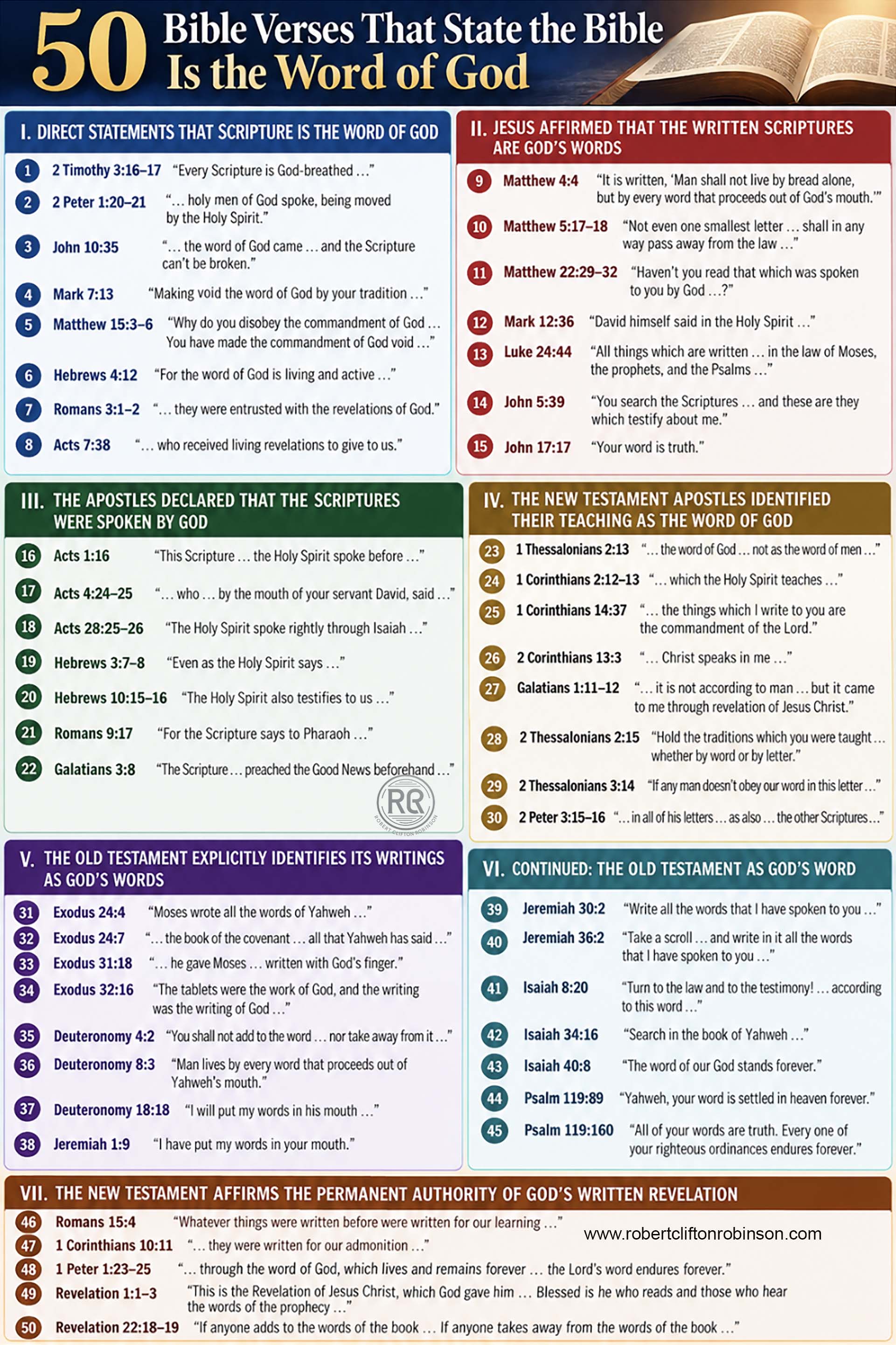
The Bible contains several citations that state the Scriptures are the Word of God, confirming that God spoke through the prophets and apostles, and declaring that the written Scriptures originated through the inspiration of the Holy Spirit.
The following biblical citations provide a biblical foundation for establishing that the Bible is not merely a collection of human religious writings, but the written revelation of God Himself.
Direct Statements That Scripture Is the Word of God
2 Timothy 3:16–17
“Every Scripture is God-breathed and profitable for teaching, for reproof, for correction, and for instruction in righteousness, that each person who belongs to God may be complete, thoroughly equipped for every good work.”
The Greek word θεόπνευστος (theopneustos) means God-breathed. Paul attributes the origin of Scripture to God Himself.
2 Peter 1:20–21
“Knowing this first, that no prophecy of Scripture is of private interpretation. For no prophecy ever came by the will of man, but holy men of God spoke, being moved by the Holy Spirit.”
Peter identifies the Holy Spirit, as God, as the source of prophetic Scripture.
John 10:35
“If he called them gods, to whom the word of God came (and the Scripture can’t be broken)…”
Jesus identifies a passage from Psalm 82:6 as Scripture and declares that Scripture cannot be broken.
See the essay that defines what Jesus meant by, “you are gods.”
Mark 7:13
“Making void the Word of God by your tradition, which you have handed down. You do many things like this.”
Jesus identifies the written commandments of Moses as the Word of God (Mark 7:9–13; Exodus 20:12; 21:17).
Matthew 15:3–6
“He answered them, ‘Why do you also disobey the commandment of God because of your tradition? For God commanded, “Honor your father and your mother,” and, “He who speaks evil of father or mother, let him be put to death.” … You have made the commandment of God void because of your tradition.’”
Jesus attributes the written commandments of the Old Testament directly to the Word of God.
Hebrews 4:12
“For the Word of God is living and active, and sharper than any two-edged sword, and piercing even to the dividing of soul and spirit, of both joints and marrow, and is able to discern the thoughts and intentions of the heart.”
The context of this text concerns God’s spoken promise and warning, preserved in Scripture.
Romans 3:1–2
“Then what advantage does the Jew have? Or what is the profit of circumcision? Much in every way! Because first of all, they were entrusted with the revelations of God.”
The Greek expression τὰ λόγια τοῦ θεοῦ (ta logia tou theou) means the oracles or Words of God, referring to the divine revelation entrusted to Israel.
Acts 7:38
“Moses was with our ancestors, the assembly of God’s people in the wilderness, when the angel spoke to him at Mount Sinai. And there Moses received the Word of God to pass on to us.”
Stephen identifies the revelation given through Moses as living oracles received from God.
Jesus States That the Written Scriptures Are God’s Words
Matthew 4:4
“But he answered, ‘It is written, “Man shall not live by bread alone, but by every word that comes from God.”’”
Jesus quotes Deuteronomy 8:3, confirming God’s authority in the written Word.
Matthew 5:17–18
(Jesus said) “Don’t misunderstand why I have come. I did not come to abolish the law of Moses or the writings of the prophets. No, I came to accomplish their purpose. I tell you the truth, until heaven and earth disappear, not even the smallest detail of God’s law will disappear until its purpose is achieved.”
Jesus affirms the enduring authority of the written Scriptures, including their smallest textual details.
Matthew 22:29–32
“But Jesus answered them, ‘You are mistaken, not knowing the Scriptures, nor the power of God. … But concerning the resurrection of the dead, haven’t you read that which was spoken to you by God, saying, “I am the God of Abraham, and the God of Isaac, and the God of Jacob”?’”
Jesus cites Exodus 3:6, stating that what Moses recorded was spoken by God.
Mark 12:36
“For David himself said in the Holy Spirit, ‘The Lord said to my Lord, “Sit at my right hand, until I make your enemies the footstool of your feet.”’”
Jesus states that David’s words in Psalm 110:1 were from the Holy Spirit, as God.
Luke 24:44
“He said to them, ‘This is what I told you while I was still with you, that all things which are written in the law of Moses, the prophets, and the Psalms, concerning me must be fulfilled.’”
Jesus states that the authority of the three principal divisions of the Hebrew Scriptures that exists in the Law, the Prophets, and the Psalms.
John 5:39
“You search the Scriptures, because you think that in them you have eternal life; and these are they which testify about me.”
Jesus states that the Scriptures were written about Him.
John 17:17
“Sanctify them in your truth. Your word is truth.”
Jesus states that God’s Word is truth.
The Apostles Stated That the Scriptures Were Spoken by God
Acts 1:16
“Brothers, it was necessary that this Scripture should be fulfilled, which the Holy Spirit spoke before by the mouth of David concerning Judas, who was guide to those who took Jesus.”
Peter identifies the Holy Spirit as the Author of the written prophecy.
Acts 4:24–25
“Sovereign Lord, you are God, who made the heaven and the earth and the sea, and all that is in them; who by the mouth of your servant David, said, ‘Why do the nations rage, and the peoples plot a vain thing?’”
The believers in the Book of Acts attribute Psalm 2 directly to God, speaking through David.
Acts 28:25–26
“The Holy Spirit spoke rightly through Isaiah the prophet to our fathers, saying, ‘Go to this people, and say, “By hearing you will hear, and will in no way understand…”’”
Paul identifies Isaiah’s written prophecy as the speech of the Holy Spirit.
Hebrews 3:7–8
“Therefore, even as the Holy Spirit says, ‘Today if you will hear his voice, don’t harden your hearts, as in the rebellion, in the day of the trial in the wilderness.’”
Paul cites Psalm 95:7–8 and identifies the Holy Spirit as its Author.
Hebrews 10:15–16
“The Holy Spirit also testifies to us, for after saying, ‘This is the covenant that I will make with them: “After those days,” says the Lord, “I will put my laws on their heart, I will also write them on their mind.”’”
Hebrew scholar Paul states that Jeremiah 31:33 refers to the Holy Spirit.
Romans 9:17
“For the Scripture says to Pharaoh, ‘For this very purpose I caused you to be raised up, that I might show in you my power, and that my name might be proclaimed in all the earth.’”
Paul says that the words God spoke in the Exodus to Pharaoh are His Words (Exodus 9:16).
Galatians 3:8
“The Scripture, foreseeing that God would justify the Gentiles by faith, preached the Good News beforehand to Abraham, saying, ‘All the nations will be blessed in you.’”
Paul states that God’s foreknowledge and Words are Scripture, reflecting God’s authorship of the biblical revelation.
The New Testament Apostles Identified Their Teaching as the Word of God
1 Thessalonians 2:13
“For this cause we also thank God without ceasing that when you received from us the word of the message of God, you accepted it not as the word of men, but, as it is in truth, the word of God, which also works in you who believe.”
Paul distinguishes apostolic teaching from merely human words and identifies its source as God.
1 Corinthians 2:12–13
“But we received not the spirit of the world, but the Spirit which is from God, that we might know the things that were freely given to us by God. We also speak these things, not in words which man’s wisdom teaches, but which the Holy Spirit teaches, comparing spiritual things with spiritual things.”
Paul identifies the Holy Spirit as the source of his words in the New Testament.
1 Corinthians 14:37
“If any man thinks himself to be a prophet, or spiritual, let him recognize that the things which I write to you are the commandment of the Lord.”
Paul states that his written words have as their source, and carry the authority of the Yahweh-God.
2 Corinthians 13:3
“Seeing that you seek a proof of Christ who speaks in me; who is not weak, but is powerful in you.”
Paul states that Christ speaks through the words he wrote in the New Testament.
Galatians 1:11–12
“But I make known to you, brothers, concerning the Good News which was preached by me, that it is not according to man. For I neither received it from man, nor was I taught it, but it came to me through revelation of Jesus Christ.”
Paul attributes his Gospel about Jesus to the revelation of God, not human invention.
2 Thessalonians 2:14-15
“God called you to salvation when we told you the Good News (the scriptures); now you can share in the glory of our Lord Jesus Christ. With all these things in mind, dear brothers and sisters, stand firm and keep a strong grip on the teaching we passed on to you both in person and by letter.”
Paul states that the authority of authentic apostolic instruction, both spoken and written, came from the texts of the Bible, God’s Word.
2 Thessalonians 3:14
“If any man doesn’t obey our word in this letter, note that man, that you have no company with him, to the end that he may be ashamed.”
Paul treats his written words as authoritative from God, for the churches.
2 Peter 3:15–16
“Regard the patience of our Lord as salvation; even as our beloved brother Paul also, according to the wisdom given to him, wrote to you, as also in all of his letters, speaking in them of these things. In those, there are some things that are hard to understand, which the ignorant and unsettled twist, as they also do to the other Scriptures, to their own destruction.”
Peter places Paul’s letters alongside the other Scriptures, a particularly important New Testament acknowledgment of apostolic writings as Scripture.
The Old Testament Identifies The Words of These Texts as God’s Words
Exodus 24:4
“Moses wrote all the words of Yahweh…”
This is one of the clearest statements that Moses is the author of the Pentateuch, and he recorded the words that God spoke.
Exodus 24:7
“He (Moses) took the book of the covenant and read it in the hearing of the people; and they said, ‘We will do all that Yahweh has said, and be obedient.’”
The written texts of the Old Testament Pentateuch is defined as the words that Yahweh-God spoke.
Exodus 31:18
“When he finished speaking with him on Mount Sinai, he gave Moses the two tablets of the testimony, stone tablets, written with God’s finger.”
All the commandments in the Bible are clearly from God.
Exodus 32:16
“The tablets were the work of God, and the writing was the writing of God, engraved on the tablets.”
This is a direct statement concerning the origin of the written texts of the Bible as from God.
Deuteronomy 4:2
“You shall not add to the word which I command you, neither shall you take away from it, that you may keep the commandments of Yahweh your God which I command you.”
Moses identifies the commandments as God’s authoritative Word.
Deuteronomy 8:3
“Man does not live by bread only, but man lives by every word that proceeds out of Yahweh’s mouth.”
This is the scripture Jesus quotes in Matthew 4:4.
Deuteronomy 18:18
“I will raise them up a prophet from among their brothers, like you. I will put my words in his mouth, and he shall speak to them all that I shall command him.”
God declares that His prophets speak His words.
Jeremiah 1:9
“Then Yahweh stretched out his hand and touched my mouth. Then Yahweh said to me, ‘Behold, I have put my words in your mouth.’”
Jeremiah’s prophetic message originated with Yahweh.
Jeremiah 30:2
“Yahweh, the God of Israel, says, ‘Write all the words that I have spoken to you in a book.’”
God commands Jeremiah to preserve His spoken revelation in written form.
Jeremiah 36:2
“Take a scroll of a book, and write in it all the words that I have spoken to you against Israel, against Judah, and against all the nations…”
This text establishes a direct relationship between God’s spoken revelation and the written prophetic text.
Isaiah 8:20
“Turn to the law and to the testimony! If they don’t speak according to this word, surely there is no morning for them.”
The written revelation serves as the standard for evaluating all biblical teaching.
Isaiah 34:16
“Search in the book of Yahweh, and read…”
Isaiah refers to a written book (the Bible) belonging to Yahweh.
Isaiah 40:8
“The grass withers, the flower fades; but the word of our God stands forever.”
God’s Word possesses eternal authority.
Psalm 119:89
“Yahweh, your word is settled in heaven forever.”
The psalmist confirms the eternality of God’s Word.
Psalm 119:160
“All of your words are truth. Every one of your righteous ordinances endures forever.”
God’s Word is identified with truth and eternal righteousness.
The New Testament Confirms the Permanent Authority of God’s Written Revelation
Romans 15:4
“For whatever things were written before were written for our learning, that through perseverance and through encouragement of the Scriptures we might have hope.”
Paul confirms that the Scriptures written before possess continuing authority and value for believers.
1 Corinthians 10:11
“Now all these things happened to them by way of example, and they were written for our admonition, on whom the ends of the ages have come.”
Paul teaches that the written Old Testament accounts provide instruction for Christians.
1 Peter 1:23–25
“Having been born again, not of corruptible seed, but of incorruptible, through the word of God, which lives and remains forever. For, ‘All flesh is like grass, and all of man’s glory like the flower in the grass. The grass withers, and its flower falls; but the Lord’s word endures forever.’ This is the word of Good News which was preached to you.”
Peter identifies the enduring Word of God with the gospel proclaimed to believers.
Revelation 1:1–3
“This is the Revelation of Jesus Christ, which God gave him to show to his servants the things which must happen soon… Blessed is he who reads and those who hear the words of the prophecy, and keep the things that are written in it, for the time is at hand.”
The Bible identifies its revelation as originating with God through Jesus Christ.
Revelation 22:18–19
“I testify to everyone who hears the words of the prophecy of this book, if anyone adds to them, may God add to him the plagues which are written in this book. If anyone takes away from the words of the book of this prophecy, may God take away his part from the tree of life, and out of the holy city, which are written in this book.”
The closing warning confirms the authority and integrity of the written prophecy of Revelation. Its immediate reference is to that book, rather than explicitly to the entire completed biblical canon.
What Does the Bible Actually Claim About Its Origin?
These fifty scriptures demonstrate that the texts of the Bible originate with God as the Author. Second Timothy 3:16 identifies Scripture as God-breathed, while 2 Peter 1:21 explains that prophetic revelation came through men directed by the Holy Spirit.
 All of the existing texts that are now in the 66 books of the Bible were assembled and preserved by the Eternal, Living God. What we have in our modern Bible is exactly what God wants us to have. If any person thinks that the same God who “in the beginning created the heavens and the earth” is not capable of this assembly and preservation, they fail to understand the great unlimited power of the God of the universe.
Jesus treated the written Old Testament as God’s authoritative Word. Matthew 22:31–32 is important because Jesus introduces a citation from Exodus with the words, “spoken to you by God.”
The apostles claimed authority from God as the source of their teaching. First Thessalonians 2:13, 1 Corinthians 14:37, and Galatians 1:11–12 are direct.
The teaching of the Apostles was recognized as Scripture early in the first century. Second Peter 3:15–16 places Paul’s letters alongside other Scriptures from the Old Testament.
Biblical inerrancy is the assertion that the Bible is without error or fault in all its principles and teaching, or that Scripture in the original autographs does not affirm anything contrary to fact. Some liken inerrancy to biblical infallibility; others do not.
Inerrancy means that the Bible tells us the truth.
Inspiration means that everything God wants us to know about Him is in the Bible. He breathed (theopnenustos) scripture to us (2 Timothy 3:16).
Peter describes how this was accomplished: 2 Peter 1:20-21 “Knowing this first, that no prophecy of Scripture is of any private interpretation, for prophecy never came by the will of man, but holy men of God spoke as they were moved by the Holy Spirit.”
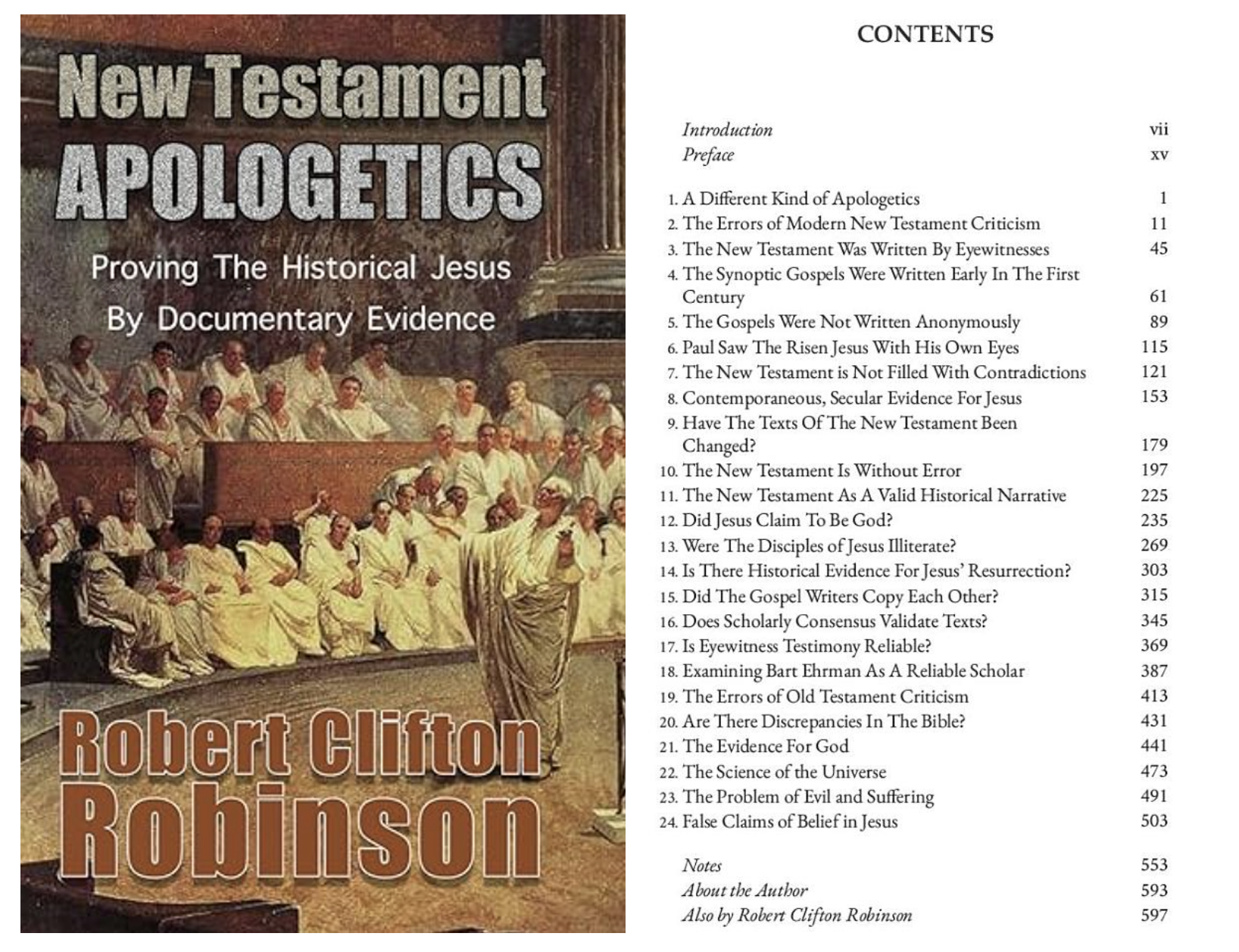
The same God who has the power to speak the universe into existence (Ps. 33:6) also has the power to speak to us, exactly what He wants us to know about Him, and how we can have a relationship with Him. He also has the power to preserve His word for every generation.
It is important to understand that it doesn’t matter what people say about the Bible; it matters what the Bible says about itself.
What some critics see as inaccuracies are just a misunderstanding on their part. Often, people who have only read through the Bible a few times think that they know what the Bible means. Those who have spent their lives studying the Hebrew and Greek Scriptures understand that what is contained within these 66 books is not comparable to any other book or literature in the history of the world.
If we can understand that a Being exists who has the technology to create the vast and complex universe we live in, it is not impossible to comprehend that how this Being communicates with us will also be extraordinary. Since it is by human words that we communicate with each other, it is also by human words that the God of the universe communicates with us.
Not All Of The Bible Is God’s Word, But All Of The Bible Is The Word Of God
Although this sounds like a heretical statement, it is true. The Bible contains the words of evil men, liars, demons, murderers, and the immoral. The statement that “every word is God’s word” cannot be true. What is true is that God included His words, the words of evil men, and those of the righteous, to demonstrate the sin of man and describe for us how He intends to save those who receive the Savior He sent into the world.
The Bible is the Word of God in that it contains His principles regarding sin, evil, suffering, the nature of man, his need for salvation, and the Savior He provided for every person. In this regard, the Bible is reliable.
When God Himself Is Speaking, This Is Made Clear To The Reader By The Words:
- “The Lord Said,” 217 times in the Old Testament
- “Says the Lord,” 841 times in the Old Testament
- “The Word of the Lord,” 250 times in the Old Testament
- “God Said,” 43 times in the Old Testament
There are hundreds of additional places where God is described as speaking, using various terms and descriptions. The point is that we can tell when God is speaking in the Bible, and we can also tell when it is men or women who are speaking.
There are also many places where men are either speaking or writing the words that God dictated to them in the Bible. When we arrive at the New Testament, we see that the writers of the various letters we read in the 27 books of the New Testament often used a scribe—someone who took dictation from the author and wrote their words for us to read. In the case of Paul, he suffered from an eye disorder and required assistance in writing the various letters we see placed in the New Testament. This does not mean that Paul was not the author, only that he used an assistant to record his words.
We see an example where Paul used a scribe to write for him in his letter to the Colossians. At the end of this letter, the NLT version shows us where Paul is writing the text himself by the use of all caps:
“HERE IS MY GREETING IN MY OWN HANDWRITING—PAUL. Remember my chains. May God’s grace be with you all.” ~Colossians 4:18
In the case of Luke, he was a well-educated physician who took extraordinary steps to interview the various eyewitnesses who had firsthand knowledge of Jesus’ life, death, and resurrection. He then recorded their testimony in his Gospel and the Book of Acts. Notice how Luke begins his Gospel account of Jesus:
“Many people have set out to write an account of the events that have been fulfilled among us. They used the eyewitness reports circulating among us from the early disciples. Luke 1:1-4: “Having carefully investigated everything from the beginning, I also have decided to write an accurate account for you, most honorable Theophilus, so you can be sure of the truth in everything you were taught.”
Notice the statement: “Having carefully investigated everything from the beginning.” Here, we see that Luke intended to write a very orderly, accurate, and reliable account of all that concerned Jesus. One of the world’s greatest archeologists and historians, Sir William Ramsay, describes the accuracy and detail of Luke’s historical references, without a single error.[1]
Dr. Ramsay believed that during his extensive trip through Asia Minor, he would find that Luke had made several errors in his descriptions that were recorded in the book of Acts. Instead, Ramsay discovered that Luke was “a historian of the first rank.”[2]
If A Man Is Honest In The Least, He Will Be Honest In The Greater
Dr. Ramsay learned that Luke was proficient in recording every minor detail in all of his descriptions. The historical accuracy of Luke was unequaled by any who wrote during that period of history.
If Luke was so proficient in these minor details, Ramsay determined that he must also be honest in all the larger facts that concerned Jesus Christ. Understanding that Luke was accurate in the cities, names, places, and customs he recorded, it is certain that the important narratives of Jesus’ death and resurrection would also be reliable.
The Book Of Ecclesiastes: An Example Of Inaccurate Words Of Men
Most people who read the book of Ecclesiastes assume that Solomon is writing an accurate account of the things he describes. Our assumption would be wrong. When Solomon wrote his words in Ecclesiastes, he was in a backslidden place regarding his relationship with God. Not everything Solomon wrote is true because he is writing his observations about how he thinks life operates, from a heart and mind that have been compromised by sin and disobedience.
The book of Ecclesiastes is unique amongst those of the Bible. This is the only complete text in the Bible that is a reflection of the human point of view rather than the view of God. For this reason, it is filled with errors. At the same time, Ecclesiastes is also fully inspired, because God wanted the world to see what happens when a person forgets God.
Inspiration Is Not A Guarantee Of Truth
Some people have the idea that if it is in the Bible, then it is guaranteed by God to be true. There is no place in the Scripture where God said this. If it is God speaking, then we can be certain that what we are reading is the truth. If it is a human being speaking, it may or may not be true. Sometimes satan is speaking in the Bible, and we can be sure that these words are not true. On other occasions, we see evil men or women making statements that are also not true.
Click The Image To Look Inside
We can have great confidence in the fact that when there are errors in what is said in the Bible, there is also text to tell us that these words are not true. From these examples, you can see that the Bible is filled with various errors by many individuals. For this reason, many people who are not trained in the Scriptures misunderstand, twist, or misuse the words of the Bible. People who have not taken the time necessary to read the Bible with understanding do not understand that when people or the devil make statements in the Bible, this is not the word of God but their own words.
Despite this truth, God wanted their words to be recorded so we can see that not all that people say or profess is reliable. Only those things God has told us are the truth, and we can rely upon the words of God. When we say that the Bible is “inspired,” this is what is meant. When we say “the word of God,” we are describing the Bible with all of its inspired text—both His words and the words of individuals who often do not speak the truth.
This is why people who read the comments of those who criticize the Bible as filled with errors begin to imagine that the Bible cannot be trusted. The reason some people make these comments and observations is that they don’t understand what they are reading. In this regard, sometimes it is helpful to have someone who has spent a great deal of time studying the Bible to guide us. We see an example of this principle in the New Testament.
Acts 8:30-31: “So Philip ran to him, and heard him reading the prophet Isaiah, and said, “Do you understand what you are reading?” And he said, “How can I unless someone guides me?” And he asked Philip to come up and sit with him.”
God Does Not Sugarcoat Our Spiritual Condition
One of the unique attributes of the Bible is that God wanted us to be able to see real people with their real faults. God never seeks to sugarcoat our sinful nature. He points out the faults of the people whom He includes in the Bible so that we can see how He works in the lives of those who are fallible—but He still loves them and is faithful to bring fallible people into a correct relationship with Himself.
God wanted us to see that Abraham, although he is spoken of by God as “the Father of Faith,” there were times when Abraham did not have much faith. When a plague broke out in the world, Abraham did not trust God. His fears caused him to go down to Egypt to find food. While there Abraham told his wife, Sarah, to lie for him and say that she was his sister. This was because Abraham knew the Egyptian kings would often take the beautiful wife of a man and have him executed.
Genesis 12:12-13: “Therefore it will happen, when the Egyptians see you, that they will say, ‘This is his wife’; and they will kill me, but they will let you live. Please say (lie) you are my sister, that it may be well with me for your sake, and that I may live because of you.”
Abraham did not exercise the correct behavior of a person who truly trusts in God, and God wanted us to see this character flaw in Abraham so that we would be encouraged. When we also fail to have faith and act wrongly in our lives, by the example God gave us with Abraham, we can see that God will not abandon us, cease to love us, or fail to complete all of His promises in our lives.
Because God placed people before us in the Bible who are sinners just like us, people with wrong intentions often take the false things these biblical characters said or did and seek to prove that the Bible is filled with errors.
The inclusion of sinners and their incorrect statements in the Bible is inspired by God for our benefit. It is helpful for us to see these individuals as they were and how God was exceedingly patient with them. It helps us in our weaknesses when we see how gracious and kind God is to people when they are amid their sins. It is this kindness of God that softens our hearts and brings us to repentance in our own lives.
This Is What Is Meant By The Term “Inspired By God”
Solomon, in writing Ecclesiastes, shows us how God wanted the world to see what happens to a man when he forgets God. What happens to a person when they let the pursuit of wealth, pleasure, building, and the things of this world take the place of God? Solomon began well, but he did not finish well. God wants all of us to finish our life on earth successfully and make it home to heaven. For this reason, God inspired the writing of Solomon to place this text before us, so that we can see the folly of a man who has lost the most precious possession he began his life with—God.
In no way should anyone take all of the words of Solomon in Ecclesiastes as the words of God. To rightly determine if what someone writes or says is from God, we must be able to compare it to what has already been written by God Himself in the Bible. Anything that is said or written that is contrary to what God has said is wrong and not from God.
Ecclesiastes presents the human view of God and, because of this, it is often wrong. Solomon repeatedly uses the term “under the sun” to describe his view. This is evidence that Solomon’s opinion in this text comes from a human perspective of life on Earth (under the sun). In this regard, Ecclesiastes shows us the error of human thinking in comparison to the thoughts and opinions of God.
See all 52 of Rob’s Published Books at Amazon: Kindle eBook, Print, and Audiobooks
Sources and Citations:
1. William M. Ramsay, St. Paul the Traveler and the Roman Citizen, 1982, page 8: “I began with a mind unfavorable to (the accuracy of the New Testament) but more recently I found myself brought into contact with the Book of Acts as an authority for the topography, antiquities, and society of Asia Minor. It was gradually borne upon me that in various details the narrative showed marvelous truth.”
2. William M. Ramsay, The Bearing of Recent Discovery on the Trustworthiness of the New Testament, 1915, page 222: “Luke is a historian of the first rank; not merely are his statements of fact trustworthy…this author should be placed along with the very greatest historians.”
Categories: Robert Clifton Robinson


Please see, "Guidelines For Debate," at the right-side menu. Post your comment or argument here: