The Bible contains several texts in which Jesus, Paul, John, Daniel, and Jude describe Hell as a place of eternal punishment, unquenchable fire, everlasting destruction, and torment that continues forever.
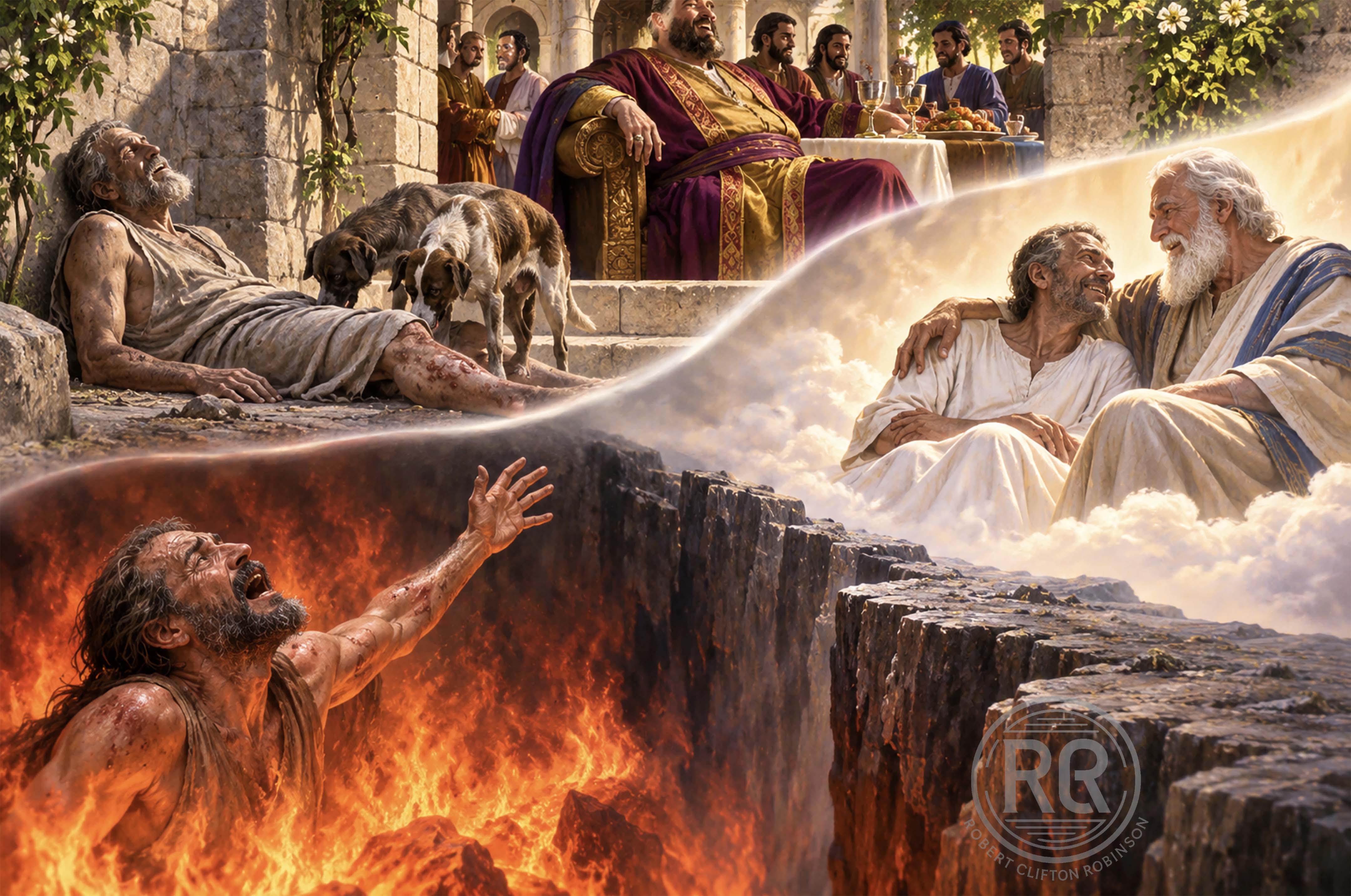
Jesus Describes Hell As Eternal, in Luke 16:19-31
Some of the strongest statements come directly from Jesus Himself. The following biblical texts in this essay are 18 important biblical scriptures proving the doctrine of eternal punishment, with quotations from the Bible, many of which show that Jesus describes Hell as eternal
Matthew 25:46 — Everlasting punishment
“These will go away into eternal punishment, but the righteous into eternal life.”
This is one of the clearest statements in Scripture. Jesus uses the same Greek adjective, aiōnios (αἰώνιος), to describe both eternal punishment and eternal life.
The parallel is significant: the punishment of the wicked and the life of the righteous are both described as eternal.
Mark 9:43 — The fire that will never be quenched
“If your hand causes you to stumble, cut it off. It is better for you to enter into life maimed, rather than having your two hands to go into Gehenna, into the unquenchable fire.”
Jesus describes the fire of Gehenna as asbestos (ἄσβεστος), meaning unquenchable.
Mark 9:47–48 — The worm does not die
“If your eye causes you to stumble, cast it out. It is better for you to enter into God’s Kingdom with one eye, rather than having two eyes to be cast into the Gehenna of fire, ‘where their worm doesn’t die, and the fire is not quenched.’”
Jesus quotes Isaiah 66:24, describing judgment using the imagery of undying worms and unquenchable fire.
Matthew 18:8 — Eternal fire
“It is better for you to enter into life maimed or crippled, rather than having two hands or two feet to be cast into the eternal fire.”
Jesus uses the expression “eternal fire.”
Matthew 25:41 — Everlasting fire prepared for the devil
“Then he will say also to those on the left hand, ‘Depart from me, you cursed, into the eternal fire which is prepared for the devil and his angels.’”
Jesus identifies the final judgment of the wicked with the eternal fire prepared for Satan and his angels.
Matthew 3:12 — Unquenchable fire
“His winnowing fork is in his hand, and he will thoroughly cleanse his threshing floor. He will gather his wheat into the barn, but the chaff he will burn up with unquenchable fire.”
John the Baptist describes the judgment of the wicked using the same language of unquenchable fire.
The chaff imagery is also cited by those who understand final punishment as destruction rather than everlasting conscious suffering.
Luke 3:17 — Fire that cannot be extinguished
“He will gather the wheat into his barn, but he will burn up the chaff with unquenchable fire.”
This repeats the warning recorded in Matthew 3:12.
This Subject Is of Extreme Importance to Many, as is Evidenced by Hundreds of Comments I Received From Critics
The following post I made on X recently depicts this subject and the doubts that people have that Hell is Eternal

Revelation describes torment continuing forever
Revelation 14:10–11 — Tormented forever and ever
“He also will drink of the wine of the wrath of God, which is prepared unmixed in the cup of his anger. He will be tormented with fire and sulfur in the presence of the holy angels, and in the presence of the Lamb. The smoke of their torment goes up forever and ever. They have no rest day and night, those who worship the beast and his image, and whoever receives the mark of his name.”
This passage contains three especially important statements:
-
Their torment is associated with fire and sulfur.
-
The smoke of their torment ascends forever and ever.
-
They have no rest day or night.
The Greek expression translated “forever and ever” is eis aiōnas aiōnōn (εἰς αἰῶνας αἰώνων).
This is among the strongest descriptions of eternal punishment in the New Testament.
Revelation 20:10 — Tormented day and night forever
“The devil who deceived them was thrown into the lake of fire and sulfur, where the beast and the false prophet are also. They will be tormented day and night forever and ever.”
This is perhaps the most explicit statement concerning the everlasting torment of Satan, the beast, and the false prophet.
Revelation 20:14–15 — The lake of fire
“Death and Hades were thrown into the lake of fire. This is the second death, the lake of fire. If anyone was not found written in the book of life, he was cast into the lake of fire.”
This text identifies the final destination of those whose names are not found in the Book of Life.
The lake of fire is the same place mentioned in Revelation 20:10.
Revelation 21:8 — The second death
“But for the cowardly, unbelieving, sinners, abominable, murderers, sexually immoral, sorcerers, idolaters, and all liars, their part is in the lake that burns with fire and sulfur, which is the second death.”
This verse connects the final judgment of unrepentant sinners with the lake of fire.
Paul describes everlasting destruction
2 Thessalonians 1:8–9 — Eternal destruction
“Giving vengeance to those who don’t know God, and to those who don’t obey the Good News of our Lord Jesus, who will pay the penalty: eternal destruction from the face of the Lord and from the glory of his might.”
Paul uses the Greek expression olethron aiōnion (ὄλεθρον αἰώνιον), meaning eternal destruction.
The historical understand for this verse is, everlasting ruin and exclusion from the Lord’s favorable presence, rather than cessation of existence. Expositors who defend conditional immortality understand the phrase as destruction with permanent consequences. The passage clearly teaches an eternal penalty, although its precise nature is debated.
Jude describes eternal fire and everlasting darkness
Jude 1:7 — The punishment of eternal fire
“Even as Sodom and Gomorrah and the cities around them, having in the same way as these given themselves over to sexual immorality and gone after strange flesh, are shown as an example, suffering the punishment of eternal fire.”
Jude uses Sodom and Gomorrah as an example of divine judgment. Jude references Jesus as Yahweh-God who visits Sodom and Gomorrah in Genesis 19:24, and destroys all the men of these two cities because they refused to repent of their homosexual sin.
The expression “eternal fire” is explicit. However, because the historical cities are not still visibly burning, interpreters disagree about whether Jude emphasizes an eternally continuing punishment or the irreversible results of divine judgment.
Jude 1:13 — Blackness of darkness forever
“Wild waves of the sea, foaming out their own shame; wandering stars, for whom the blackness of darkness has been reserved forever.”
Jude describes darkness reserved forever for the ungodly teachers he condemns.
Daniel and Isaiah describe everlasting judgment
Daniel 12:2 — Everlasting contempt
“Many of those who sleep in the dust of the earth will awake, some to everlasting life, and some to shame and everlasting contempt.”
Daniel places everlasting life and everlasting contempt in parallel, much as Jesus does in Matthew 25:46.
The Hebrew word ʿolam (עוֹלָם) is used for both.
Isaiah 66:24 — Their worm will not die
“They will go out, and look at the dead bodies of the men who have transgressed against me; for their worm will not die, neither will their fire be quenched; and they will be loathsome to all mankind.”
This is the Old Testament passage Jesus cites in Mark 9:48.
An important distinction is that Isaiah explicitly describes dead bodies, while Jesus applies this judgment imagery to Gehenna. Traditional and conditionalist interpreters differ over what this imagery establishes about the continuing consciousness of the condemned.
Isaiah 33:14 — Everlasting burning
“The sinners in Zion are afraid. Trembling has seized the godless ones. Who among us can live with the devouring fire? Who among us can live with everlasting burning?”
The phrase “everlasting burning” appears here, although the immediate context concerns God’s terrifying holiness and judgment upon Zion. It is therefore a less direct proof text for the final state of the wicked.
Jesus describes Hell as an eternal separation
Luke 16:23–26 — A great gulf fixed
“In Hades, he lifted up his eyes, being in torment, and saw Abraham far off, and Lazarus at his bosom.”
Jesus continues in verse 26:
“Besides all this, between us and you there is a great gulf fixed, that those who want to pass from here to you are not able, and that no one may cross over from there to us.”
Jesus depicts conscious torment and an impassable separation. The torment does not come from God, but from the prison of Hell itself, where the inmates torment and torture each other, forever.
Strictly speaking, this passage concerns Hades, the intermediate state, rather than explicitly describing the final lake of fire. Nevertheless, it is significant in the traditional understanding of punishment after death.
The five strongest texts for eternal punishment in Hell:
| Scripture | Clear Description |
|---|---|
| Matthew 25:46 | Eternal punishment contrasted with eternal life |
| Mark 9:47–48 | The worm does not die; the fire is not quenched |
| Matthew 25:41 | Eternal fire prepared for the devil and his angels |
| Revelation 14:10–11 | Torment, with no rest day or night; smoke ascending forever |
| Revelation 20:10 | Tormented day and night forever and ever |
An important distinction about the Greek text
Three different expressions appear in these passages.
1. Αἰώνιος (aiōnios) — Eternal, everlasting
Used in Matthew 25:41, Matthew 25:46, and 2 Thessalonians 1:9. The term can describe an unending duration or something belonging to the age to come, depending on context.
2. Ἄσβεστος (asbestos) — Unquenchable
Used in Mark 9:43 and Matthew 3:12. It describes fire that cannot be extinguished. By itself, the adjective does not necessarily establish that the fire burns without end; the context determines whether its emphasis is perpetual burning or irresistible judgment.
3. Εἰς αἰῶνας αἰώνων (eis aiōnas aiōnōn) — Forever and ever
We find this text also in Revelation 14:11 and 20:10.
This term for Hell also describes God’s eternal existence and reign in Revelation 4:9–10, 10:6, and 11:15. The use of the same expression is especially significant in arguments for everlasting conscious punishment.
The Bible teaches that the final judgment of the wicked has eternal consequences
The central disagreement is whether those consequences consist of everlasting conscious punishment or irreversible destruction. The biblical doctrine of eternal conscious punishment draws its strongest support from several texts, particularly the narrative recorded from Jesus’ own words in Luke 16:
Luke 16:22-31 “So it was that the beggar died, and was carried by the angels to Abraham’s bosom. The rich man also died and was buried. 23 And being in torments in Hell, he lifted up his eyes and saw Abraham afar off, and Lazarus in his bosom. 24 “Then he cried and said, ‘Father Abraham, have mercy on me, and send Lazarus that he may dip the tip of his finger in water and cool my tongue; for I am tormented in this flame.’ 25 But Abraham said, ‘Son, remember that in your lifetime you received your good things, and likewise Lazarus evil things; but now he is comforted and you are tormented. 26 And besides all this, between us and you there is a great gulf fixed, so that those who want to pass from here to you cannot, nor can those from there pass to us.’ 27 “Then he said, ‘I beg you therefore, father, that you would send him to my father’s house, 28 for I have five brothers, that he may testify to them, lest they also come to this place of torment.’ 29 Abraham said to him, They have Moses and the prophets; let them hear them.’ 30 And he said, ‘No, father Abraham; but if one goes to them from the dead, they will repent.’ 31 But he said to him, If they do not hear Moses and the prophets, neither will they be persuaded though one rise from the dead.’ ”
Jesus describes Hell as a real and eternal place where the unsaved, unrepentant are taken, and their torment in this place is eternal. The man Jesus is speaking to who states he is “tormented in this flame,” is alive, fully conscious, and feels the pain in his body and soul. Jesus states that this place in Hell where the torment exists, is eternal; no one may ever pass from Hell to a place outside its torment.
Also, texts from Matthew 25:46, Revelation 14:9–11, and Revelation 20:10. The alternative view of conditional immortality appeals particularly to the language of death, destruction, and perishing in passages such as Matthew 10:28 and John 3:16.
Of all these passages, Matthew 25:46 is especially important because Jesus places eternal punishment and eternal life in the same sentence, using the same Greek adjective for both. Revelation 14:11 adds the particularly forceful description of torment without rest, day or night.
Together, these biblical texts form the principal biblical foundation for the historic biblical fact that the punishment of the unrepentant, unsaved, is eternal.
SEE ALL 52 OF ROB’S PUBLISHED BOOKS AT AMAZON IN KINDLE EBOOK, PRINT, AND AUDIOBOOK FORMATS
See All 52 of Rob’s Books
Categories: Robert Clifton Robinson


Please see, "Guidelines For Debate," at the right-side menu. Post your comment or argument here: