
I have published several books and essays that impeach the false assertions of atheist New Testament Scholar,Paul. This essay is a brief examination of Ehrman’s false assertion that Paul didn’t write anything of importance about Jesus. The insinuation by Ehrman is that Paul really didn’t know that much about Jesus, so how reliable are his few words about Jesus in his letters.
Bart Ehrman: “Why Doesn’t Paul Say More About Jesus?
May 14, 2014
“To this point I h,ave enumerated everything that Paul explicitly says about what Jesus said, did, and experienced during his earthly life. The driving question is the one that I turn to now and in the next post. Why didn’t Paul tell us *more*? I’ve long been fascinated by this question, and even though I’ve thought about it for well over thirty years, I’ve never decided on what I really think. There are just too many counter-arguments for every perspective that I’ve heard or thought of! In these two posts I want to lay out three of the main options. If you think of others that need to be aired, feel free to make a comment.”
“I have taken the following from my textbook The New Testament: A Historical Introduction to the Early Christian Writings.”
***********************************************************
“Paul of course has a lot to say about the importance of Jesus, especially the importance of his death and resurrection and his imminent return from heaven. But in terms of historical information, what I’ve listed above [i.e., in the previous posts] is about all that we can glean from his letters. Imagine what we wouldn’t know about Jesus if these letters were our only sources of information. We hear nothing here of the details of Jesus’ birth or parents or early life, nothing of his baptism or temptation in the wilderness, nothing of his teaching about the coming Kingdom of God; we have no indication that he ever told a parable, that he ever healed anyone, cast out a demon, or raised the dead; we learn nothing of his transfiguration or triumphal entry, nothing of his cleansing of the Temple, nothing of his interrogation by the Sanhedrin or trial before Pilate, nothing of his being rejected in favor of Barabbas, of his being mocked, of his being flogged, etc. etc. etc. The historian who wants to know about the traditions concerning Jesus — or indeed, about the historical Jesus himself — will not be much helped by the surviving letters of Paul.”
Bart Ehrman Is An Atheist New Testament Scholar Who Writes In Opposition To Jesus
Notice in his comments, above, hrman doesn’t deny that Paul knew anything about Jesus, only that what he wrote is of no great importance in proving that Jesus actually said and did the things written in the four Gospels. In other words, Ehrman’s efforts are directed at creating doubt in the minds of readers, that wht the four Gospels record, is realy the truth and reliable.
See The 21 Primary Arguments Presented By Atheist New Testament Scholars
Ehrman has stated in his books that about 85% of all that is written about Jesus in the Gospels, was fabriated. Ehrman claims that we don’t really know what Jesus said, and what the Gospels present to us, Jesus never said. Ehrman has repeatedly stated that the men who wrote the New Testament, “made Jess God.” Ehrman’s posit is that Jesus never claimed to be God HImself, butiwas made God by the men who recorded the letters found in the New Testament scriptures. In fact, in the following link you will f,ind over 100 references by Jesus in the New Testament, that He claimed to be God—then proved this claim—by thousands of miracles only possible by God.
- Evidence That Jesus Claimed To Be God
- The New Testament Exhibition Of Jesus’ Miracles: Evidence Of Truth And His Identity
Paul Said That Jesus Told Him More About Himself, Than He ToldTo Any Other Person
Paul’s documentation in his letters, proves that te words he placed in his 14 letters, reveal to us greater knowledge of Jesus than any other writer in the remaining 13 letters of the New Testament.
Paul said that Jesus personally revealed to him, 18 Mysteries tat were never revealed to anyone before during the entire history of the Bible:
Mysteries Jesus Gave Paul, Revealed In The New Testament:
- The kingdom of heaven and the kingdom of God (Mt. 13:11; Mk. 4:11; Lk. 8:10)
- Israel’s blindness (Rom. 11:25)
- Salvation in Christ (Rom. 16:25)
- The wisdom of God (1Cor. 2:7)
- The doctrines of God (1Cor. 4:1; Col. 2:2; 1Tim. 3:16)
- The gospel (Eph. 6:19)
- Gift of knowledge (1Cor. 13:2)
- Speaking in tongues (1Cor. 14:2)
- The rapture of the church (1Cor. 15:23,51-58 Jn. 14:1-3 1Th. 4:13-16)
- God’s will (Eph. 1:9)
- The church (Eph. 3:1-9; 5:32)
- Christ in people (Col. 1:26-27)
- Doctrines of Christ (Col. 4:3)
- Spirit of lawlessness (2Th. 2:7)
- Faith of the gospel (1Tim. 3:9)
- Seven candlesticks (Rev. 1:20)
- God’s delay in casting out of Satan (Rev. 10:7; 12:7-17)
- Mystery Babylon (Rev. 17:5,7)
Paul Said He Saw The Risen Jesus With His Own Eyes
1 Corinthians 9:1: “Am I not as free as anyone else? Am I not an apostle? Haven’t I seen Jesus our Lord with my own eyes?”
1 Corinthians 15:3-8: “I passed on to you what was most important and what had also been passed on to me. Christ died for our sins, just as the Scriptures said. He was buried, and he was raised from the dead on the third day, just as the Scriptures said. He was seen by Peter and then by the Twelve. After that, he was seen by more than 500 of his followers at one time, most of whom are still alive, though some have died. Then he was seen by James and later by all, the apostles. Last of all, as though I had been born at the wrong time, I also saw him.”
Acts 9:3-5: “As Paul was approaching Damascus on this mission, a light from heaven suddenly shone down around him. He fell to the ground and heard a voice saying to him, “Saul! Saul! Why are you persecuting me?” “Who are you, lord?” Saul asked. And the voice replied, “I am Jesus, the one you are persecuting!”
Note: In the two verses (above) from 1 Corinthians 9 and 15, Paul also said he “saw Jesus at that time.”
Galatians 1:15-16: “But even before I was born, God chose me and called me by his marvelous grace. Then it pleased him to reveal his Son to me so that I would proclaim the Good News about Jesus to the Gentiles.”
The Greek word used to translate “reveal” here in Galatians 1:16 is ἀποκαλύπτω apokalyptō—which means to unveil, to let us see, to fully disclose. This is the same Greek word used in the introduction to the book of Revelation, where it states that this book is an apokalyptō for Jesus, an “unveiling,” so that we might be able to see Him and who He is.
Critics say that Paul never saw Jesus. Before Jesus was arrested and crucified, Saul of Tarsus was a member of the Great Sanhedrin. There is evidence this is true in
Acts 26:9-10 Paul speaking: “I used to believe that I ought to do everything I could to oppose the very name of Jesus the Nazarene. Indeed, I did just that in Jerusalem. Authorized by the leading priests, I caused many believers there to be sent to prison. And I cast my vote against them when they were condemned to death.”
To cast a vote with the members of the Great Sanhedrin against Christians, Paul must have been a voting member.
Paul was well aware of all that Jesus had been saying and doing. When Jesus was brought before the Sanhedrin He is questioned whether He is claiming to be, the Son of God.
Luke 22:66-71: “Early the next morning at daybreak the High Sanhedrin assembled, including the chief priests and all the top religious authorities of the nation. Jesus was led before this Council (Great Sanhedrin) and instructed to state whether or not he claimed to be the Messiah. But he replied, “If I tell you, you won’t believe me or let me present my case. But the time is soon coming when I, the Messiah, shall be enthroned beside Almighty God.” They all shouted, “Then you claim you are the Son of God?” And he replied, “Yes, I am.” “What need do we have for other witnesses?” they shouted. “For we ourselves have heard him say it.”
Paul certainly had seen Jesus before He was crucified—in the days of His ministry. The evidence for this is seen in John 12:9, the raising of Lazarus, and John 5:9-10, the man who had been crippled for 38 years.
When we examine the text for ourselves, we can see that there is a great deal of evidence that has been preserved for us—that Paul did see Jesus before and after He was raised from the dead. After He had risen, Paul stated that Jesus spoke to Paul and revealed 18 secrets (mysteries) of the scriptures that no other man has ever known.
1 Corinthians 2:7-8: “But we speak the wisdom of God in a mystery, the hidden wisdom which God ordained before the ages for our glory, which none of the rulers of this age knew; for had they known, they would not have crucified the Lord of glory.”
The Greek word in the text of 1 Corinthians 2:7 is “μυστήριον mystērion”—information from God that was not formerly known by the prophets or anyone else in the Bible. Paul stated that because God had given him these eighteen “mysteries” (15 for Paul, 3 for John), he was also given a “thorn in the flesh” to humble him so that he did not become exalted above measure. Essentially, Paul suffered a physical ailment in his vision for all of his life as a reminder from Jesus that what he had been given as revelation was to be received and spoken with humility, and not to exalt himself but Christ.
2 Corinthians 12:7: “And lest I should be exalted above measure by the abundance of the revelations, a thorn in the flesh was given to me, a messenger of Satan to buffet me, lest I be exalted above measure.”
Paul describes these eighteen mysteries that Jesus gave him which were not given to any other Apostle.1
Jesus Said His Disciples Are Eyewitnesses Of All That He Said And Did
Jesus tells His disciples that He came to fulfill all the prophecies of Moses and the Prophets:
Luke 24:44-49: Then Jesus said, “When I was with you before, I told you that everything written about me in the law of Moses and the prophets and in the Psalms must be fulfilled.” Then he opened their minds to understand the Scriptures. And he said, “Yes, it was written long ago that the Messiah would suffer and die and rise from the dead on the third day. It was also written that this message would be proclaimed in the authority of his name to all the nations, beginning in Jerusalem: ‘There is forgiveness of sins for all who repent.’ You are witnesses of all these things.”
Jesus Said That John The Baptist And His Miracles Are Witnesses For Him
John 5:31-38: “If I were to testify on my own behalf, my testimony would not be valid. But someone else is also testifying about me, and I assure you that everything he says about me is true. In fact, you sent investigators to listen to John the Baptist, and his testimony about me was true. Of course, I have no need of human witnesses, but I say these things so you might be saved. John was like a burning and shining lamp, and you were excited for a while about his message. But I have a greater witness than John—my teachings and my miracles. The Father gave me these works to accomplish, and they prove that he sent me.”
Jesus Said The Apostles Will Be His Witnesses To the World
Acts 1:6-9: So when the apostles were with Jesus, they kept asking him, “Lord, has the time come for you to free Israel and restore our kingdom?” He replied, “The Father alone has the authority to set those dates and times, and they are not for you to know. But you will receive power when the Holy Spirit comes upon you. And you will be my witnesses, telling people about me everywhere—in Jerusalem, throughout Judea, in Samaria, and to the ends of the earth.” After saying this, he was taken up into a cloud while they were watching, and they could no longer see him.”
Peter Said That All The Apostles Are Witnesses Of Jesus
In the book of Acts, chapter 2, Peter is standing before a great crowd of people from many countries, who are gathered at Jerusalem for the Feast of Pentecost. Although Peter is a simple fisherman who is not trained in the scriptures, he displays an incredible knowledge of the Hebrew scriptures and can relate the Prophecies of the Messiah to Jesus as the fulfillment of all that was written by the prophets about the Messiah.
What is incredible about this text is that Peter is taking the verses of scripture from Psalms 110, which are very specific to the Messiah, and directly stating that Jesus fulfilled these words David wrote for his future descendants.
Acts 2:25-32: “King David said this about him: ‘I see that the Lord is always with me. I will not be shaken, for he is right beside me. No wonder my heart is glad, and my tongue shouts his praises! My body rests in hope. For you will not leave my soul among the dead or allow your Holy One to rot in the grave. You have shown me the way of life, and you will fill me with the joy of your presence.’
“Dear brothers, think about this! You can be sure that the patriarch David wasn’t referring to himself, for he died and was buried, and his tomb is still here among us. But he was a prophet, and he knew God had promised with an oath that one of David’s descendants would sit on his throne. David was looking into the future and speaking of the Messiah’s resurrection. He was saying that God would not leave him among the dead or allow his body to rot in the grave. God raised Jesus from the dead, and we are all witnesses of this.”
Notice that Peter is clear, that Psalms 110 was not written for David but for his future descendant—the Messiah. Peter states that David wrote this Psalm as a prediction that the Messiah would be resurrected from the dead, nearly 1,000 years before Jesus was crucified and rose on the third day.
Peter states that all of the Apostles who saw Jesus crucified and alive on the third day are witnesses of this.
In Acts 3:12-26, Peter Repeats His Declaration Of Jesus’ Resurrection, While At The Temple
He states that all 12 apostles are eyewitnesses and saw that Jesus was raised from the dead
In Acts Chapter 3, Peter again reiterates the fact that Jesus is the Messiah whom the prophets predicted. Jesus is the specific “Prophet” whom Moses predicted.
Deuteronomy 18:15: Moses continued, “The Lord your God will raise up for you a prophet like me from among your fellow Israelites. You must listen to him.”
Peter states that beginning with Samuel, every Old Testament prophet wrote about what had happened with Jesus as He fulfilled every prophecy of the Messiah. Peter says the 12 Apostles are “witnesses” of Jesus’ death and resurrection.
Acts 3:12-26: “Peter saw his opportunity and addressed the crowd. “People of Israel,” he said, “what is so surprising about this? And why stare at us as though we had made this man walk by our own power or godliness? For it is the God of Abraham, Isaac, and Jacob—the God of all our ancestors—who has brought glory to his servant Jesus by doing this. This is the same Jesus whom you handed over and rejected before Pilate, despite Pilate’s decision to release him.
“You rejected this holy, righteous one and instead demanded the release of a murderer. You killed the author of life, but God raised him from the dead. And we are witnesses of this fact! Through faith in the name of Jesus, this man was healed—and you know how crippled he was before. Faith in Jesus’ name has healed him before your very eyes.
“Friends, I realize that what you and your leaders did to Jesus was done in ignorance. But God was fulfilling what all the prophets had foretold about the Messiah—that he must suffer these things. Now repent of your sins and turn to God, so that your sins may be wiped away. Then times of refreshment will come from the presence of the Lord, and he will again send you Jesus, your appointed Messiah. For he must remain in heaven until the time for the final restoration of all things, as God promised long ago through his holy prophets. Moses said, ‘The Lord your God will raise up for you a Prophet like me from among your own people. Listen carefully to everything he tells you.’ Then Moses said, ‘Anyone who will not listen to that Prophet will be completely cut off from God’s people.’
“Starting with Samuel, every prophet spoke about what is happening today. You are the children of those prophets, and you are included in the covenant God promised to your ancestors. For God said to Abraham, ‘Through your descendants all the families on earth will be blessed.’ When God raised up his servant, Jesus, he sent him first to you people of Israel, to bless you by turning each of you back from your sinful ways.”
Peter, Before The High Priests And Officials, States That All The Apostles Are Witnesses Of Jesus’ Death And Resurrection
Acts 5:17-32: “When the high priest and his officials arrived, they convened the high council—the full assembly of the elders of Israel. Then they sent for the apostles to be brought from the jail for trial. But when the Temple guards went to the jail, the men were gone. Then someone arrived with startling news: “The men you put in jail are standing in the Temple, teaching the people!”
“The captain went with his Temple guards and arrested the apostles, but without violence, for they were afraid the people would stone them. Then they brought the apostles before the high council, where the high priest confronted them. “We gave you strict orders never again to teach in this man’s name!” he said. “Instead, you have filled all Jerusalem with your teaching about him, and you want to make us responsible for his death!”
“But Peter and the apostles replied, “We must obey God rather than any human authority. The God of our ancestors raised Jesus from the dead after you killed him by hanging him on a cross. Then God put him in the place of honor at his right hand as Prince and Savior. He did this so the people of Israel would repent of their sins and be forgiven. We are witnesses of these things and so is the Holy Spirit, who is given by God to those who obey him.”
Peter States That All The Men Who Wrote A Testimony Of Jesus In The New Testament Are Not Making Up A Story—They Told The Truth
- Peter specifically states that he is not making up a story.
- Peter says that he saw Jesus with his eyes.
- Peter is referencing a text from Mark’s Gospel, Mark 9:2-8.
- Peter states that this experience of actually seeing Jesus transformed, as He will be at His return, and hearing the Father’s voice from heaven, strengthened his faith that Jesus was the fulfillment of all the prophets had written for the Messiah.
2 Peter 1:16-21: “For we were not making up clever stories when we told you about the powerful coming of our Lord Jesus Christ. We saw his majestic splendor with our own eyes when he received honor and glory from God the Father. The voice from the majestic glory of God said to him, “This is my dearly loved Son, who brings me great joy.” We ourselves heard that voice from heaven when we were with him on the holy mountain.”
“Because of that experience, we have even greater confidence in the message proclaimed by the prophets. You must pay close attention to what they wrote, for their words are like a lamp shining in a dark place—until the Day dawns, and Christ the Morning Star shines in your hearts. Above all, you must realize that no prophecy in Scripture ever came from the prophet’s understanding, or from human initiative. No, those prophets were moved by the Holy Spirit, and they spoke from God.”
Peter Is Referring To The Testimony He Recorded Through Mark In His Gospel
Mark 9:2-8: “Six days later Jesus took Peter, James, and John, and led them up a high mountain to be alone. As the men watched, Jesus’ appearance was transformed, and his clothes became dazzling white, far whiter than any earthly bleach could ever make them. hen Elijah and Moses appeared and began talking with Jesus.
Peter exclaimed, “Rabbi, it’s wonderful for us to be here! Let’s make three shelters as memorials—one for you, one for Moses, and one for Elijah.” He said this because he didn’t really know what else to say, for they were all terrified. Then a cloud overshadowed them, and a voice from the cloud said, “This is my dearly loved Son. Listen to him.” Suddenly, when they looked around, Moses and Elijah were gone, and they saw only Jesus with them.”
Peter’s reference to Mark 9 is a confirming piece of evidence that Mark’s Gospel is actually from Peter, who dictated these words to Mark as a scribe. This confirms the true authorship of Mark and impeaches the idea by Liberal Theologians that Mark was written anonymously. We know that Peter is the author by his statement in 2 Peter Chapter 1, referencing what he dictated to Mark in Chapter 9 of his Gospel.
Paul Writes To Timothy That Jesus’ Death And Resurrection Is Confirmed By “Many Witnesses”
2 Timothy 2:1-2: “Timothy, my dear son, be strong through the grace that God gives you in Christ Jesus. You have heard me teach things that have been confirmed by many reliable witnesses. Now teach these truths to other trustworthy people who will be able to pass them on to others.”
Paul Preaches At The Synagogue At Antioch: “Many Saw Jesus Alive After His Resurrection”
Acts 13:26-31: “Brothers—you sons of Abraham, and also you God-fearing Gentiles—this message of salvation has been sent to us! The people in Jerusalem and their leaders did not recognize Jesus as the one the prophets had spoken about. Instead, they condemned him, and in doing this they fulfilled the prophets’ words that are read every Sabbath. They found no legal reason to execute him, but they asked Pilate to have him killed anyway.”
“When they had done all that the prophecies said about him, they took him down from the cross and placed him in a tomb. But God raised him from the dead! And over a period of many days he appeared to those who had gone with him from Galilee to Jerusalem. They are now his witnesses to the people of Israel.”
Paul Stated That If The Apostles Denied Jesus Had Risen, They Would All Be Lying
1 Corinthians 15:13-15: “For if there is no resurrection of the dead, then Christ has not been raised either. And if Christ has not been raised, then all our preaching is useless, and your faith is useless. And we apostles would all be lying about God—for we have said that God raised Christ from the grave.”
John Said The Disciples Of Jesus Saw Him Perform Many Miracles
John 20:30-31: “The disciples saw Jesus do many other miraculous signs in addition to the ones recorded in this book. But these are written so that you may continue to believe that Jesus is the Messiah, the Son of God, and that by believing in him you will have life by the power of his name.”
John Said Jesus Appeared To His Disciples After Jesus Was Raised From The Dead
John 21:1-2: “Later, Jesus appeared again to the disciples beside the Sea of Galilee. This is how it happened. Several of the disciples were there—Simon Peter, Thomas (nicknamed the Twin), Nathanael from Cana in Galilee, the sons of Zebedee, and two other disciples.”
Stephen Saw Jesus Raised From The Dead, Seated In Heaven
Acts 7:55-56: “But Stephen, full of the Holy Spirit, gazed steadily into heaven and saw the glory of God, and he saw Jesus standing in the place of honor at God’s right hand. And he told them, “Look, I see the heavens opened and the Son of Man standing in the place of honor at God’s right hand!”
Jesus Said He Appeared To Paul So That He Could Tell People He Has Seen Jesus
Acts 26:12-16: “One day I was on such a mission to Damascus, armed with the authority and commission of the leading priests. About noon, Your Majesty, as I was on the road, a light from heaven brighter than the sun shone down on me and my companions. We all fell down, and I heard a voice saying to me in Aramaic, ‘Saul, Saul, why are you persecuting me? It is useless for you to fight against my will.’ ‘Who are you, lord?’ I asked. And the Lord replied, ‘I am Jesus, the one you are persecuting. Now get to your feet! For I have appeared to you to appoint you as my servant and witness. Tell people that you have seen me, and tell them what I will show you in the future.’ ”
Luke Said That He Personally Interviews Those Who Had Seen The Events Of Jesus’ Life, Death, And Resurrection
Luke 1:1-4: “Many people have set out to write accounts about the events that have been fulfilled among us. They used the eyewitness reports circulating among us from the early disciples. Having carefully investigated everything from the beginning, I also have decided to write an accurate account for you, most honorable Theophilus, so you can be certain of the truth of everything you were taught.”
The question of whether Luke’s Gospel is credible as an eyewitness account is important but also often misunderstood. One of the founders of the Harvard Law School examined the four Gospels for their testimony, to disprove them as reliable testimony. As an atheist, Doctor Simon Greenleaf was certain that he would be able to impeach the reliability of the New Testament, by showing that the Gospel writers were not eyewitnesses. Instead, Dr. Greenleaf found himself a believer in Christ by the end of his thorough examination of the four Gospels.
Concerning Luke’s Gospel, Dr. Greenleaf said the following:
“He does not affirm himself to have been an eye-witness; though his personal knowledge of some of the transactions may well be inferred from the “perfect understanding” which he says he possessed. Some of the learned seem to have drawn this inference as to them all, and to have placed him in the class of original witnesses…what is the legal character of his testimony?”
“If it were the result of inquiries, made under competent public authority, concerning matters in which the public are concerned, it would possess every legal attribute of an inquisition, and, as such, would be legally admissible in evidence, in a court of justice.”[1]
In other words, the testimony Luke presents to us carries the weight of competent public authority and retains all the legal attributes necessary to be considered admissible as valid evidence of eyewitness testimony.
Dr. Greenleaf continues…
“If, therefore, Luke’s Gospel were to be regarded only as the work of a contemporary historian, it would be entitled to our confidence. But it is more than this.”
“It is the result of careful inquiry and examination, made by a person of science, intelligence, and education, concerning subjects which he was perfectly competent to investigate, and as to many of which he was peculiarly skilled, they being cases of the cure of maladies; subjects, too, of which he already had the perfect knowledge of a contemporary, temporary, and perhaps an eye-witness, but beyond doubt, familiar with the parties concerned in the transactions, and belonging to the community in which the events transpired, which were in the mouths of all; and the narrative, moreover, drawn up for the especial use, and probably at the request, of a man of distinction, whom it would not be for the interest nor safety of the writer to deceive or mislead.”
“Such a document certainly possesses all the moral attributes of an inquest of office, or of any other official investigation of facts; and as such is entitled, in foro conscientiae, to be adduced as original, competent, and satisfactory evidence of the matters it contains.” —Simon Greenleaf [2]
This is a great dissertation in legalese, but in simpler terms it all means that Luke was so proficient in the process he used to interview all the eyewitnesses, going back to the beginning of Jesus’ ministry; and understanding, as a medical doctor, many of the things he confirms in his Gospel—the testimony Luke presents in his Gospel is equal to that of an actual eyewitness.
Why Are These Scriptures Describing Eyewitnesses Important?
One of the primary objections that atheists and critics of the New Testament narratives make concerning Jesus and the text that declares Him as performing miracles, claiming to be God, crucified, and risen from the dead is that none of these accounts was written by eyewitnesses.
As you can see, from just a few of the places where eyewitnesses declared and specifically stated they saw Jesus with their own eyes, the assertion that these are not eyewitness accounts is not true. All of the narratives in the New Testament come to us by honest men, who wrote what they saw and heard. They state that they saw Jesus with their own eyes and they are telling us the truth.
We have 24,593 surviving manuscripts today, some from as early as 60 AD, and nearly the entire New Testament from 175-225 AD. When we compare these thousands of surviving manuscripts with each other, they all preserve a concise, fundamental narrative that Jesus claimed to be God, performed miracles to prove He is God, fulfilled all the 400 Prophecies of the Messiah, and was crucified and rose from the dead.
What We Can Learn From Simply Studying The Text Of The New Testament
Many of the false assertions about the New Testament are impeached by simply studying the text itself. What ancient texts say is a crucial key in determining whether the narratives are true. All ancient surviving manuscript copies of events are first evaluated by their written text. Historians always give greater credence to what the writers state, rather than the commentary of later skeptics or critics. The writers who were present when these events took place have greater knowledge of the events in the texts, than someone 2,000 years later who states that these events did not happen. This is particularly true when no impeaching evidence is presented to cause the historian to doubt the narratives of these ancient manuscripts.
The men who wrote the New Testament say that Jesus rose from the dead, and they state in their own words that they saw Him alive.
Critics state that they know better today, that the writers were not eyewitnesses and Jesus did not rise from the dead. If we think about this, it is easy to decide who is telling the truth. Do we believe the men who were there and saw the events, or people today who claim these events never happened?
There Is No Evidence That The Writers Of The New Testament Lied
Men like Bart Ehrman, who is described as a New Testament Scholar, freely admit that he is an atheist. Ehrman has stated that he doesn’t believe the Bible is true. We might ask: “How, then, can anyone rely upon a person who starts his examination of the New Testament with the certainty that it is not true?”
Would you go to a doctor who told you ahead of time that he doesn’t believe in medicine? Why would anyone believe a Biblical scholar who does not believe that God exists?
New Testament Scholarship is not biased, but many New Testament Scholars are. Every human being is capable of cognitive prejudice. People tend to choose their preferred conclusions, and then justify their choices by fallacious reasoning.
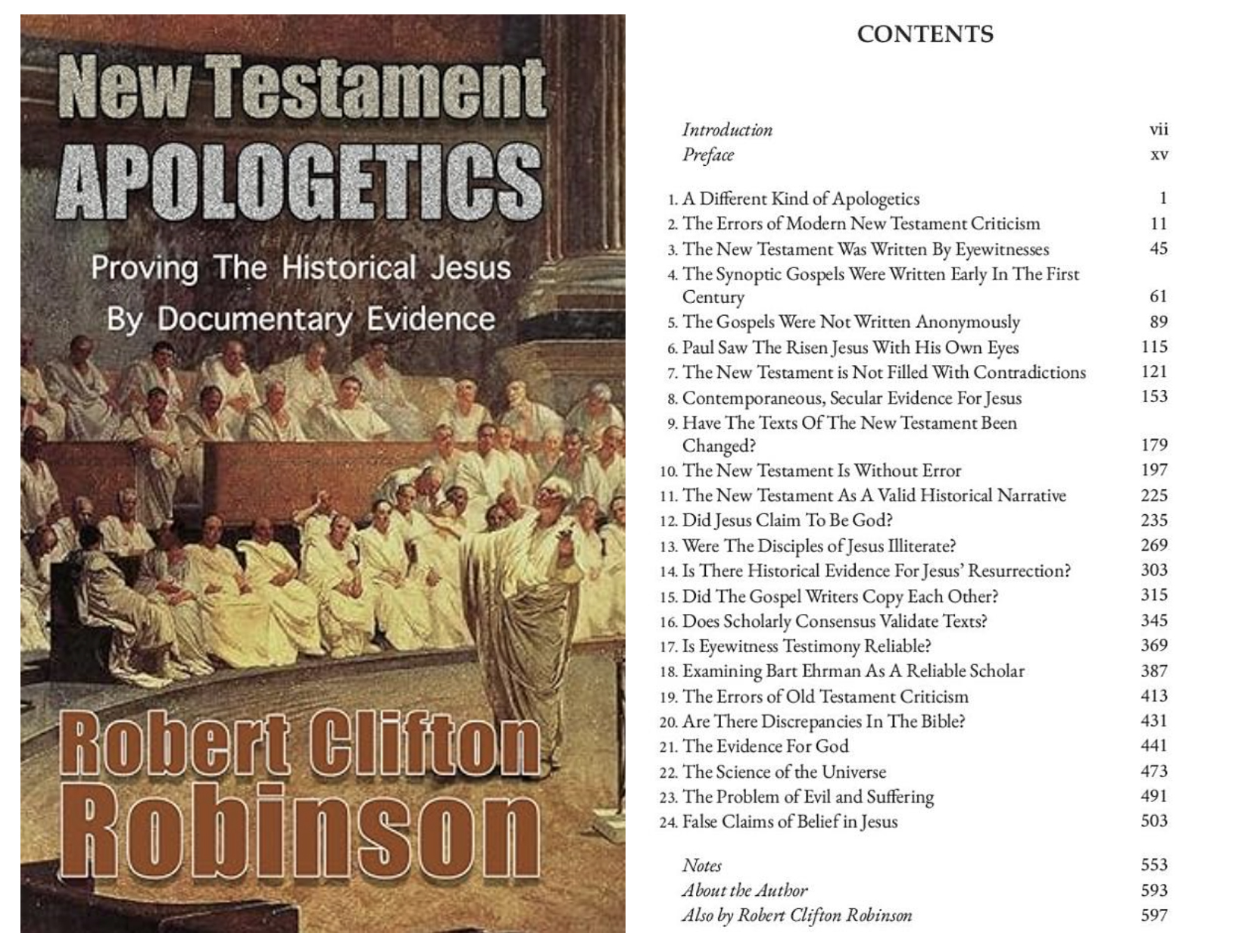
The Preceding Is From “New Testament Apologetics,” Chapter 13: “Were The Disciples of Jesus, Illiterate?”
NOTES:
[1] Simon Greenleaf. The Testimony of the Evangelists: The Gospels Examined by the Rules of Evidence (Kindle Locations 229-234). Kindle Edition.
[2] Simon Greenleaf. The Testimony of the Evangelists: The Gospels Examined by the Rules of Evidence (Kindle Locations 240-246). Kindle Edition.
Categories: Agnostics and Skeptics, Apologetics, Bart Ehrman, Common errors of Atheists, does god harden hearts?, Empirical Evidence for God, Forgiveness of Sin, Historical Validity of the New Testament, How Salvation Occurs, Jesus Cross is Offensive, Jesus is God, Jesus is the Messiah, Must Be Born Again, New Testament Apologetics, New Testament Apologetics, New Testament Manuscripts, Old Testament Apologetics, Origin of the Universe, Reasons For Unbelief, Reliability of the New Testament, Religion vs. Relationship, Repentance Necessary, Resurrection Proven by Secular Sources, Robert Clifton Robinson, Salvation through Jesus, Science and the Bible, The Condition of the Heart, The Existence of God, The Historical Crucifixion of Jesus, The Historical Jesus, The only way to heaven, The Resurrection, The Resurrection of Jesus, Those who stop believing, True Repentance, We must repent, What happens after death?, What is required for Heaven?, Why God Allows Evil, Why God Permits Evil
 Robert Clifton Robinson
Please see, "Guidelines For Debate," at the right-side menu. Post your comment or argument here: